Decentralized stablecoin protocol Syncus is about to launch a new paradigm DeFi lending platform
TechFlow Selected TechFlow Selected
Decentralized stablecoin protocol Syncus is about to launch a new paradigm DeFi lending platform
Syncus enables liquidity generation by staking its DAO governance token $SYNC.
 Navigating Web3 tides with focused insights
On December 19, zkSync ecosystem project Syncus announced the upcoming launch of its lending platform. The new platform will allow users to stake $SYNC and borrow USDC or ETH at an 85% loan-to-value ratio, enabling them to regain liquidity. Syncus aims to build a novel paradigm for DeFi lending, leveraging its continuously growing treasury through dividend distributions.
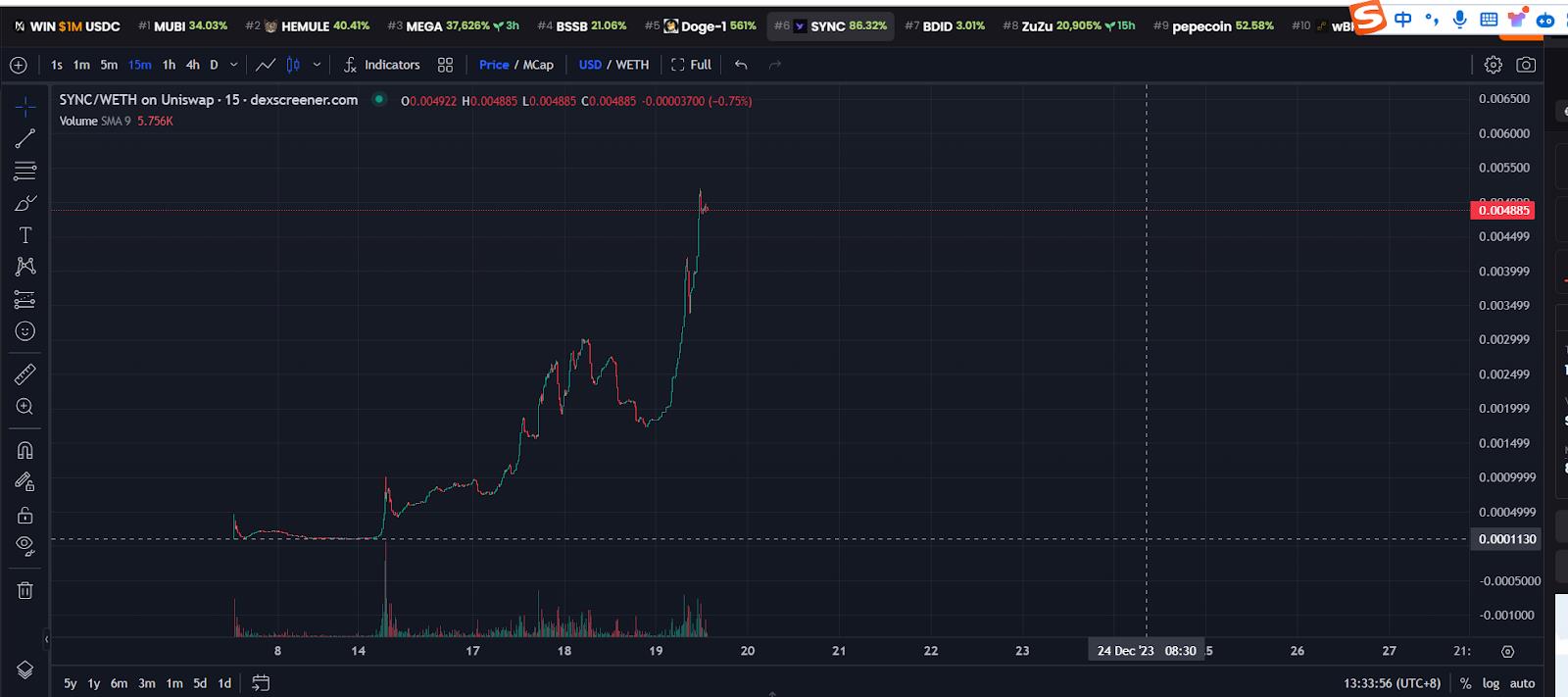
Syncus is a decentralized stablecoin ecosystem protocol that distributes transaction fee revenues to stakers. It aims to fix and improve upon Olympus’ sustainability issues by establishing a self-reinforcing treasury system through positive incentives. As of today, the token has surged over 40x from its bottom price in just four days.
Unlike traditional platforms such as MakerDAO and Aave, which rely on users collateralizing mainstream assets to borrow stablecoins, Syncus enables users to obtain liquidity by staking its own DAO governance token $SYNC. This innovation stems from Syncus adopting a (3,3) flywheel growth model similar to Olympus (OHM), where economic mechanisms drive the value of $SYNC into a positive upward spiral.
If users choose to sell directly instead of staking, they must pay a 15% tax to the Treasury and only receive 85% of the liquidity. In contrast, when participating in staking and borrowing, their collateral is only liquidated if the $SYNC price drops below the borrowed asset’s value—yielding the same net liquidity as selling. Syncus incentivizes staking: as more users stake, the treasury grows larger, increasing APY rewards, further encouraging staking and driving up $SYNC's value. Meanwhile, the 15% sell tax discourages immediate exits, reducing selling pressure.
Thus, this mechanism creates a sustainable growth flywheel: high yields → increased demand → higher trading volume → treasury growth → even higher yields → repeat.
In comparison, Olympus relies on a bond mechanism, meaning users always receive discounted OHM tokens as bonds appreciate. This effectively amounts to continuous discounted sales, a model overly dependent on perpetual OHM price appreciation. Only while OHM keeps rising do users have incentive to buy these discounted future tokens. However, the flaw lies here: if OHM rises indefinitely while still allowing perpetual discounts, it essentially allows third parties to extract value violently from the protocol. Who could imagine a perpetually appreciating token always offering discounted purchases? Such a model inevitably faces collapse risks over time.
Recognizing the inherent risks in bond mechanisms, Syncus completely removed the bond-based discount sales model, replacing it with a more robust and sustainable mechanism based on dual-direction taxes and continuous treasury dividends.
Coupled with its new lending platform feature—staking $SYNC to instantly access 85% liquidity in major tokens—users are strongly incentivized to stake rather than sell, drastically reducing downward selling pressure and fueling sustained growth. Compared to Olympus’ bond discount model, Syncus’ approach of earning discounted liquidity via staking proves more attractive and mitigates the compounding risk of a collapsing positive feedback loop.
According to available data, Syncus raised 187 ETH within 5 minutes during its IDO. It currently holds a market cap of $20 million, a treasury valued at $1.6 million, an APY of 116.4% (dynamically adjusted), and has distributed $1.23 million in dividends. Over the past week, $SYNC has performed exceptionally well, increasing over sevenfold in market value.
While Olympus was a breakout product during the last bull cycle, it wasn't OHM that created the bull market—rather, the bull market enabled OHM’s success. Bull markets naturally foster similar innovative mechanisms and products. Syncus has identified the core weaknesses of OHM and designed a more resilient operational framework. Whether Syncus can reach Olympus-level prominence in this cycle remains uncertain—but given its current momentum, the potential is enormous!
Join TechFlow official community to stay tuned
Telegram:https://t.me/TechFlowDaily
X (Twitter):https://x.com/TechFlowPost
X (Twitter) EN:https://x.com/BlockFlow_News
 @Syncus_Fi