








Exploring the Potential and Risks of Coinbase's Layer 2 Chain, Base
TechFlow Selected TechFlow Selected
Exploring the Potential and Risks of Coinbase's Layer 2 Chain, Base
Base is Coinbase's new Layer 2 blockchain network designed to enhance the performance of the Ethereum mainnet by increasing transaction speed, reducing costs, and expanding functionality.
 Navigating Web3 tides with focused insights
Written by: [email protected]
In the ever-evolving cryptocurrency landscape, Coinbase has established itself as a leading centralized exchange (CEX). However, believing that decentralization is key to creating an open and globally accessible crypto economy for everyone, Coinbase published its "secret master plan" in 2016, aiming to achieve this vision by launching a Dapp. In August 2023, Coinbase took a significant step toward realizing this goal with the official launch of Base.
Base is Coinbase's new Layer 2 blockchain network designed to enhance Ethereum’s mainnet performance by increasing transaction speed, reducing costs, and expanding functionality.
Coinbase has further demonstrated its commitment to openness and collaboration through multiple initiatives. For over a year, Coinbase has collaborated with Optimism and contributed to the development of EIP-4844 (also known as Proto-danksharding), aimed at lowering fees and increasing transaction throughput. To ensure ecosystem decentralization, Coinbase has established five core principles to create a level playing field where users can participate and thrive without bias or barriers.
Backed by a strong user base, Coinbase has entered the competitive arena of Layer 2 blockchain solutions. Through Base, Coinbase aims to bring over one billion users into the global crypto economy.
Base Leads a New Development Paradigm in the Layer 2 Landscape
Currently, Layer 2 networks are making impacts across various domains including Web3 gaming, NFTs, and SocialFi, witnessing widespread adoption. Many prominent players such as BitDAO (Mantle Network), Consensys (Linea), and Kraken have also entered the fiercely competitive Layer 2 market.
With the emergence of numerous decentralized applications, Layer 2 has become essential infrastructure within the Ethereum ecosystem, significantly reducing transaction costs while improving user experience.
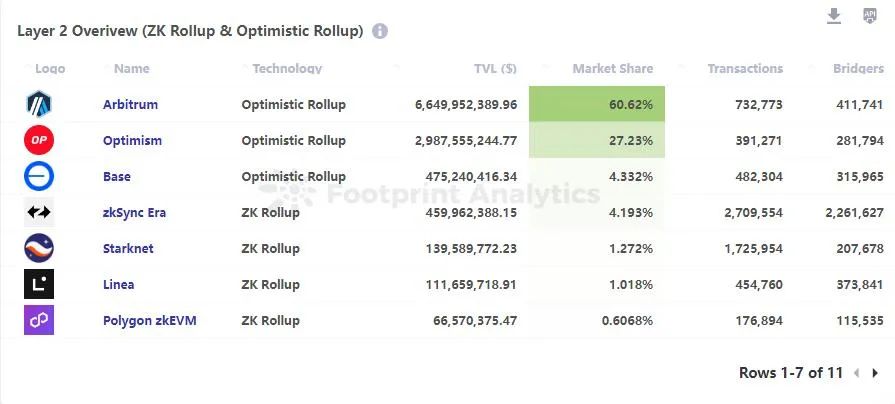
Layer 2 Overview
According to Footprint Analytics data, Base ranks third in the Layer 2 market share, trailing only established chains like Arbitrum and Optimism. Among emerging public chains, Base’s performance is impressive.
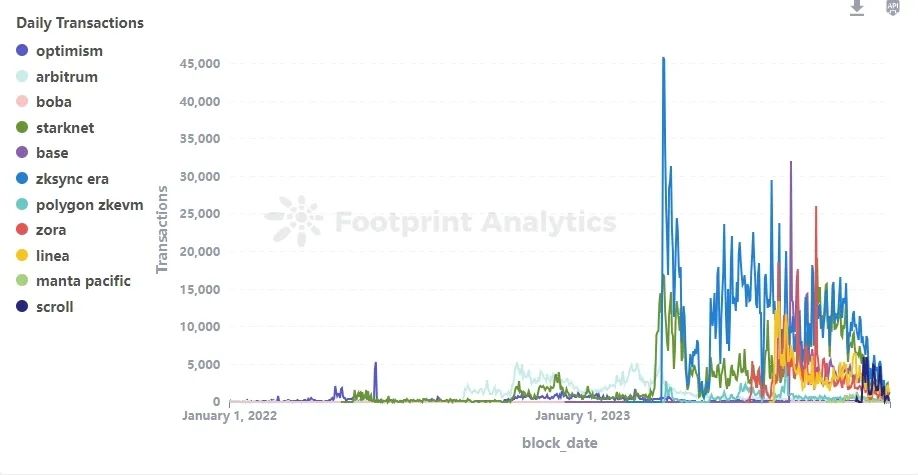
Layer2 Daily Bridged Transactions
In the following sections, we will review Base’s growth trajectory and analyze the key factors behind its rise. For more insights on Layer 2, check out our previous analysis report.
Features of Base
-
Ethereum-based Layer 2 Public Chain: Base leverages Ethereum’s security, stability, and scalability, combined with Coinbase’s best practices, ensuring developers can seamlessly migrate from Coinbase, Ethereum Layer 1, and other interoperable blockchains to Base.
-
Seamless Integration with Coinbase: Base is fully integrated with Coinbase’s products, users, and tools, giving developers access to Coinbase’s ecosystem of over 110 million verified users and $80 billion in assets. This integration enhances user experience and accelerates blockchain adoption.
-
Powerful and Low-Cost: Base offers EVM-compatible services at extremely low costs, enabling account abstraction via simple APIs for fee transactions and secure multi-chain application development using easy-to-use bridges.
-
Open Source, Powered by Optimism: Committed to decentralization and openness, Base welcomes visionary creators. Built on Optimism’s open-source OP Stack, it ensures a permissionless and inclusive environment for innovation.
Despite its promising outlook, Base still faces several challenges.
-
Immature Technology: Layer 2 technology remains in early stages, requiring extensive development and testing to ensure security and stability. Base is addressing this by collaborating with Paradigm on the Breath client and developing open-source monitoring tools like Pessimism to improve technical maturity.
-
Regulatory and Policy Challenges: As a centralized company, Coinbase operates in an uncertain regulatory environment for cryptocurrencies, posing business risks. However, Coinbase takes a proactive approach, striving to lead in resolving regulatory issues.
-
Security Concerns: As an open blockchain, Base hosts many unaudited protocols, leading to frequent security incidents after its official launch due to users’ inability to thoroughly assess technical details.
The Layer 2 stack space continues to evolve, with Polygon launching its Layer 2 stack—Polygon CDK—in September.
Polygon CDK and Optimism’s OP Stack share similar design philosophies, aiming to lower barriers for developers through modularity and composability, building Ethereum-centric L2 interoperable networks by parallelizing app-specific chains.
However, there are some differences:
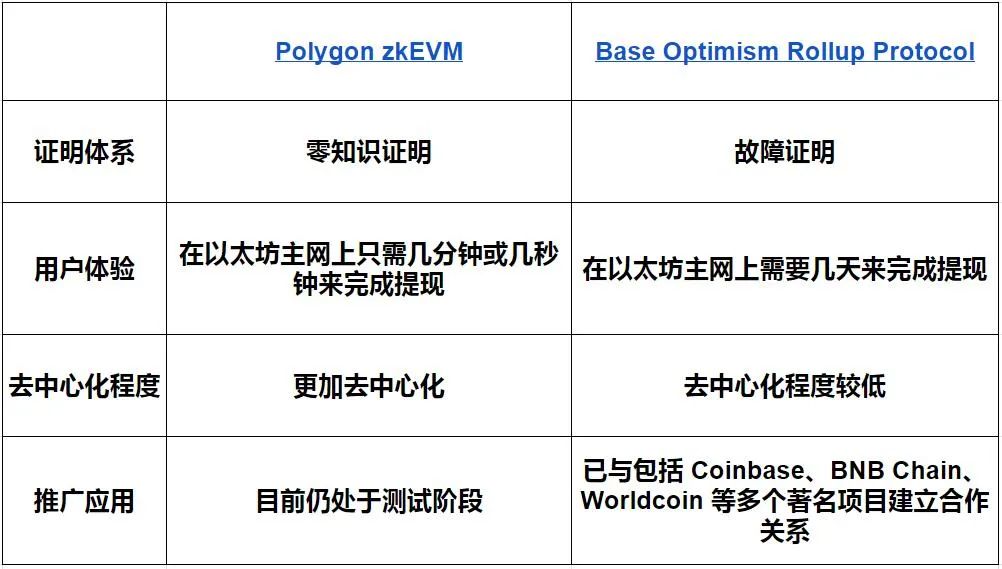
This general-purpose chain architecture represents a key trend in today’s Layer 2 landscape. Polygon and Optimism are leading this movement with exceptional scalability and developer-friendly support. Such designs are expected to gain advantages by attracting developers, thereby accelerating the growth of Layer 2 technology. However, the actual performance and long-term sustainability of these Layer 2 solutions require deeper observation and validation through real-world market operations.
Development Journey of Base
Base plays a crucial role in Coinbase’s vision of building a global open financial system and has drawn significant attention since its testnet launch in February.
Base TVL
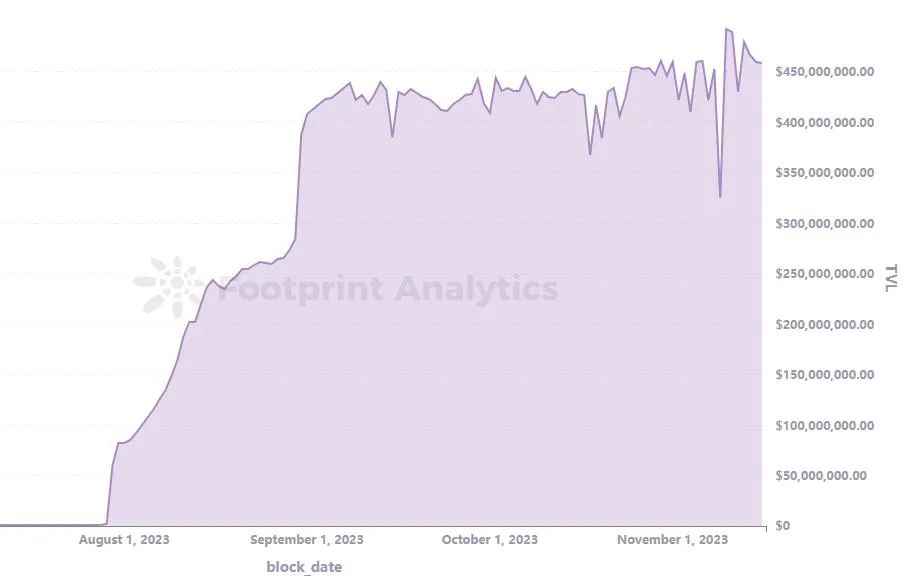
According to Footprint Analytics, Base’s TVL exceeded $148 million on launch day and had grown to $459 million by early December.
Gaining Attention via $BALD
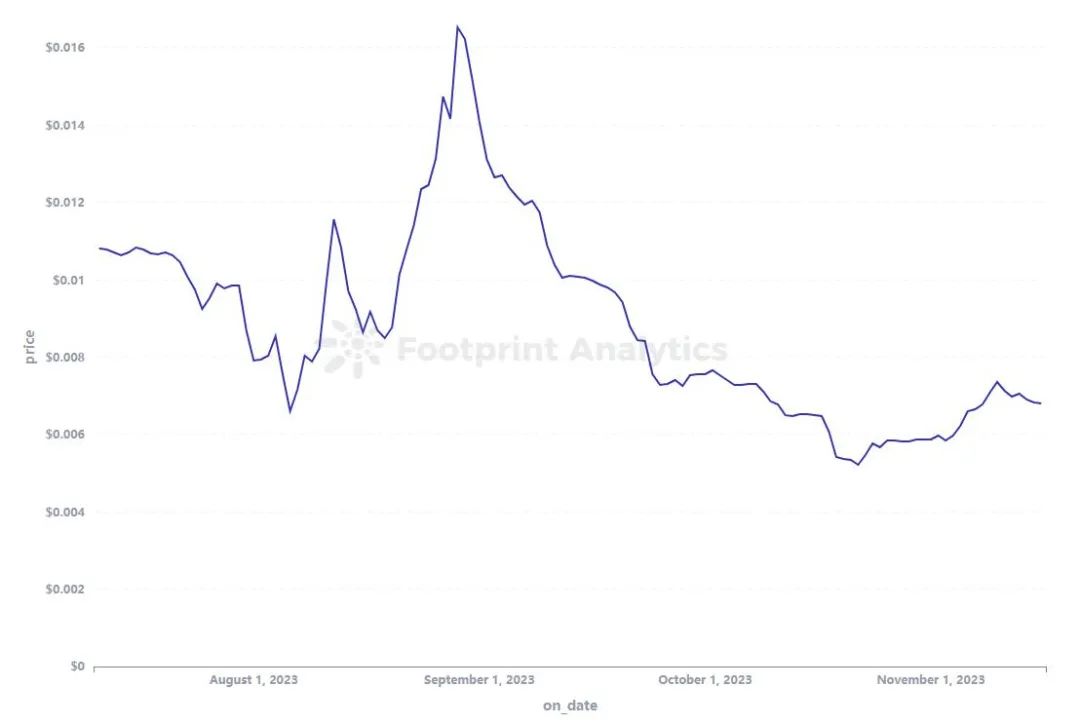
Launched on July 30, $BALD immediately attracted substantial capital and initial buzz due to its humorous association with Coinbase CEO Brian Armstrong (known for his iconic bald head). Some even speculated that $BALD might be Coinbase’s official token.
BALD Daily Token Price
The $BALD hype surged rapidly, pushing its market cap above $100 million in just two days. However, the enthusiasm was short-lived. The developer “BaldBaseBald” executed a malicious exit scam, withdrawing over 10,500 ETH (approximately $20 million) from liquidity pools, severely impacting $BALD’s liquidity and causing Base’s TVL to plummet. Jesse Pollak of Coinbase responded on August 14, stating that Base is a “permissionless” system and thus cannot control such events.
Driving Market Momentum with friend.tech
friend.tech is a social media decentralized application (DApp) built on Base, Coinbase’s incubated Ethereum Layer 2 blockchain. This innovative platform skillfully combines fan economies and on-chain gaming concepts, creating a unique synergistic effect.
The public launch of friend.tech on August 10 coincided perfectly with Base’s debut, demonstrating remarkable timing. Its success stemmed not only from strategic timing but also from its innovative concept, revenue-sharing model, and strong influencer effect. These elements collectively propelled friend.tech into a viral phenomenon, attracting widespread user participation and recognition. Its popularity boosted both its own success and significantly elevated Base blockchain’s usage and visibility.
Achieving Excellence with Aerodrome Finance
On August 31, Velodrome, the largest DEX protocol on Optimism, launched Aerodrome—a forked DEX project—on the Base network. Within less than two days, Aerodrome’s total value locked (TVL) reached $200 million, accounting for 50% of Base’s total TVL.
Aerodrome strategically allocated 7% of veAERO to the AERO-USDC LP pool, attracting liquidity providers to buy the scarce AERO tokens available on the market due to highly attractive staking rewards. This scarcity drove up AERO’s price, increasing provider returns and creating a positive feedback loop. However, doubts remain about the sustainability of this cycle.
Current Status
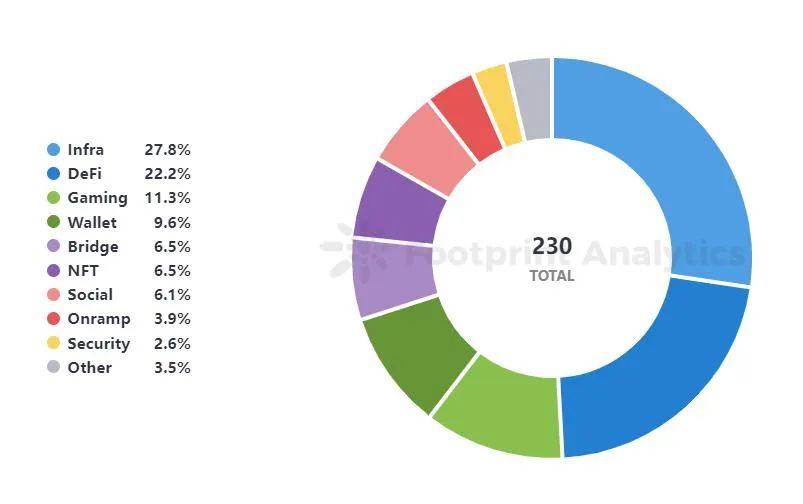
Backed by Coinbase and fueled by high-traffic projects like Friend.Tech, along with Base’s active developer funding efforts, Base has experienced rapid growth in just a few months, evolving into a robust ecosystem. As of November 15, the ecosystem hosted over 230 projects, primarily distributed across infrastructure (64), DeFi (51), and gaming (26). The surge in project numbers reflects Base’s ability to attract diverse applications and foster vibrant ecosystem development.
Base Ecosystem Project Distribution
The diversity across project types indicates that Base is not merely a DeFi hub but a versatile platform supporting various domains—from infrastructure to gaming—showcasing its potential as a comprehensive blockchain solution for broad applications.
Leading DeFi protocols from Ethereum and other chains are actively expanding to Base, invigorating its DeFi ecosystem. As of November 15, 51 DeFi projects were live on Base. Major lending protocols such as Aave and Compound have been deployed, while DEXs like Uniswap, SushiSwap, and Balancer offer decentralized trading. Yield aggregators like Beefy Finance optimize returns across multiple protocols.
Base has also integrated NFT infrastructure including OpenSea, ZORA, and Manifold to support digital collectibles and NFT markets. It is collaborating with game studios like Animoca Brands to develop blockchain-based games.
With continuous expansion in developer tools, wallets, oracles, and node services, Base is building solid foundational infrastructure to support diverse dApps and services on its network. The thriving ecosystem demonstrates strong momentum, positioning Base as a leading Layer 2 scaling solution.
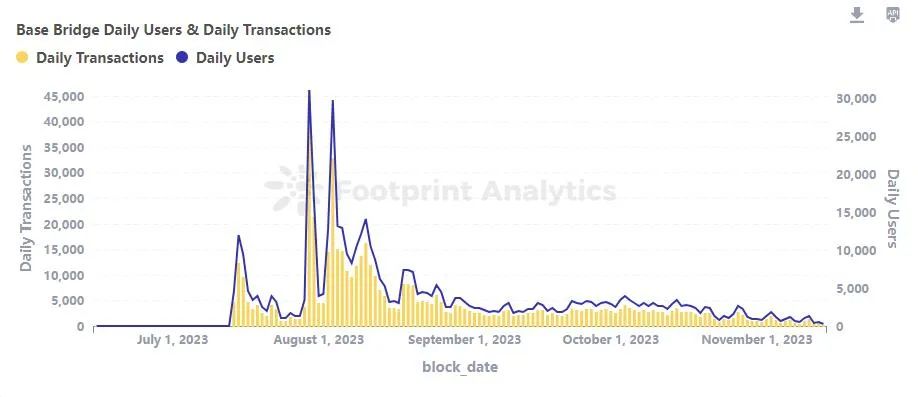
Base Bridge Daily Users & Daily Transactions
However, amid market fluctuations, Base’s sustainability has become a concern.
Alongside growing fame and influence, the Base ecosystem has faced several security incidents. Starting with the $BALD incident, followed by the SwirlLend team absconding with $460,000 in August. About ten days later, the Magnate Finance team withdrew nearly $6.5 million worth of crypto assets from the platform. Security breaches continued: in August, hackers targeted the DEX RocketSwap, stealing over 472 ETH (about $869,000). Due to potential vulnerabilities, LeetSwap DEX paused trading on Base on August 1.
Summary
In just a few months, Base has experienced rapid growth, demonstrating its potential to attract diverse applications. Despite industry-wide challenges such as immature technology and uncertain regulation, Base has captured significant market attention. The inclusion of high-traffic projects like friend.tech has notably accelerated ecosystem development.
Looking ahead, Coinbase plans to bring over one billion users into the crypto economy via Base—an exciting prospect. Nevertheless, investors should remain cautious, recognizing the potential risks inherent in ecosystem development.
Join TechFlow official community to stay tuned
Telegram:https://t.me/TechFlowDaily
X (Twitter):https://x.com/TechFlowPost
X (Twitter) EN:https://x.com/BlockFlow_News
 Footprint Analytics









