








Bitget Research: Reviewing the 2024 Halving Cycle – Bitcoin vs. Other Cryptocurrencies
TechFlow Selected TechFlow Selected
Bitget Research: Reviewing the 2024 Halving Cycle – Bitcoin vs. Other Cryptocurrencies
Halving reduces the rate at which new coins enter circulation, aiming to prevent inflation and increase scarcity, similar to mining precious resources.
 Navigating Web3 tides with focused insights
In the dynamic world of cryptocurrencies, "halving" is a common yet unique process for each coin. Beyond Bitcoin, cryptocurrencies such as Litecoin (LTC), Bitcoin Cash (BCH), Bitcoin SV (BSV), Dash (DASH), and Zcash (ZEC) will also undergo halvings. This article delves into the details of these cryptocurrency halving events.
About Cryptocurrency Halving
Cryptocurrency halving is a significant event in the life cycle of certain cryptocurrencies, particularly Bitcoin and its derivatives. It refers to the process of cutting in half the reward miners receive for adding new blocks to the blockchain. This typically occurs at preset intervals—after a specific number of blocks have been mined. Halving reduces the rate at which new coins enter circulation, aiming to prevent inflation and increase scarcity, similar to the mining of precious resources. It has notable impacts on the cryptocurrency's economy, including price, mining profitability, and network security.
List of Cryptocurrency Halving Dates
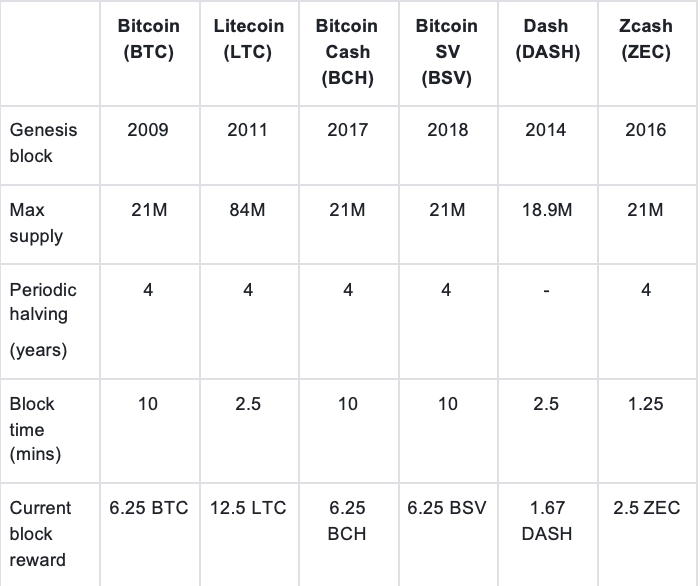
The table below summarizes the cryptocurrencies that have undergone or will undergo halving, along with relevant parameters, as of December 12, 2023.
Bitcoin Halving
Bitcoin (BTC), the first and most well-known cryptocurrency, was invented in 2009 by an unknown person or group using the pseudonym Satoshi Nakamoto. It operates on a decentralized network of computers using blockchain technology, enabling secure peer-to-peer transactions without intermediaries.
Bitcoin quickly gained popularity among early adopters and tech enthusiasts, with its value soaring from cents to over $1,000 within just a few years. In the following years, other cryptocurrencies—commonly known as "altcoins," such as Litecoin, Polkadot, and Cardano—emerged, each with unique features and use cases.
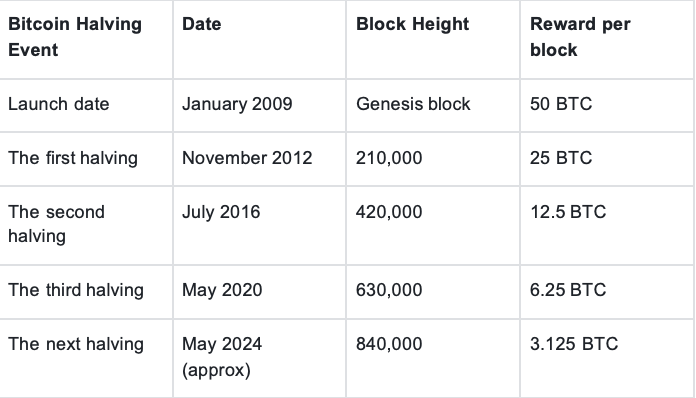
The 2024 Bitcoin halving will occur at block height 840,000 (the number of blocks mined), expected between April 25 and May 8, 2024. Below is the timeline of past and future Bitcoin halving events:
Litecoin Halving
Litecoin was created in October 2011 by Charlie Lee, a former Google engineer and engineering director at Coinbase. Often regarded as the "silver" to Bitcoin’s "gold," it operates on a decentralized, open-source global payment network. Litecoin’s founder intended it to overcome some of Bitcoin’s limitations, offering faster transaction confirmation times and making it more suitable for everyday transactions.
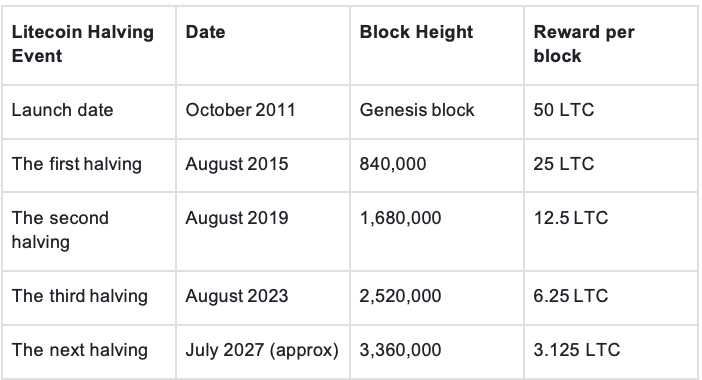
Litecoin’s halving, similar to Bitcoin’s, is a scheduled event occurring approximately every four years—or every 840,000 blocks mined—where block rewards are halved. This cycle is expected to continue until 2142. While its market impact is less pronounced than Bitcoin’s, LTC typically sees increased trading volume and price volatility ahead of halving events.
Litecoin halving dates:
Bitcoin Cash Halving
Bitcoin Cash (BCH) emerged in August 2017 from a hard fork of the Bitcoin blockchain. With larger block sizes, BCH can handle over 100 transactions per second, providing a decentralized monetary system focused on peer-to-peer electronic cash.
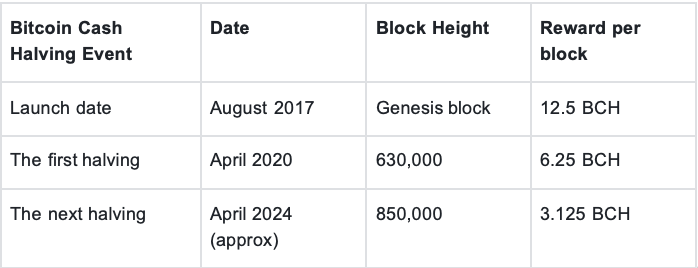
Bitcoin Cash’s first halving occurred in April 2020. Contrary to expectations, BCH’s halving did not coincide with Bitcoin’s due to different mining algorithms, leading to faster block discovery and an earlier halving date.
Bitcoin Cash halving dates:
However, after the halving event, the network experienced nearly two hours of stagnation before the next block was mined. Despite Bitcoin Cash’s processing capacity of around 116 transactions per second, this rate plummeted to just 1.11 TPS.
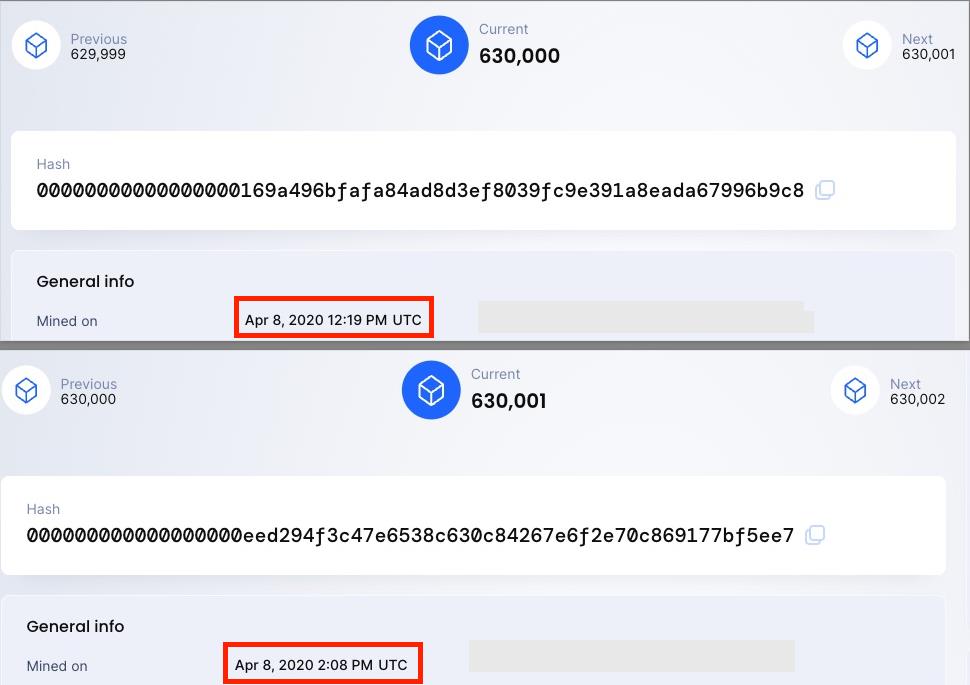
Block 630,001 was mined two hours after the halving (source: blockchair.com)
Because BCH shares the same mining mechanism as Bitcoin, miners can easily switch between the two. This led many miners to leave the Bitcoin Cash network in search of better profits elsewhere. As a result, mining difficulty rose, making it less profitable for remaining miners to continue mining BCH. Therefore, upcoming BCH halving events may be particularly contentious.
Bitcoin SV Halving
Bitcoin SV (BSV), forked from BCH, was created in November 2018 by a team led by Craig Wright, who claims to be Satoshi Nakamoto. BSV supports virtually unlimited block sizes—up to 4GB—enabling low and stable transaction fees.
BSV’s unrestricted block size allows miners to choose their preferred block size. However, this flexibility introduces risks of centralization and vulnerability to attacks, as demonstrated in October 2022 when an unknown miner controlled over 51% of the hash power.
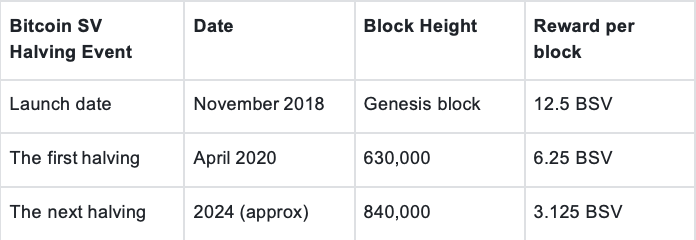
Bitcoin SV halving dates:
Dash Halving
Dash is an open-source cryptocurrency launched in 2014, branching from the Bitcoin protocol. It operates as a decentralized autonomous organization (DAO) and is managed by "masternodes"—powerful servers backed by staked Dash assets, designed to provide advanced services and governance on the blockchain.
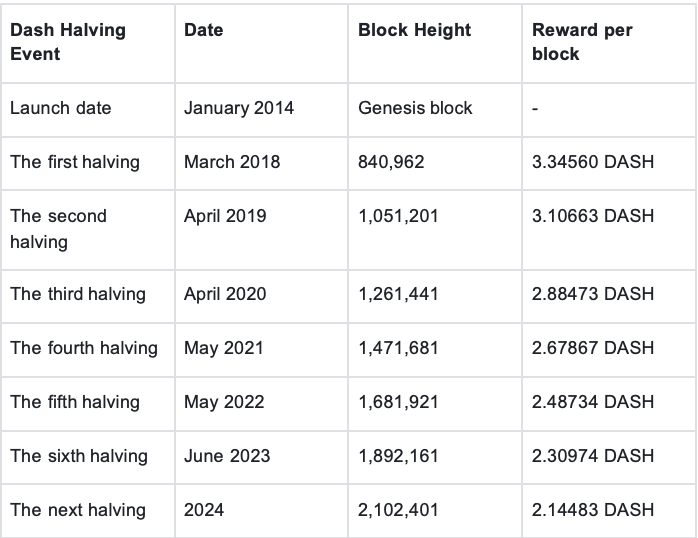
Unlike the sudden halvings seen in other cryptocurrencies, Dash undergoes a gradual halving process, decreasing by approximately 7.14% roughly every 383.25 days.
Dash halving dates:
Zcash Halving
Developed by experts from MIT and Johns Hopkins University, Zcash is renowned for its privacy technology, enabling confidential transactions.
Zcash has a unique reward distribution model. At launch, Zcash implemented a Founder’s Reward (FR) program to fund its development. Under this plan, 80% (5 ZEC) of the mining reward went to miners, while 20% was allocated to founders and investors at Electric Coin Company.
After the FR period ended, the community voted to approve a new distribution: 80% of mining rewards go to miners, while the remaining 20% is distributed among funding programs for independent third-party developers (8%), Electric Coin Co (7%), and the Zcash Foundation (5%), helping support continued ZEC mining.
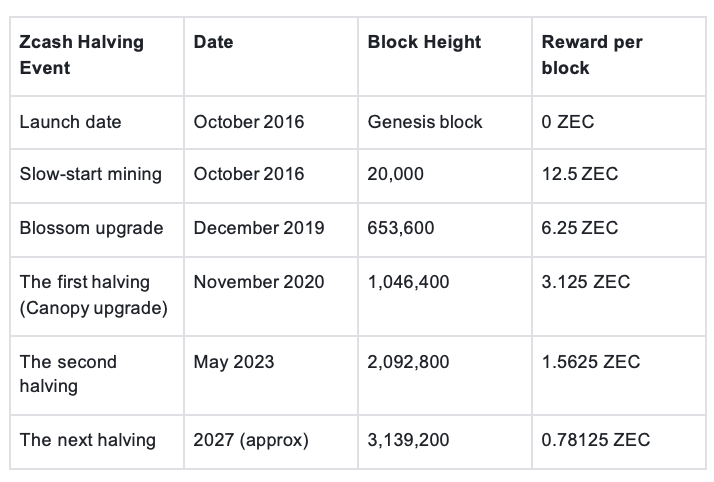
Zcash halving dates:
Despite differing halving mechanisms, these cryptocurrencies share a common goal: regulating the influx of new tokens, balancing supply and demand, and maintaining token value. As the cryptocurrency landscape evolves, these halving events play a crucial role in shaping the future of each currency. Stay updated with Bitget Academy for the latest developments in this fascinating field.
Disclaimer: The views expressed in this article are for informational purposes only. This article does not constitute endorsement of any products or services discussed, nor does it provide investment, financial, or trading advice. Please consult qualified professionals before making any financial decisions.
Join TechFlow official community to stay tuned
Telegram:https://t.me/TechFlowDaily
X (Twitter):https://x.com/TechFlowPost
X (Twitter) EN:https://x.com/BlockFlow_News


