Interpreting Morph: Focused on Consumer Scenarios and Technology Integration, Can It Break Through from L2 Homogeneous Competition?
TechFlow Selected TechFlow Selected
Interpreting Morph: Focused on Consumer Scenarios and Technology Integration, Can It Break Through from L2 Homogeneous Competition?
This article aims to explore Morph and the opportunities and challenges within its Layer 2 sector from the perspectives of technological innovation, ecosystem development, and future development plans.
 Navigating Web3 tides with focused insights
Written by: TechFlow
As a highly sought-after sector since its inception, Layer 2 has seen particularly fierce competition in 2023.
Statistics from Coin98 Analytics show that there are now over 50 Layer 2 solutions. As the primary beneficiary of Ethereum's value overflow, Layer 2 is viewed by many entrepreneurs and investors as a promised land flowing with milk and honey.
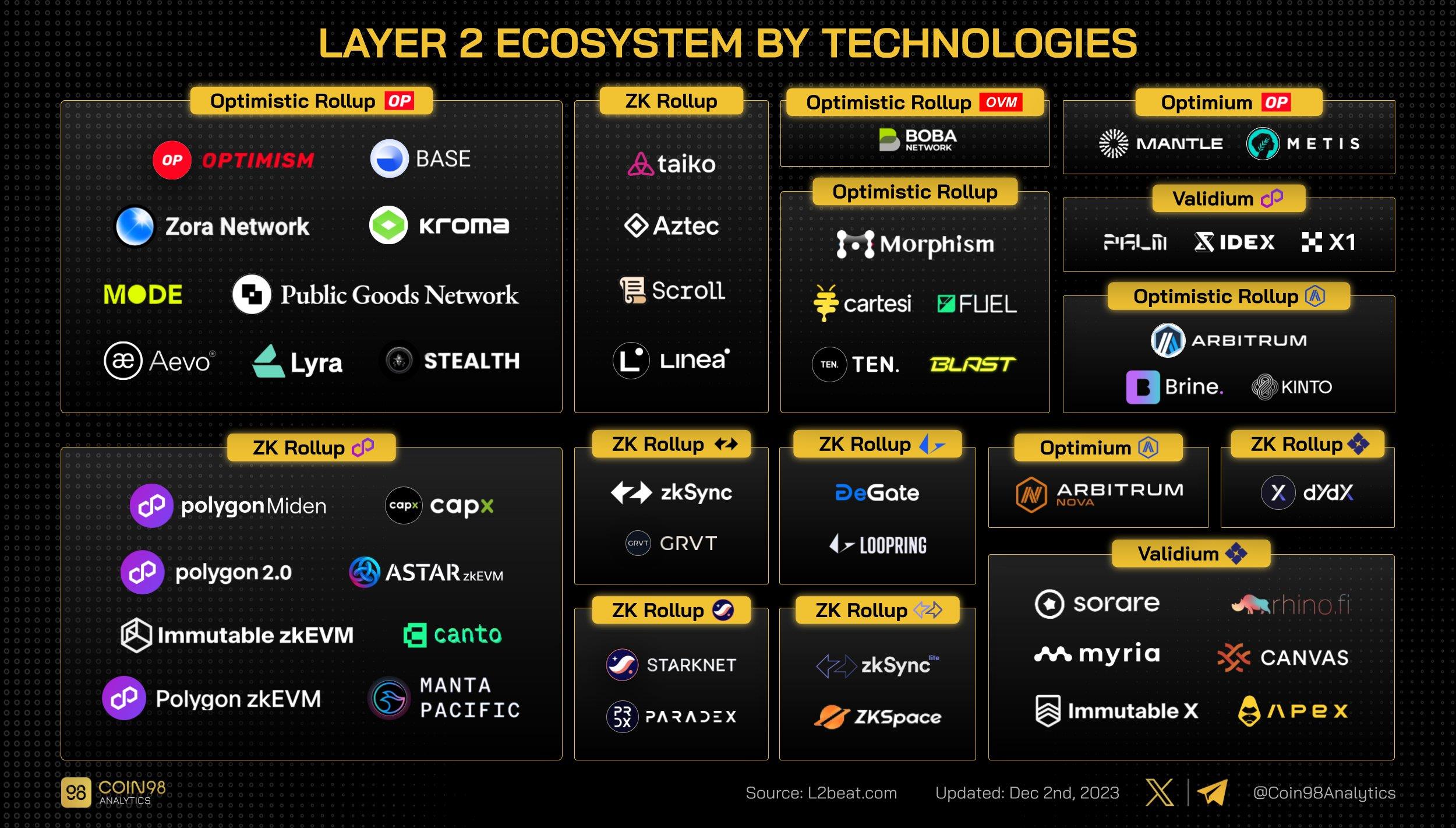
Beneath this bustling landscape, however, Layer 2’s glossy surface hides growing risks: on one hand, OP and ZK rollups dominate, and open-source availability has led to increasingly severe technological homogenization among Layer 2 solutions; on the other hand, due to a lack of real-world applications, many Layer 2 projects fall into a cycle of short-lived hype—users flock to different L2s solely to farm rewards, then vanish once campaigns end.
Yet despite these issues, market enthusiasm for Layer 2 remains strong.
Take Blast, the new Layer 2 network launched recently by Blur's founder—as an example. It not only secured $20 million in funding but also saw its Total Value Locked (TVL) surge rapidly. Additionally, the broader Layer 2 sector experienced a modest rally this week. As a new bull market begins to take shape, investing in Layer 2 appears to be a necessity for savvy investors. In this context of increasing homogenization, differentiated Layer 2s—those with technological innovation, solid backing, and rich ecosystems—are becoming the norm.
In such an environment, which emerging L2 projects can win favor during the transition from bear to bull market?
In January 2024, the consumer-grade Layer 2 solution Morph will launch its Beta testnet. Selected for investment by Bitget, Morph has attracted significant community attention through its innovative concept of a "consumer-grade L2," aiming to empower ecosystem development via diverse application scenarios. Moreover, its proprietary Responsive Validity Proof (RVP) combines the strengths of both OP and ZK Rollups, and at a time when many remain ambiguous about decentralized sequencers, Morph offers a clear and decisive solution—aiming to deliver users a seamless, efficient, and secure consumer-grade L2 experience.
In this heated Layer 2 war, can Morph’s “consumer-grade L2” concept break through the dominance of the current top four (Arbitrum, Optimism, zkSync, StarkWare) and stand out among rising challengers? This article explores Morph’s opportunities and challenges within the broader Layer 2 landscape through the lenses of technological innovation, ecosystem development, and future roadmap.
Unique Market Positioning: The Consumer-Grade L2 Development Plan
With OP’s open-source tech stack and customizable infrastructure lowering the barrier to building L2s, the resulting homogenization challenges every project hoping to claim a share of the L2 space: how can one escape the post-farming ghost town syndrome and build a truly standout, sustainable Layer 2 in this hyper-competitive arena?
Recently, the market has seen some notable successes: BASE surged in popularity thanks to the social app FriendTech, while Blast attracted massive attention with its native RWA yield model. It's clear that today’s Layer 2 projects must focus on two key elements to succeed:
-
Attracting users: Find a unique positioning and differentiate
-
Retaining users: Empower ecosystem growth with real applications and yield
With deep reflection on these two points, Morph focuses squarely on the end-user, pioneering the long-term vision of a “consumer-grade L2,” and continues to push forward aggressively in ecosystem development.
Even before Morph formally introduced the concept, many forward-thinking Web3 founders had already sensed the vast potential hidden within “Consumer Crypto”:
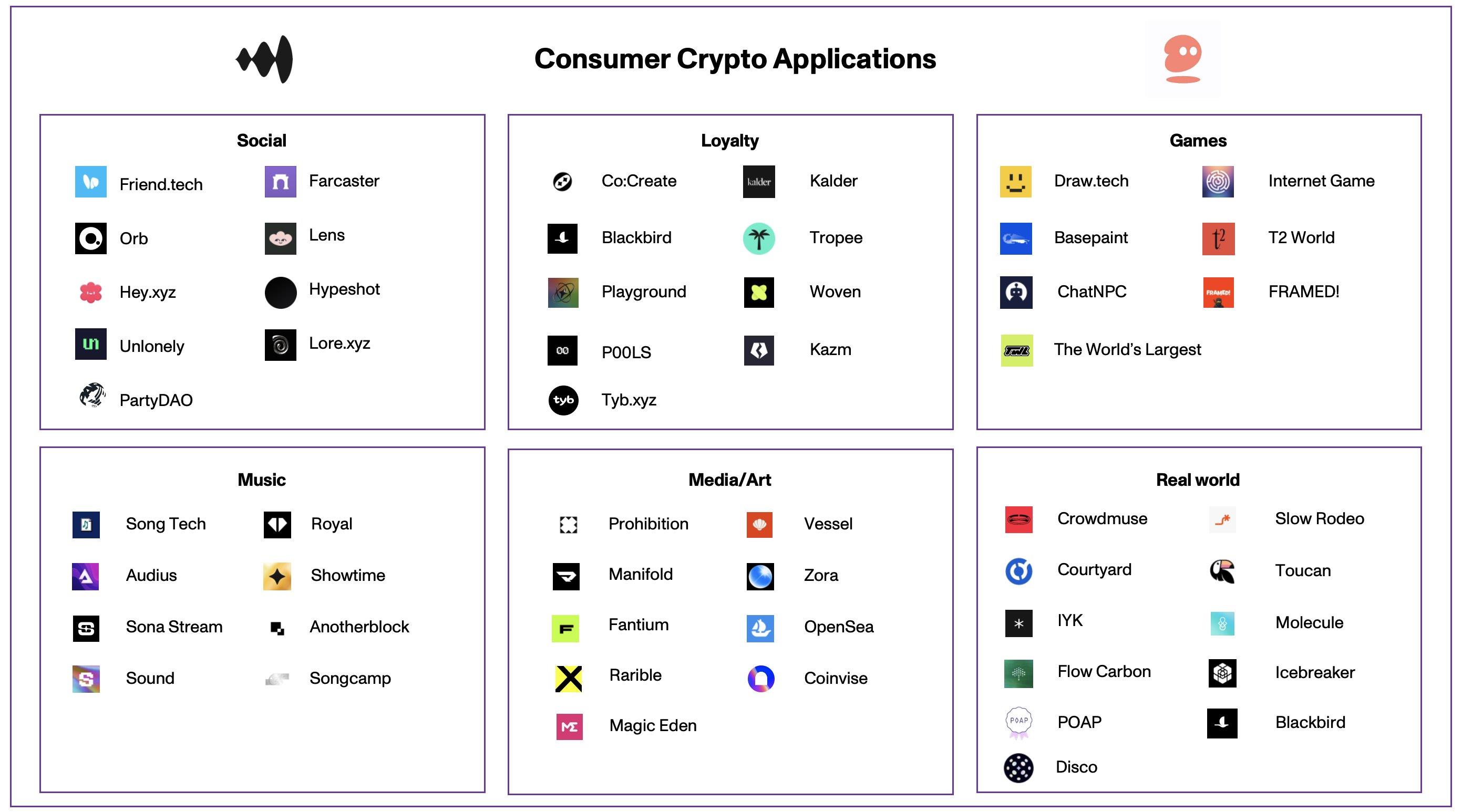
Image source: Twitter @decentxyz
The brilliance of Morph’s “consumer-grade L2” concept lies in two aspects: first, it encompasses a wide range of use cases, offering ample room for ecosystem expansion—from entertainment and leisure to on-chain asset ownership, Morph aims to cover all areas through continuous ecosystem development. Second, it targets a broad user base. At a time when blockchain seeks mainstream adoption, Morph aims to become the gateway for vast numbers of Web2 users entering the Web3 world by providing low-barrier, seamless experiences.
While others compete for existing users, Morph’s introduction of the “consumer-grade L2” concept reveals a profound understanding: the true path forward for Layer 2—and indeed the entire crypto industry—is to bring in new users and grow the overall market. This vision reflects Morph’s determination to drive real-world application adoption and bring blockchain into everyday life.
Moreover, Morph doesn’t stop at conceptualizing—it has systematically mapped out a comprehensive implementation strategy.
At its core, markets revolve around transactions between providers and consumers. Therefore, capturing user traffic is an essential battle in the Layer 2 war, and Morph is no exception.
On the journey to building a “consumer-grade L2,” being selected for investment by Bitget gives Morph a major advantage: access to Bitget’s massive user base provides a significant head start in attracting traffic compared to other projects.
Notably, Morph plans to collaborate with Bitget Wallet on innovations like account abstraction and embedded wallet solutions, further lowering entry barriers for users.
After attracting users into the ecosystem, the next critical challenge is retention. Just as consumers choose malls based on store variety, discounts, and service quality, Morph will focus on ecosystem diversity, cost efficiency, and user experience to ensure users have engaging activities, earn meaningful rewards, and enjoy smooth interactions.
In ecosystem development, leveraging its high-quality user base and strong partnerships, Morph aims to start with wallets to lower entry barriers, then expand across verticals including social, finance, art, gaming, and real-world asset (RWA) tokenization—covering multiple real-life consumer scenarios and gradually building a full picture of its “consumer-grade L2.” Furthermore, through events like hackathons at TOKEN2049, Hong Kong Web3 Festival, and Istanbul Devconnect, Morph has attracted and identified top developers from DeFi, GameFi, SocialFi, NFT, and music sectors, laying strong groundwork for future mainnet launches.
Following the launch of its Beta testnet, Morph will continue optimizing network performance and expanding product features, while actively engaging the community and strengthening ecosystem development. The goal is to offer users diverse, multi-layered application scenarios and gameplay options, driving ecosystem vitality, boosting participation, and enabling users to earn rewards through engagement.
For developer support, Morph already benefits from EVM compatibility, allowing Ethereum developers to migrate seamlessly. Beyond that, it has rolled out a series of supportive measures. On one hand, Morph is organizing technical documentation and tutorials tailored to different modules, aiming to provide developers with clear, practical guidance. On the other hand, Morph is building a comprehensive, cohesive tech stack aligned with its “consumer-grade L2” vision, creating a powerful and collaborative technical ecosystem. Additionally, Morph is prioritizing the development of IDEs and other developer tools to offer robust support. Looking ahead, Morph will host regular hackathons and accelerator programs, providing not just technical resources but also funding and marketing support to promising projects—maximizing developers as the most effective lever for ecosystem growth.
In terms of user experience, Morph’s innovative Responsive Validity Proof (RVP) enhances efficiency by simplifying verification processes and reduces L2 transaction submission costs by compressing data using ZK-proof characteristics. Combined with upcoming integrations with Bitget Wallet—including account abstraction and embedded wallet solutions—this will deliver users a smoother, lower-cost, and seamless experience.
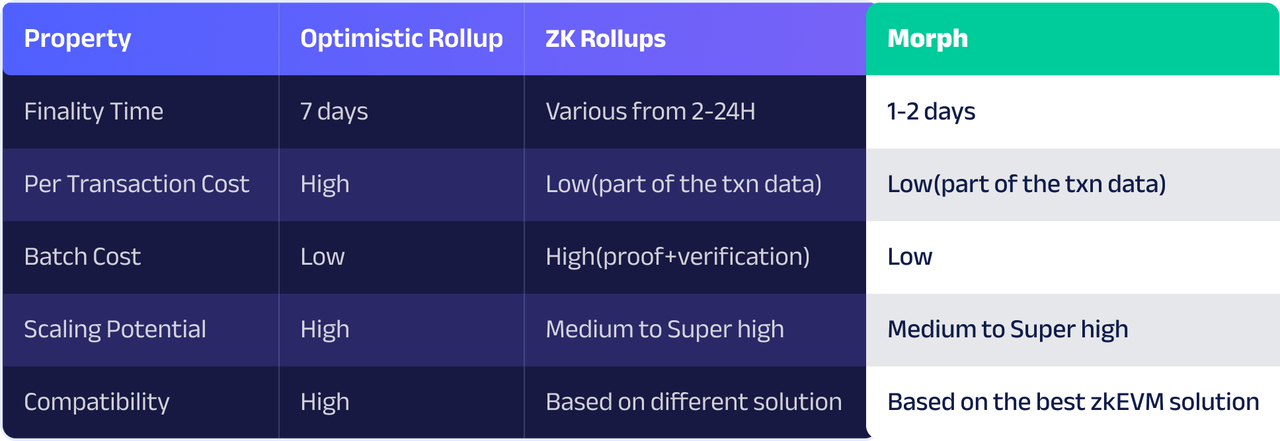
Of course, lofty visions require solid foundations. Morph’s path to realizing a “consumer-grade L2” depends on strong technical capabilities. When we zoom in from ecosystem to technology, Morph’s proprietary Responsive Validity Proof (RVP) and decentralized sequencer design reveal a deep understanding of industry needs.
Technologically Distinctive: An L2 That Fuses OP and ZK
The highly innovative Responsive Validity Proof (RVP) is a standout technical feature of Morph.
As previously mentioned, Layer 2 solutions suffer from severe technological homogenization. Most L2s stem from one of two dominant approaches: Optimistic Rollups (OP) or ZK Rollups—each with their own limitations.
Optimistic Rollups are efficient but lack security: they easily achieve Ethereum compatibility and avoid frequent state validation costs under normal conditions, keeping fees low. However, due to their optimistic nature, finalizing states takes a long time—often up to a week for withdrawals. Most OP-based rollups today do not implement interactive fraud proofs, meaning users cannot respond if incorrect Layer 2 states are submitted. This leaves no way to monitor malicious behavior by operators, rendering such systems fundamentally insecure.
ZK Rollups are secure but inefficient: they rely on mathematical proofs to guarantee absolute security without dispute periods. However, generating ZK proofs is computationally intensive and slow, and achieving full EVM compatibility remains challenging in the short term.
In summary, most existing L2s—whether OP or ZK—come with inherent trade-offs. To address this, Morph introduces the innovative Responsive Validity Proof (RVP), combining the best of both worlds.
As a state validation method, RVP uses ZK validity proofs to respond to challenges within an optimistic rollup framework. After a state change is accepted on Layer 2, if a challenge is raised, the sequencer must generate and submit a ZK-proof to Layer 1 for verification within the challenge window. This design reduces verification complexity and theoretically shortens the challenge period from 7 days to just 1–2 days, enabling fast, secure, and low-cost transaction processing.
This process can be loosely compared to Alice (the sequencer) conducting a bank transaction. If the teller (validator) raises a concern, Alice must provide special proof (a ZK-proof) within a set timeframe. If she succeeds, the transaction goes through.
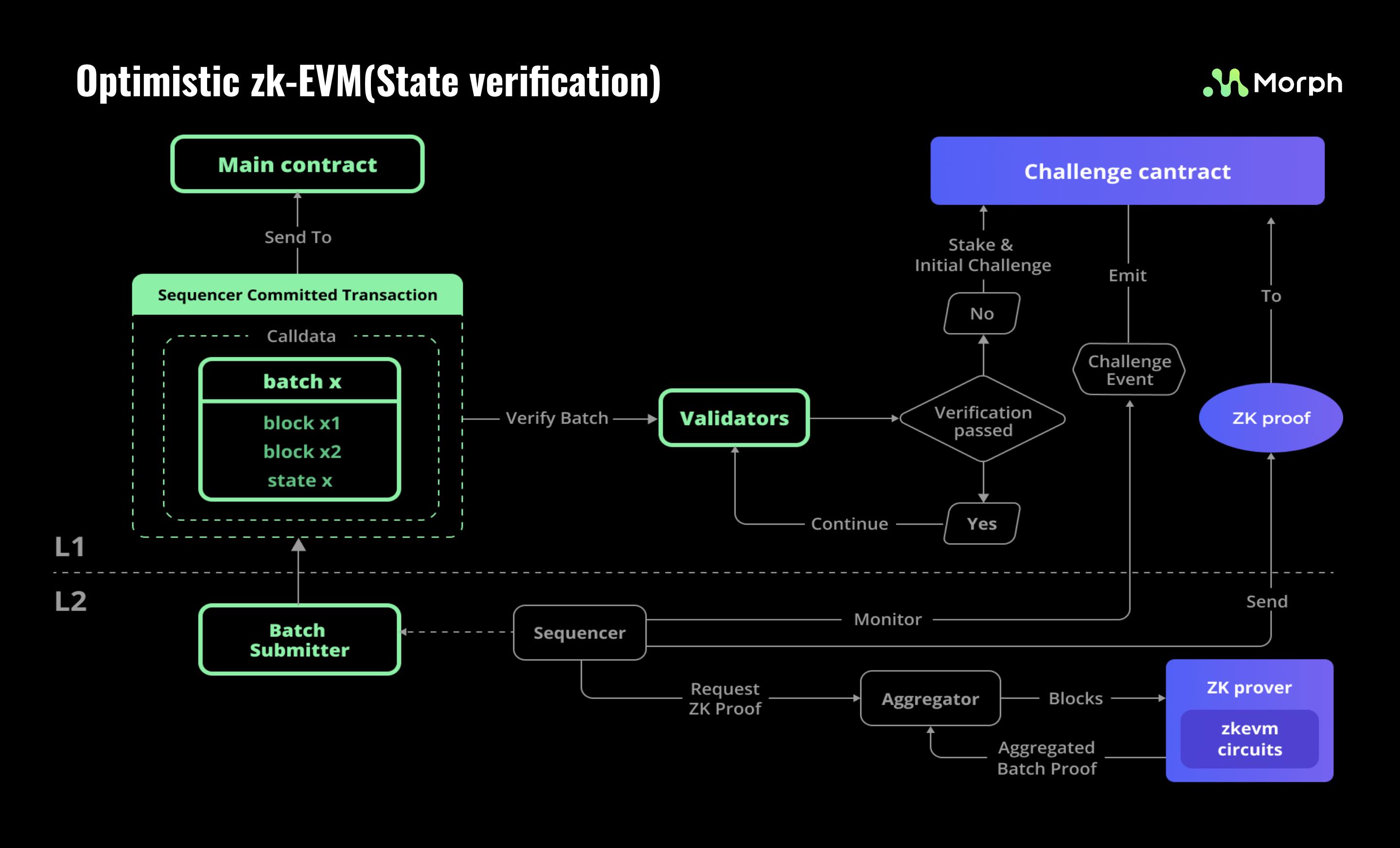
Additionally, another major technical highlight of Morph is its decentralized sequencer.
As widely known, sequencers control transaction ordering. Centralized sequencers offer fast confirmation times but pose serious risks: downtime could cause prolonged network outages, and they may manipulate transaction order to maximize MEV extraction, delay user transactions, or even censor them entirely.
Binance Research highlighted in its report “Deep Dive into Decentralized Sequencers”: at the time of writing, all major Ethereum L2s still rely on centralized sequencers. While many projects have proposed decentralization plans, little tangible progress has been made. Sequencer centralization remains a critical unresolved issue.
From day one, Morph has emphasized the importance of building a decentralized sequencer and designed a feasible solution based on principles of high efficiency, low cost, scalability, and maintainability. In Morph’s architecture, a decentralized network of nodes (sequencers) collectively handles transaction packing and ordering, rather than relying on a single centralized entity.
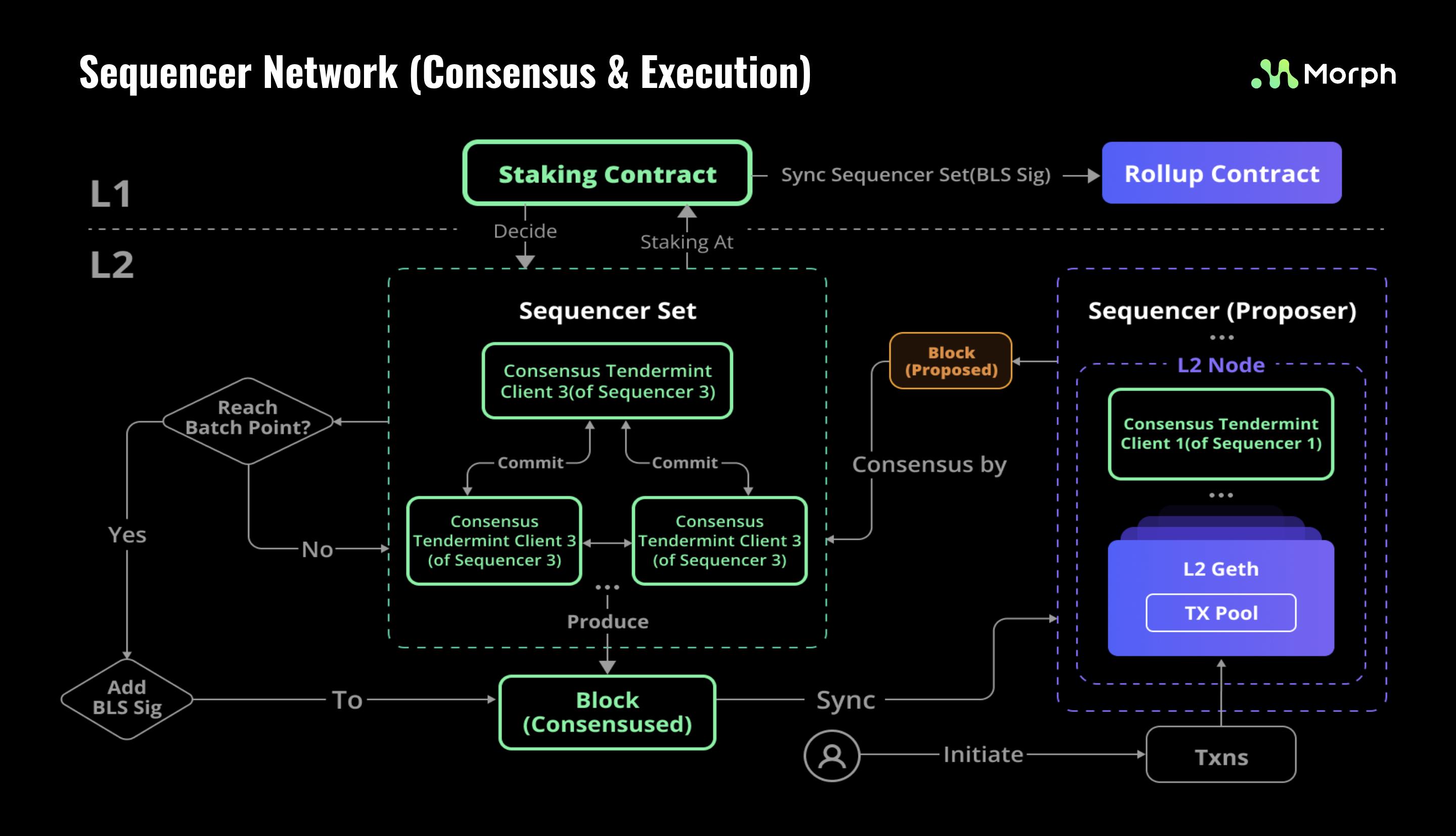
In the fiercely competitive landscape of “differentiated L2s,” technological innovation is no easy breakthrough—it demands both sharp insight into market trends and user needs, and exceptional technical execution.
The designs of RVP and the decentralized sequencer reflect Morph’s deep understanding of user demands for security, efficiency, and decentralization—and may well be why Morph stands out among numerous L2 projects.
From Testnet to Mainnet: Accelerating Decentralization
Of course, before the grand vision of a “consumer-grade L2” becomes reality, Morph is steadily progressing step by step.
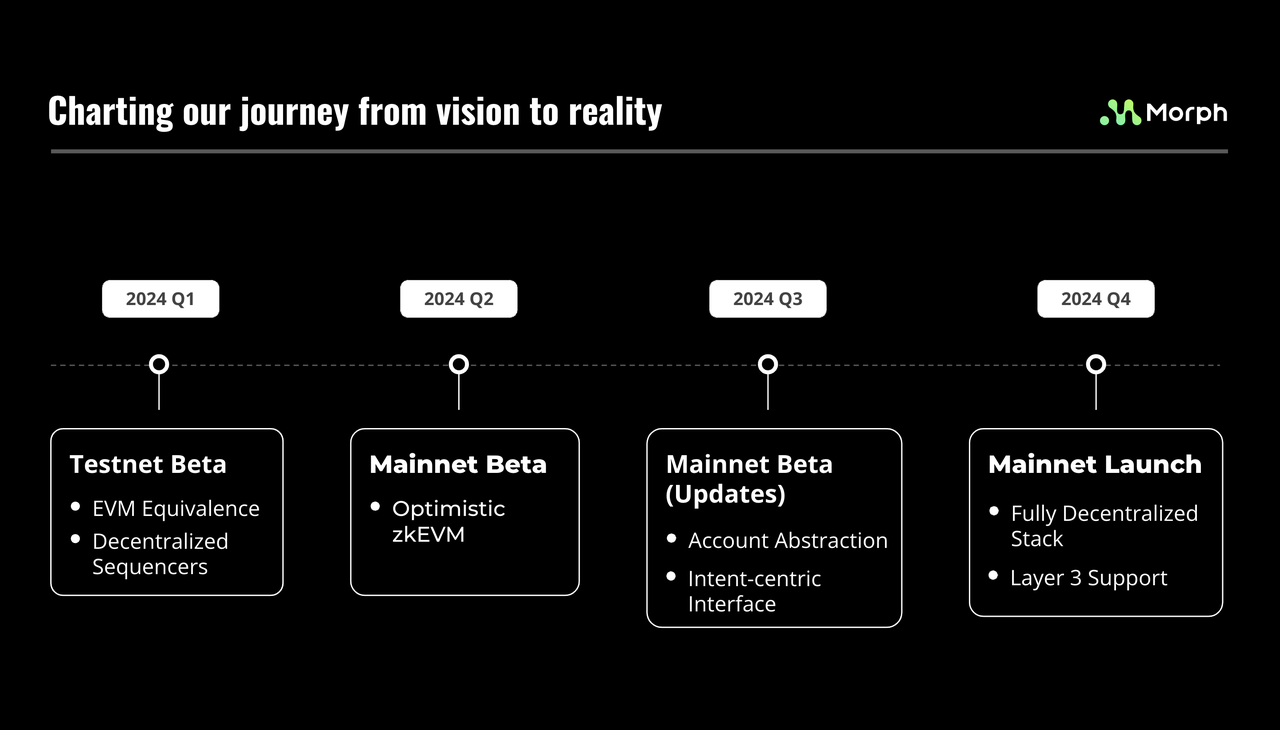
According to its official roadmap, Morph’s Beta testnet will launch in January 2024, achieving EVM equivalence to attract more Ethereum developers, while further strengthening security with enhanced decentralized sequencer functionality. In Q2 2024, Morph will swiftly roll out its mainnet Beta version.
After mainnet launch, a period of adjustment, optimization, and growth will follow. By Q3 2024, Morph will take another major step forward—achieving full decentralization of key L2 components—and may consider launching a Layer 3 solution depending on ecosystem maturity, pushing further toward its “consumer-grade L2” vision.
Notably, while official details about testnet/mainnet launch events and token information remain scarce, given the typical patterns of past L2 projects, key milestones may present significant farming opportunities—reward hunters should stay tuned.
Morph: A Timely Innovation, Delivering Win-Win Outcomes Across the Industry
As the saying goes: “Timing makes the hero.” At a time when the crypto industry lacks fresh narratives, faces uncertain regulation, and seeks collaboration across the value chain, Morph’s emergence seems perfectly timed.
On one hand, Bitget’s selection of Morph allows its vast resources to extend beyond trading, reaching deeper into the L2 space and the broader ecosystem;
On the other hand, Morph leverages Bitget’s strong financial backing, large high-quality user base, and rich ecosystem partnerships to accelerate its growth—creating a win-win scenario across the industry value chain.
But to become a true challenger capable of breaking the dominance of the “Big Four” L2s, timely arrival isn’t enough—Morph must also possess exceptional strength.
In an era of technological homogenization, Morph’s timely introduction of RVP as a long-term core competitive advantage is truly impressive. Its early commitment to decentralized sequencer design directly addresses widespread user concerns about security and efficiency. And in response to the lack of real-world applications, Morph cleverly introduces the novel concept of a “consumer-grade L2.” On the eve of a new bull market, an L2 narrative tied to “consumption” holds strong appeal for both users and investors.
Whether it’s the era that creates the hero, or the hero that shapes the era, in this crowded Layer 2 battlefield, the war for “differentiated L2s” has already begun. We await with greater excitement than ever the arrival of a true game-changer—one that will shake up the status quo and usher in the next bull cycle.
Learn more about Morph:
Twitter: https://twitter.com/MorphL2
Discord: https://discord.gg/5SmG4yhzVZ
Medium: https://medium.com/@morphlayer2
Telegram: https://t.me/MorphL2official
LinkedIn: https://www.linkedin.com/company/99122196/admin/feed/posts/
Join TechFlow official community to stay tuned
Telegram:https://t.me/TechFlowDaily
X (Twitter):https://x.com/TechFlowPost
X (Twitter) EN:https://x.com/BlockFlow_News
 深潮TechFlow