Chronicle Protocol: A new oracle launched by the Maker DAO spin-off team, reshaping on-chain data infrastructure
TechFlow Selected TechFlow Selected
Chronicle Protocol: A new oracle launched by the Maker DAO spin-off team, reshaping on-chain data infrastructure
Chronicle Protocol's solution is not only more cost-effective and transparent from a technical standpoint, but also emphasizes commercial viability and sustainability.
 Navigating Web3 tides with focused insights
Author: Ryan Allis
Compiled by: TechFlow
Editor's note: The oracle sector has recently drawn market attention due to project airdrops. Beyond tokens and yield, the current oracle market faces common challenges in business models, operating costs, and security. This article details Chronicle, a new oracle launched by the oracle team spun out from MakerDAO, which attempts to solve these systemic issues through technological and economic design.

Most people in DeFi have heard of oracles, but far fewer understand how critical they are to many of the products and protocols we use daily. Even fewer know the actual cost of building or using an oracle.
The current landscape is fragmented—choosing an oracle can feel like gambling. Even with so-called "leading" providers, poorly designed or inadequately supported oracles have led to improper liquidations of DeFi users.
Moreover, especially for price-feed oracles, service-level agreements (SLAs) between oracle providers and users are either unclear or nonexistent. Many early price-feed oracles were designed to be permissionless. This sounds ideal, but in practice, it means anyone can freely read the values reported on-chain by the oracle, while the oracle provider bears sometimes substantial gas costs to regularly update those values.
This forces oracle providers to operate as leanly as possible, offering little guidance on how to securely and reliably use the oracle, or technical support when things go wrong. Oracles are critical infrastructure protecting billions of dollars in value—end users need much stronger support from oracle providers.
An Unsustainable Model
Protocols still relying on traditional permissionless oracles have few alternatives but to spend raised capital or sell their tokens on the market to cover oracle operating costs (mainly gas and developer expenses). Some providers have even sent "requests" to dapps using their oracles, asking them to sign contracts and start paying fees—even though the oracles are permissionless.
In the medium to long term, this model is commercially unviable. It’s also neither transparent nor predictable, leaving commercial users unprepared for the inevitable shift toward paid access models as the industry matures.
This shift is already happening in most recently developed oracle utilities—such as verifiable randomness and cross-chain messaging—where access is controlled via paywalls.
Security vs. Operating Costs
Much of the current oracle business models and commercial landscape reflect limitations of the technology. Secure oracle construction is resource-intensive, and operating on chains like Ethereum is extremely expensive due to gas fees.
This leads to many oracles being highly centralized, with varying levels of security. Why? Oracle security comes from validators—the more validators (or participants) attesting to the truthfulness of the reported value, the safer the oracle is from manipulation. Just like Ethereum, an attacker would need to control a majority of validators to manipulate consensus and force the oracle to report an invalid value.
This holds true for all oracle providers, as they all use the same ECDSA signature scheme to secure their oracles. One validator equals one signature, and each ECDSA signature requires on-chain verification gas. As a result, all oracle providers limit the number of validators—and thus signatures—to manage operating costs. Overall, this reduces the security of oracle protocols. In some cases, the number of validators may be very low.
A Fundamentally Different Approach
As foundational components underpinning everything from cross-chain bridges to DeFi and DePIN, this trade-off between security, decentralization, and cost severely limits the future scalability of oracles.
Yet, there is light at the end of the tunnel. The newly launched oracle Chronicle, from the oracle team recently spun out of MakerDAO, leverages a signature aggregation scheme called Schnorr to resolve the trade-off between security and operating costs.
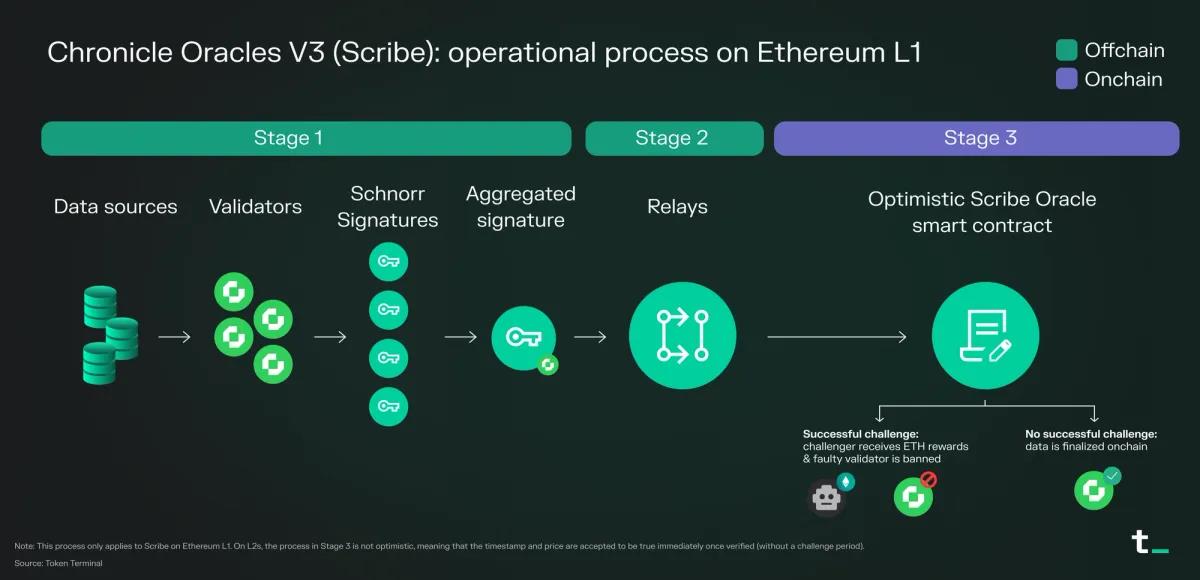
The Chronicle Labs team has created a new type of oracle called Scribe, which solves the "oracle problem" at the cryptographic layer and can scale to any number of validators without increasing operating costs.
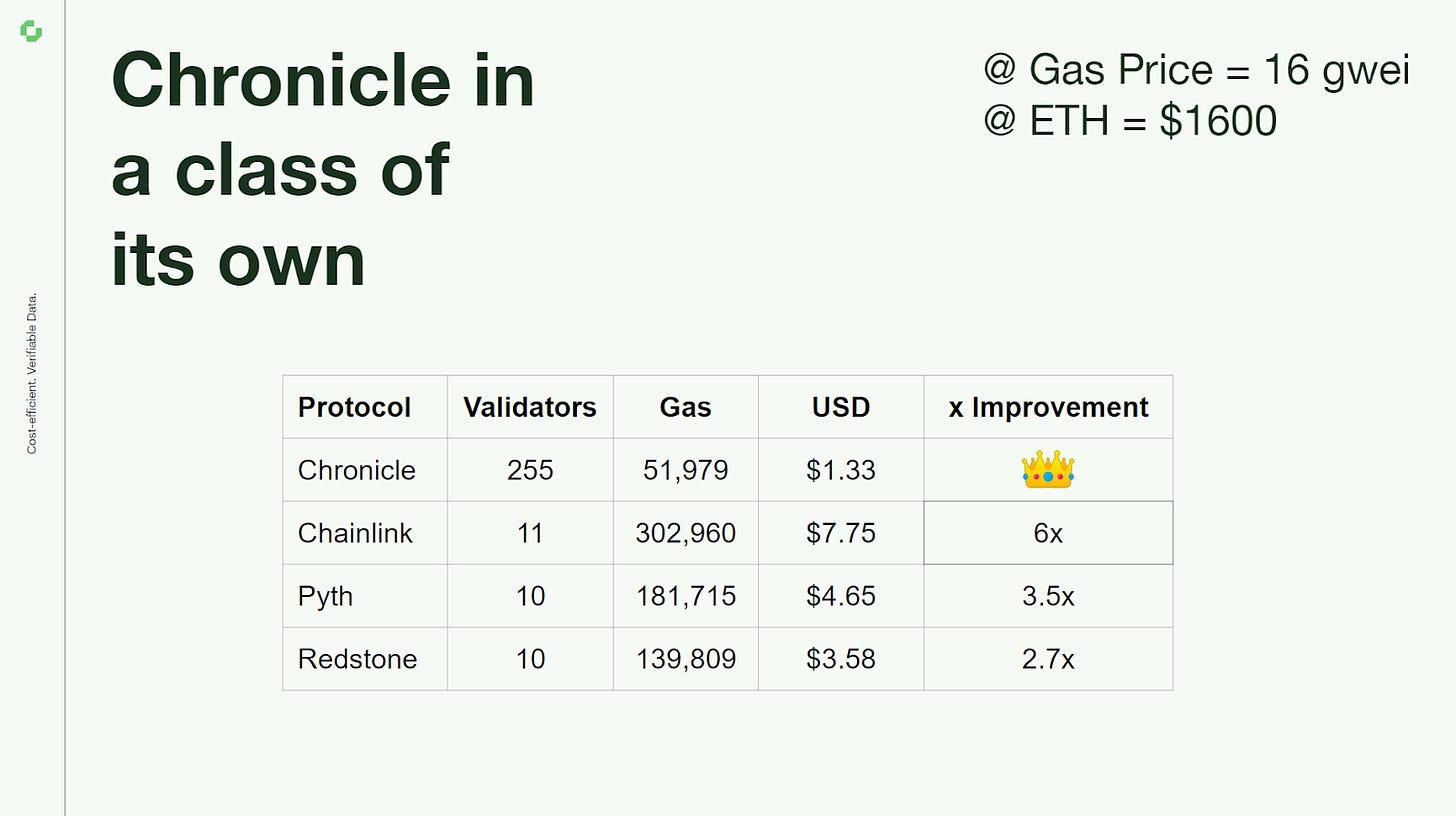
Additionally, Scribe achieves massive gas savings, significantly reducing oracle update costs on both L1 and L2. Compared to other providers, this represents a 6x improvement over Chainlink, a 3.5x improvement over Pyth, and a 2.7x improvement over Redstone.
Schnorr signature cryptography has been used in Bitcoin for years. The Chronicle Labs team is the first to leverage Schnorr to create this novel oracle.
Furthermore, since Scribe is designed as a single implementation on EVM, the new oracle can be rapidly and efficiently deployed across any EVM chain, allowing Chronicle to charge lower deployment costs than leading providers.
Unlocking Future Business Models
Solving the long-standing technical challenges of blockchain oracles opens up a much-needed new business model for oracle providers—one that doesn’t compromise security or decentralization. It enables a fully serviced, supported, and premium oracle offering, implemented in a SaaS-like manner: Subscribe to the oracles you need and pay only when you use them. Permissioned, yet predictable in cost.

This approach is reinforced by Chronicle’s unique focus on transparency, building an on-chain dashboard that allows any user to track oracle-delivered data end-to-end and cryptographically verify the signatures of every reported oracle update.
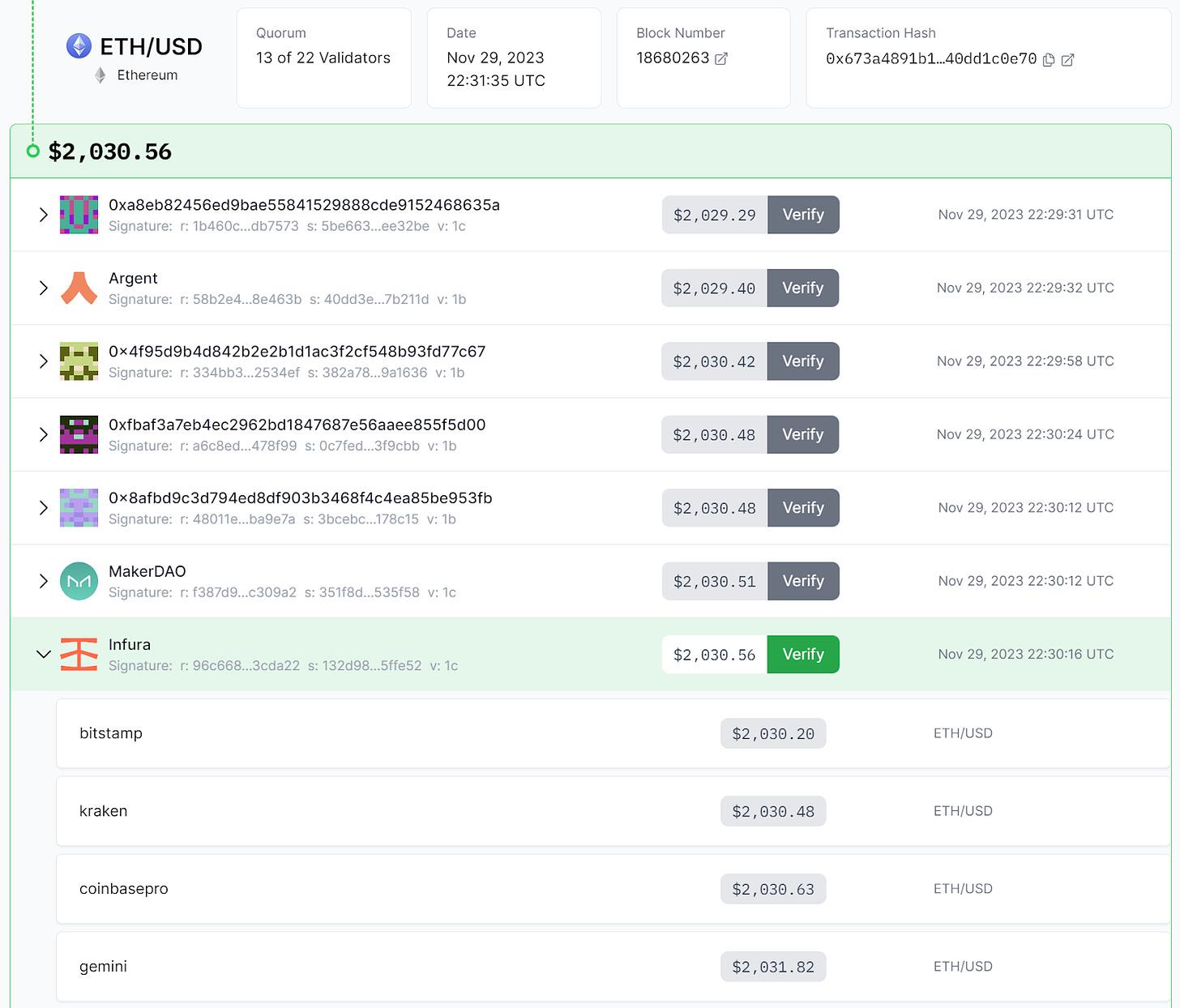
The overall outcome is a professional, predictable service designed to protect billions of dollars in value in a verifiable way. If “the future of finance” will be on-chain, financial providers will need a more transparent and supported data delivery option.
In short, Chronicle Protocol appears ahead of its competitors, delivering a solution that is not only more cost-effective and transparent from a technical standpoint but also focused on commercial viability and sustainability. Whether Chronicle maintains its lead or other projects adopt this improved tech stack, one thing is clear: a transformation is coming in the realm of on-chain data.
Join TechFlow official community to stay tuned
Telegram:https://t.me/TechFlowDaily
X (Twitter):https://x.com/TechFlowPost
X (Twitter) EN:https://x.com/BlockFlow_News
 @coinstackcrypto