








From Luke Dashjr's Proposal to Reflections on the Essence of Blockchain
TechFlow Selected TechFlow Selected
From Luke Dashjr's Proposal to Reflections on the Essence of Blockchain
If the foundational beliefs of Bitcoin OGs and Satoshi maximalists are flawed, then what is the real value of blockchain?
 Navigating Web3 tides with focused insights
Written by: Faust & Wuyue, Geeker Web3
-
The Ordinals protocol is a system that assigns serial numbers to satoshis (SATS, the smallest unit of Bitcoin), or more precisely, a derivative protocol using Bitcoin UTXOs as data storage medium—essentially following the same logic as "colored coins";
-
Luke Dashjr is primarily concerned with solving the problem of "junk data" that BRC-20 and Ordinals have introduced to Bitcoin’s mainnet. His goal is to reduce the burden on Bitcoin, preserving its simplicity and decentralization—not an absolute rejection of BRC-20 itself;
-
Judging solely from Luke’s proposed solution, as long as one mining pool continues to include Ordinals and BRC-20 transactions, both can survive on the Bitcoin network, albeit with significantly worse user experience (e.g., longer confirmation delays for BRC-20 transactions); yet this also reveals the potential and opportunity for Bitcoin Layer 2;
-
If utopian slogans like “dollar replacement” or “code is law” continue to be disproven over time, then what is the true purpose of Bitcoin and blockchain? What real problems can they actually solve?
Recently, veteran Bitcoin community member Luke Dashjr sparked widespread debate with his strong statements against BRC-20. Luke argues that BRC-20 and inscription protocols circumvent Bitcoin’s block-level data size limits, stuffing large amounts of “junk data” into blocks. This practice imposes unnecessary burdens on nodes, increasing bandwidth and storage costs. If this trend persists, it will gradually erode Bitcoin’s decentralization—an essential tradition upholding what is considered the “most decentralized blockchain ecosystem.”
Luke’s concerns are not unfounded. On February 1st this year, the Bitcoin network produced its “largest block ever,” measuring 3.96MB, simply because it contained an NFT called Taproot Wizards. This phenomenon was already identified by Luke Dashjr and others as a threat that could permanently inflate Bitcoin’s block sizes, thereby raising hardware requirements for running full nodes—a direct contradiction to one of decentralization’s core tenets: lowering the cost for users to run nodes. If Bitcoin eventually becomes like Solana or Sui, where only third-party data centers can host nodes, it would indeed be a tragedy for the Bitcoin community and the broader Web3 space.
Beyond increasing node bandwidth and storage demands and weakening decentralization, larger blocks also impact security: bigger blocks propagate slower across the network, leading to poorer data consistency among nodes, higher orphan rates, and increased likelihood of ledger forks. The Conflux team has emphasized this point multiple times, and the Ethereum Foundation has been actively assessing how EIP-4844 might affect security once larger blocks are enabled. Such changes inevitably create ripple effects throughout the system.
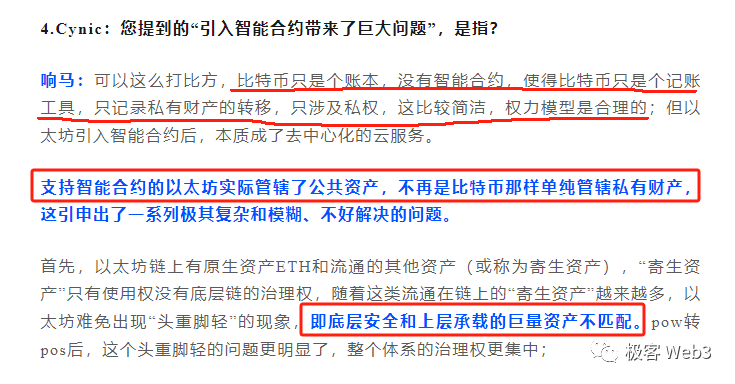
Setting aside the negative impacts of BRC-20 and Ordinals on Bitcoin’s underlying security and decentralization, the practice of nesting derivative assets within Bitcoin’s UTXO model creates new risks—essentially offloading the security responsibilities of these derivatives directly onto the Bitcoin network. If the total value of such derivatives exceeds the amount of capital or hash power securing Bitcoin’s safety, it could lead to an unstable “top-heavy” structure. This risk is becoming increasingly evident in proof-of-stake Ethereum. Prominent tech figure Xiangma expressed similar concerns during a recent interview.
Interestingly, although Luke has expressed negative views toward BRC-20 and various inscriptions, stating that if a new version of the node client were released and widely adopted, BRC-20 and Ordinals might disappear, he did not outright reject alternative solutions. When others suggested placing BRC-20 on Bitcoin Layer 2 to relieve pressure on the mainnet, Luke endorsed the idea, showing he does not ideologically oppose BRC-20 itself. Luke later clarified: eliminating all inscriptions isn’t necessary to benefit the Bitcoin network.
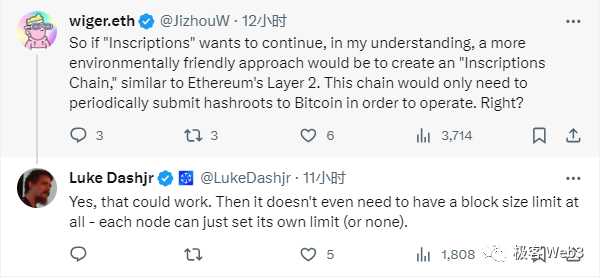

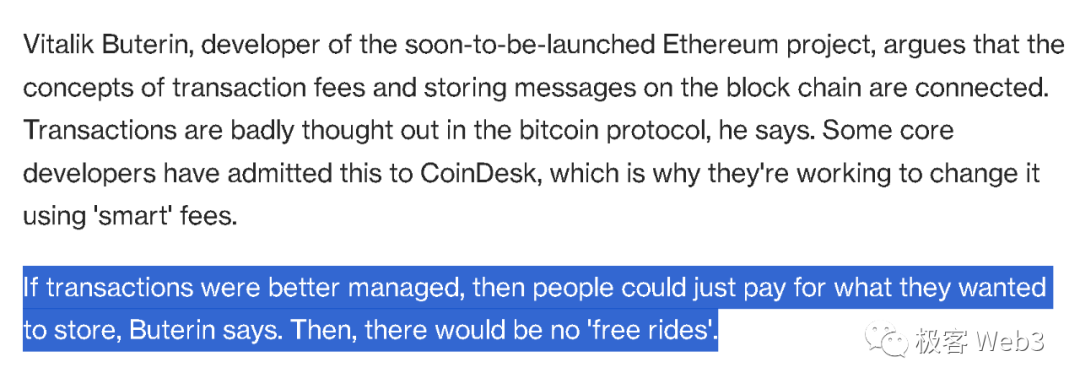
Ultimately, Luke’s objection appears to center on the risks posed by data bloat from derivative applications on Bitcoin’s main chain—not a desire to completely eradicate such innovations. Rather, his aim seems to be pushing protocols like Ordinals off the mainnet and onto external infrastructures, which ironically opens opportunities for Bitcoin Layer 2 development. However, Luke’s aggressive approach has stirred controversy, touching on disputes over influence within the Bitcoin ecosystem and highlighting fundamental differences in product design philosophy between BTC and ETH—years ago, Vitalik Buterin disagreed with Luke and others on similar issues, indirectly motivating him to build his own blockchain.
In the following sections, we will analyze the technical aspects of the Ordinals protocol and Luke’s proposed solution, while briefly examining the positions of both camps: the “Satoshi purists” represented by Luke and the “speculators” embodied by BRC-20 enthusiasts. If Web3 isn't as grand and idealistic as some claim, then what is its actual value?
A Brief Analysis of the Ordinals Protocol
From a purely technical perspective, the Ordinals protocol is a system that assigns serial numbers to satoshis (SATS, Bitcoin’s smallest unit), or more precisely, a derivative protocol using Bitcoin UTXOs as a storage medium. Ordinals assign each satoshi a unique number and attach additional data (text, images, code, etc.), turning each into a unique NFT—a process known as “inscribing.”
Building on Ordinals, BRC-20 introduces a method for issuing fungible tokens similar to ERC-20. However, Bitcoin’s scripting language is not Turing-complete and cannot support complex smart contract systems like Ethereum. For example, even a simple transfer function based on the Ordinals protocol requires embedding content like the following into the script:
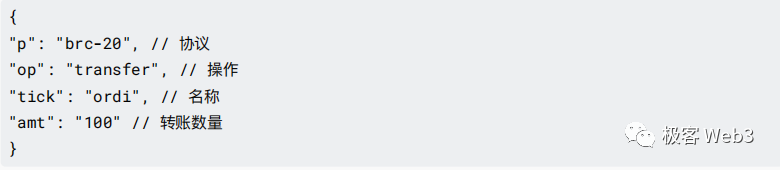
As shown, this is a purely textual interaction. The Bitcoin network itself performs no computation or state validation on BRC-20 transaction content. Messages indicating successful BRC-20 transfers are derived only after nodes that recognize the Ordinals protocol parse and compute raw scripts from the BTC chain.
For instance, you could attempt to send 10,000 ORDI tokens even if you only hold 100, and the transaction would still be broadcastable to the Bitcoin network—but indexing nodes and explorers would not interpret it as a valid transfer.
Therefore, Ordinals essentially treats the Bitcoin network as an immutable, permanent cloud drive. Only metadata and operation declarations are inscribed on-chain, while all computations and state settlements occur off-chain, hosted on indexer servers. This approach closely resembles projects in the Arweave ecosystem, such as EverPay.
In summary, Ordinals faces the following issues:
-
No unified consensus layer for state computation. Different wallets and browsers may display inconsistent results, and there have been repeated instances where users see different balances across wallets.
-
Reliance on centralized Indexer infrastructure. By blockchain standards, such applications lack rigorous security guarantees and are inherently unreliable.
-
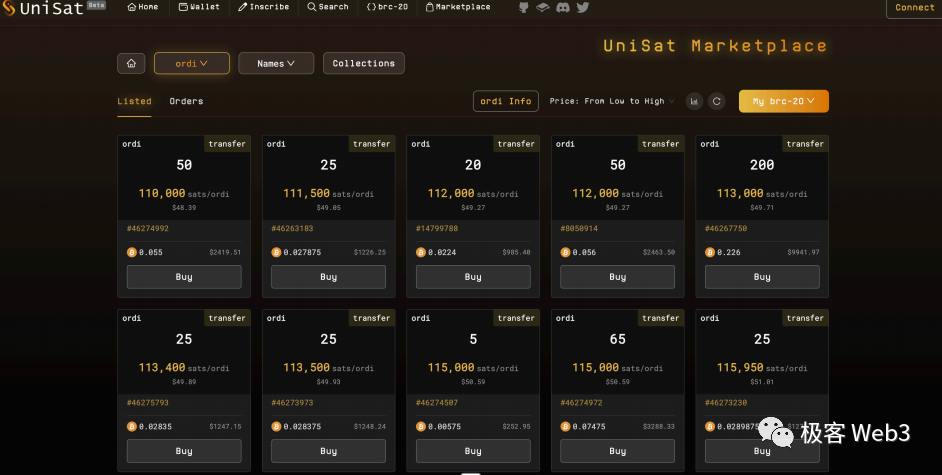
Narrow use cases. Complex DeFi activities common on Ethereum cannot be supported by the simple Ordinals protocol. Even current Ordinals trading relies on order books rather than popular AMMs. In fact, such applications might work better if implemented on Ethereum.
-
Network pollution. The way Ordinals manipulate satoshis—such as thousands of users moving $0.1 worth of value while paying $10 in fees—is seen by Bitcoin purists as akin to dust attacks. To these users or developers, Bitcoin should primarily serve as a store of value and transfer mechanism, and Ordinals activity severely disrupts normal network operations.
-
Increased user costs. Inscriptions have driven up Bitcoin’s mainnet transaction fees, affecting other users. Additionally, BRC-20 and Ordinals require new wallets and tools, adding complexity for users.
Luke’s Proposed Solution
In response to the BRC-20 and Ordinals issue, Luke did not propose modifying the consensus layer but instead suggested updating the Spam Filter (policy) module so that nodes automatically reject Ordinals transactions upon receiving P2P broadcast messages. Within the policy module, multiple isStandard() functions check whether various aspects of a transaction meet standard criteria; if not, the transaction is quickly discarded.
In other words, Ordinals transactions can still be included in blocks, but most nodes won’t keep them in their mempools, increasing the delay before such data reaches miners willing to include it. However, if a mining pool broadcasts a block containing BRC-20 transactions, other nodes will still accept it as valid.
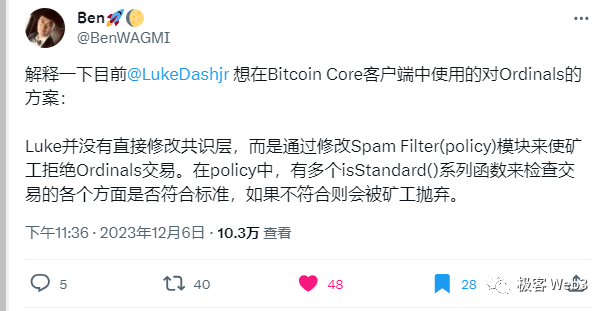
Luke has already submitted this policy change to the Bitcoin Knots client and aims to incorporate it into Bitcoin Core. In policy.cpp, he added a new parameter named g_script_size_policy_limit, which imposes script size restrictions at multiple points.
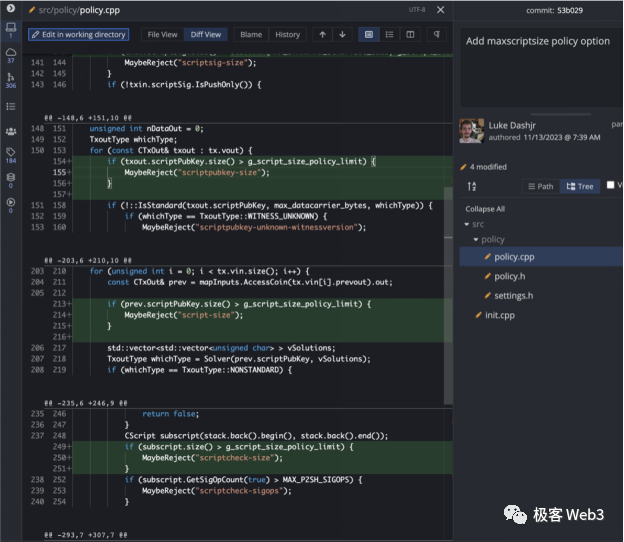
Previously, the client imposed no script size limits on Pay-to-Taproot (the transaction type used by Ordinals), which is now being addressed.

The default value of g_script_size_policy_limit is set to 1650 bytes, which restricts many scripts used in Ordinals. Below is an example of the script size associated with an NFT:
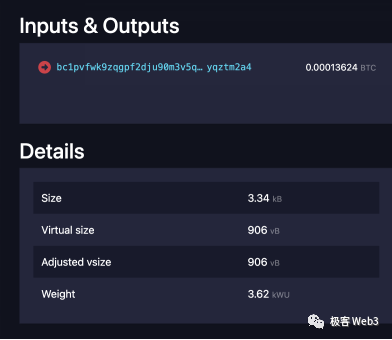
However, since this parameter applies only to the Spam Filter module and not the consensus layer, nodes can manually adjust its value to accept larger scripts. While such transactions deviate from Core developers’ expectations, they remain valid under Bitcoin’s consensus rules. Thus, as long as at least one mining pool is willing to include Ordinals-related transactions, they can persist on the Bitcoin network—albeit with significantly degraded UX for users (longer response delays than currently experienced).
This method cannot fully eliminate Ordinals activity on-chain and does not require a hard fork. Although some nodes may ignore the new policy, given that no such rule previously existed, adoption by even a subset of nodes could reduce Ordinals activity. Luke expects most nodes to follow his proposed policy. Overall, this update is soft in nature: as long as one mining pool supports BRC-20 and Ordinals, they can continue existing on Bitcoin’s mainnet, though with poor user experience. Meanwhile, rapid development of Bitcoin Layer 2 could allow BRC-20 and Ordinals to thrive there instead.
The Hidden Crisis of Blockchain Faith Behind Luke Dashjr’s Actions
How should we evaluate Luke Dashjr’s actions? Is this merely a dispute between “big-block” and “small-block” ideologies? Admittedly, from a technical and product standpoint, Luke appears to be defending the Bitcoin community’s long-standing minimalist philosophy and commitment to decentralization—a conservative approach sharply contrasting Ethereum’s expansive vision, and historically vital within the blockchain world.
Others argue that Bitcoin itself is a massive experiment in community governance, with Luke Dashjr representing just one faction. Bitcoin doesn’t belong to any single individual but emerges from the博弈 among miners, exchanges, developers, and users. Regardless of Luke’s stance on BRC-20, flashy inscriptions will likely find their place within the Bitcoin ecosystem.
However, this article does not intend to dwell on these two perspectives, but rather to highlight a deeper, often overlooked issue:
Viewed through an ideological lens, the recent “Luke Dashjr incident” reflects a conflict between “technocrats” and “traders.” Previous debates between Blast and Polygon zkEVM already revealed tensions between these two camps. Luke’s actions have further intensified this divide, prompting reflection on who truly owns Bitcoin—and by extension, blockchain itself: Is it the OG contributors claiming succession from Satoshi, or the speculators endlessly chasing profits on-chain?
From the viewpoint of Bitcoin OGs like Luke, most BRC-20 enthusiasts are profit-driven individuals “ignoring everything else while obsessively making money on-chain.” Their self-interest may seem unworthy of protection, and removing BRC-20 from Bitcoin serves the ecosystem’s long-term health—far more “important” than satisfying traders’ greed.
Conversely, those who entirely dismiss BRC-20 and Ordinals while ignoring the interests of mainstream Web3 users also appear selfish and shortsighted. If what they deem “noble” and “correct” proves impractical and hypocritical, is their condescension toward so-called “vulgar” participants merely another form of arrogance—laughing at others while walking the same flawed path?
At its core, financial markets operate without inherent morality. It’s difficult to judge whose behavior is more ethical—everything is governed by mechanisms and rules (as Soros noted). Blockchain’s permissionless ethos does not inherently invalidate “aircoins” like BRC-20. Therefore, attacking inscription users solely under the banner of distant “Bitcoin fundamentalism” might itself contradict the spirit of permissionlessness. From this angle, is Luke’s action truly commendable? Have his supporters or critics deeply reflected on this?
Countless people have passionately described blockchain’s grand visions, repeatedly promoting ideals like “Satoshi spirit” and “trustless maximalism.” Yet why haven’t the promised “dollar replacements” or “next-generation internet” envisioned by Satoshi and Gavin Wood arrived, while a series of seemingly “unsophisticated” phenomena emerge first? Is this due to the inherently poor UX and high barriers of decentralized networks?
For a technology that is user-unfriendly and unlikely to compete with Web2 in user experience, what unique scenarios can it offer? If it struggles to achieve advantages beyond Web2, can slogans like “trustless” really gain mass acceptance? Is it hypocritical—akin to Confucian elitism—to preach distant ideals like “code is law” and “mass adoption” while dismissing mainstream users such as yield farmers?

Perhaps technocratic purists do have grounds to mock BRC-20 players for being profit-driven or viewing blockchain as nothing more than an “on-chain casino.” But we must seriously reconsider blockchain’s true significance. If it fails to live up to Satoshi’s grand vision, and if many of its utopian ideals are repeatedly disproven over time, then beneath slogans like “code is law,” “mass adoption,” and “Web3.0,” could there be a profound crisis of faith akin to Nietzsche’s “death of God”? If “Satoshi-ism” turns out to be an ideological castle in the air like Marxism, should we re-examine what problems Web3 can actually solve?
We may not have definitive answers to these questions, but it is undeniable that blockchain’s inherent properties—forkability and multi-community diversity—ultimately grant individuals greater freedom of choice than exists in real-world politics. In this imperfect Web3 world, there will never be just one version of the chain. Compared to sovereign states, blockchains—capable of forming diverse “nations” according to different group preferences—can serve as a complement and improvement to real-world democratic governance, rather than mere idle slogans like “dollar replacement” or “Web2 grave-digger.” Often, solving immediate real-world problems matters far more than indulging in beautiful illusions perpetually deferred to tomorrow.
Join TechFlow official community to stay tuned
Telegram:https://t.me/TechFlowDaily
X (Twitter):https://x.com/TechFlowPost
X (Twitter) EN:https://x.com/BlockFlow_News
 @godrealmx









