









Luke Sparks Bitcoin Inscriptions "Debate," How Does the Overseas Community View It?
TechFlow Selected TechFlow Selected
Luke Sparks Bitcoin Inscriptions "Debate," How Does the Overseas Community View It?
Is banning Ordinals and BRC-20 tokens wishful thinking or meeting public expectations?
 Navigating Web3 tides with focused insights
By James Hunt, The Block
Translated by Felix, PANews
Key Takeaways
-
Luke Dashjr, Bitcoin developer and co-founder of Ocean mining pool, claims inscriptions are exploiting a vulnerability in the Bitcoin Core client to spam the blockchain—a flaw he says was recently "fixed" in Bitcoin Knots V25.1, which he maintains.
-
Many community members disagree, arguing that amid ongoing heated debates over network congestion and how Bitcoin should be used, inscriptions will not stop.
-
The inscription trend also appears to be spreading to other chains, causing surges in transaction volumes on Ethereum, Solana, Near, Polygon, Celo, and Fantom.
Luke Dashjr, a core Bitcoin developer and co-founder of the Ocean mining pool, has published a lengthy critique of inscriptions such as Ordinals and BRC-20 tokens, labeling them as “spam” on the Bitcoin blockchain, amid an intensifying debate within the community about network congestion and differing views on Bitcoin’s intended use.
In a post on X, Dashjr stated: "Inscriptions are exploiting a vulnerability in Bitcoin Core to spam the blockchain. Since 2013, Bitcoin Core has allowed users to set limits on the size of attached data when relaying or mining transactions. Inscriptions bypass this restriction by obfuscating data as program code."
Dashjr added: "This bug was recently fixed in Bitcoin Knots v25.1. However, Bitcoin Core remains vulnerable in its upcoming v26 release. I only hope it gets fixed before next year’s v27 version."
When asked whether fixing this bug/vulnerability would mean the end of Ordinals and BRC-20 tokens, Dashjr replied: "Yes, Ordinals never existed in the first place—it's all a scam," although existing inscriptions would still remain.
Bitcoin Knots is a derivative of Bitcoin Core, primarily maintained by Dashjr. Currently, only a small fraction of Bitcoin nodes—147 (0.22%)—run Bitcoin Knots, compared to 66,545 nodes (98.83%) using Bitcoin Core, the most widely adopted software in the Bitcoin protocol. Therefore, achieving consensus for similar changes in Bitcoin Core is an entirely different matter.
However, according to recent updates, when responding on X to a question about whether "as long as one miner does not opt out, can that miner still process inscription transactions on the blockchain?" or whether miners need majority consensus to opt in/out, Dashjr replied: "We don’t need to eliminate all inscriptions to bring benefits to the Bitcoin ecosystem."
Sparking Heated Debate Abroad, Dashjr Criticized for Being Overly Subjective
While Dashjr’s views have been supported by other Bitcoin enthusiasts such as Bitcoin educator Giacomo Zucco, many others strongly disagree.
Trevor Owens, general partner at Bitcoin Frontier Fund (formerly Stacks Ventures), responded to Dashjr’s post: "Regardless of whether this 'bug/vulnerability' makes it into Bitcoin Core v27 (hint: it won’t), inscriptions will never stop. People will pay for them, miners will mine them. As long as there is market demand, you cannot stop it—accept reality." Several other members of the Ordinals community echoed similar sentiments.
Udi Wertheimer, co-founder of Taproot Wizards, a Bitcoin Ordinals project, said: "Dashjr has contributed sporadically to open-source Bitcoin projects over the years—he doesn’t own the Bitcoin network."
Wertheimer added: "Since February this year, Dashjr has been angrily tweeting against Ordinals inscriptions but has failed to halt their momentum. As Ordinals further solidify their position as a primary use case on the Bitcoin network, we expect these rants and frustrations to continue. We’d like to take this opportunity to thank Dashjr for permanently hosting our wizard JPEG on his Bitcoin node." (A sarcastic jab implying Dashjr is powerless against inscriptions.)
Eric Wall, co-founder of Taproot Wizards, noted: "He isn't proposing a change to consensus rules, but rather suggesting miners block inscriptions from entering blocks. If Dashjr had his way, it would only take one mining pool to include inscriptions on-chain. We already know of a pool that likes Ordinals—Luxor, which helped us mine a 4MB Taproot Wizard JPEG. If Luxor monopolizes inscription mining, it would become the most profitable mining pool to date. Even if you buy into Dashjr’s fantasy, hash power would become highly centralized, as most people would flock to mine with Luxor. Dashjr’s proposal completely contradicts his own goals."
"Luke Dashjr has taken a subjective moral stance against Ordinals inscriptions while implementing a mining approach at Ocean Pool that completely ignores data-heavy inscription transactions. Solving monetary problems with math is a task few take seriously—most miners will choose to mine inscriptions because they’re more economically valuable. Dashjr could implement a method that doesn’t clog the Bitcoin blockchain. However, Dashjr’s view does not reflect network consensus. Given that inscriptions generate greater profits for Bitcoin miners, Dashjr’s efforts may amount to nothing more than wishful thinking," said Jesse Shrader, co-founder and CEO of Amboss, a lightning network data analytics provider.
He added: "Taking a subjective moral stance on whether transactions are good or bad fundamentally conflicts with Bitcoin’s long-standing nature: Bitcoin is a ruthlessly neutral protocol. Once you start making subjective judgments based on transaction content, users may find their censorship resistance diminished, as we move away from fee-based transaction prioritization."
Jameson Lopp, CTO of Casa, said: "Luke Dashjr has the right to express his opinion, but I doubt many agree with classifying inscriptions as bugs. Calling them spam is subjective—it depends on whether you believe you should decide which use cases are appropriate for the Bitcoin protocol, or whether you believe any valid transaction paying competitive fees should be allowed to purchase block space."
Lopp expects economic rationality to prevail, explaining that most miners today are large institutions responsible for maximizing shareholder profits, so they will mine any valid transaction offering the highest fees. On the developer side, Lopp previously stated, 'Banning arbitrary data is a rabbit hole you don’t want to fall into.'
Ocean Pool Faces Controversy Over Filtering Ordinal Inscriptions
Last week, Ocean Pool, founded by Luke Dashjr, secured $6.2 million in seed funding led by Jack Dorsey, CEO of Block, to support the launch of Ocean Pool and other mining decentralization initiatives.
Ocean Pool uses a “fixed” version of Bitcoin Knots to filter inscription transactions. "In addition to other improvements, this upgrade fixes a long-standing vulnerability exploited by spammers. As a result, our blocks now include more legitimate transactions and help put an end to DoS attacks being carried out on the Bitcoin network," the team stated.
Udi Wertheimer previously commented on the filtering: "I strongly doubt this is true—if it were, they’d go bankrupt quickly."
When confronted with criticism over transaction censorship, Bitcoin Mechanic, Ocean’s global sales director (using a pseudonym), responded: "It’s meaningless to discuss censorship with those who don’t understand it. We’ll filter out inscription spam, and of course, you’re free to mine with other pools and keep spreading FUD."
Nonetheless, many miners remain enthusiastic about the rise of Bitcoin inscriptions, as they provide additional transaction fees beyond Bitcoin block rewards. In defense, Dashjr argued: "Bitcoin operates under the assumption that most miners are honest and non-malicious. Moreover, for some reason, blocks filtering spam often collect higher fees."
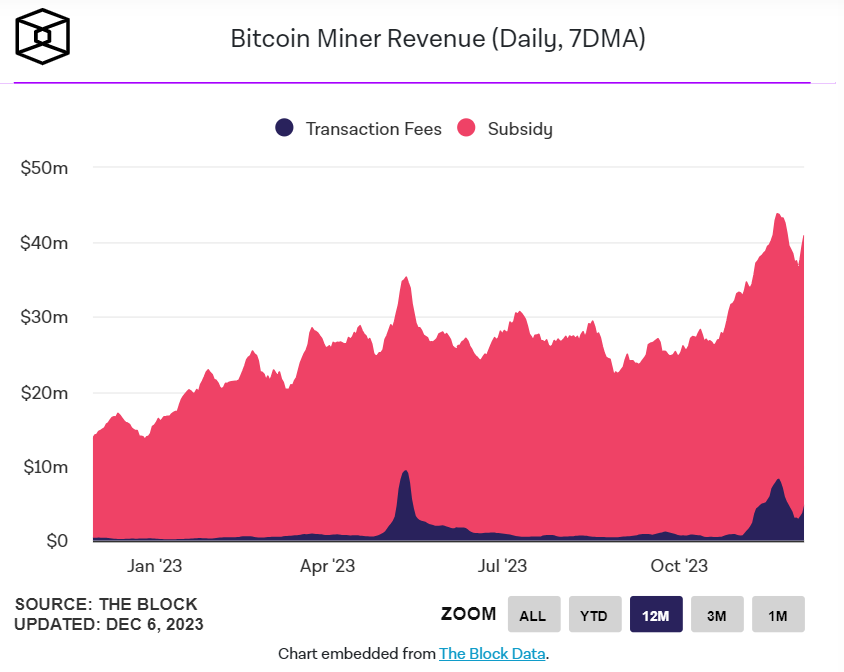
Miner Revenue Surges
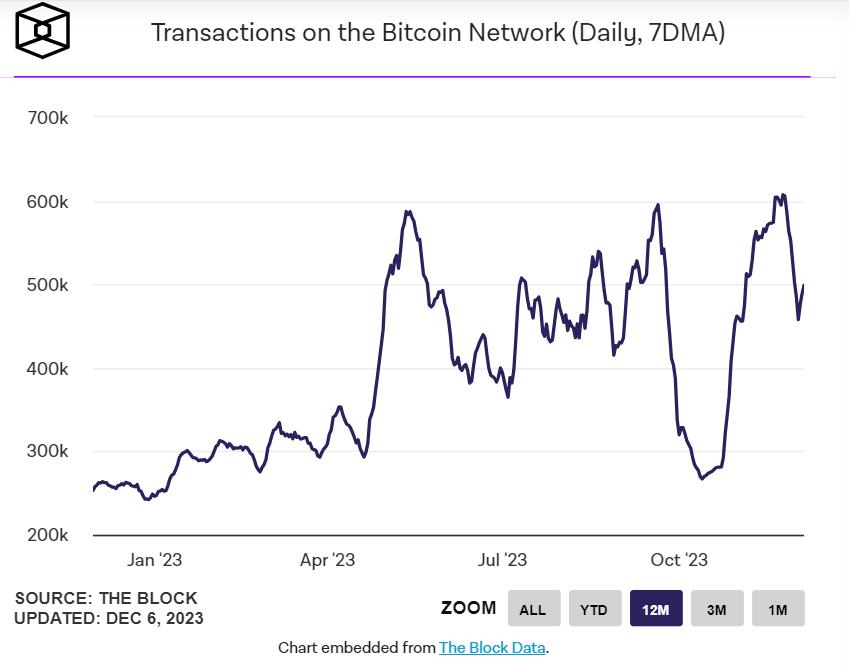
According to The Block data, transaction activity on the Bitcoin network has surged at various points this year. Meanwhile, inscription-related activity has also increased, with Bitcoin’s daily average transactions reaching a record high of 607,000 in November.
As a result, Bitcoin miners’ income from transaction fees has risen relative to block reward subsidies.
However, inscription activity has also caused network congestion. If other users are unwilling to pay higher fees, this leads to increased costs or delayed transaction processing. At the time of writing, over 275,000 transactions were pending confirmation on the Bitcoin network—more than five times the allocated 300 MB memory pool capacity. According to data from the Bitcoin mempool explorer, the average transaction fee for the next block is around $17, significantly higher than the historical average of $1–$2.
Inscription Boom Drives Transaction Volume Spikes Across Chains
Earlier this year, the growing popularity of Bitcoin Ordinals sparked debate over whether NFTs and BRC-20 tokens inscribed on Bitcoin should exist, as inscriptions rely on Bitcoin’s OP_RETURN function to store arbitrary data on the blockchain.
Some argue these features are unintended consequences of Bitcoin’s SegWit and Taproot upgrades, which made inscriptions economically feasible, and should therefore be removed from Bitcoin. Others contend that such unintended outcomes are part of the upgrade process, and as long as users follow Bitcoin’s rules, they should be allowed to continue.
Lopp said in July: "I think this is a clash between two main views on how Bitcoin should be used. One is more subjective, believing only simple and pure financial transactions should be allowed—as if Bitcoin were just cash. The other sees Bitcoin as a programmable monetary protocol, open for use by anyone as long as they operate within the rules."
Despite ongoing market controversy, the current BRC-20 token craze has spread to other chains—including Ethereum, Solana, Near, Polygon, Celo, and Fantom—causing transaction volumes to spike.
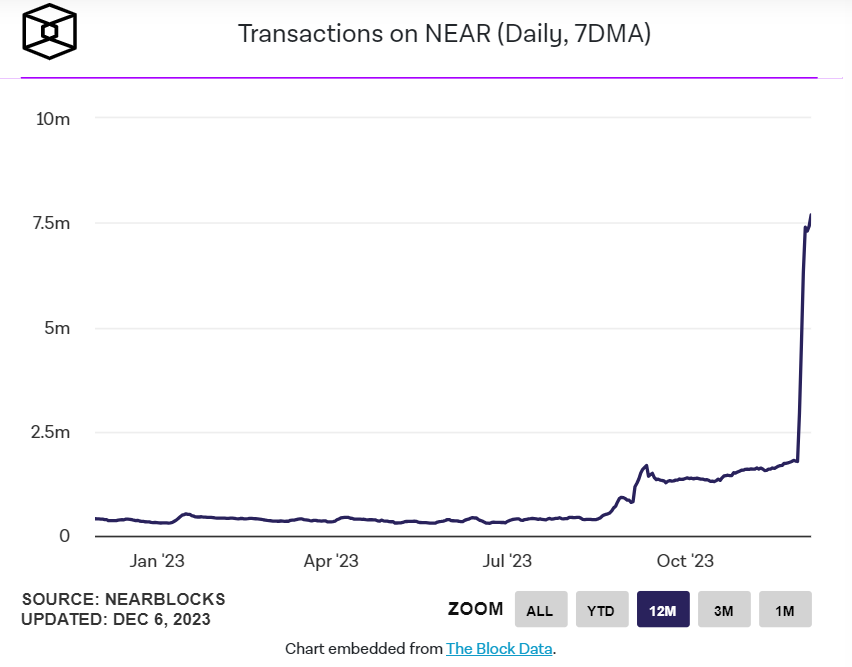
For example, according to The Block data, Near blockchain’s daily average transaction volume surged to a record high this month due to inscriptions.
A similar surge recently occurred on Polygon, where transaction counts jumped from 2.89 million to 6.1 million between November 14 and 15—the highest level since October last year.
Regarding this, Bitcoin advocate Eric Wall explained: "Because burning gas/wasting block space is the last 'open retail' distribution mechanism available. Retail investors often face multiple challenges accessing low-market-cap cryptocurrencies—such as the illegality of ICOs, risks of market manipulation, difficult airdrops, or investing in Memecoins. BRC-20 tokens allow anyone to fairly participate in a specific token’s issuance from day one. Degens have found a way out."
Join TechFlow official community to stay tuned
Telegram:https://t.me/TechFlowDaily
X (Twitter):https://x.com/TechFlowPost
X (Twitter) EN:https://x.com/BlockFlow_News
 The Block









