Bitcoin developers spark controversy over inscription ban, a博弈局 of multi-party interests
TechFlow Selected TechFlow Selected
Bitcoin developers spark controversy over inscription ban, a博弈局 of multi-party interests
How likely is it that Bitcoin Core developers will propose disabling inscriptions during a Bitcoin Core version upgrade?
 Navigating Web3 tides with focused insights
By Nancy, PANews
The booming Ordinals ecosystem has just been doused with a bucket of cold water. On December 6, Bitcoin Core developer Luke Dashjr stated that inscriptions are exploiting a vulnerability in Bitcoin and expressed hope that it would be finally fixed in next year’s V27 release. How likely is it that a Bitcoin Core upgrade will disable inscriptions? And does Ordinals still have room to survive?
Proposal to disable inscriptions next year — “Inscription Chain” as a viable solution
"Inscriptions are exploiting a vulnerability in the Bitcoin Core client to send spam messages onto the blockchain. Since 2013, Bitcoin Core has allowed users to set size limits on extra data relayed or mined in transactions. By obfuscating their data as program code, inscriptions bypass this limit. This vulnerability was recently fixed in Bitcoin Knots V25.1. Due to serious disruptions in my workflow last year (V24 was completely skipped), the fix took longer than usual. The vulnerability still exists in the upcoming V26 version of Bitcoin Core. I can only hope it will be finally resolved before next year's V27 release," said Bitcoin Core developer Luke Dashjr in a post today on X.
According to analysis by Taproot Assets contributor @Ben077, Luke Dashjr introduced two key parameter restrictions in Bitcoin Knots to filter so-called fraudulent Bitcoin transactions: datacarriersize primarily limits data carried via op-return, i.e., data written into the output section of a UTXO; maxscriptsize restricts inscription protocols based on Taproot scripts, whose data is inscribed into the witness field of a UTXO. If Luke Dashjr’s proposal makes it into Bitcoin Core, the default values of these two parameters could leave only taprootassets and RGB—those occupying the smallest on-chain footprint—in the Bitcoin ecosystem.
According to Luke Dashjr, once the vulnerability is patched, Ordinals and BRC-20 would cease to exist. However, some users have suggested an alternative: "If inscriptions want to continue, a more sustainable approach would be creating an inscription chain, similar to Ethereum’s Layer 2, which operates by periodically submitting hash commitments to Bitcoin." In response, Luke Dashjr commented, "Yes, that would work. Then it wouldn’t even need a block size limit—each node could set its own limit (or none at all)."
Luke Dashjr is one of Bitcoin’s earliest core developers, having contributed since 2011. As a prominent opponent of the Ordinals protocol—the most representative Bitcoin NFT standard—he has long argued that the protocol constitutes an attack on Bitcoin, opposes minting NFTs on Bitcoin, and has even developed a simple "spam filter" enabling miners to screen out inscriptions and prevent their propagation across the Bitcoin network.
Recently, Ocean Pool, founded by Luke Dashjr and backed by Twitter co-founder Jack Dorsey, sparked controversy in the crypto community by using multiple filtering strategies to exclude inscription-based "spam" from blocks it mines. Some view filtering spam data as beneficial, while others see it as a form of censorship.
Luke Dashjr’s stance has found support among others. For example, early Bitcoin adopter Samson Mow previously stated that the hype around Ordinals and BRC-20 tokens is unsustainable and will disappear within months—essentially amounting to paying massive fees directly to Bitcoin miners, which cannot last indefinitely. Additionally, in June this year, it was revealed that Bitcoin developers were discussing whether Bitcoin’s code should be adjusted to suppress Ordinals and BRC-20 activity.
How is the community reacting?
Luke Dashjr’s proposal does not guarantee implementation. He does not hold authority over Bitcoin’s codebase, and any upgrade requires miner consensus through voting.
"Bitcoin isn't Ethereum—developers don't get to decide. Code upgrades require miner votes. If miners oppose it, it won’t happen," said Eric Ciotti, co-founder of F2Pool, on social media. Even if developers push for an upgrade, miners could fork off independently—but given the critical juncture of Bitcoin spot ETF approvals, the likelihood of a fork is extremely low.
Crypto researcher Haotian also noted that Bitcoin v25.1 gave miners a toggle option to choose whether to include transactions exceeding certain size thresholds. But since miners benefit financially, no miner is likely to turn it off.
Yu Xian, founder of SlowMist, commented: "This view from Bitcoin Core developers is provocative. If things go his way, future Bitcoin versions will patch what he sees as a vulnerability: that ordinals/inscriptions are a bug in Bitcoin, a form of spam attack. This debate existed from the beginning, but now there may finally be action... Personally, I don't think it's necessary to patch this. While Taproot's introduction (a positive development) accidentally opened this Pandora’s box, its impact isn’t just spam—it also brought vitality to the Bitcoin ecosystem, which extends beyond just ordinals/inscriptions. Of course, if a patch comes with a compatible solution that better unlocks Bitcoin’s ecosystem potential, then perhaps short-term pain is worth long-term gain."
Miners and exchanges emerge as key stakeholders in the power struggle
As mentioned earlier, beyond Bitcoin developers, miners and exchanges are also pivotal players in this battle of interests.
In fact, the rise of Ordinals has led to a surge in inscription creation. According to Dune Analytics, as of December 6, total Ordinals inscription mints exceeded 46.376 million, with cumulative transaction fees reaching 3,362.3 BTC (approximately $140 million). Meanwhile, rising prices of tokens like ORDI have fueled a trading frenzy around BRC-20. Data shows that as of December 6, BRC-20 had nearly 39.891 million transactions, totaling 2,670.8 BTC in volume.
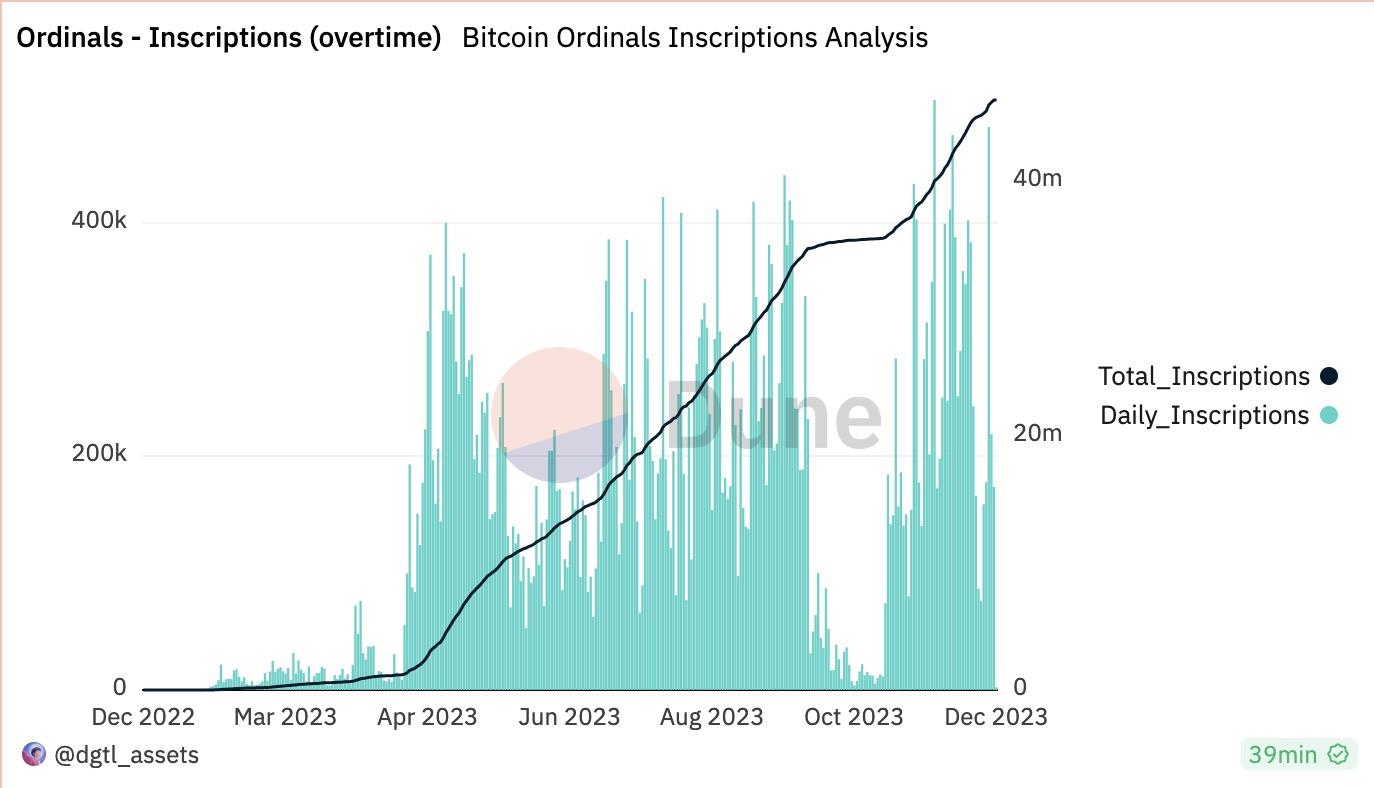
The broader Bitcoin NFT ecosystem continues to expand rapidly. CryptoSlam data shows that as of December 6, total NFT sales volume on Bitcoin surpassed $1.03 billion, with over 216,000 unique users. In the past month alone, Bitcoin has overtaken Ethereum to become the blockchain with the highest NFT sales volume.
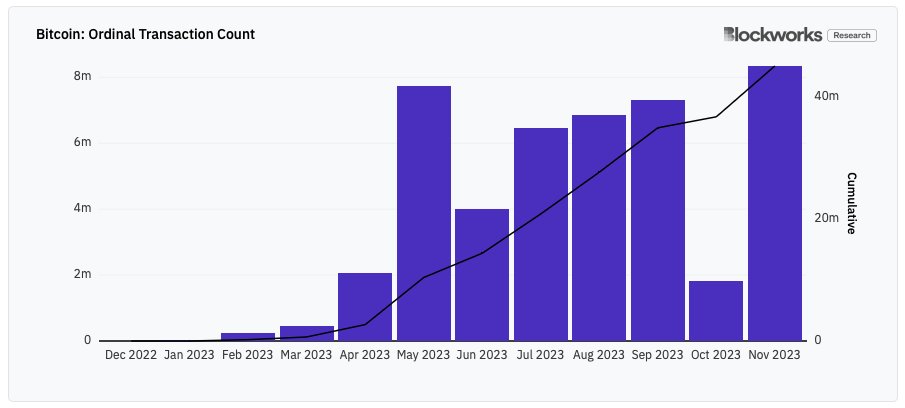
Due to soaring demand for Ordinals, Bitcoin’s on-chain gas fees have remained high, significantly increasing mining revenues. Miners and mining pools are reaping huge profits. According to BTC.com data, as of December 6, daily transaction fees across the Bitcoin network reached about 236.6 BTC—roughly 33.8 times higher than at the beginning of the year. Blockworks Research reported that in November alone, a record 8.34 million Ordinals-related transactions generated approximately $38.7 million in revenue for Bitcoin miners.
Moreover, exchanges are becoming major participants in this game. Take ORDI, the leading BRC-20 token, as an example. CoinGecko data shows that in the past 24 hours, ORDI’s spot trading volume exceeded $1.31 billion—surpassing its own market cap—with Binance and OKX accounting for over 79.5% of the total trading volume.
Faced with this clash of interests, although miners, exchanges, and users lack direct control over Bitcoin Core’s code, as major beneficiaries, they are unlikely to remain passive.
Join TechFlow official community to stay tuned
Telegram:https://t.me/TechFlowDaily
X (Twitter):https://x.com/TechFlowPost
X (Twitter) EN:https://x.com/BlockFlow_News
 PANews