Understanding Metis: The First Decentralized Sequencer in Layer2
TechFlow Selected TechFlow Selected
Understanding Metis: The First Decentralized Sequencer in Layer2
Metis is an Ethereum Layer 2 scaling solution built on Optimistic Rollup, designed to address the blockchain trilemma.
 Navigating Web3 tides with focused insights
Author: Riyue Xiaochu
1. Overview
-
In Layer2, the sequencer's role is to organize, sort, and compress thousands of transactions into a single batch before submitting it to Layer1 for confirmation. It is precisely this function that enables Layer2’s high performance and low transaction fees. However, if such a critical component remains centralized, there are risks of malicious behavior or single points of failure. Therefore, decentralizing Layer2 sequencers has become imperative. Metis is taking the lead, conducting tests of its decentralized Proof-of-Stake (PoS) sequencer on the Holesky testnet on the 27th, with community testing set to begin on January 2nd.
-
Metis is an Optimistic Rollup-based Layer2 solution launched on mainnet in 2021, making it one of the earliest operational Rollup Layer2 networks. In 2024, it upgraded to a Hybrid Rollup architecture combining Optimistic Rollup with zero-knowledge proofs (zk).
-
Metis has a circulating market cap of only $83 million and a fully diluted valuation (FDV) of $180 million. Allocations for institutions and the core team have already been fully unlocked. On-chain wallet tracking indicates that institutional holdings were sold off long ago, leading to the conclusion that there are effectively no remaining institutional holders. In contrast, OP and ARB still face massive future unlocks from teams and institutions—equivalent to significant monthly token emissions. Beyond governance functions similar to OP and ARB, Metis tokens also serve as gas for network transactions and for node staking (each node requires at least 20,000 METIS), creating real, tangible demand for the token.
2. Project Introduction
Metis is an Ethereum Layer2 scaling solution built on Optimistic Rollup technology, designed to address the blockchain trilemma:
-
Decentralization
-
Security
-
Scalability
As Ethereum usage grows, transaction costs have surged while speeds lag. As a smart Layer2 on Ethereum, Metis significantly increases transaction speed (rapid finality) and throughput (handling many more transactions per second).
Most importantly, Metis aims to create solutions that are accessible, affordable, and adaptable—enabling anyone to use blockchain technology to build, operate, and grow applications, businesses, and communities.
Hybrid Rollup
On March 2, 2023, MetisDAO announced it was building the world’s first hybrid Rollup, combining Optimistic Rollup architecture with zero-knowledge proofs (zk). According to a ChainCatcher report, on July 13, the MetisDAO Foundation officially launched ZKM, a new project incubated by the foundation. ZKM will launch its testnet before year-end, upgrading the existing Optimistic Rollup into a Hybrid Rollup, enabling near-instant withdrawals (compared to OP’s 7-day withdrawal period) while enhancing security.
ZKM uses the MIPS instruction set to implement zero-knowledge proof (ZKP) security at the CPU level for all virtual machines (VMs) and applications, supporting multiple blockchain smart contract engines. Its plug-and-play design allows developers to adopt ZKPs without modifying their codebase, reducing integration costs. Leveraging Ethereum’s decentralized security infrastructure, ZKM can verify both blockchain and non-blockchain transactions. The project aims to go beyond L2, expanding into L1, cloud computing, and IoT domains, positioning Ethereum as the settlement layer for both blockchain and non-blockchain worlds globally.
3. Decentralized Sequencer
For every Layer2, user transaction data must eventually be submitted to the Ethereum mainnet. In theory, users could submit data directly to Layer1, but doing so would make Layer2 transactions just as expensive and slow as those on Ethereum—defeating the purpose of Layer2. This is where sequencers come in. A sequencer aggregates hundreds or thousands of Layer2 transactions into a single batch before sending it to the mainnet for inclusion, drastically reducing transaction fees and confirmation times on Layer2.
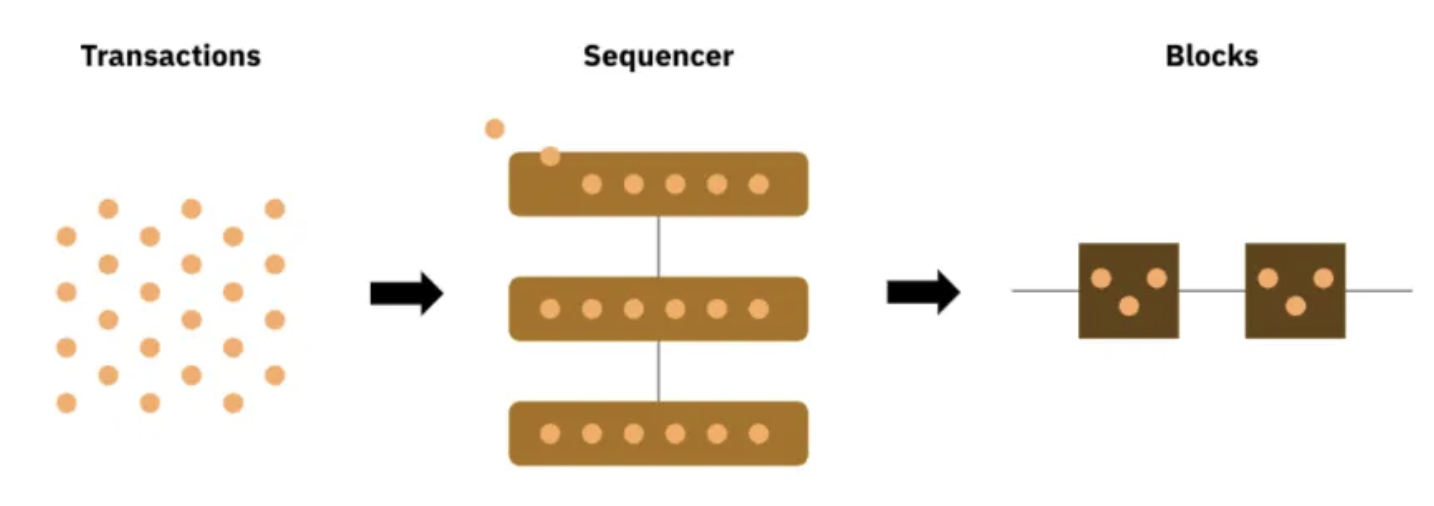
The value of Layer2 lies in increasing Ethereum’s throughput and lowering transaction costs. The sequencer makes this possible, underscoring its critical importance. However, in practice, most Layer2 sequencers today remain centralized—typically operated by project foundations like the OP Foundation or Arbitrum Foundation. This raises serious concerns about centralization. Regardless of whether these entities act maliciously, a centralized sequencer represents a single point of failure; any outage or attack could severely impact the entire Layer2 network.
While most major Layer2 projects include sequencer decentralization in their roadmaps, actual progress has been slow. This may be due to lower priority or conflicting interests—after all, centralized sequencers generate substantial gas revenue for project teams annually. Each L2 scaling solution therefore needs a decentralized sequencer to improve security and reduce systemic risk. Metis is poised to become the first L2 to achieve this milestone.
Metis’ decentralized PoS sequencer is already running on the Holesky testnet, progressing through three phases: simulating real node behavior, increasing node count, and staking tests. Starting January 3, 2024, community testing will open, allowing users to interact with new ecosystem dApps on the Holesky testnet and earn rewards over a one-month period.
Each sequencer node requires a stake of 20,000 METIS. In return, mining rewards will be generous, with 50% of the total METIS supply allocated to node incentives. For users who lack sufficient capital to run a node, Metis will soon launch Enki, a liquid staking dApp, enabling broader community participation in staking and reward distribution.
4. Current Status
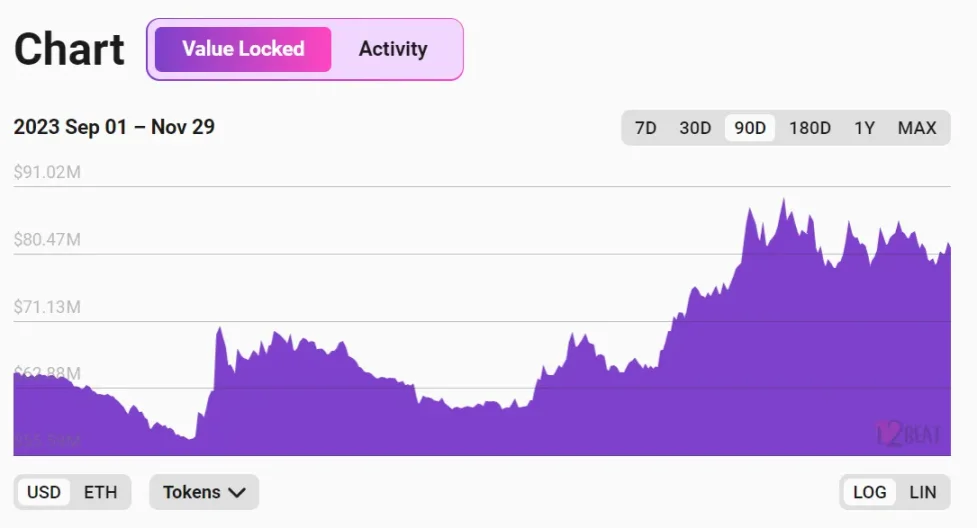
According to L2beat data, Metis currently has a TVL of $81.45 million, ranking 12th among Layer2 networks. Its peak TVL this year reached $165 million.
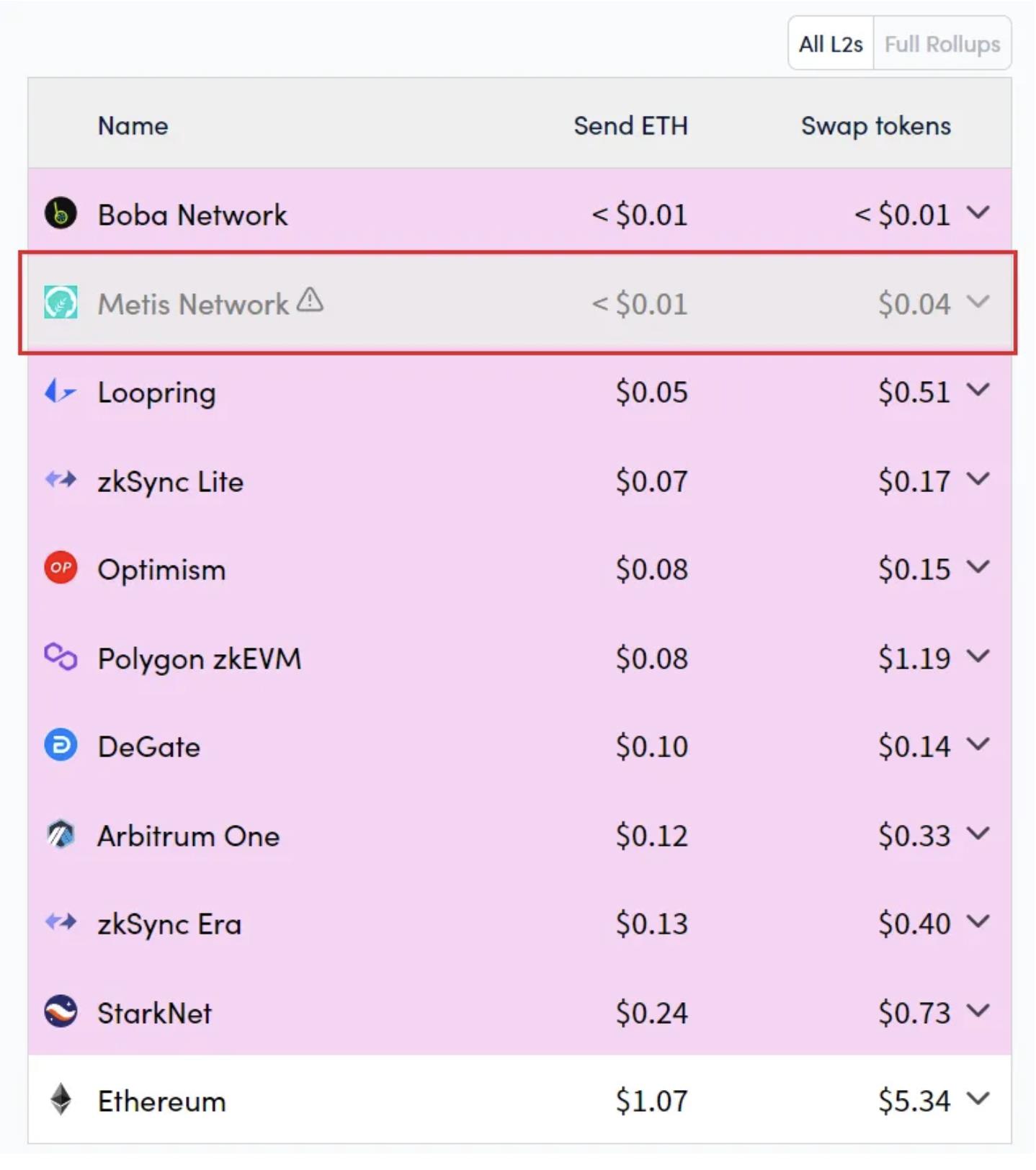
Among all Layer2s, Metis offers the lowest transaction fees. ETH transfers cost less than $0.01, compared to $0.12 on Arbitrum, $0.08 on Optimism, and $0.24 on StarkNet. Token swaps cost just $0.04—second only to Boba Network—and significantly cheaper than Arbitrum or Optimism.
However, in the near future, Metis' fees are expected to rise, approaching levels seen on Optimism. Currently low fees are due to Metis integrating MemoLabs, a decentralized storage solution. Metis submits only transaction commitments in Merkle tree format to Ethereum mainnet, storing full transaction data on MemoLabs, where validators can download and submit fraud proofs when needed. However, a recent community vote approved migrating the data availability (DA) layer to Ethereum mainnet—ensuring the highest Rollup security standard and supporting the upcoming decentralized PoS sequencer.
Ecosystem
DefiLlama lists 44 protocols on Metis, including multi-chain deployments such as Aave, Stargate, Synapse, Beefy, and SushiSwap. With the upcoming launch of the decentralized PoS sequencer and ecosystem incentive programs, a new wave of application growth is anticipated.
Maia
Maia is a DeFi yield enhancer. MAIA was issued 100% fairly via bond offerings, making it a truly community-owned token. The Maia ecosystem aims to become a one-stop shop for native DeFi financial tools—a mature trading hub—currently featuring:
-
Maia Decentralized Strategy Vault
-
Hermes Omnichain AMM and YLM (Yield & Liquidity Market)
-
TALOS Transparent Automated Liquidity Omnichain Strategies
-
Ulysses Omnichain Liquidity Protocol
Hummus Exchange
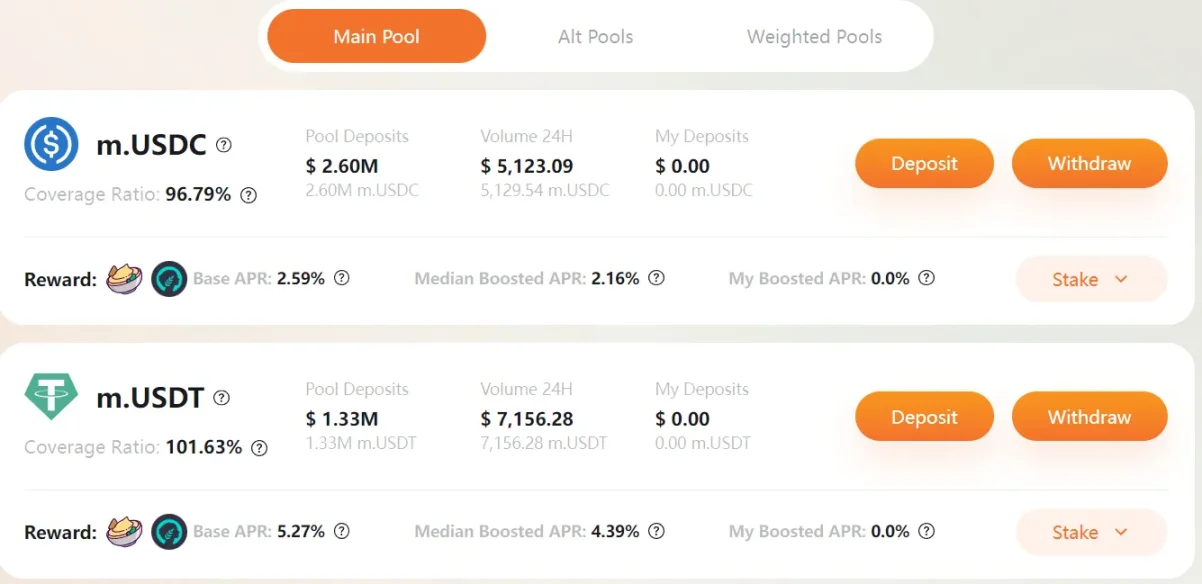
Hummus is a stablecoin trading platform on Metis, operating as a single-sided automated swap. It supports depositing into single-sided stablecoin pools.
Netswap
Netswap is a decentralized exchange (DEX) on the Metis chain, using the same AMM model as Uniswap and featuring its own governance token, NETT.
5. Tokenomics
Metis has a total supply of 10 million tokens. TGE Date: May 13, 2021
-
Founding Team 7%: 6-month lockup, then 12.5% released quarterly over 8 quarters
-
Foundation 4%: 10% unlocked at TGE, then 11.25% released quarterly over 8 quarters
-
Advisors 1.5%: 5% unlocked at TGE, then 11.875% released quarterly over 8 quarters
-
Angel Investors 1%: 5% unlocked at TGE, then 11.875% released quarterly over 8 quarters
-
Seed Investors 6%: 10% unlocked at TGE, then 22.5% released quarterly over 4 quarters
-
Private Sale 7%: 10% unlocked at TGE, then 22.5% released quarterly over 4 quarters
-
Community Star 3%: 10% unlocked at TGE, then linear monthly vesting over 12 months
-
Strategic 1.5%: 10% unlocked at TGE, then linear monthly vesting over 12 months
-
IDO 0.3%: 100% unlocked at TGE
-
Airdrop 6%
-
Liquidity Reserve 6%
-
Community Development 3%
-
Transaction Mining 14.86%
-
Transaction Mining 32.84%
1. All investor allocations—including angels, seed, private sale, community rounds, and strategic investors—have been fully unlocked for some time.
2. Founding team and advisor allocations were fully unlocked by November this year.
3. After the PoS sequencer launches, 50% of the total METIS supply will be allocated to node mining rewards.
Utility of the Metis Token
-
Gas Token: Every transaction consumes METIS as gas, similar to paying ETH for gas on Ethereum.
-
Builder Mining Rewards: Metis provides long-term support for ecosystem growth. Builders within the Metis ecosystem earn rewards based on the transaction volume they generate—the more transactions, the higher the rewards—creating a win-win between the ecosystem and developers.
-
Staking: Enhances network security. With the launch of the first decentralized sequencer pool, nodes must stake large amounts of METIS to qualify as sequencers and process transactions. The higher the stake, the greater the chance of being selected. New business models, such as liquid staking tokens (LST) for METIS, will emerge as a result.
-
Sequencer Mining Rewards: Sequencer nodes help secure the network, process transactions, and mine METIS tokens as rewards.
-
Governance: METIS tokens can be used to vote on key decisions within the ecosystem.
6. On-Chain Data Analysis (as of 11/30)
https://etherscan.io/token/0x9E32b13ce7f2E80A01932B42553652E053D6ed8e#balances
https://andromeda-explorer.metis.io/token/0xDeadDeAddeAddEAddeadDEaDDEAdDeaDDeAD0000/token-holders
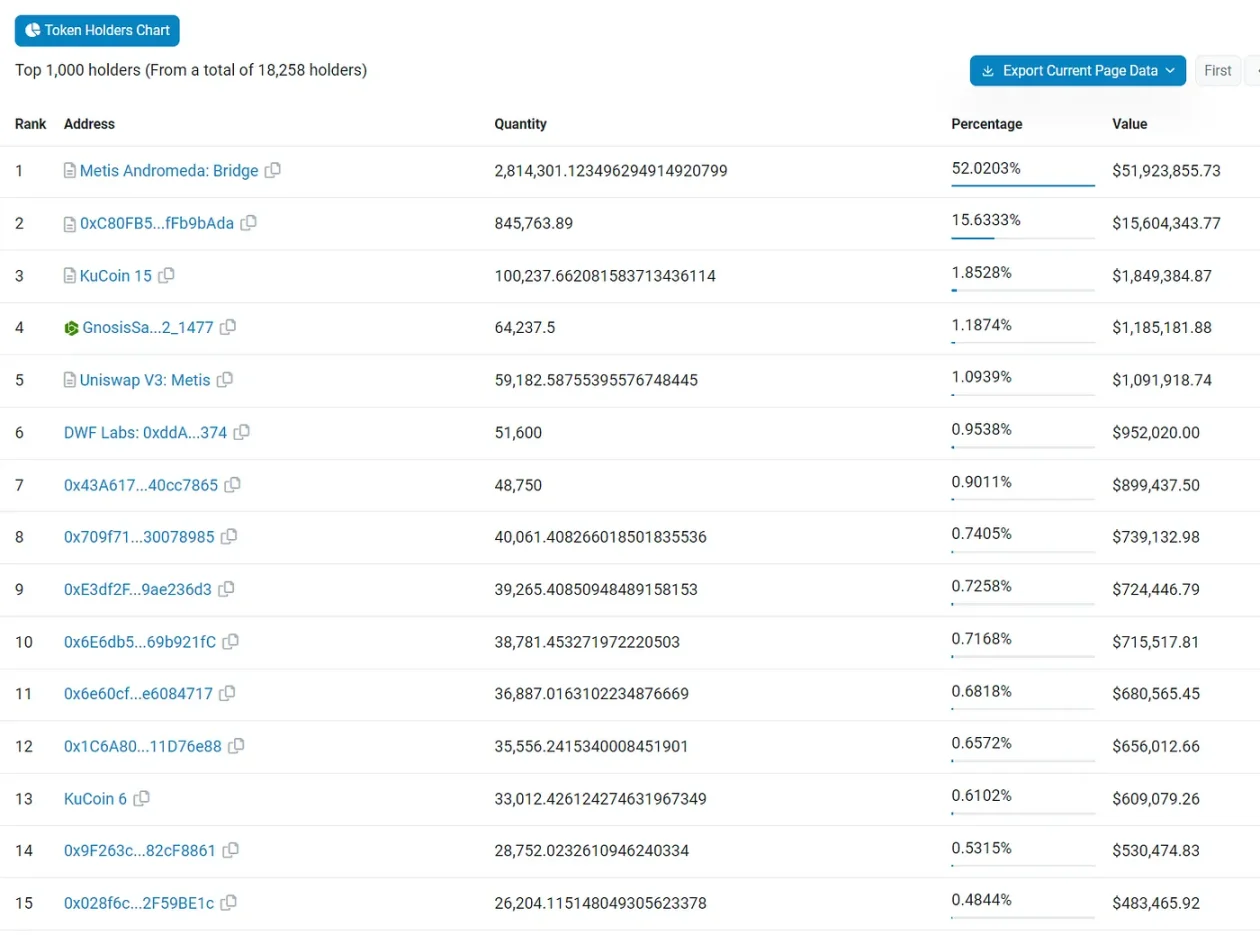
As of November 30, 2023, the total METIS supply is 5.41 million, with 2.81 million held on the Metis chain.
Top Holder Address 1: METIS on the Metis mainnet
Top Holder Address 2: Presumed to belong to investors and the founding team, initially holding 3 million METIS. This allocation has fully vested, with 845,000 tokens remaining in the wallet.
Top Holder Address 3: KuCoin exchange, holding 100,000 METIS
Top Holder Address 5: Uniswap, holding 64,000 METIS
Top Holder Address 6: DWF wallet
Top Holder Addresses 8, 10–12, 14–16: Coinbase cluster wallets
Tracking Top Holder Address 2
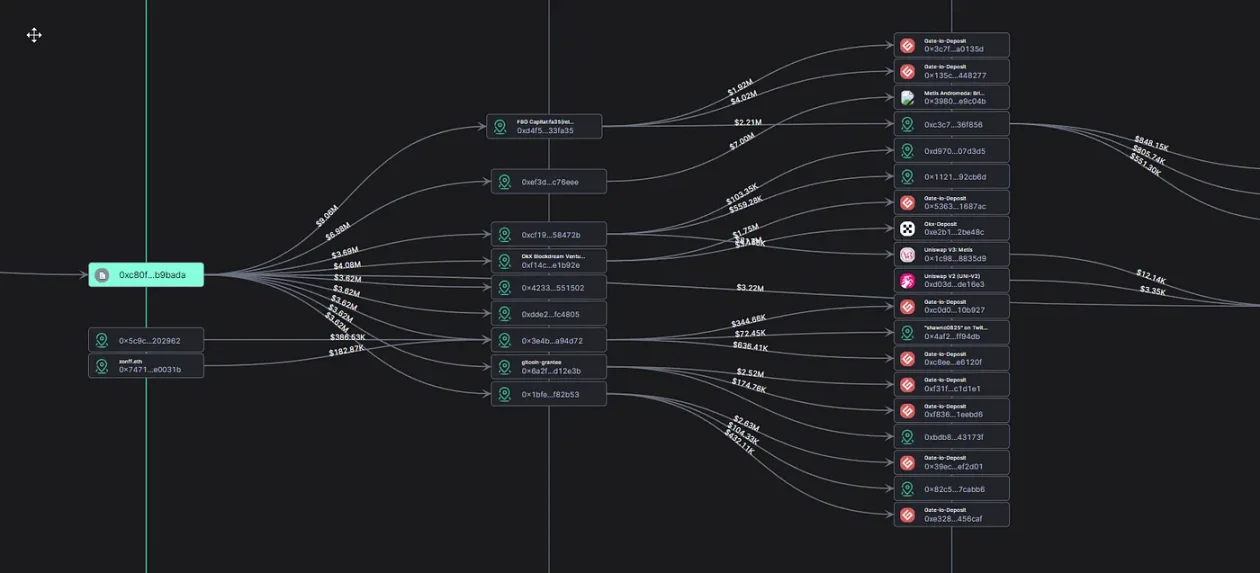
Address 2 is believed to belong to early investors and the founding team. Although fully unlocked, it still holds 845,000 METIS. Tracing fund flows reveals that most tokens have been transferred to exchanges and sold. FBG Capital received the largest amount—166,600 METIS—and fully exited one year ago. The second-largest recipient remains unidentified, having transferred all funds to the Metis mainnet. Okx Venture received 75,000 METIS and also completed selling one year ago. In summary, given the extended timeline, early institutional holdings have largely been sold. Founding team METIS remains in this address, unmoved.
Metis Network Supply Distribution
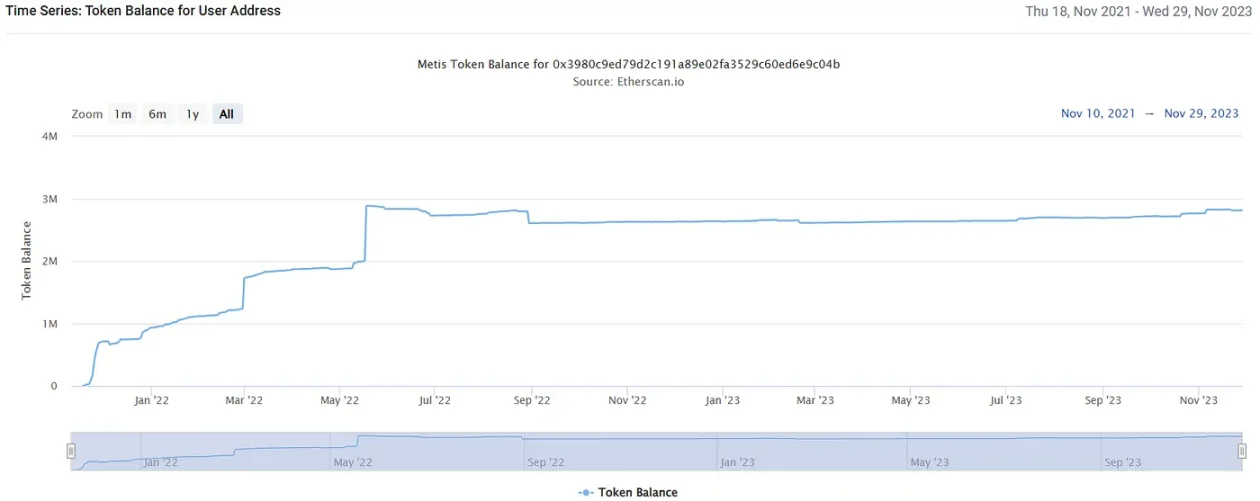
Looking at the supply on the Metis network, rapid growth occurred before June 2022, with two noticeable step-like increases likely corresponding to unlock events. The supply peaked at 2.88 million in May 2022. Over the past 18 months, it saw a slight decline, bottoming out at 2.61 million, before recovering recently to 2.81 million. Thus, the METIS supply on the mainnet has remained relatively stable.
Join TechFlow official community to stay tuned
Telegram:https://t.me/TechFlowDaily
X (Twitter):https://x.com/TechFlowPost
X (Twitter) EN:https://x.com/BlockFlow_News
 @riyuexiaochu