









Founder's firsthand account: Everything you want to know about Mint Cash
TechFlow Selected TechFlow Selected
Founder's firsthand account: Everything you want to know about Mint Cash
This article elaborates on Terra's underlying mechanism flaws, Mint Cash's operational mechanisms and unique architecture, as well as related token airdrop plans.
 Navigating Web3 tides with focused insights
Author: Shin Hyojin, Founder of Mint Cash
Translation: Frank, Foresight News
In fact, what happened to Terra and its stablecoin ecosystem is truly one of the most fascinating, dramatic, and painfully tragic stories in cryptocurrency history—second only to the collapse of FTX in terms of value lost.
While critics may tell investors involved in the Terra/LUNA crash that they participated in an elaborate Ponzi scheme meticulously orchestrated over the past three years, a closer look at how Terra began, what it once promised, and who was affected reveals that this is far from the truth.
This is the story of a stablecoin project that pursued a genuinely meaningful vision with the execution capability to make it work.
The Case for a "Decentralized" Stablecoin
We've heard countless stories of people exchanging their funds into UST and depositing them into Anchor Protocol instead of traditional bank accounts. This wasn't because they were crypto zealots blindly investing in leveraged trades, but because UST gave them access to banking infrastructure that many of us take for granted.
For example, families in Ukraine moved their life savings into Anchor deposits when their banks shut down during war; people in Venezuela, Argentina, and other Latin American countries held UST and deposited into Anchor because their governments wouldn’t allow free holding or conversion of USD to hedge against inflation; small communities in Sub-Saharan Africa held UST instead of USD to avoid foreign exchange controls during periods of inflation. Yet all were severely harmed after the UST collapse.
These are real stories shared via emails sent shortly after the UST crash to a former Anchor employee. Under similar crises, even more people were heavily impacted by FTX’s collapse because they believed their USDT held in spot accounts on FTX was safe—only to find out six months later that FTX had imploded.
Did they stop being so naive and pull all their money out of crypto? No, most actually shifted to holding USDT in Binance hot wallets or Binance Earn, desperately trying to hedge against inflation amid lacking stable financial infrastructure.
It's undeniable in the crypto industry that most liquidity stems from speculative demand—and this won't change anytime soon. Even we desire such speculative demand. Ironically, however, the use of UST on Anchor or USDT in exchange wallets became an unintended side effect of speculative activity.
Why did they choose USDT or UST instead of fully regulated alternatives? It’s well known that neither stablecoin has 1:1 fiat backing. For UST, the reason was relatively straightforward—20% yields offered these individuals a great opportunity to easily hedge against rampant inflation. For USDT, it was actually due to higher OTC liquidity, as Bitcoin liquidity is highly correlated with USDT.
"Unregulated" makes them popular among drug traffickers and criminals, but also allows people in regions underserved by financial infrastructure or under strict capital and foreign exchange controls to safely avoid domestic currency depreciation.
So do we—we believe in financial privacy and the right to free capital movement. Stablecoins not fully backed by “legitimate” assets are more likely to deliver these attributes, as demonstrated by USDT and UST. Holding Bitcoin directly is another popular choice, but in economies where dollarization has made significant progress, this may simply not be an option for many.
UST and Anchor had the chance to become a better alternative to USDT, since Anchor deposits didn’t require complex KYC login processes like exchanges—especially important for those who already rely on OTC trading anyway. For ordinary users, it was simple enough to serve as a substitute for exchange-based stablecoin savings products.
Yet, in one fatal crash of UST and Anchor, the world lost a potentially superior alternative to USDT. This is where our story begins.
Terra's Stabilization Mechanism: The Story So Far
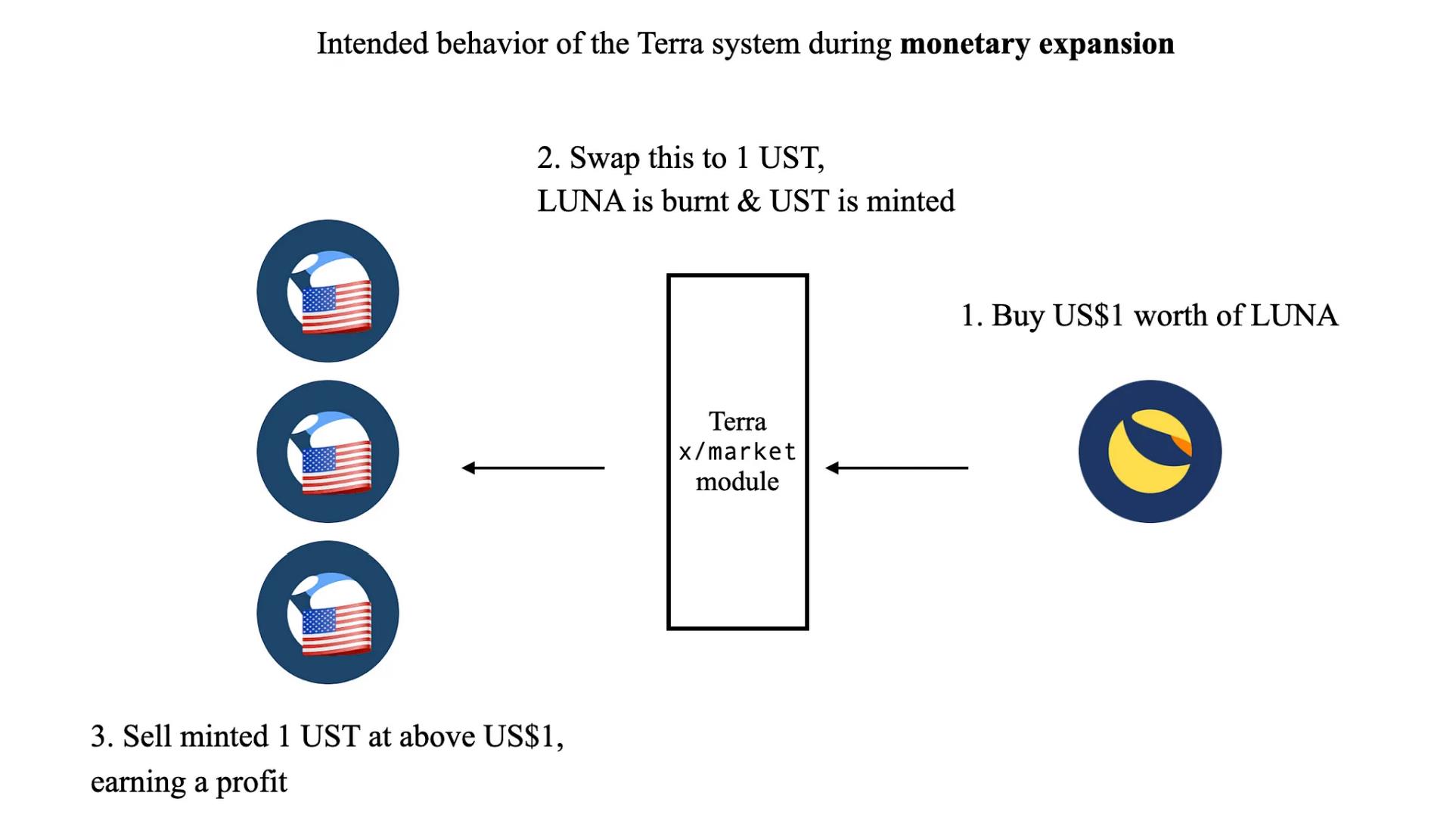
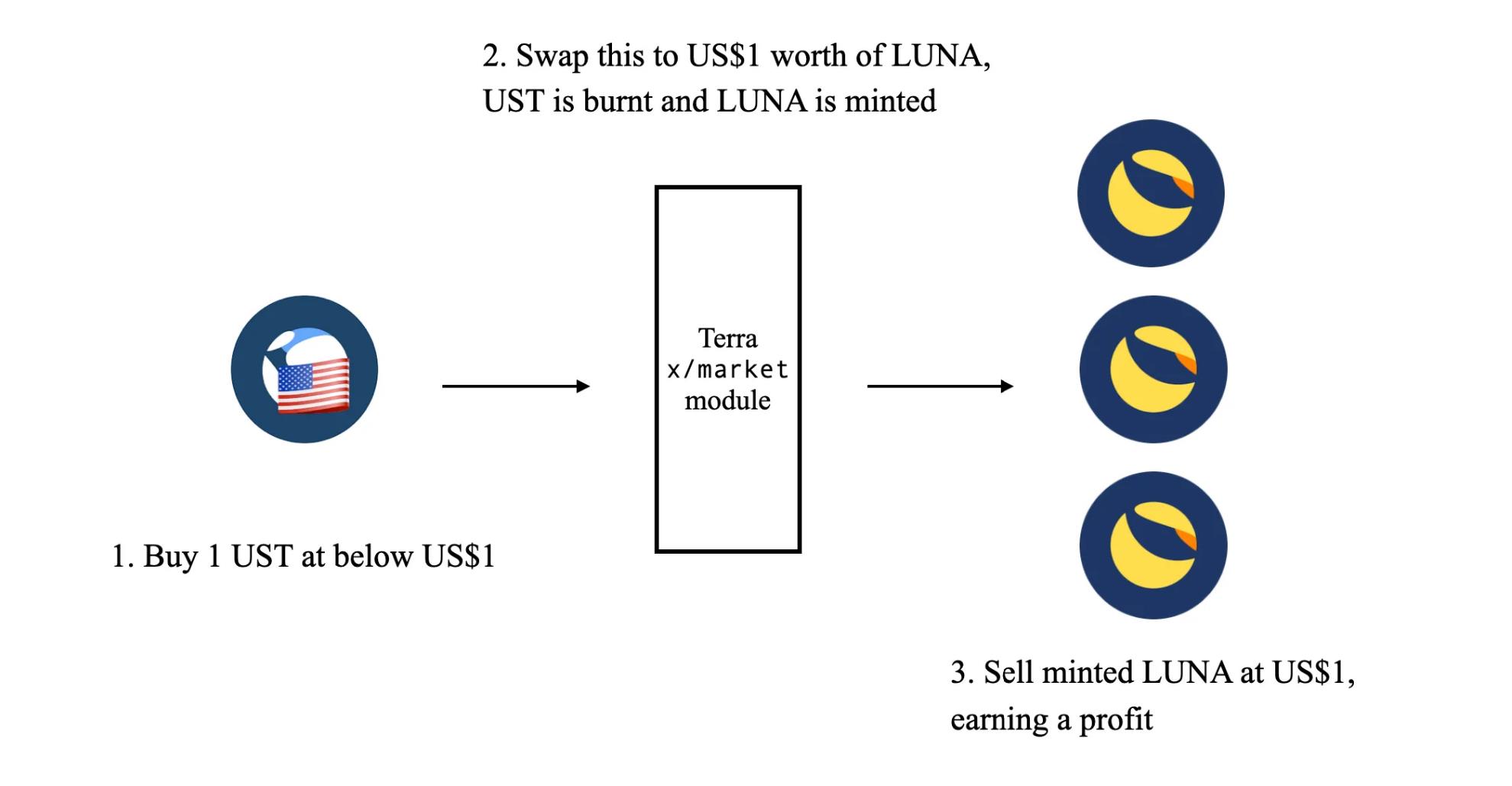
Before diving deeper, let’s briefly review how Terra worked. UST was an “algorithmic” stablecoin designed to maintain parity with $1 through an arbitrage-based mechanism allowing synthetic exchange between UST and LUNA.
The core idea behind Terra was enabling 1 UST to always be exchangeable for $1 worth of LUNA, with LUNA’s value provided by price oracles protected by Terra validators, and vice versa.
-
When 1 UST trades above $1, external arbitrageurs are incentivized to buy $1 worth of LUNA on the market, swap it into 1 UST via the protocol, then sell it at a premium;
-
When 1 UST trades below $1, external arbitrageurs are incentivized to buy 1 UST below $1, swap it into $1 worth of LUNA via the protocol, then sell the LUNA at $1 on the open market, profiting from the spread;
At least, that’s how it was supposed to work in theory—the rest is history.
So, what went wrong?
First, there are several lesser-known facts about how Terra minting (officially called the Terra Market Module) actually functioned—because the explanation above oversimplifies things and omits key details.
The Terra Market Module executed the aforementioned mint-and-burn mechanism based on two governance-defined parameters (BasePool and PoolRecoveryPeriod), first implemented in Columbus-2:
BasePool is a parameter defined in TerraSDR units, specifying the total virtual liquidity available for swaps on both sides during the number of blocks defined by PoolRecoveryPeriod;
PoolRecoveryPeriod is a parameter defined in Tendermint block counts, indicating how frequently BasePool should reset (replenish) back to its initial state;
Correctly setting these parameters within the Terra system was crucial, because if the virtual liquidity parameter wasn't set slightly below LUNA’s actual market liquidity (relative to fiat on exchanges), the entire system would quickly spiral into death.
Identifying the Fundamental Flaw in Terra's Stabilization Mechanism
Why is that? Let’s examine what happens without external market makers maintaining the peg, under the following scenarios:
Virtual Liquidity Significantly Less Than LUNA's Actual Market Liquidity
When external participants dump large amounts of LUNA on the market (far exceeding the liquidity defined by the on-chain market module), while UST simultaneously depegs downward, the system lacks sufficient virtual liquidity to keep up with the scale of LUNA trades happening off-chain.
This means so many external arbitrageurs jump in that the on-chain market module cannot burn enough UST in time to mint LUNA and restore UST’s value. The depeg becomes prolonged, trust in the system erodes, and more people begin dumping UST—over time, the crisis worsens until it loses all value, spiraling into collapse;
Theoretically, in this case, although loss of confidence may lead people to also dump their LUNA holdings, LUNA’s supply itself isn’t directly affected.
Virtual Liquidity Greater Than LUNA's Actual Market Liquidity
This means manipulating UST’s market cap below $1 is relatively easy given sufficient capital (due to low market liquidity). Even without attackers, a large number of users trying to exit the system could trigger this issue.
But this time, the on-chain market module can mint more LUNA than the external market can absorb. Due to this oversupply, LUNA’s value plummets rapidly. If this continues, LUNA will keep being minted until it loses all value—and as LUNA collapses, so does UST’s ability to support arbitrage against the market module, leading to a death spiral.
Simply put, buying LUNA on the market offers no arbitrage incentive because the on-chain change is smaller than actual off-chain buying pressure, resulting in infinite LUNA minting.
To prevent the second scenario, Terra’s original whitepaper defined a maximum cap on LUNA supply—which was quietly removed sometime between Columbus-3 and Columbus-4, leading to infinite LUNA minting during the Terra crisis. Even if they hadn’t removed the LUNA supply cap, when UST supply needed to contract beyond what the cap allowed, a death spiral similar to the first scenario would still occur.
Another change introduced shortly after the Columbus-4 upgrade redirected all UST/LUNA swap transactions on Terra Station frontend to Terraswap (and later Astroport), meaning UST-to-LUNA swaps on Terra Station would continue burning LUNA to mint more UST.
Although Terra Core’s actual functionality remained intact (manual interaction via Terra LCD still allowed native UST-to-LUNA swaps), end users effectively lost operational access to shrink UST’s value. Columbus-5 introduced another change to the market module allowing different liquidity limits for UST-to-LUNA vs. LUNA-to-UST swaps, though this was reverted shortly afterward.
Another critical yet widely unknown parameter of the Terra Market Module is oracle time delay. In 2019 alone, Terra suffered one oracle attack, prompting the team to deploy patches on the Terra oracle that largely mitigated oracle-based attacks—but at the cost of reduced resilience against depegging.
Initially, the Terra oracle simply fed the current spot price of LUNA to the on-chain market module. This enabled an attack—attackers artificially created massive bid-ask spreads for LUNA on South Korean exchange Coinone, allowing repeated on-chain swaps between TerraKRW (another Terra stablecoin pegged to KRW instead of USD) and LUNA, ultimately minting more LUNA than initially deposited, albeit with minimal funds.
The Terra team initially responded by temporarily deploying additional exchange liquidity to narrow the spread, then changed their oracle logic from spot price to a 15-minute moving average. This didn’t stop the same attacker from executing another attack using the same strategy, just stretched over a longer timeframe (due to the added 15-minute delay). The team responded again, changing the oracle logic to a 30-minute median-time moving average of on-chain spot data.
As noted in Medium articles and reports, this made sense at the time because LUNA’s exchange liquidity was very low.
However, this came with trade-offs: slower oracle feeds mean arbitrage opportunities between on-chain and off-chain markets become possible, which rapidly dilutes LUNA’s value.
Yet, Terra seemingly never deeply investigated this oracle trade-off problem until the collapse. The only adjustment made was tweaking the time delay between spot prices and on-chain oracles.
Higher LUNA market liquidity triggered other issues not addressed in any prior research by the company: implicit risks caused by oracle delays in high-volume, liquid markets. Typically, as markets become more liquid, volatility is assumed to decrease, since increasingly larger capital is required to move spot prices similarly. However, this isn’t always true—when markets turn turbulent in such environments, massive capital flows occur.
In such cases, oracle delays become fatal, as described earlier—arbitrageurs have ample room for capital outflows. Compounding the issue, DeFi’s UST liquidity was confined within StableSwap-like AMMs (such as Curve Finance), which didn’t exist in 2019. These curves are designed to maintain the peg as long as possible before collapsing suddenly.
As previously mentioned, due to Terra’s inherently delayed oracle, it simply didn’t have enough time to react in high-volatility, high-liquidity markets.
In summary, we believe that despite ongoing evolution of the Terra ecosystem, no further research was conducted in this area, with expectations that the Luna Foundation Guard (LFG) would take over by becoming another native module on the Terra blockchain, collateralizing Bitcoin. In this process, market makers were expected to assume responsibility for maintaining the UST peg without fundamentally altering the underlying mechanism—unfortunately, the now-familiar attack occurred before TFL and Jump Trading could fully implement the native LFG module plan.
Mint Cash: Continuing From Where We Left Off
Mint Cash continues the work previously done by the Terra stablecoin system, patching its mechanistic flaws and unlocking new use cases. It represents a major redesign involving numerous fundamental changes, making it much closer to an overcollateralized stablecoin like DAI than an algorithmic system like UST. Specifically:
-
All stablecoins are fully backed by Bitcoin collateral, partially inspired by Jump Trading’s original proposal for the Luna Foundation Guard (LFG);
-
An organic synthetic swap mechanism between Bitcoin collateral, Mint (equivalent to LUNA), and CASH (equivalent to UST);
-
Anchor transformed into part of the stablecoin leverage system, rather than a printing press;
The first challenge of this redesign is defining a market where Bitcoin collateral can be synthetically swapped for stablecoins and vice versa—similar to LUNA/UST. The Luna Foundation Guard (LFG) proposal suggested creating another market module with governance-set virtual liquidity parameters simulating Bitcoin liquidity—similar to the existing market module between UST and LUNA.
A problem with this approach is that there will be no market liquidity between our stablecoin and Bitcoin collateral at launch. When no market liquidity exists, it may be impossible to set synthetic market parameters due to lack of reference markets for calibration.
To mitigate this, we employ a novel type of trading curve that inherently generates trading liquidity on-demand. This serves as an initial market bootstrapping mechanism, as it can establish a market for any non-liquid asset as long as there is demand for swapping into liquid assets.
There is a trade-off here—the curve produces exponential implied volatility (i.e., exponentially increasing delta and linearly increasing gamma), so the goal is to gradually phase it out via a hybrid market combining on-demand liquidity with a synthetic market curve (similar to the original LFG proposal).
This process is entirely permissionless and requires no intervention from the project team. Anyone can 'exchange' Bitcoin for MINT or CASH. Perhaps most importantly, no new MINT or CASH can be minted without explicitly providing Bitcoin collateral. This also means free airdrops or private sales of either token are impossible under this redesign.
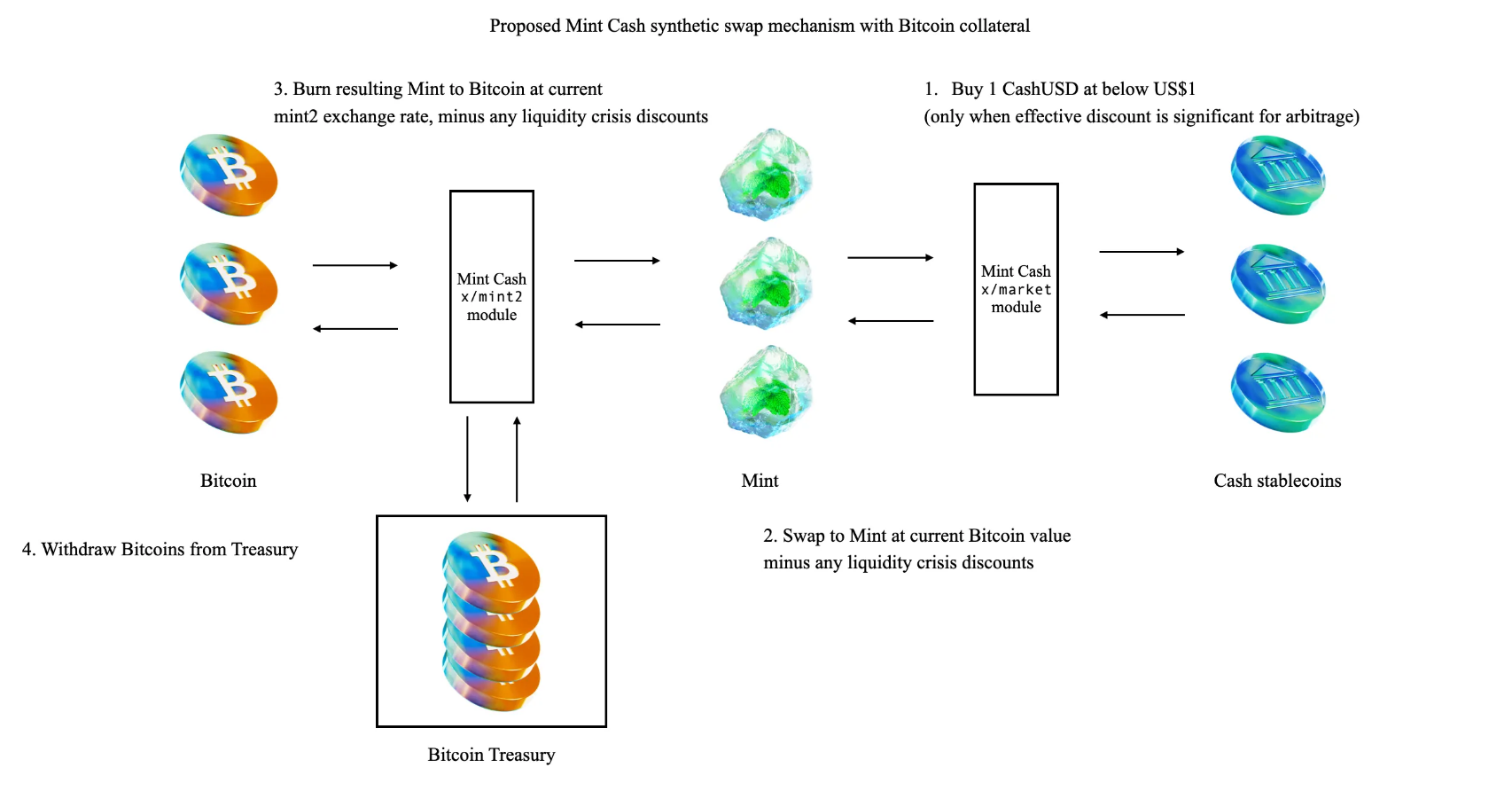
The value of MINT represents how much corresponding asset in the Mint Cash system is explicitly backed by Bitcoin. This also implies oracle attacks similar to those described earlier could still occur, but as an initial mitigation measure, Bitcoin’s value is used as the oracle reference, rather than directly sourcing MINT’s market value, which would likely lack liquidity initially.
This aims to alleviate some of the aforementioned oracle issues by introducing non-synthetic assets as collateral, creating linear correlation with oracle prices instead of exponential correlation.
In summary:
-
Anyone can mint MINT via the 'mint2' module by providing Bitcoin collateral;
-
Anyone can burn MINT to redeem Bitcoin, minus any taxes or liquidity discounts;
-
MINT can be freely exchanged for stablecoin CASH via the market module;
This sounds quite simple. Additionally, four further key mechanisms ensure price stability:
-
MINT staking module (bMINT), with unstaking subject to vesting periods;
-
Liquidation module;
-
Tax module (inherited from Terra’s original tax policy);
-
Anchor Sail itself;
MINT Staking: Better Overcollateralization, Powering PoS
One major issue with overcollateralized stablecoins like DAI is the lack of incentives for providing or withdrawing stablecoin supply. As Do Kwon pointed out in a previous Medium article:
DAI is Ethereum’s most widely used decentralized stablecoin, but suffers serious scalability issues due to mismatched supply and demand in its monetary policy.
DAI is supplied by users seeking leveraged exposure to ETH and ERC-20 assets;
Users wanting on-chain dollar-denominated value storage need DAI;
Problems arise when demand for stability exceeds demand for leverage on Ethereum assets. Recent widespread use of DAI across many DeFi protocols led to a surge in DAI demand (misaligned with leverage demand), causing DAI to trade at a significant premium to the dollar, forcing Maker Foundation to take emergency measures to restore the peg.
DAI’s scalability issues extend to all other stablecoins on Ethereum, whose minting costs exceed the face value of the minted asset. Money supply is constrained by the market’s willingness to bear excess capital costs (e.g., leverage demand), unrelated to stablecoin demand. In turn, obstacles in DAI’s monetary policy limit DeFi growth and adoption.
Objectively speaking, his critique of DAI is very reasonable. Overcollateralization must rely on borrowing positions, which are inherently leveraged long exposures. Clearly, people prefer seeking stablecoins over going long on ETH or other assets, creating supply-demand mismatches.
So how do we solve this while ensuring the system remains fully collateralized? Our answer is to integrate it with Proof-of-Stake (PoS) and liquid staking.
Staking means actively taking financial risk and committing long-term to network growth in exchange for steady transaction fees. This aligns perfectly with those willing to provide collateral for stablecoins—they too actively take financial risk and commit to stability while earning some of the system’s rewards.
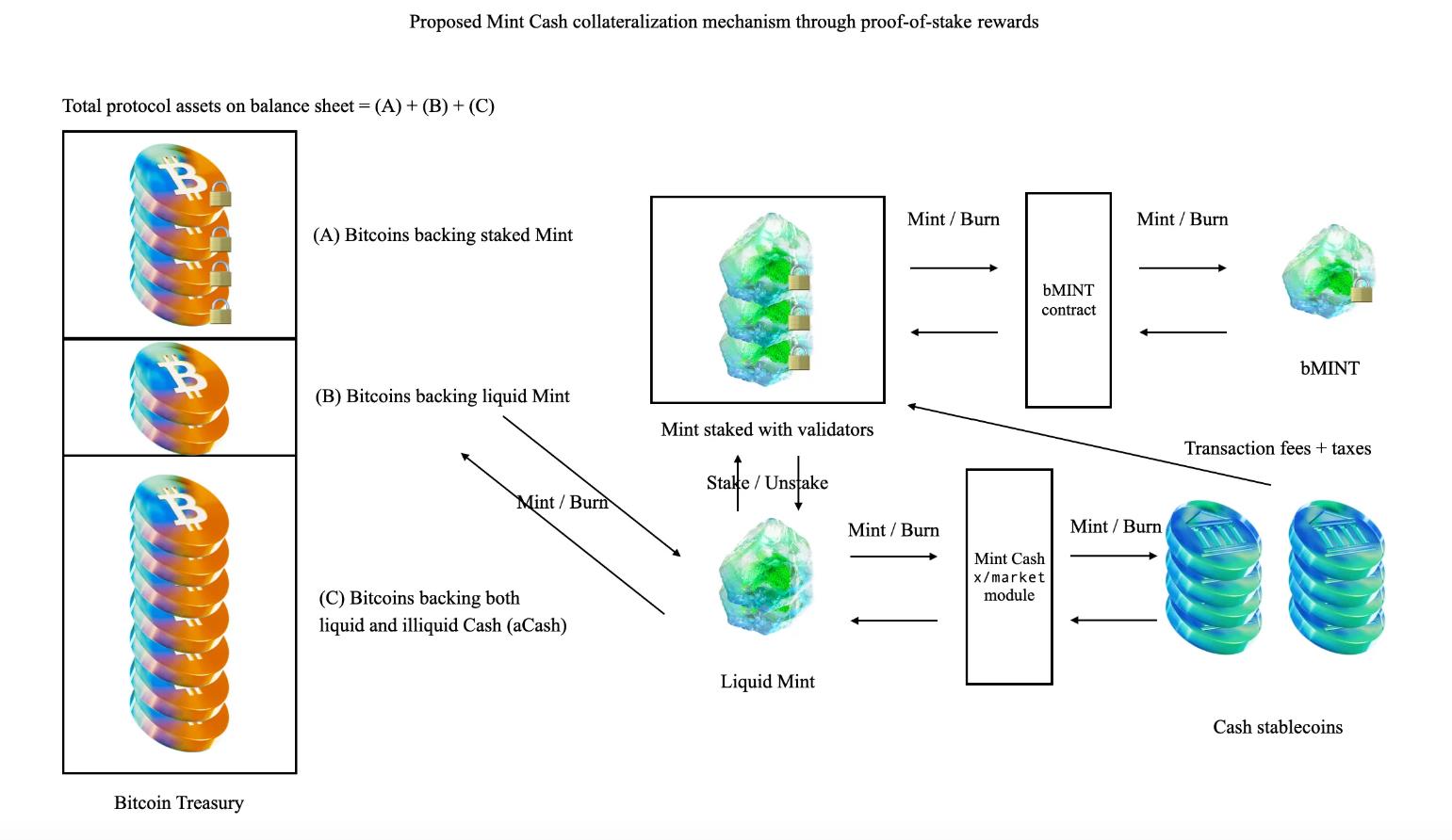
Users either delegate MINT to validators or mint bMINT (a liquid staking derivative of MINT), first bearing the risk of under-collateralization, while exclusively earning continuous transaction fees plus taxes levied on stablecoin CASH or Anchor interest.
This makes staking MINT slightly different from standard PoS blockchains. First, during protocol-triggered liquidations, MINT stakers are initially subject to average slashing across the validator set (without consequences typically associated with other security-related slashing events). The protocol also sets a global minimum staking ratio, used as a factor in determining whether protocol-wide forced liquidation is triggered.
Unstaking may also be subject to vesting periods, meaning MINT is released gradually over time rather than immediately.
Protocol-Level Collateral Liquidation
Another feature of the Mint Cash system is a protocol-level liquidation module, common in most synthetic asset protocols. Liquidation is triggered when the current value of staked MINT falls below the minimum minting collateralization ratio, calculated as follows:

A protocol-level parameter “LiquidationWeights” determines how much indirect loss staked MINT holders should bear relative to liquid MINT, to shoulder responsibility during monetary contraction. This is necessary because:
-
Higher liquidation weight on staked MINT collateral leads to significant bMINT depegging, which could also trigger liquidation of Anchor Protocol—potentially increasing the likelihood of a protocol run;
-
Lower liquidation weight on staked MINT collateral results in greater impact on the oracle price of MINT relative to Bitcoin;
Both MINT and CASH are accepted in liquidation auctions. Bids denominated in CASH take priority over bids in MINT. All received assets are immediately burned to bring the current MINT staking ratio above the minimum threshold.
Two additional fees apply during liquidation events:
-
Protocol liquidation fee: charged by the protocol to control capital outflows;
-
Liquidation premium: paid to liquidators as compensation for participating in protocol liquidation;
Cash Tax
Mint Cash directly inherits Terra’s monetary policy, which taxed transactions denominated in stablecoins in addition to standard transaction fees. There are two reasons for this:
-
No inflationary incentive risk: Unlike most PoS assets, inflation does not exist in the Mint Cash system, as all minted assets must be directly backed by Bitcoin. This is particularly important because MINT stakers also bear additional collateral risk compared to liquid MINT holders—requiring extra incentives;
-
Economic leverage for monetary contraction: Typically, higher tax rates correlate with monetary tightening, and vice versa—similar to interest rate factors. When monetary contraction is needed, adjustments to these monetary levers should be faster than standard governance proposals (if necessary). Since the Mint Cash system has a direct relationship between tax rates and interest rates, this is relatively trivial;
Anchor Rate as Part of Mint Cash Monetary Policy
Under modern economic theory, domestic interest rates play a key role in monetary policy and stability. Anchor’s 20% rate was crucial to Terra’s massive success—claiming to be “the base rate for all DeFi.” DAI has a similar concept called the DAI Savings Rate, which also incentivizes staked DAI holders to earn interest while contributing to protocol stability.
Notably, higher foreign interest rates are always associated with higher leverage costs (i.e., reduced domestic market liquidity), higher inflation rates (i.e., currency depreciation in foreign exchange markets), or both. Meanwhile, lower rates are generally believed to lead to net capital outflows.
With this in mind, we can establish a 'safety buffer rate' between the interest rate offered by an on-chain anchored currency and real-world rates, where the rate difference is sufficient to prevent mass capital flight without causing higher effective borrowing costs. This buffer rate can be funded by:
-
Yields from external liquid staking derivatives, including staked ETH, staked SOL, staked ATOM, etc.;
-
Any efficiency gains achieved by automating lending processes via smart contracts instead of banks, thus requiring smaller interest rate spreads;
As long as external LSTs (like Lido or EigenLayer) have sufficient risk hedging strategies or proven resilience against potential slashing events to maintain constant known rates relative to their underlying assets, such LSTs can also represent leveraged positions of the base unleveraged assets. Hedged positions can also combine multiple asset exposures to reduce risk while increasing return potential. This should help incentivize borrowing on the protocol, rather than relying solely on market makers or artificial token incentives.
As previously stated, stablecoin CASH deposited into Anchor is not taxed. However, its interest is automatically taxed, either burned or transferred to the treasury to reward MINT stakers. Since this corresponds to synthetic M1 supply, while base cash corresponds to M0, exporting CASH to other blockchains may focus on aCash (representing deposited cash) rather than base CASH, simplifying tax calculations.
Anchor Sail is our new version of Anchor, also featuring non-dollar-denominated deposits. This is enabled by a new synthetic FX lending module allowing users to borrow CASH into another stablecoin pegged to a currency they’re familiar with, such as CashEUR or CashKRW. Since CASH can be minted as long as Bitcoin has liquidity against the base currency, this greatly expands coverage for users wishing to continue using non-USD currencies—also one of the original Anchor’s primary functional requirements.
Why Not Build on Terra Classic?
A common question we’ve received from the Terra/LUNA Classic community is: why aren’t we building on Terra Classic to rebuild UST?
We need to start from a clean slate for several reasons:
-
Fundamental Redesign—In principle, Mint Cash is a fundamental redesign, though still built upon similar ideas, concepts, and blockchain code that once powered the old Terra stablecoin protocol. While we could fork Terra Classic and start from there, some damage caused by hyperinflation may be irreversible;
-
Unfixed Defects—One reason for this complete redesign is that the old Terra stablecoin protocol had fundamental flaws that remained unaddressed for years. Regardless, this requires a major rewrite of the core stablecoin protocol itself. Such work goes beyond the scope of a single team operating on an existing blockchain, requiring funding, support, and infrastructure levels from new companies and projects;
-
Centralized Infrastructure—Certain infrastructures like LCD (Light Client Daemon) and block explorers are slowly becoming independent of Terraform Labs thanks to efforts by the Terra Classic community. However, much of the Terra stablecoin protocol and its core DeFi components (like Anchor) were designed to be operated by centralized entities, not for fully decentralized ownership migration. This includes the WLUNA contract on Ethereum (originally designed as part of the now-retired Shuttle Bridge, integrated with Mirror, lacking proper design choices for decentralized asset migration on Ethereum), CosmWasm contract ownership for Anchor/Mirror and other TFL-built protocols, and operational infrastructure tied to these smart contracts (e.g., commands manually called by contract admins every epoch on Anchor);
-
Asset Distribution and Inflation Control—Following the collapse of the Terra stablecoin, severe inflation led to many entities unfavorable to ordinary LUNA holders acquiring large quantities of these now nearly worthless tokens. Asset distribution on the Terra blockchain was already highly centralized among TFL, VCs, exchanges, market makers, and large validators. Overall, fixing all these issues without a restart would be extremely difficult, as even a full-chain rewrite would leave these participants holding substantial supply;
Nevertheless, we sincerely wish to help the Terra Classic community recover, at least partially, from some of the devastating losses caused by the collapse of the Terra stablecoin system. That’s why we decided to introduce a 'Burndrop' program, rewarding only those interested in our new ecosystem, while those uninterested can still benefit from burned tokens and reduced supply.
Burndrop: A Token Distribution Plan for Burning USTC
The Burndrop program will distribute a basket of tokens to be delivered at Mint Cash launch. This will include the following two assets (with potential for additional tokens as the plan evolves, while we continue refining the final distribution framework):
-
oppaMINT (OPtion Per Annum MINT): a special call option token allowing holders to mint new bMINT at a steep discount (50%+) relative to the current spot price at exercise, with exact discount rates to be announced closer to launch;
-
ANC: governance token for Anchor Sail;
oppaMINT significantly lowers the entry barrier for previous and current Terra Classic token holders—the more USTC they burn, the more oppaMINT they receive. Once issued post-launch, these tokens can be freely transferred, so users can sell them anytime if unwanted.
oppaMINT will also be allocated to VCs for project funding, since no new MINT or CASH tokens can be minted in the Mint Cash system without explicitly provided Bitcoin collateral.
ANC resembles the previous ANC token, as stakers continuously receive buybacks funded by Anchor yields, while borrowers are compensated. The difference is:
ANC will directly govern certain aspects of native Mint Cash protocol governance, and MINT staking will always be subject to fixed vesting periods. While ANC tokenomics involve far more changes than described here, further details will also be revealed closer to launch.
Conclusion
We’ve covered many details in this article. In summary, we are building this with great seriousness and are committed to realizing the potential that the original Terra protocol aimed for but never saw come to fruition—including its diversified stablecoin system, liquid markets tied to Bitcoin, and all protocol building blocks accepting CashUSD stablecoins, including Anchor Sail itself.
Join TechFlow official community to stay tuned
Telegram:https://t.me/TechFlowDaily
X (Twitter):https://x.com/TechFlowPost
X (Twitter) EN:https://x.com/BlockFlow_News










