








Ethereum's innovator's dilemma: valuation and use cases have peaked, where will the ecosystem go without incentives?
TechFlow Selected TechFlow Selected
Ethereum's innovator's dilemma: valuation and use cases have peaked, where will the ecosystem go without incentives?
Successful companies often fail to adapt to paradigm shifts, especially in technological innovation.
 Navigating Web3 tides with focused insights
Author: JAY
Translation: TechFlow
Where is Ethereum headed?
In this article, I will explore modular blockchains, database design principles, and incorporate insights from GCR to answer that question.
Disclosure: I am currently long on Ethereum.
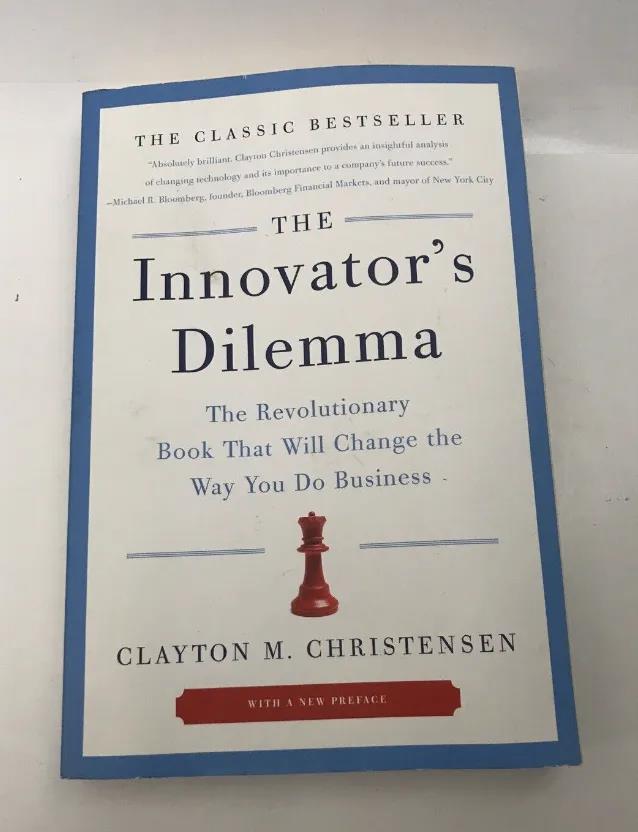
The core argument behind the innovator's dilemma can be summarized as:
“Successful companies often fail to adapt to paradigm shifts, especially in technological innovation. The reason lies in their focus and over-allocation of resources toward what made their products successful, rather than experimenting with novel, unfamiliar ideas.”
In the world of blockchains and smart contracts, we've made significant progress over the past few years. Now, the key question is: What is the future of Ethereum?
Through this article, I will argue that Ethereum has already peaked both 1) in valuation relative to all other crypto assets, and 2) in terms of usage and adoption.
I'll begin by exploring the concept of modular blockchains, comparing it with traditional database design principles, and then connect all of this back to Ethereum and its future.
Modular Blockchains
We now have a more principled way of thinking about what makes a well-functioning blockchain and how to logically decouple (and scale) its core components. This is at the heart of the monolithic vs. modular debate.
The core idea behind blockchain modularity is that there are four fundamental functions:
Execution
Determines the state after transactions. If I send tokens to a given wallet, the execution layer determines the relevant balances before and after the transaction.
Settlement
Determines whether submitted transactions are "valid." After sending tokens, if the balance becomes xyz—settlement verifies whether xyz is correct.
Consensus
Determines the final state after a sequence of transactions. This layer establishes 1) the correct order of a given set of transactions, and 2) what the final state is after processing them.
Data Availability (DA)
For any of the above functions to exist, there must be an initial state and a final state. DA provides the state to the execution layer and updates it based on consensus finality.
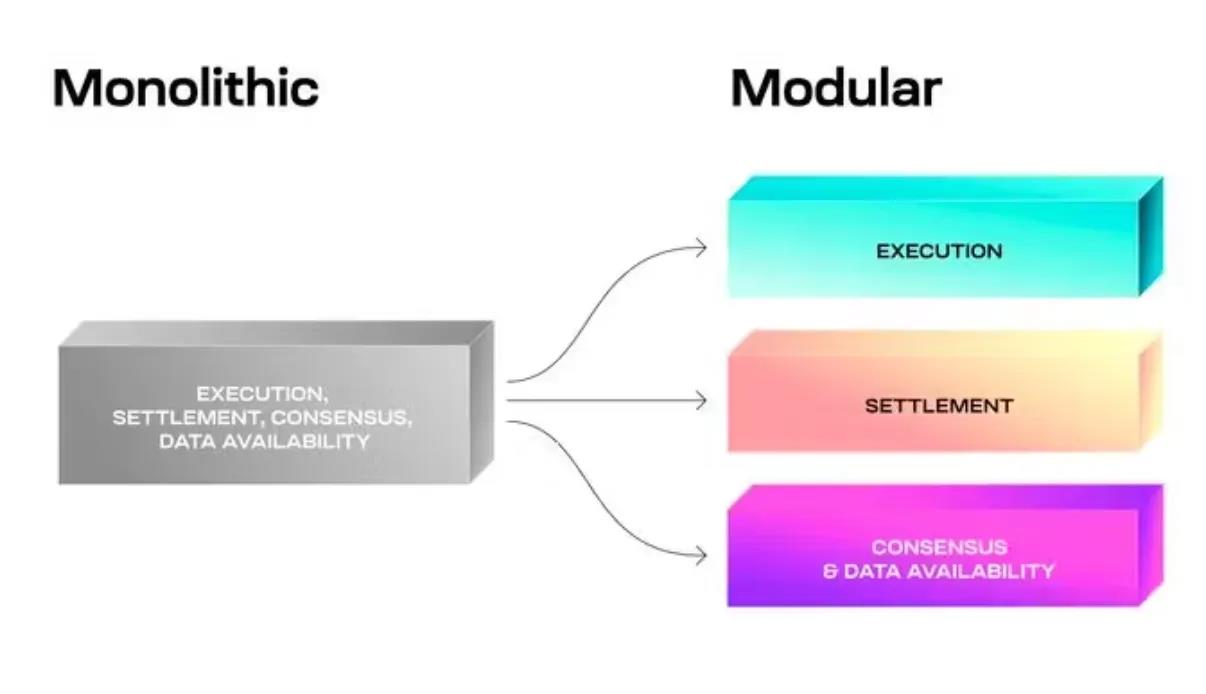
As with any engineering problem, the concept of a “perfect” blockchain only makes sense when tied to clearly defined use cases. This framework enables more specialized blockchain designs—a blockchain built for high-throughput gaming will have vastly different requirements than one intended to serve as a global, decentralized ledger.
This way of thinking reminds me of principles in database design, particularly the SQL vs. noSQL debate.
Database Design
Databases have existed decades longer than blockchains. When it comes to their design, the first thing experts will tell you is that there’s no such thing as a perfect database. Like most engineering problems, everything comes down to trade-offs.
The framework for building scalable databases starts with: “What is the use case?” Before making decisions, I typically ask myself several questions:
-
What is the approximate read-to-write ratio? On apps like Telegram or Slack, reads and writes occur at similar scales, while on Twitter, reads vastly outnumber writes;
-
In distributed systems, there’s the concept of consistency versus availability. In other words, do we care more about data inaccuracy or application downtime? It depends. For fintech applications, consistency (accurate data) is more important;
-
How critical is stale versus up-to-date data? How does this relate to read/write load? Does our database allow strategies to handle concurrent reads and writes? For example, my wife withdraws cash from the bank just as I swipe my debit card—how do we prevent the classic double-spend issue?
-
What are the read patterns like? Do you need flexibility in accessing data, or are queries usually predefined? Do you need extensive joins across datasets?
Beyond technical considerations, it’s also important to consider:
-
How many engineers are proficient in this technology? How many actually want to build with it?
-
If we want to fork the underlying code and customize it, is there active support available?
The Future of Ethereum
Now let’s tie it all together—there is no such thing as a perfect blockchain. Good engineering is about trade-offs, and one size does not fit all. So how did Ethereum become such a dominant platform? Why does its price act as if it were the perfect blockchain? And ultimately, where is Ethereum headed?
How Did Ethereum Become Such a "Dominant" Platform?
Four years ago, Ethereum was the go-to choice for building smart contract platforms. It had superior developer tools (relative to all others), such as Hardhat, CryptoZombies, etc. It also had a dedicated user base, and the chain and token were considered “decentralized.” At the time, centralized blockchains were more likely to be scams. ETH was also much cheaper, meaning lower gas fees.

Fast forward to today, developers have far more smart contract platforms to choose from, each with unique trade-offs. While fraud still exists, it has significantly decreased compared to four years ago, thanks to increased talent and capital entering the space.
The very reasons for Ethereum’s past success are becoming the sources of its future limitations. There was a time when Ethereum was the only viable smart contract platform for developers. Legitimate use cases (DeFi, NFTs) gave ETH a massive head start. But at this stage, the focus has shifted toward value accumulation and competing with Bitcoin as internet-native store of value (anti-Bitcoin).
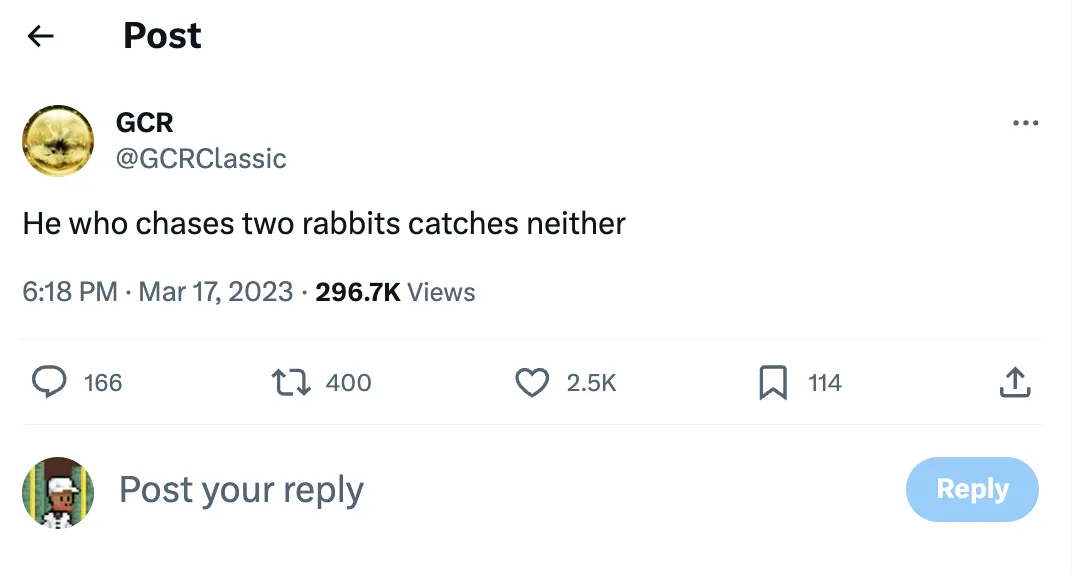
The desire to be both a smart contract platform and the decentralized “largest currency” creates significant friction for marginal users and developers (higher gas costs, congested network). As Confucius (and GCR) said: “The man who chases two rabbits catches neither.”
Where Is Ethereum Headed?
Users will go where applications exist and costs are reasonable. However, application developers tend to think more carefully and long-term about these issues, as they bear higher overheads compared to end users. Developers will build on platforms where their applications have room for long-term growth and scalability.
Now look at Ethereum—it processes 15 to 20 transactions per second on average, and gas fees frequently spike to $200. There are clear constraints on what kinds of applications can be built on Ethereum—only those requiring minimal interaction. For example, lending protocols work well on Ethereum because I might interact with them only a few times a year.
But if I’m an app developer wanting to build something aimed at scaling to 100,000 or 1 million users with higher usage frequency, building such an application on Ethereum is simply not feasible.
This becomes even clearer as viable alternatives continue emerging:
-
FriendTech is built on Base L2;
-
The Pacman and Blur teams are considering launching their own L2s;
-
DYDX uses its own application-specific chain.
The modular blockchain framework offers a set of selectable trade-offs. We’re now at a stage where blockchain infrastructures supporting various points along the trade-off curve are beginning to emerge.
Finally, it’s incentives, incentives, incentives.
As Charlie Munger always says, “Show me the incentive and I’ll show you the outcome.” Compared to other existing blockchains, Ethereum’s incentive structure is weaker. Venture capital firms and new L1 teams have strong interests in building robust, thriving ecosystems. As an investor, I’d ask: Why would I want my team to build on Ethereum when tokens are so diluted and the ecosystem is already so crowded? Why not promote application development on a blockchain where I have a vested interest and where the L1 valuation is much lower?
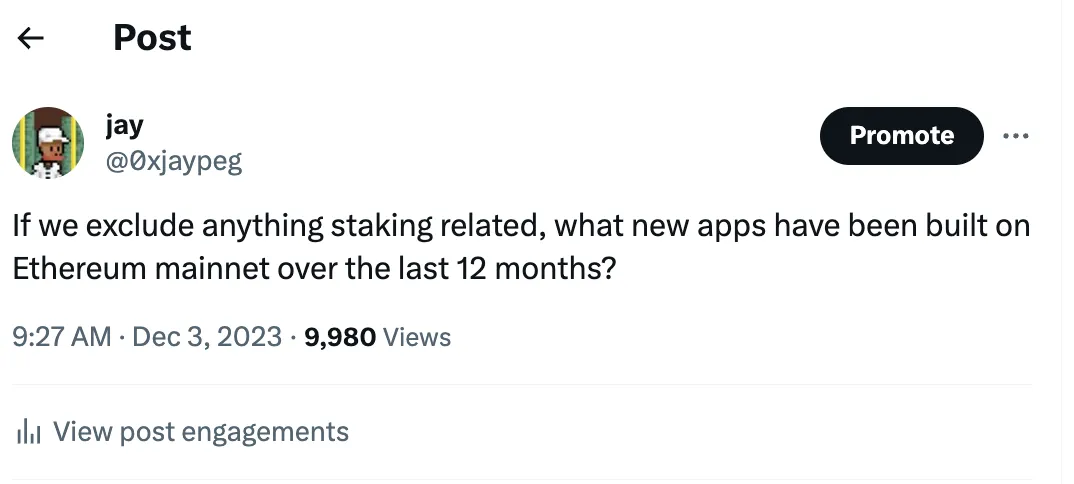
Ethereum is no longer on the efficient frontier of blockchain design. No matter where you want to sit on the trade-off curve, there are better smart contract platform options available, and the incentive structures are stacked against it. Unless there is a fundamental shift in how Ethereum operates as a community and organization, its dominance—both in valuation and usage—has already peaked.
Join TechFlow official community to stay tuned
Telegram:https://t.me/TechFlowDaily
X (Twitter):https://x.com/TechFlowPost
X (Twitter) EN:https://x.com/BlockFlow_News
 @0xjaypeg


