









Next Bull Market Highlights: Privacy-Focused Public Chain Narratives and Potential Projects
TechFlow Selected TechFlow Selected
Next Bull Market Highlights: Privacy-Focused Public Chain Narratives and Potential Projects
Does Web3 actually have any privacy-related application scenarios?
 Navigating Web3 tides with focused insights
Author: Fishery Isla, Core Contributor of Biteye
Editor: Crush, Core Contributor of Biteye
For Ethereum and the broader blockchain narrative, numerous excellent teams have already launched scaling solutions—and scaling is no longer the only challenge that needs to be addressed.
The next critical feature to achieve is privacy, which has recently become a hot focus for infrastructure-level investments in the primary market.
This article will introduce two popular technical approaches to privacy-focused blockchains—Zero-Knowledge Proofs (ZK) and Fully Homomorphic Encryption (FHE)—and highlight promising projects worth watching.
First, let’s address one fundamental question: Does Web3 actually have real use cases for privacy?
01 Why Does Web3 Need Privacy?
Most mainstream chains today are public ledgers, where all transactions occur on-chain. This means state changes related to assets tied to addresses or accounts are fully transparent and publicly visible.
Initially, transparency was merely an incidental feature designed to support consensus security. As the industry evolved, consensus mechanisms have become increasingly optimized and reliable, shifting the role of public ledgers toward enabling technical arbitrage:
Miners can selectively prioritize transactions based on fees, making low-fee transactions less likely to be processed—forcing users to increase their gas costs. More troubling is the risk of frontrunning and censorship attacks conducted by miners or block producers who monitor the public ledger.
By monitoring buy orders on-chain and inserting their own buy orders ahead of retail trades, attackers exploit significant security vulnerabilities. Over the past year, MEV (Maximal Extractable Value) has successfully extracted nearly $2 billion from the market.
Such massive and continuous capital outflows represent a major obstacle to the sustainable development of the crypto market.
Moreover, without privacy support, users lose ownership of their data. Asset holdings and transaction histories linked to addresses can be surveilled and exploited—directly contradicting the core vision of Web3.
Therefore, after resolving scalability issues, privacy-preserving smart contract platforms have emerged as the next urgent priority.
Currently, three main technical paths are being pursued to enable private smart contracts:
1) TEE (Trusted Execution Environment) solutions represented by already-launched but under-the-radar projects like Secret Network and Oasis Network;
2) zkVM approaches derived from Zero-Knowledge Proof (ZK) principles, popularized through Ethereum zk-rollups;
3) FHE (Fully Homomorphic Encryption), a newer approach only recently entering market awareness.
TEE technology is the most mature, with abundant documentation available. Interested readers can explore these projects firsthand. This article will therefore focus on the more topical zkVM and FHE approaches.
02 Zero-Knowledge Proof (ZKP)
zkEVM vs. zkVM
Most ZK solutions fall into two broad categories: those built atop Ethereum (zkEVMs), and custom-built systems (zkVMs), which may adopt different underlying trade-offs and foundational parameters.
A zkEVM is an Ethereum Virtual Machine-compatible, zero-knowledge-proof-friendly virtual machine that ensures correctness of programs, operations, inputs, and outputs.
Built on top of the Ethereum blockchain, zkEVM inherits both its strengths and weaknesses.
By optimizing compatibility with Ethereum, it benefits from Ethereum’s large user base and developer ecosystem—Solidity developers are plentiful, and shared infrastructure (including execution clients) lowers development barriers.
However, this also limits its ability to integrate zero-knowledge proofs and other privacy features within Ethereum's inherent constraints.
The closer a zkEVM model gets to full Ethereum emulation, the greater the performance cost—proof generation becomes significantly slower.
Since computation occurs on-chain, every transaction remains fully transparent. While beneficial for some applications, this lack of privacy is unreasonable or even unsafe for others—especially those involving sensitive personal financial data.
In contrast, a zkVM is a virtual machine designed specifically to leverage zero-knowledge proofs for secure and verifiable computation: you input the old state and program, and it reliably returns the new state. It optimizes the environment to make integrating ZK proofs into on-chain transactions cheaper, more efficient, and easier.
Essentially, a well-designed zkVM allows all its applications to easily incorporate zero-knowledge proofs into every transaction. True zkVMs are built with ZK-first principles, deeply integrating them throughout the entire tech stack.
Ethereum was originally designed as a fully transparent blockchain. Any attempt to retrofit privacy will inevitably underperform compared to blockchains designed with privacy from day one.
From an engineering perspective, this is challenging—developers must code programs not originally intended to run in such environments, leading to large, complex circuits.
Thus, zkVMs generally outperform zkEVMs and represent a highly promising technical direction worth early investment.
Several zkVM-based projects have already gained traction—such as L1s: Aleo, Mina; and L2: Aztec. These projects carry high market expectations, making early participation less cost-effective. Below, we introduce a more accessible zkVM project suitable for early positioning.
Ola Network
Ola is a scalable, privacy-preserving, and compliance-optimized ZKVM Rollup platform. Its key features include programmable privacy, scalability, and multi-language compatibility. Ola aims to serve as a universal Layer 2 scaling solution, adding privacy and scalability capabilities to various programmable Layer 1 blockchains.
Recently, Ola raised $3 million in seed funding led by Web3 Ventures and Foresight Ventures, with participation from Token Metrics Ventures, J17 Capital, Skyland Ventures, LD Capital, and CatcherVC.
Ola’s core products include the ZK-optimized virtual machine Ola-VM and the smart contract language Ola-lang.
Ola-lang is a general-purpose language built for ZK-VMs, offering higher programmability. Developers can use Ola-lang to flexibly deploy any type of smart contract—whether on public chains or enterprise private chains.
The ZK-optimized Ola-VM uses a reduced instruction set architecture, achieving superior performance through full ZK support and non-deterministic computing.
In short, Ola is building a Layer 2 infrastructure that combines optional privacy with full programmability.
It enables public chains to inherit network security while gaining privacy protection and performance scaling by simply deploying corresponding verification contracts.
This approach avoids sacrificing the programmability and decentralization of public chains. Developers can add privacy and scaling solutions to different public chains on demand—without requiring any on-chain modifications.
This offers customizable privacy and scalability while preserving the openness of public chains.
Currently, Ola has launched tasks via the Ola Gala campaign, offering participants access to the 2024 Ola Public Testnet and rewards such as NFTs.
Additionally, on November 10, Ola opened applications for its Devnet testnet. Developers are encouraged to apply—selected participants will receive rewards, technical support, developer resources, and opportunities to deploy DApps on the Ola mainnet.
03 Fully Homomorphic Encryption (FHE)
Fully Homomorphic Encryption (FHE) is a relatively new technology applied to blockchains. Following the peak of ZK hype, FHE has emerged as one of the most favored institutional-grade public chain solutions. As a nascent concept, there are few existing projects—all still in early stages, making them ideal candidates for early positioning.
FHE was first proposed decades ago as an open problem in cryptography. As early as 1978, Rivest, Adleman, and Dertouzos introduced the idea in the context of banking applications.
While traditional encryption focuses on securing stored data, homomorphic encryption uniquely emphasizes secure data processing.
Specifically, homomorphic encryption enables encrypted data to be processed without decryption. Other parties can perform computations on private data without accessing the original content. When the result is decrypted by the key holder, it yields exactly the correct processed output.
For example: Alice buys a gold bar and wants a worker to craft it into a necklace. Is there a way for the worker to process the gold without stealing any of it?
Alice could lock the gold bar in a sealed box accessible only by a single key. The box has two holes fitted with gloves, allowing the worker to manipulate the gold inside—but not remove any of it.
After crafting, Alice retrieves the box, unlocks it, and obtains the finished necklace.
Here, the box represents the FHE algorithm, and the worker’s actions correspond to homomorphic operations—processing encrypted data without ever accessing the plaintext.
Applications of Fully Homomorphic Encryption
In Web2, homomorphic encryption is almost tailor-made for cloud computing. Consider this scenario: a user wants to process data but lacks sufficient local computing power. They could offload computation to the cloud.
But sending raw data to the cloud risks exposure. Instead, the user encrypts the data using homomorphic encryption and sends the ciphertext to the cloud for direct processing, receiving back the encrypted result.
In this way, the user pays for computation and receives the correct outcome, while the cloud provider earns revenue. However, FHE faces computational limitations:
-
High computational cost: Compared to traditional encryption, FHE relies on more complex mathematical algorithms and larger ciphertexts, resulting in slower operations and higher resource consumption.
-
Low computational efficiency: FHE only supports arithmetic operations on encrypted data—addition, multiplication, and exponentiation. For more complex functions like sorting, searching, or string manipulation, additional transformations are required, increasing computational demands.
Fortunately, we live in an era of rapidly advancing computational power. As FHE integrates further with Web3 development, hardware performance and cost are expected to better align with FHE requirements. Now is thus an ideal time to position early in the FHE space.
Fhenix
Fhenix is the first blockchain to implement Fully Homomorphic Encryption, enabling EVM smart contracts to compute directly on encrypted data.

The fhEVM used by Fhenix was initially developed by Zama, a cryptography company building open-source encryption solutions for blockchain and AI, and later integrated with Fhenix Network through strategic collaboration.
Fhenix also adopts Arbitrum’s Nitro validator and Zama’s Rust-based TFHE library (tfhe-rs), underscoring the close relationship between Zama and Fhenix.
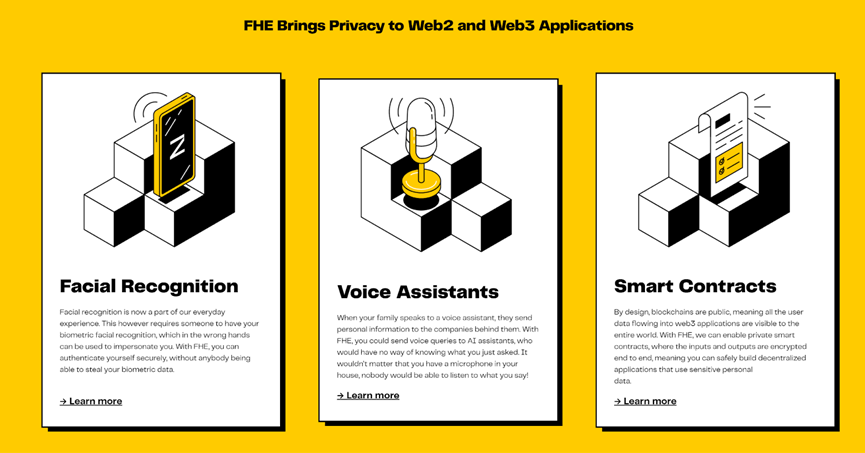
According to Zama’s official website, the company is developing FHE-powered Web3 solutions for cutting-edge Web2 use cases—including facial recognition, voice recognition, and smart contracts (the latter being Fhenix’s current focus). In the future, we can expect Zama to integrate these applications into the Fhenix ecosystem.
In September, Fhenix raised $7 million in seed funding led by Multicoin Capital and Collider Ventures, with participation from Node Capital, Bankless, HackVC, TaneLabs, Metaplanet, and Robot Ventures (led by Tarun Chitra and Robert Leshner).
Unlike ZK, which can only verify pre-encrypted data segments and cannot combine private data from multiple parties—thus limiting broader encrypted computation—FHE enables higher levels of data security and supports unprecedented use cases through its “fully” homomorphic nature.
Therefore, having privacy capabilities on Fhenix not only solves privacy concerns but also paves the way for hundreds of new applications—blind auctions, on-chain identity verification and KYC, tokenization of real-world assets, private DAO voting, and more.
04 Summary: ZK vs. FHE
After exploring these two cutting-edge privacy-preserving smart contract solutions, many readers may still confuse Zero-Knowledge Proofs (ZK) and Fully Homomorphic Encryption (FHE).
Beyond differences in encryption flexibility discussed earlier, the distinction lies in:
Technically speaking, ZK focuses on proving correctness while preserving the privacy of statements; FHE emphasizes performing computations without decryption, thereby protecting data privacy itself.
From an industry development standpoint, ZK-based projects have a head start—from early transfer-only ZCash to today’s smart contract-enabled zkVM blockchains—giving ZK deeper technical foundations in blockchain than FHE. FHE theory emerged much later than ZK and has long been an academic research hotspot. Only recently have Web3 projects using FHE begun raising funds, meaning its practical development lags behind ZK.
Yet both share a common dependency: computational power. The growth of the privacy sector has benefited greatly from the surge in computing capabilities. Thanks to recent advances in hardware, these once-theoretical technologies are now becoming practically accessible to users.
Join TechFlow official community to stay tuned
Telegram:https://t.me/TechFlowDaily
X (Twitter):https://x.com/TechFlowPost
X (Twitter) EN:https://x.com/BlockFlow_News
 @BiteyeCN









