








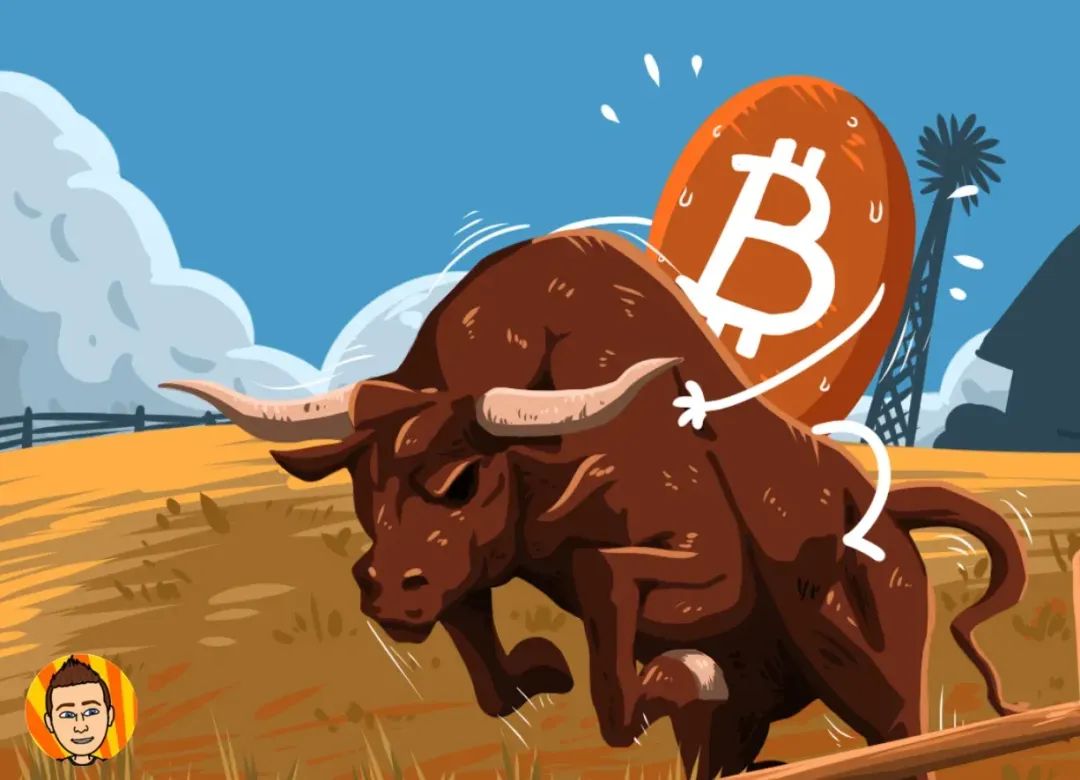
Bitcoin Rally Debate: Approaching $100,000?
TechFlow Selected TechFlow Selected
Bitcoin Rally Debate: Approaching $100,000?
1 BTC = 1 BTC, this is Bitcoin in the truest sense.
 Navigating Web3 tides with focused insights
Compiled by: Qin Jin
On December 4, BTC broke above $40,000. Most industry executives have called this the beginning of a new bull market. Some are even predicting BTC could reach a record high of $100,000 in 2024.
As of December 2023, BTC has gained over 120% this year, and many remain optimistic that this upward trend will continue into 2024.
Pascal Gauthier, CEO of Ledger, said in an interview with CNBC that 2023 overall felt like a year of preparation for a bull run, and expectations remain high for both 2024 and 2025.
In November 2021, BTC reached an all-time high of nearly $69,000.
Since then, the crypto industry has faced a series of setbacks—from the collapse of cryptocurrencies and crypto projects to bankruptcies and criminal trials. FTX, once one of the largest exchanges globally, collapsed, and its founder SBF was convicted on seven counts of criminal fraud and now faces over 100 years in prison.
Meanwhile, Binance CEO Changpeng Zhao admitted to criminal charges as part of a $4.3 billion settlement agreement with the U.S. Department of Justice and stepped down from his role as CEO.
Many in the industry believe that the resolution of these two major cases marks the end of long-standing issues that had plagued the crypto market.
David Marcus, CEO of Lightspark, said in a recent CNBC interview: "I think once we move past the speculative phase—where I believe we’re almost out of, though maybe not fully yet—you can allow real builders to focus on technology that solves real-world problems, rather than just having a massive digital casino for people to trade."
Marcus, former leader of Facebook’s failed stablecoin project Diem, is now focused on improving BTC’s technical capabilities as a payment network.
With these issues now largely resolved, investors are turning their attention to what they see as positive developments. First, there's growing excitement around the potential approval of a Bitcoin exchange-traded fund (ETF), which could attract more traditional investors who previously avoided crypto.
"I think ETFs really signify that Bitcoin is going mainstream—and that’s exactly what people have been waiting for," said Gauthier.
The second major catalyst is the Bitcoin halving, which occurs every four years, with the next one scheduled for May 2024. The halving cuts in half the reward miners receive for maintaining the Bitcoin network. This enforces Bitcoin’s hard supply cap—only 21 million BTC will ever exist—and has historically been a key driver behind new price rallies.
Vijay Ayyar, Vice President of International Markets at CoinDCX, said: “Some market participants expect a bull run following the halving, but given the momentum around ETFs, we might actually see a rally before the halving, leaving most investors in a wait-and-see position.”
Will Bitcoin hit $100,000?
There are also bold price predictions for Bitcoin in 2024.
First, Standard Chartered Bank recently reaffirmed its April forecast that BTC could reach $100,000 by the end of 2024, driven by multiple ETF approvals.
According to CoinDesk data, this would represent an increase of about 160% from last Friday’s price of $38,413.
Many analysts believe that loose monetary policy benefits Bitcoin, which is viewed as a risk asset. Others consider Bitcoin a “safe-haven” asset, where capital can be allocated during times of geopolitical tension.
When asked whether Bitcoin could reach $100,000 in 2024, Gauthier responded, “Maybe,” but declined to offer a specific price prediction. “What we’re seeing are strong fundamentals,” he said.
Vijay Ayyar noted that Bitcoin is currently “consolidating” below the “key level” of $38,000, which he sees as bullish. He said that once this level is broken, Bitcoin could rebound to between $45,000 and $48,000.
However, he warned that much of Bitcoin’s rally hinges on expectations of ETF approval, and if regulators reject the product again, the rally could fail.
“A full rejection of ETFs would severely disrupt this rally, so it’s important to keep an eye on that,” he said.
The Great Bitcoin Debate
@Joe Weisenthal, Co-host of Bloomberg Odd Lot podcast
Throughout human history, the evolution of money reflects our relentless pursuit of efficiency, trust, and value. From Yap stones to Bitcoin, each iteration of currency echoes the past while paving the way for a future of boundless potential. The journey of money is not merely an economic phenomenon—it is a philosophical odyssey, exploring the depths of human trust, the ingenuity of our systems, and our intrinsic desire to allocate and understand value.
Consider the Rai stones of Yap Island—massive and immovable, yet imbued with great value. These stones embody humanity’s profound ability to collectively assign value to something inherently worthless.
This concept resonates strongly in Bitcoin’s digital realm. Just as those ancient stones relied on social consensus to establish value, Bitcoin depends on digital consensus among its participants—a modern manifestation of an ancient understanding of value.
Evolve to cattle, a form of money with intrinsic utility. Here, the concept of value gains a tangible dimension—cattle were not only symbols but providers of food and labor. This idea of intrinsic value may seem distant from the digital world, yet finds parallels in Bitcoin. Though lacking physical form, Bitcoin’s mathematical scarcity and robust underlying technology evoke a similar sense of intrinsic worth.
In the smoke-filled corners of history, cigarettes became currency among prisoners of war, revealing money’s adaptability. Like those divisible, portable, and practical cigarettes, Bitcoin is a digital chameleon—capable of being subdivided infinitely, instantly traversing the globe, and adapting to diverse economic needs.
The birth of the euro tells a story of standardization and unification, bringing disparate economies under a single monetary umbrella. Bitcoin, with its borderless nature, echoes this unification on an unprecedented scale. It transcends national boundaries, creating a global financial language accessible to anyone, anywhere.
As we stand at the threshold of this new era of digital currency, Bitcoin is not just money or a technological marvel—it is a philosophical redefinition of money itself. It challenges us to rethink the nature of trust, the meaning of value, and the mechanisms of exchange. Bitcoin doesn’t just facilitate transactions; it redefines them, offering a glimpse into a future where money is not merely a medium of exchange but a catalyst for an interconnected, efficient world.
Within this grand evolutionary arc, Bitcoin is not merely the next step—it is a leap into a new realm of possibility. Philosophically, it mirrors our collective journey in understanding and valuing what matters. In the long river of monetary history—from Yap stones to Bitcoin—we find not just the story of money, but of humanity’s continuous evolution, endless innovation, and profound interconnectedness.
@Nayib Bukele, President of El Salvador
El Salvador’s Bitcoin investment is losing money!
After thousands of articles and comments mocking our so-called losses, all based on BTC’s market price at the time...
At today’s Bitcoin market price, if we sold our holdings, we wouldn’t just recover 100% of our investment—we’d make a profit of $3,620,277.13 (as of now).
Of course, we have no intention of selling—that was never our goal. We fully understand that prices will continue to fluctuate, but this does not affect our long-term strategy.
However, it’s important that critics and authors of those popular articles retract their statements. Responsible journalism demands they issue retractions, apologies, or at least acknowledge that El Salvador is now profitable—just as they repeatedly reported our losses.
If they claim to be real journalists, they should report this new reality with the same intensity they used to report the old narrative.
We’ll be watching… stay tuned!
@MacroScope, Institutional Trader
Last week, I flew from JFK Airport in New York to El Salvador. Here’s what happened during my trip.
Because of Bitcoin, I’ve been reading about this country and decided to visit. More on Bitcoin later. I also want to talk about security. First, here’s my takeaway:
If I were an investor looking internationally for on-the-ground opportunities, I would immediately set up an office in San Salvador and figure out how to put money into this country—either by starting a new business and hiring Salvadorans, or supporting existing enterprises. Multiple sectors—including tourism, hospitality, and real estate—are rapidly developing. The opportunities appear substantial.
I spent a week in San Salvador and El Zonte (“Bitcoin Beach”). The first impression at the airport is modern and efficient. My flight from New York was delayed, so I arrived several hours late. But my hotel driver was already there, patiently waiting with a sign bearing my name, smiling. That was my introduction to the country, and it reflected my entire experience. The people are friendly, hardworking, proud, entrepreneurial, and family-oriented.
You quickly notice ongoing construction and infrastructure upgrades everywhere. Impressively, construction workers appear highly diligent. You get the sense this is a nation moving forward, which explains why El Salvador’s fiscal situation has improved. The country’s sovereign bonds have recently delivered strong returns, and institutional investors should keep an eye on allocation opportunities here.
El Salvador’s goal seems to be a Latin American version of Singapore: business-friendly, growth-oriented, and tough on crime. Based on what I saw during my visit, this is achievable, and progress is being made. Remember, Singapore wasn’t always what it is today—in fact, far from it. It first needed the right policies and leadership. By the way, I don’t recall international media criticizing Singapore for its tough-on-crime approach.
On safety, I felt extremely safe and relaxed throughout my stay—safer than in even the best parts of New York City today. Police and private security are visible everywhere—professional, polite, alert, and firm. You wouldn’t want to be a criminal here. But it wasn’t always this way. I had an interesting conversation with a young man working in a small shop. He said that before the gang crackdown, most of his earnings went to criminals, making opening a store or doing business nearly pointless. I asked where the gang members are now. He replied: “Dead or in prison.” During this trip, I developed a particular disdain for people in North America and elsewhere who criticize other countries for clearing out crime while their own cities crumble around them.
If anything, President Bukele and his “New Ideas” policy are clearly vital to sustained progress. Bukele is immensely popular, seen by many as a national hero, so current advancements appear likely to continue after the upcoming elections. El Salvador’s continued stability and future prosperity are crucial to the United States, and as an American citizen, I believe we should do everything possible to be a strong ally and support the country’s current trajectory.
Regarding Bitcoin, it’s part of El Salvador’s “New Ideas” policy. During my visit, I realized news reports about the country’s gains or losses on BTC are absurd. Bitcoin has already paid for itself many times over. If the country hadn’t adopted Bitcoin, I wouldn’t have visited—and neither would many others. But Bitcoin’s benefits go beyond tourism. It’s part of a broader, holistic education in computers, technology, finance, personal growth, and independence. (I believe as Bitcoin becomes more widespread globally, this serves as a great case study.) Young people here are learning Bitcoin. In the coming years, they’ll gain knowledge and skills to land good jobs at companies or start tech-related businesses. Bukele’s decision to adopt Bitcoin may be one of the smartest socioeconomic moves any country has ever made, and it will continue delivering dividends in various ways for years to come. Other nations should learn from this and follow suit.
On youth and education, I visited the new National Library in San Salvador, which left a deep impression. Then I asked myself: In the U.S., do we still have the vision and determination to build such public facilities? I wonder.
I know this Twitter account has many readers working in finance, especially in New York. I encourage you to add El Salvador to your travel list. You’ll find the country’s economic development story fascinating (historically, it’s rare to witness such national transformation firsthand), and the authenticity offers a refreshing contrast to Wall Street and its favorite vacation spots. You can take a direct morning flight and be on a beach or near a volcano by afternoon. Understand this: it’s not the Bahamas or the Hamptons (guys, how many times can you go there?). It’s raw, organic, authentic—great food, coffee, surfing, and wild natural beauty. As for San Salvador, it’s vibrant—with upscale shopping and dining, big hotels, and greener, quieter accommodations.
This was my first trip to Latin America, and I don’t speak Spanish, but everyone smiled and was helpful. I tipped generously for drivers, waiters, and hotel staff—all expressed deep gratitude. If you go, do the same. Be a good tourist. They work hard.
As someone who remembers El Salvador’s headlines from 40 years ago, I never imagined I’d visit. Being here feels surreal. But what’s happening isn’t just national transformation—it’s a story of human perseverance and triumph over difficult history. We should cheer for them.
I look forward to returning.
@Brian Armstrong, Coinbase CEO
One idea I’ve been thinking about is that Bitcoin might be key to preserving Western civilization.
Whichever country holds the reserve currency naturally tends to inflate its money supply and increase deficit spending until it loses that privilege. Many have discussed this trend regarding the U.S., including Ray Dalio in “Principles 2.”
The RMB and euro have their own issues and aren’t currently viable alternatives, so the assumption is that the U.S. can keep inflating. But what many don’t consider is that people now have cryptocurrency as an alternative. They might start shifting fiat into crypto as a hedge against inflation.
Contrary to some assumptions, I don’t think this threatens the dollar or the U.S. Instead, I see it as a natural check and complement—one of the best defenses of America’s long-term interests and, more broadly, Western civilization. Shifting from dollars to crypto is better than shifting to another nation’s fiat. I also believe fiat and crypto will coexist long-term. They’re more complementary than substitutes. Dollar-backed stablecoins (like USDC or flat coins) will play a key role in bridging these two worlds.
I’m still thinking through this. Any other good perspectives?
@Gabor Gurbacs, Tether Strategic Advisor
One of the best things about El Salvador is that 1 BTC = 1 BTC—the real Bitcoin, because Bitcoin is legal tender alongside the dollar. So profits in dollar terms matter, but as the economy becomes more Bitcoinized, they matter less. Of course, few truly understand this.
Some like to say Bitcoin is an experiment. But the euro was launched just over 20 years ago, and the gold-unbacked dollar is about 50 years old. Modern major fiat currencies are relatively recent too. Only time will tell what proves enduring.
Join TechFlow official community to stay tuned
Telegram:https://t.me/TechFlowDaily
X (Twitter):https://x.com/TechFlowPost
X (Twitter) EN:https://x.com/BlockFlow_News










