








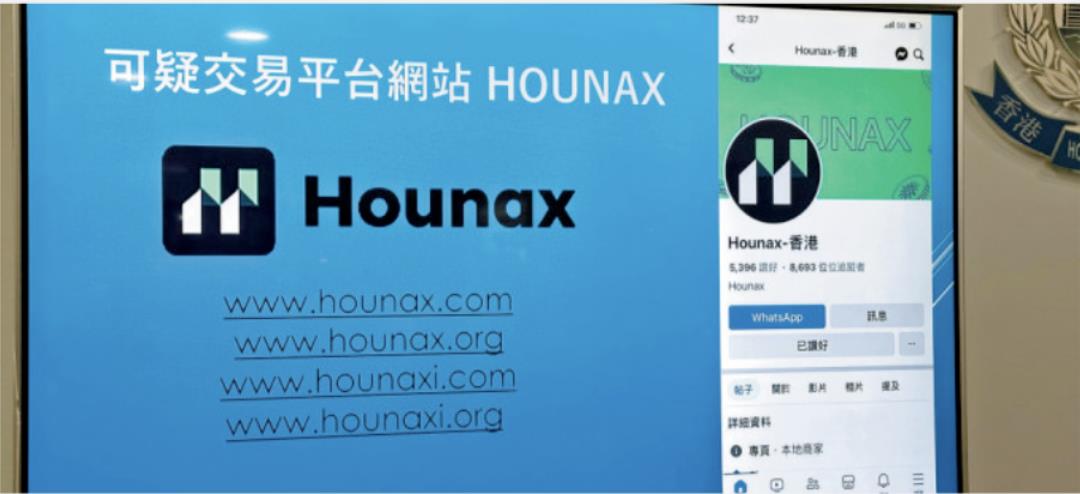
Three platforms newly added to SFC "blacklist"; HOUNAX involved in fraud and has fled
TechFlow Selected TechFlow Selected
Three platforms newly added to SFC "blacklist"; HOUNAX involved in fraud and has fled
About 158 Hong Kong investors were lured by unlicensed platform HOUNAX into investment, losing approximately HK$155 million.
 Navigating Web3 tides with focused insights
By Weilin
Following the JPEX investigation in September over false advertising and regulatory violations in Hong Kong, another virtual asset platform, HOUNAX, has been caught in a suspected fraud case. On November 29, Hong Kong police reported that 158 local investors were lured into investing through the unlicensed platform HOUNAX, suffering losses totaling approximately HK$155 million (CN¥137 million).
HOUNAX had attracted investors with promised returns as high as 40%, but starting in September this year, users began encountering withdrawal difficulties, eventually losing access entirely. On November 1, HOUNAX was added to the Securities and Futures Commission’s (SFC) warning list of “suspected virtual asset trading platforms,” which aims to alert investors to potential risks.
After launching investigations, the SFC reiterated its stance on investor protection, stating it would swiftly implement enforcement actions, public information dissemination, and investor education initiatives.
Meanwhile, the SFC is accelerating its review of applications for Virtual Asset Service Provider (VASP) licenses. Currently, eight platforms or companies—including OKX—have been included in the SFC’s “Virtual Asset Trading Platform Applicant List,” which publicly discloses entities applying for VASP licenses.
HOUNAX Scam Leaves 158 Investors Losing HK$155 Million
The number of victims affected by the HOUNAX scam has increased between two disclosures from Hong Kong police.
On November 27, police reported 131 victims with losses exceeding HK$110 million. By the second update on November 29, the number of victims had risen to 158, with total losses reaching HK$155 million. According to the SFC, known victims range in age from 19 to 78 years old, with individual losses ranging from HK$12,000 to over HK$10 million. One 69-year-old retired woman lost HK$12 million, making her the single largest individual victim in the case.
Investigations revealed that so-called investment managers from HOUNAX used WhatsApp groups to lure users. The platform advertised up to 40% returns on crypto investments, but when users attempted withdrawals, they were either denied or charged exorbitant verification fees—up to 80%—before ultimately being blocked completely, with the platform itself becoming inaccessible.
On November 27, Julia Leung, CEO of the SFC, stated that the commission first received complaints about HOUNAX at the end of September, with complaint volumes steadily increasing throughout October.
On November 1, HOUNAX was officially listed on the SFC's “suspected virtual asset trading platforms” list, with a note stating: "The company claims to be a cryptocurrency trading platform collaborating with a financial institution and a venture capital firm, which is untrue. It appears to target Hong Kong investors, pre-filling the +852 country code on its login page and on social media channels such as 'Hounax Hong Kong' on Facebook, X (formerly Twitter), and YouTube."
In promotional materials still available online, HOUNAX claimed it was “co-founded by industry leaders and former Coinbase technical team members, registered in Melbourne, Australia, with operational branches in Singapore, Australia, and other countries, holding MSB compliance licenses in the U.S. and Canada.” Given current findings, these claims are clearly fraudulent.
The SFC said it began investigating after receiving complaints and shared intelligence with law enforcement. Hong Kong police noted that in the aftermath, HOUNAX’s supposed investment managers or customer service representatives vanished without a trace, victims were removed from chat groups, and the platform disappeared entirely.
Following the HOUNAX incident, the SFC reaffirmed its zero-tolerance policy toward unauthorized virtual asset platforms and pledged swift action to protect investors through enforcement, public alerts, and education. Due to the severity of the case, on November 28, Hong Kong Chief Executive John Lee responded, emphasizing the importance of government regulation in safeguarding investor interests and cracking down on unlicensed platforms.
Nine Platforms Added to SFC’s “Blacklist” Within Two Years
Since the JPEX collapse earlier this year, the SFC has urged virtual asset investors to consult its published list of “suspected virtual asset trading platforms” to better understand associated risks.
JPEX was first added to the list on July 8 last year. In September this year, the SFC accused the platform of falsely claiming regulatory compliance and illegally serving Hong Kong investors. After police launched an investigation, more than 66 individuals were arrested, including several well-known local “crypto KOLs” and offline OTC dealers.
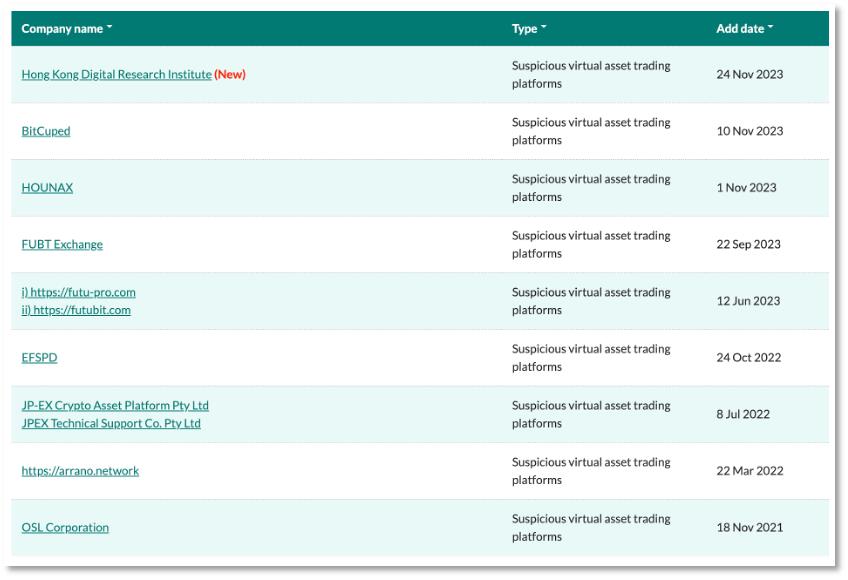
SFC publicly lists nine suspicious virtual asset trading platforms
Currently, there are nine platforms on the SFC’s warning list of suspected virtual asset trading platforms, registered between November 2021 and November 2023. So far this year, five platforms have been added, three of them in November—including HOUNAX, now under investigation for fraud.
On September 22, another name familiar to Chinese-speaking crypto communities—“FUBT Exchange”—was also added to the SFC blacklist, with a note stating: “The company claims to be a cryptocurrency trading platform and provides a fake Hong Kong phone number, asserting it operates in Hong Kong.”
Currently, FUBT’s domain with the “.hk” suffix is inaccessible. However, on third-party crypto data platform CoinGecko, FUBT is listed as “a centralized cryptocurrency exchange founded in 2017 and registered in Hong Kong.”
According to CoinGecko, the exchange currently lists four cryptocurrencies and five trading pairs, with zero USD in 24-hour trading volume and no change over the past day. “Reserve data for FUBT cannot currently be obtained.”
Eight Platforms Enter VATP Applicant List
In addition to the one “blacklist” of suspected platforms, the SFC maintains four official lists: licensed virtual asset trading platforms, applicants for virtual asset trading platform licenses, rejected/withdrawn application records, and closed virtual asset trading platforms.
Currently, the SFC uses this “4+1” list system to enhance transparency and provide investor warnings in the virtual asset market. Only OSL and HashKey are officially recognized as “licensed virtual asset trading platforms,” meaning they have received formal licensing from the SFC. The SFC cautions, however, that inclusion on any list does not guarantee the performance or reputation of these platforms.
The “Virtual Asset Trading Platform Applicant List” currently includes eight platforms: OKX, BGE, HKbitEX, HKVAX, VDX, Meex, PantherTrade, and VAEX. The SFC states that the purpose of this list is to allow the public to verify whether a platform has applied for an SFC license, helping identify potentially false or misleading claims made by operators.
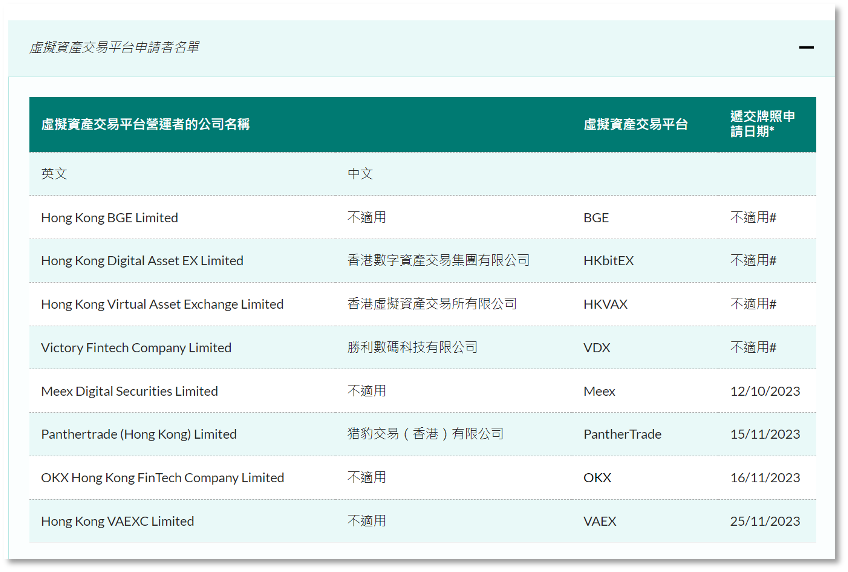
SFC website shows eight platforms have submitted VASP applications
The SFC notes at the top of the applicant list that these are entities whose license applications have not yet been approved. This means all listed applicants are neither authorized nor regulated by the SFC and may not meet regulatory requirements—they remain under review.
Among the applicants, besides OKX, several have backing from Hong Kong-based parent companies. For example, VDX is backed by Victory Securities, the first locally based Hong Kong brokerage to receive a virtual asset license. Additionally, PantherTrade—a crypto exchange established in Hong Kong by Futu Holdings’ subsidiary Cheetah Trade—is also on the list.
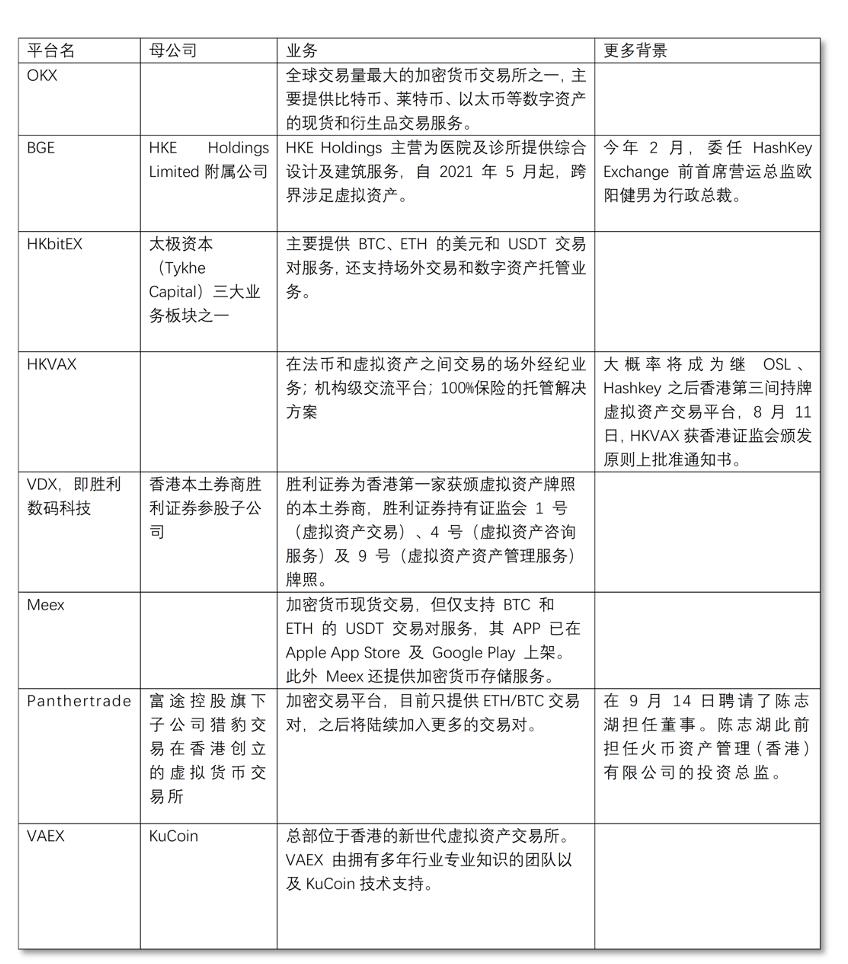
Information on the eight platforms in the applicant list
Compared to others, OKX is more widely recognized among Chinese-speaking users and is more deeply rooted in the crypto ecosystem. To strengthen its Hong Kong presence, the exchange established a local subsidiary in March and assembled a dedicated compliance team of over 20 professionals, many recruited from the SFC, SEC, international law firms, or licensed financial institutions.
To pursue full compliance and licensing, OKX has restructured its operations—including aligning its architecture with SFO MIC standards, revising its token listing process, enhancing market surveillance, and implementing Proof of Reserves. Moreover, ZA Bank, Hong Kong’s first virtual bank, announced it has opened an operating account for “OKX Hong Kong” and will provide basic commercial banking services to support its daily financial operations.
Rejection and Closure Lists Still Empty
The VATP applicant list represents part of the SFC’s push for greater transparency in regulating virtual asset platforms. After the JPEX collapse, the SFC pledged to increase openness by disclosing information on VASP license applications.
On June 1 this year, Hong Kong formally implemented a licensing regime for virtual asset service providers (VASPs), requiring all platforms operating in Hong Kong to obtain a license. A one-year transitional period for compliance began on June 1.
During this year, qualifying platforms will be granted licenses by the SFC, while non-compliant ones must cease operations and exit the Hong Kong market—this is reflected in the other two SFC lists.
Currently, both the “List of Applicants Whose License Applications Were Rejected, Withdrawn, or Returned” and the “List of Closed Virtual Asset Trading Platforms” remain empty. However, as the VASP licensing and review process progresses, these lists are expected to gradually fill.
Under the new VASP regime, license applicants face stringent requirements.
Applicants must establish a legally incorporated entity in Hong Kong, with a minimum registered capital of HK$5 million and liquid capital exceeding HK$3 million. Additionally, they must hold a Trust or Corporate Service Provider (TCSP) license in Hong Kong to conduct custodial services for virtual assets.
For personnel, VASP applicants must pass the SFC’s Fit and Proper Test. Beyond corporate and staffing qualifications, platforms must meet comprehensive compliance obligations, including proper asset custody, Know-Your-Customer (KYC) procedures, anti-money laundering (AML)/counter-terrorism financing measures, market manipulation prevention, accounting and auditing standards, conflict-of-interest management, and cybersecurity protocols.
Although well-known platforms popular among Chinese-speaking users—including OKX, BitMEX, Huobi, and Gate—as well as traditional institutions like Greenland Financial, have publicly expressed intentions to apply for Hong Kong licenses, only eight platforms—including OKX and VAEX—have so far made it onto the applicant list, highlighting just how difficult it is to obtain a VASP license.
According to estimates from an industry insider, the entire VASP licensing process could cost up to HK$60 million. This means that any crypto platform aiming for compliance in Hong Kong must prepare for a long and costly journey.
Even during the application phase, the SFC and Hong Kong police have already taken public enforcement actions twice against platforms涉嫌 false advertising and fraud in Hong Kong, aiming to clean up the market before formal licensing begins. Winnie Wong, Director of Licensing and Head of FinTech at the SFC’s Intermediaries Division, stated publicly that even after the one-year grace period ends, scams cannot be completely prevented—the root cause lies not in the grace period itself.
Join TechFlow official community to stay tuned
Telegram:https://t.me/TechFlowDaily
X (Twitter):https://x.com/TechFlowPost
X (Twitter) EN:https://x.com/BlockFlow_News










