








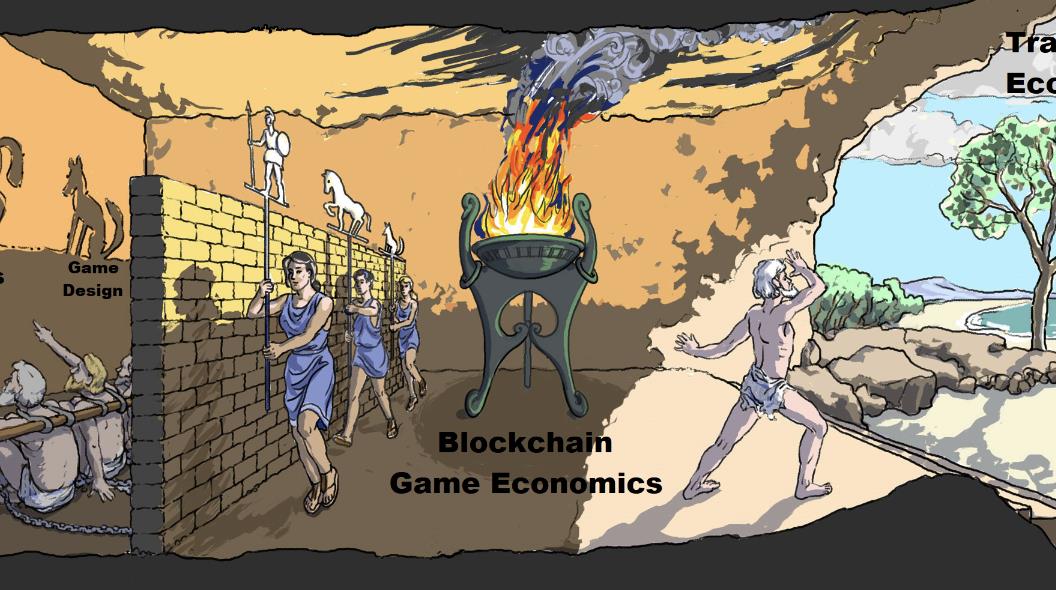
How to improve the current and future blockchain-based economy?
TechFlow Selected TechFlow Selected
How to improve the current and future blockchain-based economy?
Traditional gaming economies face challenges such as inflation, stagflation, and player migration, while open blockchain economies need to address these issues.
 Navigating Web3 tides with focused insights
Author: 0xHeimdall
Translation: Baicai Blockchain
Over the past few years, we've seen many blockchain games come and go. Most of those that survive face shrinking player bases and declining floor prices, with value continuously leaking out—seemingly without end.
Why is this happening?
Even the most economically complex traditional multiplayer game genres struggle with currency valuation and population growth. EVE Online is one such example, featuring a player-driven economy and high realism. Yet despite strong economic design, it still faces challenges like stagflation and declining player counts.
Other games have experienced economic problems too, such as the rampant inflation in Diablo III. Its economy failed to account for the impact of real-money auction houses, leading to severe devaluation of in-game gold.
Traditional game economies face challenges including inflation, stagflation, and player migration—issues that open blockchain economies must resolve. This series will explore how to improve blockchain-based economies, particularly by integrating traditional economic frameworks. It's a complex topic, but through discussion and reflection, we can gradually refine this framework.
I. Reasoning
1. Blockchain Economies Are Not Game Economies
Traditional game design does not consider external markets or players’ broader opportunity costs. In blockchain economies, your game assets must compete not only against other games but also against a growing number of emerging competitors.
Every player asks: Why should I hold your currency? “Anyone can create money—the key is why someone would choose yours.”
Nowadays, anyone can easily deploy token contracts, and many blockchain games want to tokenize their in-game currencies. Some believe that simply making the game “fun” will sustain ecosystem value—but this isn't easy. Fun is essential when developing a game; even if you build a sustainable economy, players must still enjoy playing it.
In the blockchain space, your game needs both fun and sound economic structure. Only then can you maintain player interest without losing value. Leverage player feedback during development to ensure engagement and continued support.
But let’s move forward. Given current technological progress and our environment, I propose a slight update:
Everyone can create money—the key is making it competitive.
Currency Competition
A blockchain game’s currency should possess five competitive attributes: value stability, deep liquidity, transparent distribution, broad acceptance, and high velocity.
Value stability means the currency maintains relatively stable value within a range recognized by users. Deep liquidity allows large transactions without causing price volatility. Transparent distribution requires public and fair issuance mechanisms. Broad acceptance means others are willing to accept the currency as payment. High velocity reflects frequent circulation within the ecosystem.
Most existing game tokens are “appreciation-type,” more akin to stocks than competitive currencies. These tokens exhibit volatility incompatible with automated market maker (AMM) liquidity models, have opaque distributions, and limited acceptance—potentially undermining the game’s potential. In the blockchain world, users may quickly lose confidence in a currency and convert it into more stable alternatives.
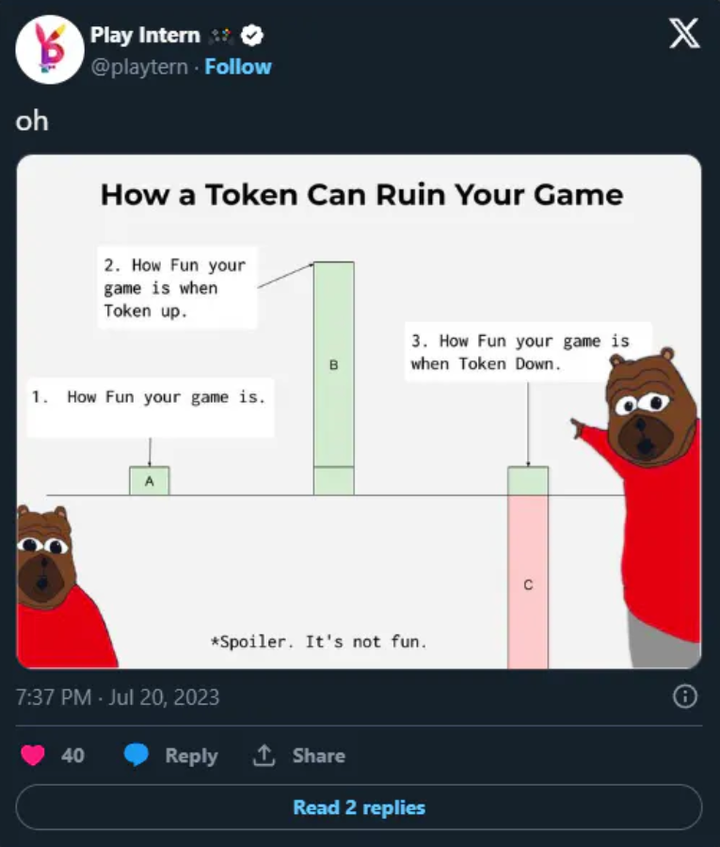
Currency collapse in games can stem from multiple factors, including speculation, value extraction, and developer neglect of open economies. Effective currencies must fulfill fundamental needs—or risk losing their store-of-value function.
2. Is Your Game Targeting Developing Countries?
In Edward Castronova’s paper, he examines the virtual society in EverQuest, comparing it to real-world economies. This virtual world exhibits unique economic characteristics—different from reality yet strikingly similar in some aspects.
We analyze factors like exchange rate volatility, foreign reserves, property rights, governance, institutions, and economic mobility. The article focuses on the importance, barriers, and solutions for reducing currency volatility, and explores the concept of foreign reserves and their role in economic architecture.
Future articles will delve into meaningful digital property rights, the critical role of governance in economics, building institutions for sustainability, and designing economic mobility for eternal games.

3. Money Is Not Magic
Money isn’t magic—and neither is the value it represents. This fact seems lost in translation within the crypto space, where too many Dogecoins and Pepecoins reach multi-million dollar valuations purely through speculation. Real value doesn’t emerge from nothing and get arbitrarily coated with lucky tokens; it must be carefully designed and nurtured.
Currency Volatility
Currency volatility is common in crypto ecosystems—almost inherent to the technology. People often hardcode token supply caps to ensure digital scarcity and encourage speculation. However, such artificial scarcity can make assets ill-equipped to handle market fluctuations. Fixed supplies do protect against privileged entities arbitrarily creating money, but this design isn’t ideal for assets meant as mediums of exchange. For tokens, an elastic supply model might be optimal—one that maintains relative stability to enable efficient transactions.
Adjusting money supply is no simple task—many multiplayer games and virtual worlds have learned this the hard way. To combat inflation, developers have experimented with various methods to guide player spending and resource usage. But in open markets, players compare gameplay time to monetary value, optimizing behavior for higher efficiency or liquidity rather than the utility intended by developers.
This behavior can lead to automation or mass farming activities, accelerating inflation and worsening the problem. Third-party gold sellers exploit demand for in-game assets, causing severe currency devaluation. Better-designed sinks are needed to prevent exploitation in monetary systems.
Another example is the black market for Runescape in Venezuela. During Venezuela’s economic crisis, many discovered they could earn income through the game, leading to massive devaluation of in-game currency and serious economic disruption.
Overall, designing an effective monetary system is difficult. EVE Online, for instance, employs sophisticated mechanisms to counteract inflation and manage its in-game currency.
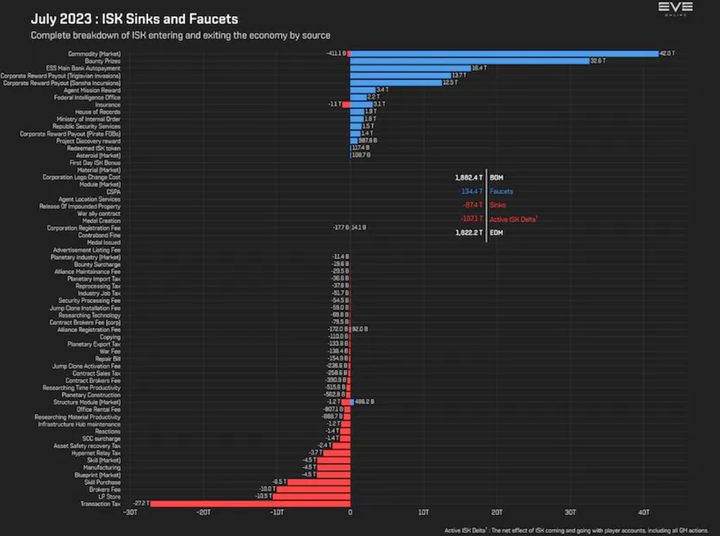
This chart illustrates the power of market economies, showing transaction taxes accounting for about 50% of direct monetary outflows. The diversity of professions and value-added services in EVE creates a more natural balance between new ISK creation and other in-game activities.
However, actual inflation rates in EVE remain concerning. The "active ISK delta" shown here indicates outflows due to players leaving or banned accounts. While this metric makes sense in closed economies, it doesn’t apply directly to open blockchain economies. It's hard to determine exactly how much new ISK is truly "sunk," since some player accounts may reactivate later.
Considering these factors, a blockchain-based version of EVE’s economy might experience even higher real inflation, potentially depreciating faster than expected. They might intentionally maintain high inflation to offset potential deflation caused by reduced circulating supply.
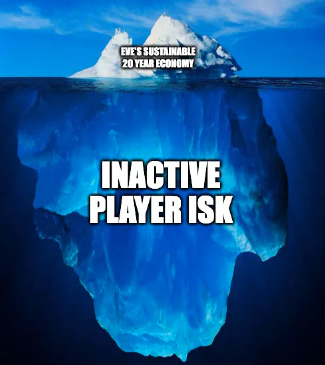
Schrödinger's Active ISK Delta
To avoid such scenarios, developers should strive to make their currency—and their entire economy—more competitive.
Build confidence in currency valuation—via currency reserves, stabilization practices, and liquidity provisioning.
Denominate valuable assets in your currency—convertible into governance assets, treasury bonds, or similar instruments.
Develop intrinsic demand drivers—taxes, inherent costs, and entropy.
Fairly distribute your currency—through competition, friction, activity, and risk.
Ideally, these frameworks should be implemented together to reduce volatility and stabilize ecosystem valuation. Before diving deeper, let’s discuss why stability matters so much.
4. Stability Is Key
Reduce volatility? Don’t we want the number to go up?
Currency volatility directly impacts an economy’s attractiveness. More stable economies require less incentive to attract investment, while volatile ones need higher risk premiums. Similar concepts exist in blockchain—various projects use incentives to attract capital. These measures may draw speculative investments but also cause inequality, dilution, and devaluation. This mirrors capital flight seen in developing nations, where investors exit projects, draining value.
Stability is crucial for capital accumulation. In blockchain environments, stability increases project competitiveness, attracts more capital inflows, and encourages sustained investor support. This stability enables participants to accumulate capital and thrive. Moreover, it reduces the need for risk premiums, allowing projects to focus on more sustainable allocation methods—like rewarding contribution and participation. Ultimately, these synergies can build stronger virtual economies and extend currency influence beyond the game itself. Next, we’ll explore how to achieve this stability and the importance of accumulating and maintaining foreign exchange reserves.
II. Methodology
1. Currency Reserves
Currency reserves refer to foreign currencies held by national central banks or monetary authorities, serving as indicators of economic stability and resilience to financial shocks. In blockchain games, the security of currency and project investments correlates with the depth of liquidity pools and treasury holdings. A game’s foreign reserves might exist in ETH, offering greater safety compared to other competing assets that may lack ETH’s stability.
So how can games acquire currency reserves?
Compared to developing countries, blockchain games have an advantage: they’re games. If the game itself is perceived as valuable, initial foreign reserves can be bootstrapped by selling citizenship-like access—similar to governance assets. For example, a blockchain game could sell governance tokens to fund a decentralized treasury. This approach provides strong reserve backing and reduces reliance on contributions from the player base. If the game fails, players could collectively vote to liquidate the treasury and recover most of its value.
Developers can submit detailed proposals outlining development goals and milestones, using checkpoint-based funding models. These models set low voting thresholds to ensure developers fulfill promises and receive funds based on actual achievements.
Developers can also consider earning revenue from secondary sales of related assets, allocating part of those proceeds toward infrastructure and expansion. This aligns developer and ecosystem incentives, increases demand for project assets, and rewards responsible developers with ongoing income.
Once initial reserves are established, how can they grow further?
2. Currency Inflows
Currency inflows are vital for economic stability, analogous to foreign reserves in developing nations. In blockchain games, inflows can be considered across four dimensions: exports, foreign direct investment, financial instruments, and investment income (interest/dividends).
Within a game ecosystem, “exports” refer to selling products for currencies other than the project’s native token—for example, minting proceeds, secondary market sales, or additional assets sold in non-native currencies.
“Foreign direct investment” in games resembles capital inflows used for infrastructure or internal investments, typically involving liquidity paired with native currency (e.g., ETH).
“Financial instruments” could involve leveraging liquidity investments to accumulate foreign reserves—akin to specialized tools created by central banks.
“Investment income” can come from ETH staking, similar to how Nouns DAO uses its ETH treasury to generate inflows.
While royalty revenue doesn’t directly bring value into the ecosystem technically, it increases individual wealth, enhances economic competitiveness, encourages reinvestment, and drives more capital back into the game’s market or native currency. Export taxes or royalties can effectively capture economic activity.
3. Royalties as Export Taxes
Royalties—a revenue stream for blockchain businesses—are actually a misunderstood yet vital source of cash flow. Although most revenues end up in developers’ wallets, this causes “leakage”—value flowing out of the ecosystem. Such leakage weakens the ecosystem because funds aren’t directly reflected in internal assets.
Compare Project A and Project B: Project A channels royalties directly into its governance asset, while Project B sends revenue straight to the developer’s wallet. This means Project A’s assets carry higher intrinsic value, as funds are reflected on its governance asset. In blockchain economies, if value leaks without being reinvested, currency value may decline, weakening confidence and depreciating both currency and associated assets.
In blockchain economies, lack of intrinsic demand for project assets can cause value erosion—unlike real-world economies, where external demand alone cannot stabilize value. An ecosystem that automatically redirects value flows back internally becomes more attractive than one where a single entity permanently drains value. This self-reinforcing mechanism enhances robustness and appeal compared to economies dependent on single actors.
Royalties are crucial in blockchain economies. This tax captures ecosystem demand and converts it into currency, benefiting residents and reducing speculation. Redirecting this value into a participant-governed treasury boosts confidence and raises asset values.
Contrary to the belief that royalty inflows peak only at launch, I predict well-structured, competitive, high-velocity blockchain economies can sustain continuous royalty inflows. Achieving this requires creating export demand, which depends on stable currency and built-in value.
We’ve funded the treasury via initial minting and export taxes—what comes next?
4. Stabilization Measures
Traditional games usually don’t care much about exchange rate stability—and often explicitly prohibit currency exiting the game ecosystem. Thus, foreign currency prices matter little, and most players avoid unofficial gray markets.
Second Life is one of the few games to effectively manage exchange rates. Developers actively buy and sell in-game currency to maintain relatively stable pricing—keeping Linden Dollars around 240 per USD. This kind of stabilization mechanism is essentially monetized.
Another stabilization strategy involves semi-stable currency frameworks. These currencies aren’t pegged directly to assets like USD or gold but allow some market fluctuation while providing stabilizing buffers to instill investor confidence.
An effective way to manage such semi-stable currencies is setting a target value range, allowing free fluctuation within bounds. When prices breach the range, automatic stabilization mechanisms kick in to keep them within desired levels. This can be achieved via decentralized two-tier Tobin taxes.
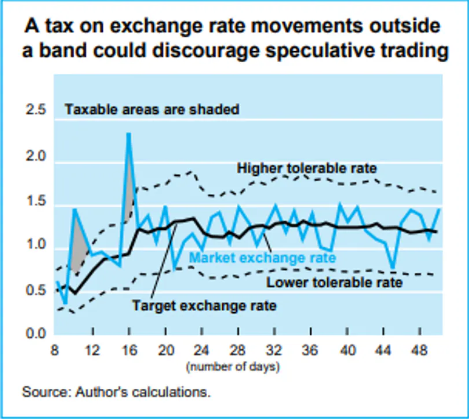
The two-tier Tobin tax, proposed by German finance professor and IMF advisor Paul Bernd Spahn, can serve as an effective currency band mechanism. It levies marginal taxes within the price band to maintain stability and deter manipulation. Implementing this taxation via smart contracts minimizes cost and trust assumptions. Theoretically, this system smooths markets—especially since high taxes outside the band discourage manipulators, possibly even profiting those who correct imbalances. In blockchain implementations, time-weighted average price (TWAP) or median price oracles can establish stable ranges.
When prices exceed the range, dynamic taxes activate—high taxes on buying or selling. Tax revenue beyond expected bands can be distributed in various ways: burned, rewarded to LPs, deposited into protocol treasuries, or awarded to traders helping restore ideal prices. At this stage, we’ve built stable reserves, velocity-based inflow mechanisms, and implemented tax-based stabilization. To make the band mechanism more effective, however, we need to further reduce price volatility so that volatility-triggered taxes don’t fire too frequently.
5. Liquidity Is a Scarce Resource
In this text, the author thanks Treasure DAO for introducing a novel concept of liquidity and explains their three metaphors for liquidity: weather, time, and space. He proposes four new conceptual frameworks to differentiate his view of open blockchain game economies—one being liquidity as a scarce resource.
Treasure DAO introduced a new idea—wrapping liquidity tokens as game assets via $MAGIC. Their Balancer Crystals are seen as energy, mintable only by providing liquidity to MAGIC-ETH pools. While this design moves in the right direction for accumulating ecosystem liquidity, there’s a flaw: lack of scarcity.
Balancer Crystals can be infinitely minted, meaning they lack expected value and fail to engage players.
The author suggests possible fixes—limiting Balancer Crystal supply or letting ETH-denominated token liquidity determine new issuance. Automatically reducing new asset emissions could increase future value and incentivize minting scarce resources for new use cases.
The author calls these scarce resources “Ether Cores.”
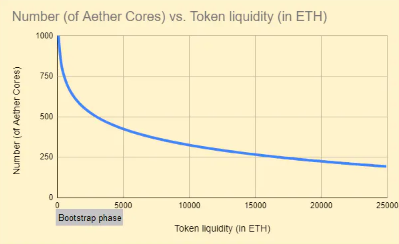
Suppose a batch of Ether Cores becomes available each week. The quantity available depends on the amount of ETH in the liquidity pool. As remaining Ether Cores in a batch decrease, the price (in LP tokens) to mint them rises linearly. For illustration, assume each LP token starts backed by 0.1 ETH. Note: each LP token consists of equal parts ETH and native token; in practice, ratios adjust dynamically based on trading—but for our example, unless specified otherwise, it remains static.
Illustration of Ether Core Supply Dynamics
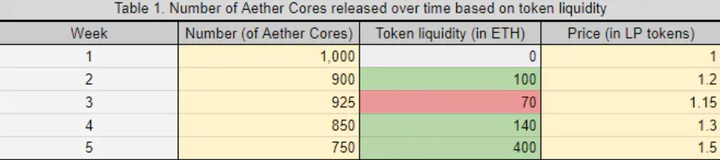
In a hypothetical five-week scenario, the author describes interactions between Ether Cores and liquidity. Starting with low liquidity, the narrative shows how ETH amounts in the pool fluctuate as Ether Core supply changes.
This depicts a cycle: decreasing Ether Core supply accelerates minting, increasing total token liquidity. Enhanced liquidity improves price stability, attracting more contributors, driving demand as utility grows. Ultimately, the design ensures Ether Cores never oversaturate and adapt supply based on demand shifts.
The author emphasizes that demand for Ether Cores is key—it acts as the engine of early demand, fueling liquidity accumulation. The next section dives into implementing such assets within a hypothetical game, The Citadel.
Liquidity as Charter
Here, liquidity is viewed as a charter-like document—analogous to foreign direct investment representing external capital injection. Through such liquidity positions, returns can be generated for ecosystem utility, and exchanging these positions contributes to the game treasury, boosting foreign reserves. Demand for Ether Cores becomes the primary source for purchasing charters—this idea extends to other utilities requiring ownership of governance assets to participate.
Players can use Ether Cores to purchase corporate charters, found companies, and issue shares—offering fundraising avenues. This framework incentivizes acquiring failed companies, expanding intrinsic value sources. This design positions the financial sector as a pillar of game stability—with deeper liquidity emerging as player and company counts grow. City charters and outpost licenses can be similarly purchased, though at higher costs. Building outposts requires resources and Ether Cores, with ownership proportionally allocated based on Ether Core contributions. Outpost establishment fosters local market growth, creates arbitrage opportunities, and opens new gameplay and economic possibilities. Meanwhile, these outposts must pay taxes to the castle to maintain their charter status, encouraging players to deploy competitive outposts meeting market demand.
Liquidity as Infrastructure
Liquidity isn’t just part of the game economy—it’s a core component of infrastructure. Like physical and soft infrastructure in reality, it plays multiple roles in games. In The Citadel, Ether Cores can activate infrastructure such as transportation systems or long-distance travel structures. These systems require player cooperation, with liquidity playing a crucial role.
These infrastructures charge usage fees—but benefits aren’t individualized. They’re public goods addressing collective action problems in decentralized governance, encouraging cooperative building and preventing freeloading. On the soft infrastructure side, EVE Online’s CONCORD system serves as an example—an automated police force. In The Citadel, similar mechanisms supported by Ether Cores ensure starting zones remain safe—critical for becoming trade hubs. As the game expands, applications of such infrastructure multiply. The potential for gamifying liquidity in blockchain ecosystems is limitless, so new systems must consider how to integrate these assets.
Royalty-Driven Liquidity
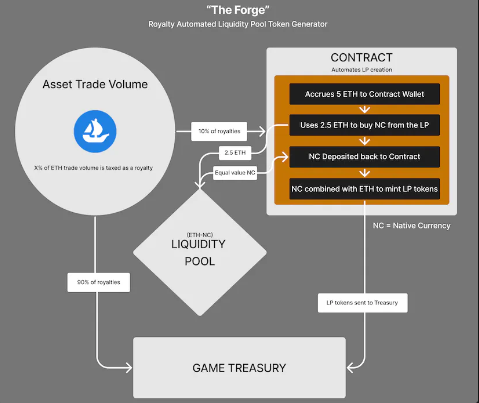
Royalty-driven liquidity directs ETH toward economic activity, channeling it directly into the ecosystem’s native currency. This concept is called “The Forge.”
The Forge is a smart contract whose main function is minting liquidity tokens. It receives royalty streams and, once a threshold is reached, purchases pairs of native currency and ETH to increase LP tokens, depositing them into the treasury.
This design enables directing ETH flows from anywhere and, acting as an automated LP generator, responds faster to market demand. Using royalties creates a value feedback loop—increased trading volume leads to more liquidity generation, enhancing currency stability and driving up asset demand.
During cold starts, treasury funds can seed liquidity pools—such liquidity seeding proposals boost participant confidence, signaling the protocol’s commitment to supporting its native currency.
Just as developing country governments use reserves to stabilize currencies, players can propose broad or concentrated liquidity initiatives.
Broad liquidity includes fungible ERC-20 token liquidity within a value range, while concentrated liquidity uses non-fungible ERC-721 tokens to provide range-bound liquidity. The latter complements two-tier Tobin taxes and can be further optimized via automated managers like Gamma Vault.
Proposals offering large liquidity may shock asset supply, rapidly increasing liquidity and reducing new asset emissions.
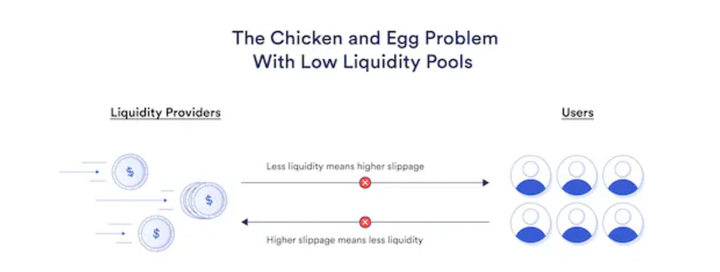
Between liquidity and stability, stability should take priority. Stable, intrinsically valuable assets generally attract more liquidity than tokens relying solely on incentives for stability.
Stability is vital for attracting liquidity—the first relatively stable ecosystem gains immense power in drawing liquidity. Such strategies include two-tier Tobin taxes and asset correlation, proven to reduce impermanent loss.
Designing intrinsic value and establishing correlations are central design challenges.
III. Execution
1. Virtual Worlds Need an Anchor
Most small nations peg their currencies to the world’s largest, safest currency—and in our blockchain world, that’s ETH. The Ethereum Standard™ (ETHS) anchors ecosystem value to held ETH, maintaining relatively stable value denominated in ETH.
ETH possesses qualities of an ideal reserve commodity—similar to gold—such as scarcity, utility, credible neutrality, and mimicking government bonds via gas fees and staking. While ETH may be volatile against USD, it’s more stable relative to crypto-native assets and protocols. Using dollar-backed stablecoins like USDC as anchors in on-chain treasuries introduces unnecessary risks—ETH is a more dynamic choice.
Join TechFlow official community to stay tuned Telegram:https://t.me/TechFlowDaily X (Twitter):https://x.com/TechFlowPost X (Twitter) EN:https://x.com/BlockFlow_News
 @HedgeEconomist









