









Meng Yan: The trend of fintech moving toward Web3 is irreversible
TechFlow Selected TechFlow Selected
Meng Yan: The trend of fintech moving toward Web3 is irreversible
The only keyword of Web3 is "sovereignty," not anything else.
 Navigating Web3 tides with focused insights
Author: Meng Yan
From November 15 to 17, the 2023 Singapore FinTech Festival (SFF), held near Changi Airport at the Singapore Expo, marked my first in-person attendance at this globally renowned fintech event, invited by the Monetary Authority of Singapore (MAS).
Describing SFF as the world’s largest fintech conference is no exaggeration. First launched in 2016 and directly organized by MAS—the central bank of Singapore—SFF had already attracted 60,000 attendees by 2019, making it the largest fintech gathering globally. This year’s edition, the first fully post-pandemic SFF, was unprecedented in scale, drawing over 66,000 participants from more than 150 countries and regions. While these figures are impressive (see Figure 1), experiencing the event firsthand makes the magnitude truly palpable. The entire convention seamlessly integrated exhibition halls and conference venues across six massive pavilions—each large enough to host a multi-thousand-person conference independently. SFF connected all six, accommodating over 66,000 attendees, dozens of stages, nearly a thousand exhibitors, and virtually every enterprise or international institution even remotely related to fintech. Complete with dining areas, meeting zones, and service hubs, the venue resembled a bustling small city. Despite its vast size, the three-day event remained packed wall-to-wall, not even counting the dozens of satellite events held concurrently—evidence of its extraordinary reach and influence.
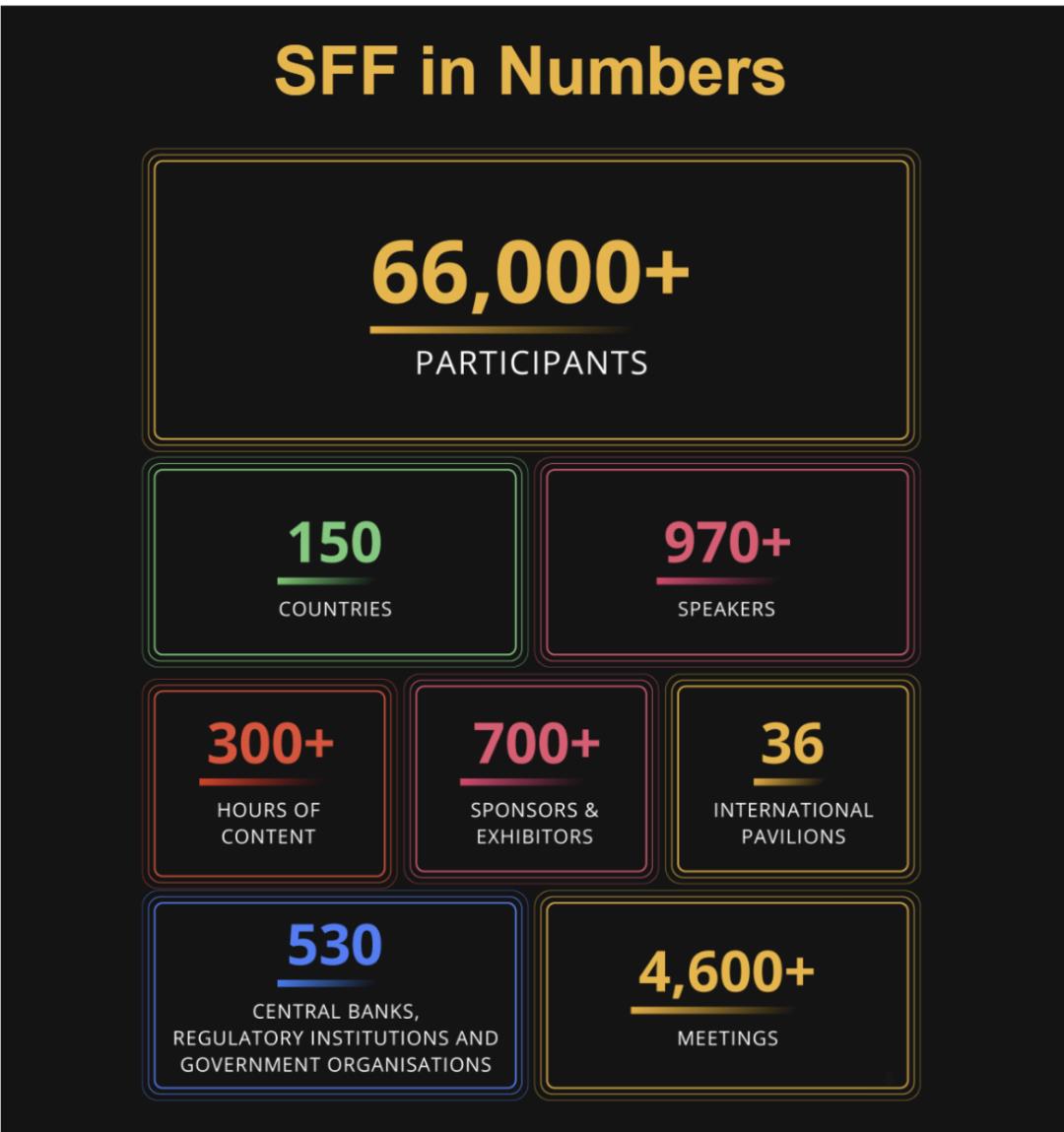
Figure 1. SFF 2023 by the Numbers
1. The Core Theme of Financial Innovation Is Deepening Digitalization
2023 has been dubbed the year of artificial intelligence, and SFF naturally highlighted AI as a key theme. Yet, upon walking the show floor, one quickly realizes that—at least for now—AI in fintech remains more hype than substance. The true star of the show remains "digitalization."
For Chinese readers, financial digitalization is hardly a novel concept; many may even feel China is “far ahead.” During conversations with fellow Chinese fintech experts at the event, I learned that domestic attitudes toward fintech innovation have recently shifted toward conservatism. I suspect this stems partly from the long-standing real estate crisis pushing China’s financial priorities firmly toward risk prevention, leaving little room for innovation. There may also be an element of complacency—after all, throughout the 2010s, China’s rapid mobile internet growth led global digital fintech innovation, spearheaded by two dominant mobile payment systems. Many things achieved in China six or even ten years ago remain out of reach for most countries today, fostering a sense of arrogant confidence: “Sit back, you’ll never catch up.”
However, judging from this year’s SFF, such arrogance may no longer be justified. A major theme across the conference agenda was the collaborative development of cross-border digital financial infrastructure by various nations, regions, and international organizations—most prominently championed by MAS, the host organizer.
As Singapore’s monetary and financial regulator, MAS introduced the “Five Anchors” of digital fintech last year: instant payments, atomic settlement, programmable money, asset tokenization, and trusted ESG data. Building on these, MAS announced three strategic goals this year:
Instant Payments: Enable efficient, low-cost cross-border payments globally.
Seamless Financial Transactions: Achieve frictionless movement of financial assets across markets through digital currencies, asset digitization, and digital transaction networks.
Trusted Sustainable Ecosystem: Build credible data and disclosure ecosystems to support sustainable finance and environmental development.
These three goals do not replace the five anchors—they form a complete strategy where the anchors serve as means and the goals as ends. The mechanisms are relatively clear, but how should we interpret the goals?
Consider finance as a form of real economy with its own flows: logistics (movement of assets), information, and capital. In finance, “logistics” refers to transferring financial assets—intangible rights rather than physical goods—hence the term “virtual economy.” MAS explicitly aims to digitally transform all three flows: not just digitizing payments, but also digitizing financial assets and the associated transactional data. The Five Anchors provide the key tools.
Among these, digitizing capital flows is relatively straightforward—China has already achieved this domestically. However, fully digitizing cross-border payments remains challenging. Asset digitization, meanwhile, is a vast frontier still in its infancy. As for information flow digitization, while documents are already digital, the crux lies not in format but in “trust and disclosure.” Information must be verifiably authentic and appropriately disclosed within defined boundaries to support digital assets and transactions. Beyond basic asset descriptions and transaction records, ESG data about entities themselves is also essential—a point reinforced by the inclusion of trusted ESG data in the Five Anchors.
Despite SFF’s diverse themes and vast audience, MAS’s vision of “instant payments, digitized assets, and trusted data” offers a clear framework capturing the event’s consensus. This “5+3” agenda represents a comprehensive deepening of fintech digitalization—not merely a domestic upgrade, but a technological revolution poised to reshape the entire financial industry.
2. Fintech Digital Innovation Will Undergo 'Fission'
Setting a vision is easier than executing it. Singapore lacks a large domestic market, so any strategy must immediately involve cross-border collaboration—an immense challenge compared to superpowers like China and the U.S. Nevertheless, fintech innovation built on such “decentralized collaboration” develops unique characteristics.
At this year’s SFF, advancing digital financial infrastructure was clearly a shared goal, not a unilateral ambition. Beyond MAS signing new cross-border agreements, numerous organizations actively coordinated and expressed strong collaboration intent. This suggests the current wave of fintech advancement will likely unfold through cooperation among smaller economies and international bodies—a decentralized model. Though global financial leaders delivered eloquent speeches and networking buzzed with energy, I refrain from overstating momentum. Decentralized collaboration will likely fragment the market, slow progress, and prevent early emergence of dominant players. However, precisely because no giant can rapidly monopolize via scale or capital, competition will remain open longer, fostering an exceptionally rich, diverse ecosystem. Complex iterations and fissions may make this the broadest, most varied, competitive, and innovative fintech transformation in history.
Decentralized collaboration driving global tech change has no historical precedent. Past shifts—mechanization, electrification, internet, mobile—were incubated domestically by powerful nations, then expanded globally via alliances, becoming de facto standards. Today, the only two nations capable of leading next-gen digital fintech—China and the U.S.—are both hesitant for different reasons. The U.S., overly protective of its financial hegemony, fears distributed, interoperable, inclusive fintech could undermine the dollar and its dominance in global markets and credit ratings. With PTSD from the FTX collapse still fresh, it prefers retreating into the kaleidoscope of AI, pretending all is well. China, prioritizing stability and risk control after past fintech excesses, remembers the shocks too vividly to risk further disruption at home.
With both powers absent, this wave of digital fintech evolution must proceed via decentralized international collaboration. My own involvement in Project DESFT exemplifies this: initiated by MAS and Ghana’s central bank, with Ghana providing use cases and sandbox testing, MAS and UNDP supplying the core UTC digital certificate standard, and Solv and zCloak Network co-developing the solution. This is decentralized innovation in action—and far from isolated, it reflects a widespread pattern today.
Why is such decentralized collaboration feasible? Four conditions enable it:
First, genuine, urgent demand exists. This demand comes not only from advanced economies like Singapore and Japan but especially from developing nations. As early as June, attending the Inclusive FinTech Forum in Rwanda, Africa, I observed that developing countries view this fintech revolution with sincerity and urgency. Many see the current financial order as unjust and hope this shift allows them to improve domestic efficiency while gaining better positioning in future global finance. This mindset makes them more aggressive, less burdened by legacy systems, and more willing to experiment despite funding shortages—offering something more valuable than money: real-world use cases, fertile ground for innovation.
Second, widespread diffusion of fintech knowledge enables new forms of dialogue. Over recent years, especially with the rise of cryptocurrency, blockchain, and DeFi, knowledge about monetary systems and fintech has spread unprecedentedly. Before 2018, even within tech circles, few understood basic terms like M0, M2, fractional reserve, leverage, netting, atomic settlement, KYC, or AML. At this SFF, professionals from diverse countries freely used advanced terms like DLT, AMM, smart contracts, and tokenization. During one session, I explained semi-fungible tokens and programmable digital vouchers to over 200 attendees. Even such a cutting-edge topic drew nods of understanding, followed by immediate interest at our booth afterward. This shared knowledge base enables trust and joint innovation across borders and institutions.
Third, the existence of the crypto ‘sandbox’. Often dismissed by mainstream observers as speculative or shady, the crypto space—led by Bitcoin and Ethereum—provides an unparalleled, irreplaceable innovation sandbox. It's massive, highly efficient, low-friction, fast-iterating, with immediate market feedback and closed technical-economic loops. No government could intentionally build such a high-quality environment, yet today’s innovators access it freely. Within this sandbox, ideas, technologies, products, and solutions can be rapidly tested. Nothing builds consensus like a working system. In Project DESFT, we first deployed a live demo on public blockchains, earning recognition from both central banks before advancing to real-world applications.
Fourth, the 'fat protocol' nature of Web3 and open-source culture enable composable, ultra-efficient development. Web3 developers often note a striking phenomenon: building on Web3 stacks is roughly an order of magnitude faster than comparable Web2 systems. Innovative, complex DeFi protocols frequently rely on just a handful of core developers—a common reality. While current Web3 systems are still relatively simple, newer technologies like blockchain, VC/DID, and zero-knowledge proofs feature “fat protocols”—layer-one protocols packed with functionality and composability, making application development remarkably easy. Functional systems built with just hundreds or thousands of lines of smart contract code are commonplace. Combined with prevailing open-source norms, this drastically reduces time and cost, accelerates iteration, and boosts innovation ROI.
Given these four factors, I believe this decentralized innovation model—though unprecedented—has real potential for success. Moreover, because innovation unfolds across diverse themes, scenarios, constraints, and technical approaches, then combines in complex ways, it will generate rich, open-ended fission. Countless new ideas will emerge, producing both fleeting experiments and breakthrough innovations.
Commercially, however, decentralized collaboration entails lengthy coordination, repeated renegotiations, and fragmented markets—slowing progress and delaying the rise of dominant winners. This is its main drawback.
Yet, successful case studies will gradually catalyze broader market formation. Crucially, I don’t believe large economies like China and the U.S. will stay sidelined indefinitely. Their current观望stems largely from conceptual hesitations and domestic pressures. When policies evolve, these massive unified markets will inevitably join the wave. The U.S., with its flexible institutional design, might adopt frameworks like a “Token Safe Harbor” to formalize and absorb the existing crypto sandbox, leapfrogging via institutionalization. China, whose financial reform trajectory diverges more significantly from this revolution’s core direction, may struggle to replicate the U.S. approach—what alternative path it might take lies beyond my current foresight.
3. 'Digital Sovereignty' Drives Fintech Toward Web3
At SFF, fintech professionals from around the world displayed diverse views: some passionately embrace blockchain, others advocate enhancing interoperability of centralized systems; some push for digital currencies to solve instant payments, others believe current systems suffice without altering monetary form; some see real-world asset tokenization as essential, others dismiss it as illusionary. These differing perspectives clashed vigorously, making consensus on “what to pursue” elusive.
Yet almost everyone agrees on what to reject: absolute refusal to let financial technology be controlled or sovereignty compromised. This shared conviction will inevitably steer fintech onto the Web3 track.
At SFF, I spoke with dozens of fintech professionals from various countries and roles. When discussing the future of fintech, nearly all expressed firm opposition to a next-generation financial infrastructure where user identity, accounts, social relationships, assets, and data remain custodied by centralized platforms.
Crucially, this isn’t limited to one group—say, SMEs being vocal while regulators stay ambiguous. In fact, representatives from SMEs, traditional financial institutions, academia, and regulatory bodies alike voiced this sentiment strongly.
Why? Because mainstream fintech’s success has bred self-destruction. Put simply, the more successful Web2 fintech becomes, the more it creates its own gravediggers.
Web2 internet platforms, built on centralized infrastructure, imposed unfair structures under the guise of custody, seizing users’ identities, accounts, social graphs, content, data, and assets—exercising absolute control over their fate.
Web2 was meant to empower users to create content and data, with platforms merely providing infrastructure. But twenty years ago, users prioritized convenience over digital sovereignty, with few alternatives. Dominant platforms seized the opportunity, consolidating critical rights into rigid structures, turning user creativity into an endlessly extractable resource—becoming digital economic overlords.
The irony is that the more successful these centralized platforms become, the more they teach everyone to oppose them. As big data awareness grew a decade ago, people realized data isn’t just an asset—it’s the most valuable one. The value of Web2 companies lies entirely in user data. How do they boast strength? By citing huge user (account) numbers, vast data holdings, and extensive asset control. The more they advertise this, the clearer it becomes: their power comes from appropriating your value.
This isn’t mere perception—it manifests directly in user experience. More and more people now feel the loss of autonomy. Though powerless to change it, many live cautiously, frustrated and resentful. Every time a platform manipulates traffic or bans accounts, it burns goodwill and tightens its own noose.
Thanks to a decade of relentless “big data value” messaging from internet giants, governments and enterprises now fully recognize data’s worth and deeply resent the centralized platforms’ exploitative data structures. Ask any developing nation: who would willingly entrust their national payment and financial data to foreign tech giants? Ask any mid-sized company with even minimal data sovereignty awareness: who still wants to hand over their data to centralized platforms for unrestricted exploitation? In the past year, speaking with officials and SMEs across multiple countries, I’ve sensed a full awakening around self-sovereign identity, data, social connections, assets, and rights. This shift is irreversible and will become universal consensus within years.
Mindsets have changed. Once set in motion, this transformation won’t reverse. This is the driving force behind today’s fintech innovation.
Web3 offers a new choice. The sole keyword of Web3 is 'sovereignty'—nothing else. It encompasses self-sovereign identity, accounts, social relationships, content, data, and assets. These aren’t abstract concepts but a new digital economic rights and transaction structure—a new order and workflow that fundamentally changes how users interact with the internet and fintech products. Driven by this principle, fintech innovation will inevitably converge on Web3. There is no alternative path. Within a few years, once users experience financial products embodying Web3 sovereignty, no whip will drag them back to Web2.
Join TechFlow official community to stay tuned
Telegram:https://t.me/TechFlowDaily
X (Twitter):https://x.com/TechFlowPost
X (Twitter) EN:https://x.com/BlockFlow_News
 Yan Meng









