Bitcoin Ecosystem DApp Landscape: DeFi, NFTs, Infrastructure, and Wallets Flourish
TechFlow Selected TechFlow Selected
Bitcoin Ecosystem DApp Landscape: DeFi, NFTs, Infrastructure, and Wallets Flourish
An increasing number of projects are attempting to build on Bitcoin Layer1. This article compiles the latest projects in the current Bitcoin ecosystem.
 Navigating Web3 tides with focused insights
Author: Web3CN
Compared to Ethereum, the Bitcoin ecosystem aimed at developers has long remained dormant. Although numerous projects have attempted to build on Bitcoin L1, the technical stack still lags far behind Ethereum, which not only supports smart contracts but also hosts a vibrant landscape of various DApps, L2s, Rollups, and more.
As a developer, it was historically difficult to justify building on Bitcoin due to the lack of infrastructure that supports a good development experience when creating applications—far inferior to smart contract blockchains. It was much easier to bridge Bitcoin to another blockchain and build there, as Stacks or Trustless Computer did. Unlike Polygon and Arbitrum, Bitcoin also lacks a large developer ecosystem to drive growth; even Ethereum took years to establish a strong developer base. However, all this could be changing. With the launch of the Ordinals protocol earlier this year, developers and projects have begun paying attention to the Bitcoin ecosystem.
The Bitcoin Ordinals protocol is a method of inscribing data into individual Satoshis on the Bitcoin network. While initially used for minting images as NFTs, users soon realized they could use text-based inscriptions to create fungible tokens—similar in concept to how ERC-20 tokens are issued on Ethereum. BRC-20 is an experimental fungible token standard using ordinal inscriptions on Bitcoin. Unlike ERC-20, however, BRC-20 tokens do not use smart contracts. Instead, they leverage JSON data within ordinal inscriptions to deploy, mint, and transfer tokens. This innovation fulfills a previously missing demand for fungible tokens on Bitcoin, though it comes with limitations. This is where developers step in, building protocols atop ordinals to further enhance the infrastructure.
For example, regular ordinals can only hold up to 4MB of data, leading to recent developments such as "recursive inscriptions," sometimes referred to as Bitcoin cloud computing. Essentially, recursive inscriptions reference data from prior inscriptions—be it an image or script—greatly saving on data size and fees. This is particularly interesting because once data is on-chain, it can be referenced repeatedly. A user can write a large codebase once, and other developers can reference it at runtime without needing to re-inscribe it.
These advancements are enough to spark speculation about the potential for DeFi and decentralized storage on Bitcoin—possibly rivaling IPFS in the future. While still in early stages, many projects are already attempting to build directly on Bitcoin’s Layer 1. Below is a compilation of the latest projects currently active in the Bitcoin ecosystem.
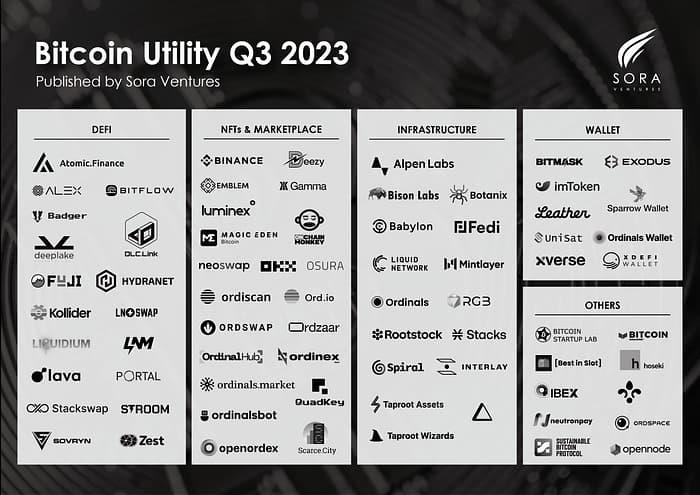
Bitcoin DeFi
Liquidium: A P2P general lending solution utilizing DLC and PSBT. Unlike existing protocols that rely on bridging Ordinals to other blockchains, Liquidium allows users to borrow and lend native Bitcoin using native Ordinals as collateral, all within a trust-minimized, non-custodial framework.
BadgerDAO: A decentralized builder collective supporting community-driven DeFi growth on Bitcoin.
Sovryn: A decentralized trading and lending platform built on Bitcoin via Rootstock (RSK). Essentially a DAO operating on the RSK Bitcoin sidechain, enabling DeFi functionality on Bitcoin.
DLC.Link: Implements Discreet Log Contracts (DLCs). Their platform locks Bitcoin in on-chain custody, controllable by Ethereum and other smart contract chains, enabling lending, trading, derivatives, and more.
Atomic Finance: A platform leveraging DLCs to allow users to earn yield on self-hosted Bitcoin. Using DLCs makes the product nearly trustless and eliminates counterparty risk.
Alex: Short for Automated Liquidity Exchange, a DeFi platform for Bitcoin built via Stacks smart contracts.
LNSwap: A decentralized exchange protocol offering fast, private swaps of Bitcoin for digital assets—and vice versa—on the Stacks layer. Supports all on-chain and Lightning Bitcoin wallets.
BSwap: A decentralized DEX built on BTC L2 network BEVM, allowing users to securely and decentralize cross-chain transfers of BTC and BRC20 assets to BEVM, then trade them on BSwap with low gas fees and high speed similar to ERC20 tokens.
Portal Finance: With its ecosystem tools, Portal enables users and autonomous agents ("AIGENT") to quickly, cheaply, and securely participate in cross-blockchain economic activities. Products include DEX, AIGENT, Swap SDK, Portal Wallet, and payment channels.
Zest Protocol: A Bitcoin-native lending protocol running on smart contracts secured by the Bitcoin blockchain via the Stacks layer. Zest offers on-chain BTC loans and BTC-backed loans, with custody managed through Stacks.
Hydranet: A DEX based on the Lightning Network. No KYC required, and via its Layer 3 solution, Hydranet claims to run Bitcoin and Ethereum chains together, enabling cross-chain coin transfers without bridges.
Stackswap: A permissionless DEX and token launchpad built on Bitcoin via the Stacks network. Stackswap functions both as an AMM and an incubator for tokenized projects.
Deep Lake: A suite of APIs designed to interact with and simplify powerful Bitcoin primitives (including DLC and PSBT), enabling developers to build trust-minimized, non-custodial smart contract applications directly on L1—without sidechains, wrapped assets, or bridges.
Bitflow: A DEX allowing users to trade and earn with Bitcoin without relying on central points of failure, replacing intermediaries with PSBT, atomic swaps, Layer 2 smart contracts, sBTC, and decentralized liquidity pools.
Stroom: A liquid staking protocol on the Bitcoin Lightning Network. Stroom aims to bridge the Lightning Network and DeFi ecosystems across all EVM-compatible chains, starting with Ethereum. The project plans to integrate InBTC—a 1:1 BTC-backed ERC-20 token—into blue-chip DeFi protocols throughout the ecosystem.
Fuji Money: A protocol enabling issuance and redemption of synthetic assets backed by Bitcoin collateral, tracking the price of a reference index. Non-custodial by design—no intermediaries—collateral can be redeemed anytime upon debt repayment.
Kollider: Claims to be the first instant-settlement DEX built on the Bitcoin Lightning Network. Also developing Bitcoin-backed synthetic stablecoins and Lightning-enabled Bitcoin wallets.
LN Markets: The first Lightning-native Bitcoin derivatives trading platform. Enables traders to minimize counterparty risk, as users can trade instantly and nearly cost-free directly from their Lightning wallets.
Lava: The Lava wallet aims to deliver sovereignty, simplicity, and security. The Lava lending protocol allows users to borrow against Bitcoin without counterparty risk.
Infrastructure
Stacks: A Bitcoin L2 protocol enhancing Bitcoin's functionality with automatically executed smart contracts—no Bitcoin fork required. Brings DApps and smart contracts to Bitcoin without altering any of Bitcoin’s core features.
BEVM: A decentralized BTC L2 compatible with EVM and using BTC as gas. Its core goal is to expand Bitcoin’s smart contract use cases, enabling decentralized applications with BTC as native gas within the EVM ecosystem.
Mintlayer: A PoS L2 protocol bringing smart contract programmability to the Bitcoin blockchain. Aims to solve Bitcoin’s scalability issues and improve functionality by enhancing DeFi apps, DEXs, stablecoins, and tokenization on the Bitcoin network.
Spiral: An independent, Bitcoin-focused entity within Block’s ecosystem. Builds and funds free, open-source projects to improve Bitcoin’s privacy, security, user experience, and scalability.
Liquid Network: A Bitcoin L2 solution enabling fast, confidential settlement and issuance of digital assets like stablecoins, security tokens, and other financial instruments on the Bitcoin chain.
Fedi: A company building technology for global Bitcoin adoption. Fedi mobile app, its flagship product, helps billions use Bitcoin securely, privately, and scalably.
Rootstock: An independent blockchain attached to the Bitcoin blockchain via two-way peg. Aims to address Ethereum’s shortcomings by leveraging Bitcoin’s unmatched stability, security, and economic strength.
Ordinals Protocol: A protocol allowing unique identifiers to be assigned to individual Satoshis (SATs) on the Bitcoin blockchain and additional data to be inscribed and traded. Developed by Casey Rodarmor, it effectively enables NFT creation directly on the Bitcoin blockchain. Bitcoin NFTs are also known as ordinal NFTs.
Interlay: A modular, programmable layer connecting Bitcoin and multi-chain ecosystems, unlocking DeFi use cases for BTC. Its DeFi hub offers BTC swapping, lending, and staking services.
Babylon: Extracts security from the Bitcoin chain and shares it with various PoS chains such as Cosmos, Binance Smart Chain, Polkadot, Polygon, and others. Babylon’s vision is to extend Bitcoin’s security to safeguard the decentralized world.
Botanix: A fully Ethereum-equivalent L2 virtual machine built on Bitcoin. Aims to combine Bitcoin’s market cap with Ethereum’s dApp ecosystem.
Bison Labs: Revolutionizing DeFi using zk-rollups on native Bitcoin, delivering unparalleled transaction speed and security.
Alpen Labs: The company’s platform builds infrastructure to enable broader adoption, allowing customers easy access to Bitcoin.
Ark: An L2 protocol for cheap, anonymous, off-chain Bitcoin payments. Allows recipients to receive payments without requiring incoming liquidity, while preserving recipient privacy.
RGB: A smart contract layer and off-chain protocol built on the Bitcoin blockchain, enabling the minting and issuance of Bitcoin-based digital assets. With RGB, users can issue stablecoins, tokens, NFTs, and client-validated confidential smart contracts on Bitcoin.
Taproot Assets: Formerly known as Taro, Taproot Assets is a new Taproot-supported protocol for issuing assets on the Bitcoin blockchain, tradable instantly, at scale, and with low fees via the Lightning Network. At its core, Taproot Assets leverages Bitcoin’s security and stability along with the Lightning Network’s speed, scalability, and low cost.
NFT/Game
On Chain Monkey / Osura Market: Metagood has been a pioneer in the NFT space and continues to lead the industry with its team’s deep understanding of Ordinals and the Bitcoin ecosystem. As the company behind On-Chain Monkey—one of the most successful NFT series on both BTC and ETH—Metagood is now working on launching Osura Market, a premium digital artifacts marketplace.
Neoswap AI: An AI-powered economic engine leveraging blockchain technology to deliver personalized, efficient, and accessible trading experiences. Current products include smart swaps, smart auctions, and AI trading.
Magic Eden: Originally a Solana-based NFT marketplace, Magic Eden has expanded support to other blockchains including Bitcoin, Polygon, and Ethereum. With the evolution of Ordinals, Magic Eden positions itself as one of the largest cross-chain NFT platforms.
OKX: OKX Wallet is the first multi-chain wallet supporting the Lightning Network, enabling cheaper and faster Bitcoin transactions. Launched in May 2023, it introduced a new Ordinals marketplace supporting minting and trading of Ordinals and BRC-20 tokens.
Binance: As the world’s largest centralized cryptocurrency exchange, Binance announced in May 2023 that its NFT marketplace would begin supporting Ordinals. This allows customers to trade ordinals directly without a separate Bitcoin wallet. The exchange recently also launched an Ordinals inscription service, making it easier for users to inscribe data directly onto individual Satoshis.
Gamma.io: A Bitcoin ordinals marketplace enabling users to easily create and trade ordinal inscriptions—comparable to non-Bitcoin platforms like OpenSea with MetaMask.
Ordinals Market: A marketplace for trading inscriptions. Facilitates Bitcoin inscription trades either directly on Bitcoin using browser wallets like Xverse, or on the Ethereum blockchain using Emblem Vault’s “storage” technology, which contains encrypted private keys of Bitcoin addresses holding inscriptions.
Emblem Vault: A Bitcoin network NFT platform allowing users to exchange NFTs and digital assets across any blockchain, including Ethereum and EVM-compatible markets.
Ordinex: Aims to provide a secure, trustless, and transparent environment for Bitcoin Ordinals trading through an easy-to-use interface.
OrdinalHub: A platform helping users track trending and popular inscriptions, giving users an edge with rich data tools on newly minted ordinals.
Ordswap: A trustless Ordinals marketplace built on Bitcoin. Allows users to list, buy, sell, and auction NFTs.
Ord.io: An application/browser providing inscription services for GIFs, text, videos, games, etc., on Bitcoin, and has recently begun supporting recursive inscriptions.
OpenOrdex: An open-source, zero-fee, trustless Bitcoin NFT marketplace based on Partially Signed Bitcoin Transactions (PSBT).
Ordiscan: Allows users to explore ordinals and inscriptions on Bitcoin, and also search inscriptions and addresses.
Ordzaar: A decentralized Ordinals marketplace allowing users to buy and sell Ordinal inscriptions with 0 platform fees. Ordzaar also organized the 2023 Singapore Ordinals Summit.
Scarce.City: An online marketplace for Bitcoin collectibles and Bitcoin NFTs.
OrdinalsBot: Makes it easy for users to inscribe Ordinals and has since launch inscribed numerous collections for projects in this space.
Luminex: A launchpad bringing high-quality, compelling Bitcoin ordinals and BRC20 projects into the Bitcoin ecosystem. Services also include image optimization, multiple whitelist tiers, marketing support, and more.
Quadkey: An inscription project for Bitcoin ordinals utilizing geospatial indexing standards to demonstrate several novel underlying technologies.
Deezy: Offers a wide range of ordinal and inscription tools. Deezy Marketplace is an open-source, fully decentralized ordinal marketplace.
Taproot Wizards: A collection of 2,121 unique wizard-themed ordinals co-created by Mavensbot, who uploaded a rough sketch of a Bitcoin-wielding wizard to r/Bitcoin on Reddit back on February 18, 2013.
Ordinals Maxi Biz (OMB): One of the most well-known Ordinals collections, with a floor price exceeding 0.2 BTC and over 400 BTC in total trading volume on Magic Eden.
Sating.io: A decentralized marketplace for users to search, collect, and share rare Satoshis (Sats).
Magisat.io: Magisat is the first P2P rare Sats marketplace. Based on PSBT, similar to Magic Eden, featuring specialized filters and rare Sats ranking.
Wallets
Xverse: A non-KYC Bitcoin wallet supporting Bitcoin and layers built on top, such as Stacks, Lightning, Ordinals, and more.
XDEFI Wallet: A multi-chain wallet allowing users to swap and bridge blockchains without leaving the app. Has its own $XDEFI token.
imToken: A multi-chain wallet supporting major Layer 1 and Layer 2 networks, featuring a built-in DApp browser. Also offers its own hardware wallet.
Exodus: Designed to eliminate geeky requirements, making crypto easy for everyone. Provides strong onboarding support for new users.
Sparrow Wallet: A tab-based desktop wallet, not browser-based. Its transaction viewer also acts as a blockchain explorer, providing charts and full transaction history.
Ordinals Wallet: Launched in February this year, supports various Ordinals-related operations such as transferring, sending, inscribing, buying, and selling.
UniSat Wallet: An open-source Chrome extension for storing and transferring Ordinals NFTs and BRC-20 tokens. Users can inscribe anytime, anywhere without running a full node. Also serves as the official Ordinal Protocol wallet.
Leather (Hiro Wallet): One of the most popular Bitcoin Ordinals wallets. A Bitcoin wallet allowing users to put their Bitcoin-backed assets to work, supporting Ordinals, Stacks, DLC, Stamps, BNS, BRC-20, and more.
Bitmask: A browser extension allowing access to decentralized applications on the Bitcoin blockchain using protocols like RGB.
Others
Bitcoin Startup Lab: The first pre-accelerator on Bitcoin. A rigorous startup bootcamp program designed for those aiming to push their limits and build investable startups on Bitcoin.
Hoseki: An app allowing users to add Bitcoin accounts in a way that proves ownership without granting custody to the platform. Building a world where Bitcoin is the standard or currency, and proving reserves is secure and easy.
OpenNode: Easy-to-use Bitcoin payment processing for any business. With OpenNode, businesses can choose auto-conversion to receive local currency and always get instant (Lightning) or near-instant (on-chain) final settlement.
Neutronpay: Provides Lightning Network infrastructure API for global remittance, payments, spending, and payouts. With simple setup, Neutronpay allows users to send, receive, and pay globally in real time.
Ordspace: An Ordinals insights and analytics platform that recalculates rankings for all BRC-20 tokens using multidimensional data.
BestinSlot.xyz: An ordinal aggregator and browser allowing users to explore, collect, and trade ordinals.
Sustainable Bitcoin Protocol: Creates a new environmental commodity incentivizing clean energy Bitcoin miners, enabling investors to achieve ESG goals while holding Bitcoin.
Layer One Foundation: Embracing root-level innovation, building open-source tools to enable efficient upgrades and interoperable standards, while aiming to bridge the gap between indexing and governance.
IBEX: A Bitcoin infrastructure company specializing in enterprise solutions for the Lightning Network (LN).
BRC-20.io: Provides real-time price tracking for various BRC-20 tokens, keeping users updated on the latest market trends.
Rare and Exotic Sats: As the name suggests, the rare and exotic Satoshis available for purchase here are fresh and un-inscribed.
Bitmap: An ambitious metaverse standard, index, and platform aiming to harness the transformative power of the Bitcoin blockchain.
Join TechFlow official community to stay tuned
Telegram:https://t.me/TechFlowDaily
X (Twitter):https://x.com/TechFlowPost
X (Twitter) EN:https://x.com/BlockFlow_News
 Web3CN