Decentralized Social Protocol Deep Dive: Interoperability Needs Are Urgent, On-chain and Off-chain Hybrid Storage Is Becoming a Trend
TechFlow Selected TechFlow Selected
Decentralized Social Protocol Deep Dive: Interoperability Needs Are Urgent, On-chain and Off-chain Hybrid Storage Is Becoming a Trend
Decentralized networks have the potential to transform the way people communicate, share information, and build communities.
 Navigating Web3 tides with focused insights
Author: 1kx Accelxr
Translation: TechFlow
Driven by commercial motives, the rise of corporate-controlled social media platforms has significantly eroded the original expectations around online participatory culture. Networked information technologies should have fundamentally democratized cultural production, but today these platforms primarily restrict and shape online participation for profit-driven purposes—the "like" button is less a gesture of appreciation and more a monetization tool fueling content creation. This is algorithmic governance driven by business interests.
Alternative social media platforms built on decentralized and federated protocols offer a path back to the internet’s original vision. Users control their data, distributed across decentralized databases; communities lead frontends and govern according to community preferences; users choose their algorithms, and open-source principles drive innovation.
The History of Decentralization and Social Media
Before the web became central to commerce, entertainment, and social interaction, it began as an academic and military tool. Tim Berners-Lee had an egalitarian vision when designing the first web protocols—the internet was originally designed as a decentralized network where information flows freely between nodes, without any single point of control or failure.
However, with the web's commercial rise, centralized platforms such as search engines and social media giants became dominant. While these entities delivered significant value, they deviated from the original decentralized ethos, leading to our current Web2 era.
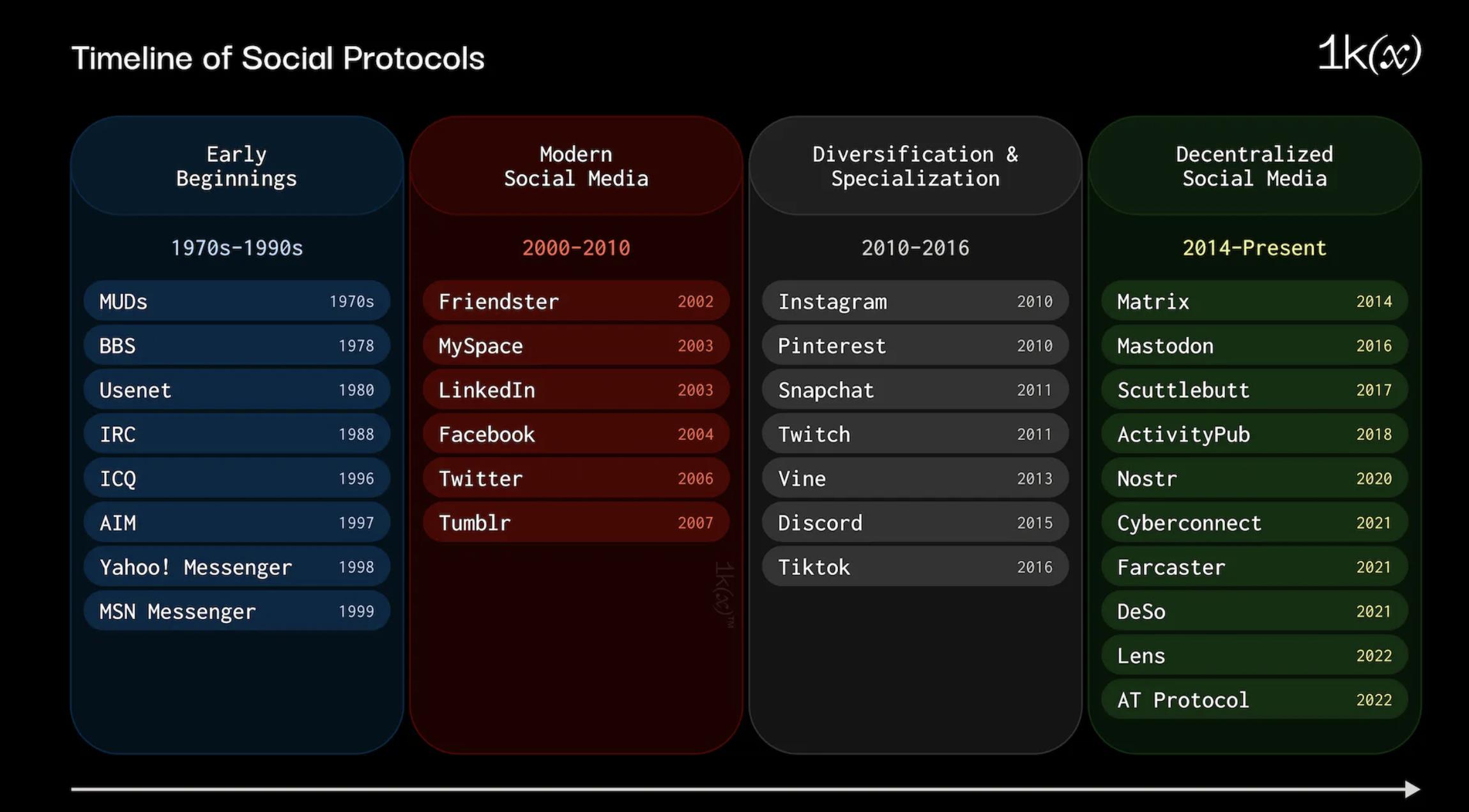
A key innovation in the timeline of alternative social networks was the emergence of the concept of federation. Federated networks refer to systems where multiple independent servers or "nodes" cooperate to form a single social network, rather than being controlled by a single organization as in centralized platforms.
In a federated system, each server runs compatible software and follows shared protocols, enabling them to communicate with one another. A user registered on one server can seamlessly follow, interact with, and share content with users on other servers as if they were on the same platform. Examples include ActivityPub and OStatus, which power federated platforms like Mastodon and PeerTube.
In a federated setup, users can choose which server to trust, migrate to different servers, or even set up their own, granting greater autonomy. The term "Fediverse," a blend of "federated" and "universe," describes such systems. The Fediverse originated with platforms like GNU social and its predecessors (StatusNet and Laconica), but the real turning point came with the development and widespread adoption of the ActivityPub protocol, standardized by the World Wide Web Consortium (W3C) in 2018.
In Web3, federated social networks become the default state after decentralizing systems move data onto the blockchain. Blockchains act as neutral backend servers storing content, while frontends index this content and deliver it directly to users. Identity is managed via public-private key pairs—already used for user wallets—allowing easy verification of any generated data or content. Furthermore, on-chain primitives such as NFTs can bundle stored content with metadata, serving as domains or decentralized identifiers (DIDs).
Similar to how ActivityPub works, Web3 protocols aim to bootstrap social graphs through authenticated relationships between user nodes. Since any frontend can index and serve this content, there is super-competition at the frontend layer, resulting in a rich landscape of features. Moreover, because data resides on-chain, users can choose algorithms they are comfortable with and may be incentivized to use specific ones, reclaiming value from their own data. Combined with more direct content monetization methods, this offers creators a better overall experience—despite the fact that their content drives platform demand, they are largely overlooked in monetization under most existing models.
Protocol Comparison
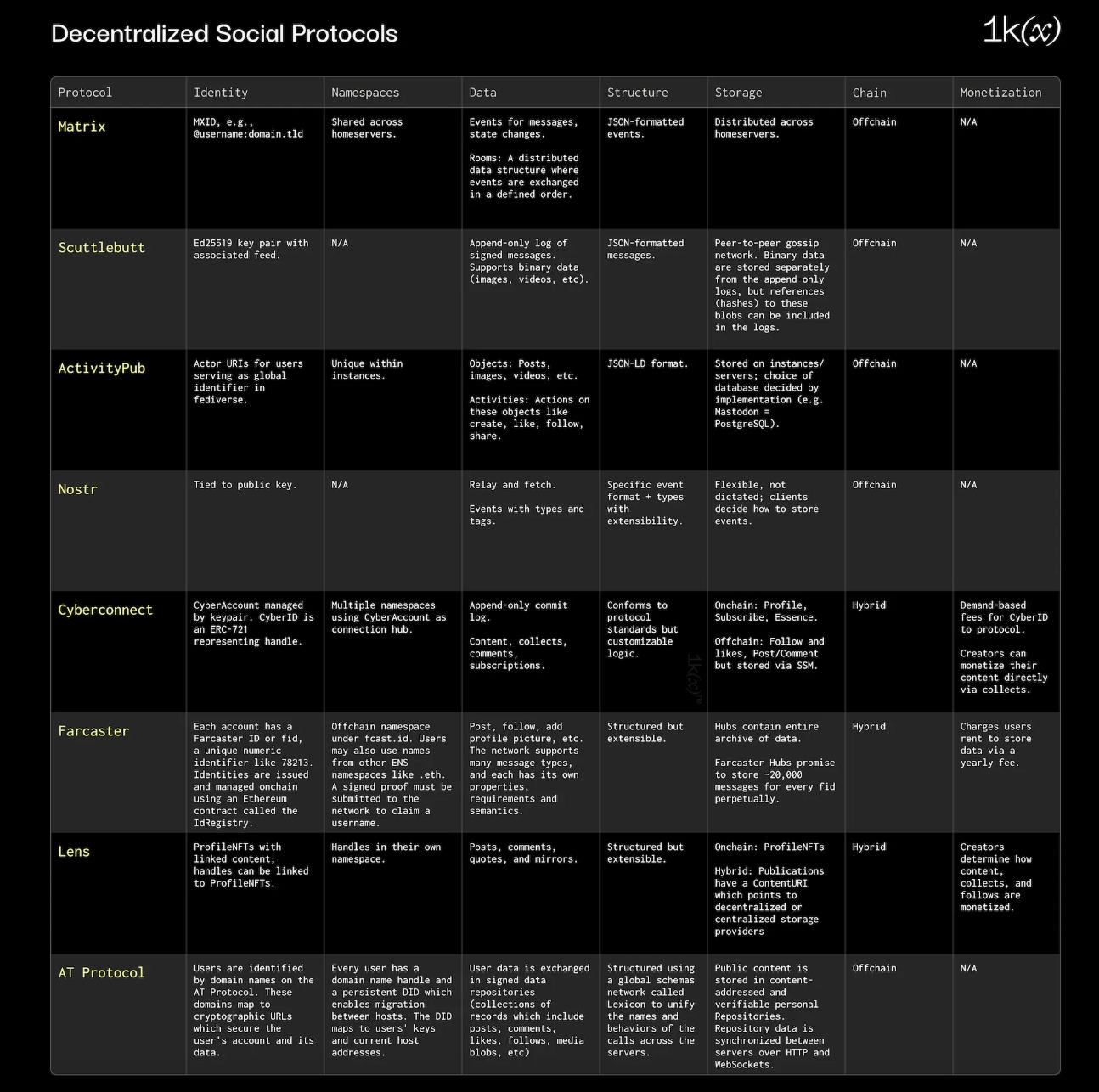
To truly understand innovation in decentralized social media protocols, it's essential to grasp the technical nuances behind their implementation. Notably, we do not cover every social protocol here, but focus on some of the most prominent ones.
Identity / Namespace
In the context of federated and decentralized social graph or network protocols, "namespace" refers to the domain or scope within which user identifiers or other resources are unique. It enables differentiation between resources or identities from one domain/server versus another, preventing conflicts or ambiguities when integrating or communicating across multiple domains.
Identity and associated namespaces in decentralized social protocols range from simple key pairs (Nostr, Scuttlebutt) to URIs pointing to HTTPS URLs hosting profiles (ActivityPub), to more complex models using on-chain primitives such as NFTs (and recently, ERC-6551 extensions, e.g., Lens v2).
Farcaster exemplifies these technologies. A Farcaster account represents an independent entity on the network. Each account has a unique numerical identifier known as a Farcaster ID (fid). Identities are issued and managed on-chain via an Ethereum contract called IdRegistry. Users send transactions to IdRegistry to claim a new fid. The address holding the fid becomes the user’s custody address. IdRegistry ensures fids can be transferred between addresses and that no two addresses share the same fid. Farcaster also extends this namespace to support ENS names hosted either on-chain or off-chain. A signed proof must be submitted to the network to claim a username.
In contrast, ActivityPub identifies each user via a unique URI, typically an HTTPS URL. This URI points to the user’s profile and acts as their global identifier within the Fediverse. To make these URIs more user-friendly, many ActivityPub platforms use a system called Webfinger, allowing users to have identities like "@[email protected]".
Lens and CyberConnect manage user profiles as NFTs. In Lens, a user’s address holds a ProfileNFT, and one address can hold multiple ProfileNFTs. Each ProfileNFT encapsulates the full history of user activity, including posts, mirrors, comments, and other content types. Additionally, Profile NFTs include a FollowModule—a set of rules defining how different accounts earn Follow NFTs. These Follow NFTs record connections between accounts and main profiles directly on-chain.
Data
Data is arguably the most critical function in decentralized networks, as its creation and standardization form the foundation upon which these systems operate. The most common techniques involve standardized formats such as JSON and common relational objects (e.g., likes, follows). Core data objects typically include:
-
Actors and Objects: Defined "actors" (e.g., users or groups) and "objects" (e.g., posts or messages).
-
Publications: Posts or comments encapsulated as "Publications," often linked externally via URLs.
-
Content in append-only logs: Each entry—whether a post or update—is a discrete item added sequentially and stored in order.
Let’s examine several examples to see how specific protocols implement these concepts.
ActivityPub uses the ActivityStreams 2.0 data format, a JSON-based structure representing various social interactions such as posts or likes. The protocol distinguishes two primary components: client-to-server (C2S) and server-to-server (S2S). C2S allows users to interact with their respective servers via client applications, while S2S enables communication between servers, enabling the protocol’s powerful federated nature.
In ActivityPub, entities are categorized as "actors" (typically user accounts or groups) and "objects" (content or actions such as posts or likes). When an actor performs an action on an object, it creates an "activity," such as "Create," "Follow," or "Like."
Web3 social graphs adopt core ideas from ActivityPub but apply them on-chain. For example, the Lens Protocol introduces "Publications," which encapsulate various forms of user-generated content such as posts, mirrors, comments, and other media. Each Publication is associated with a ContentURI pointing to content stored on decentralized protocols like IPFS or Arweave—or optionally on centralized services like AWS S3. This configuration ensures that user profiles and all associated Publications are securely stored in their personal wallets, eliminating reliance on centralized databases.
Moreover, Web3 frameworks enable easier monetization of user content and influence compared to Web2. Users can charge fees for minting Follow NFTs, or integrate Collect modules with their Publications. The latter allows charging fees for minting NFTs tied to the associated ContentURI. Beyond these capabilities, Lens Protocol provides a GraphQL API that abstracts away blockchain components in frontend interfaces, offering a more user-friendly experience than previous attempts at decentralized social networks.
Ultimately, many decentralized social network protocols create append-only data structures authenticated by user keys. For instance, on CyberConnect, each user-centric dataset is represented as a data stream, with only the data owner permitted to update it. Every update is appended to the stream, forming an append-only commit log. The resulting data structure is known as a Merkle DAG—a hash-linked data structure. Data types include content, collects, comments, and subscriptions.
Scuttlebutt similarly uses an append-only log. Each user maintains their own log, with each new message or action appended only after being signed by the user’s identity (an Ed25519 key pair). It also supports sharing binary data called "blobs," which can be images, videos, or any other binary content. Blobs are stored separately from the append-only log, but references (hashes) to them can be included within the log.
For Farcaster, messages are public updates such as posting, following someone, or adding a profile picture. These messages are encoded as protobufs and must be hashed and signed by the account’s signer. As long as sufficient storage is available, users can publish messages to a Hub. Hubs validate the signer’s authenticity before accepting any message.
Storage
Early approaches to data storage in decentralized protocols were primarily off-chain, though somewhat analogous to on-chain consensus. For example, Scuttlebutt uses a peer-to-peer gossip network, placing the responsibility of storage on users’ local devices. This method ensures data sovereignty, as users retain full control over their information. However, it also means data availability depends on whether the user’s device is online or whether other peers in the network possess copies. Over time, some Scuttlebutt clients may need to implement garbage collection strategies to prune older or less relevant data to manage storage space.
An alternative to this peer-to-peer model is server-based data storage, albeit with redundancy compared to traditional media platforms. Take Matrix, for example: multiple home servers store copies of room histories and synchronize with each other. When a user sends a message (or any event) in a room, their home server broadcasts the event to other participating home servers, which then store and forward it to connected clients. Similarly, ActivityPub stores data within each instance (or server) in the network, typically in a database. The choice of database (relational, NoSQL, etc.) depends on the specific implementation of the ActivityPub software. For instance, Mastodon, a popular ActivityPub platform, uses a PostgreSQL database.
Protocols such as CyberConnect, Farcaster, and Lens have adopted blockchain-based storage. On-chain storage ensures immutability and verifiability of data, providing a solid foundation for decentralized applications relying on underlying consensus mechanisms for state synchronization. However, this approach may lead to scalability challenges, as each piece of data requires on-chain storage, potentially resulting in high transaction fees and slower retrieval times.
This has led many Web3 social protocols to adopt hybrid approaches: using on-chain storage for infrequent operations (e.g., profile, subscription) and batching high-frequency events (e.g., likes, reposts, comments) or uploading data at regular intervals on-chain, while using off-chain storage as a temporary intermediary measure.
To efficiently handle frequent updates between user connections, CyberConnect employs hash-linked lists within decentralized data storage. When a connection is established, an "operation log" is created. Subsequent state changes—such as toggling between follow and unfollow—are added as new nodes to this log. While these updates are initially stored on centralized servers, they are periodically batch-uploaded to decentralized storage platforms such as Arweave or IPFS. For fast data retrieval, nodes in the operation log are centrally indexed. Nevertheless, users can independently verify data integrity by traversing the hash-linked list. Even though certain data queries rely on centralized servers, CyberConnect’s architecture remains sufficiently decentralized while delivering high performance.
Farcaster also adopts a hybrid model: on-chain contracts manage infrequent operations where consistency and decentralization are crucial—accounts, usernames, storage, and keys are managed via a suite of Ethereum contracts. Off-chain systems handle frequent operations where performance is paramount. Messages related to user account creation are stored and propagated across Farcaster’s peer-to-peer Hub network.
Discussion
Decentralized social protocols hold the promise of transforming the user experience of digital interaction. Driven by Web3 momentum and growing awareness of AI-generated content, the accelerated adoption of public-private key pairs will deepen public understanding and familiarity with identity primitives in this context. Meanwhile, ongoing management and data harvesting by Web2 social media companies will increasingly push users toward alternative solutions. We anticipate these protocols will enter a phase of accelerated adoption.
To facilitate the evolution of novel applications, protocol developers and open-source contributors urgently need to go beyond the basic data types and relational objects currently used at the infrastructure layer. While existing primitives suffice to encapsulate traditional Web2 social media functionality, vast potential remains for expansion and innovation. Most of the protocols discussed here inherently support extensibility within their systems, laying a strong foundation for future development and open collaboration.
However, emphasizing interoperability is crucial. Although frontend developers have the freedom to independently enhance features, doing so in ways incompatible with other applications built atop the same underlying protocol risks undermining collective benefits. Ensuring compatibility and seamless integration across diverse applications is vital for the long-term success and adoption of decentralized social protocols.
In data storage, an emerging consensus among Web3 social protocols favors hybrid approaches. Given the volume of social content and interactions, assigning high-value assets—such as identity and core content—to foundational on-chain tools is practical, while delegating lower-risk activities like likes and reactions to off-chain solutions. This balanced approach protects the integrity and security of critical data while delivering a user experience comparable to traditional social media platforms.
Decentralized networks have the potential to transform how people communicate, share information, and build communities. By prioritizing user autonomy, privacy, and organic relationships, these networks are paving the way for a fairer, more user-centric digital landscape. Furthermore, the decentralized nature of these networks helps democratize access to information and resources, mitigating risks associated with centralized control.
Join TechFlow official community to stay tuned
Telegram:https://t.me/TechFlowDaily
X (Twitter):https://x.com/TechFlowPost
X (Twitter) EN:https://x.com/BlockFlow_News
 1kx
1kx