









Clore.AI: The Rising Star with POW+AI Dual Narrative Behind the Redefinition of the New Era GPU Rental Market?
TechFlow Selected TechFlow Selected
Clore.AI: The Rising Star with POW+AI Dual Narrative Behind the Redefinition of the New Era GPU Rental Market?
This report introduces Clore.AI, a computing power leasing platform built on the dual narrative of POW+AI.
 Navigating Web3 tides with focused insights
Author: LD Capital, duoduo
With the strong breakout of KAS and TAO into the top 50 by market cap, POW-based new tokens have drawn market attention. POW tokens with compelling narratives, solid fundamentals, and low market caps have generally seen significant price increases. These new POW tokens are typically linked to concepts such as artificial intelligence, computing power services, and the Internet of Things, emphasizing "Proof of Useful Work" (PoUW). This report introduces Clore.AI, a computing power rental platform built on the POW+AI narrative.
1. Basic Information
Clore.AI is a GPU computing power rental platform built on POW, currently integrating over 5,500 GPUs. The team is based in Europe and claims compliance with European regulations, with plans to publicly disclose team information in December 2023.
The total token supply is 1.3 billion, with a current circulating supply of 222,287,324 tokens and a market cap of approximately $55 million. Mining began in June 2022. Since its exchange listing, the token's lowest price was $0.0059. In November 2023, it reached new highs consecutively, peaking at $0.27—a tenfold increase within 30 days.
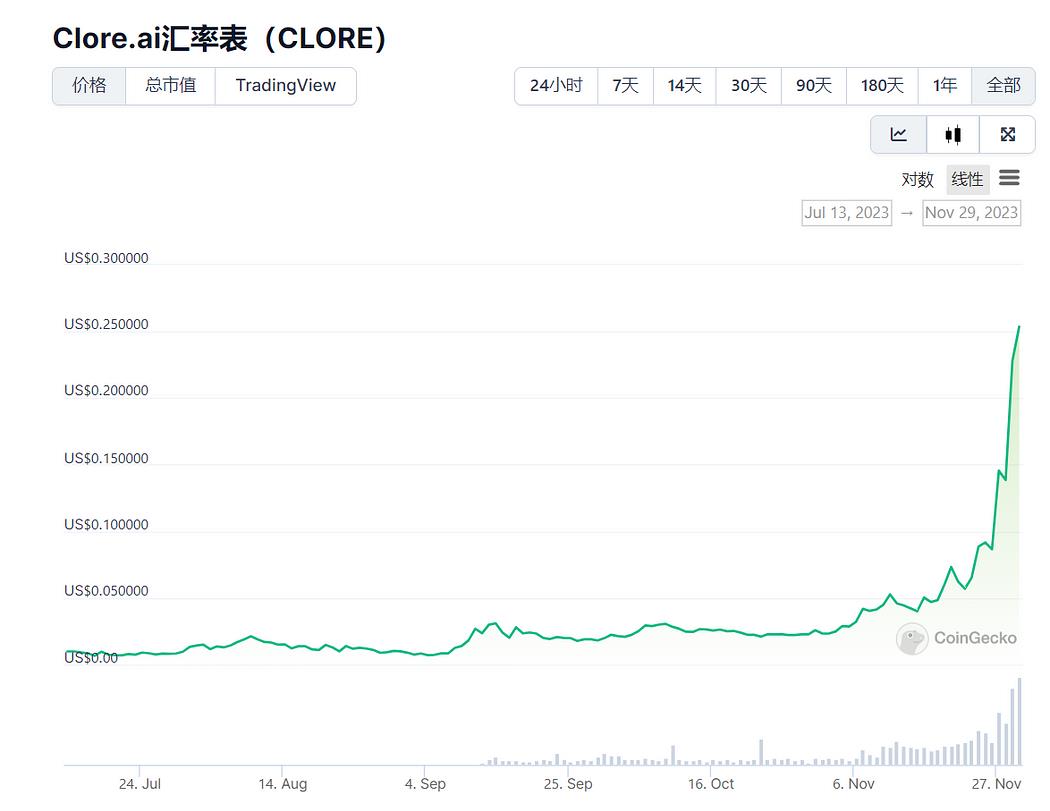
Over 80% of trading occurs on MEXC, with around 10% on Gate.io. Trading volume has steadily increased over the past month, rising from about $1 million at the beginning of the month to over $10 million currently.
2. Background of the Computing Power Industry
As internet technology advances and matures, humanity seeks new technological breakthroughs to unlock fresh economic growth drivers. Artificial intelligence has become a focal point of the next wave of technological revolution. With the phased success of ChatGPT and ongoing progress in autonomous driving, computing power has emerged as a new infrastructure.
NVIDIA CEO Jensen Huang stated in an interview that 2023 marks only the beginning of computing power construction, with the boom expected to last at least until 2025. According to the "State of AI 2023" report by venture capital firm Air Street Capital, major tech companies are building A100 clusters and plan further investments in 2024. The flagship H100 AI processor is projected to ship between 1.5 million and 2 million units in 2024—triple the estimated 500,000 units this year. For small and medium-sized tech firms, third-party computing power service platforms represent a viable alternative.
Against this backdrop, POW+AI computing power service projects have gained traction, leveraging blockchain models to aggregate distributed computing resources for individuals and institutions in need.
3. Products and Services
Business Model
Clore.AI operates as a GPU computing power rental platform. Users with NVIDIA GPUs can connect their hardware to the network and earn CLORE tokens as rewards. Those requiring computing power can rent these resources.
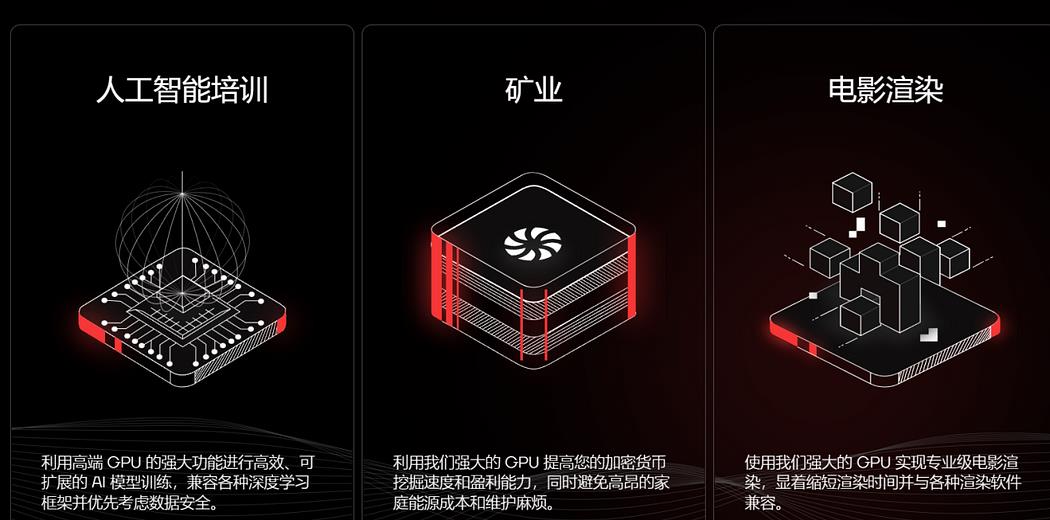
Services include AI training, film rendering, VPN, and cryptocurrency mining. When computational tasks are available, the network allocates work accordingly. Otherwise, the system identifies the most profitable cryptocurrency to mine at that time.
Pricing
Specific GPU models, configurations, and rental prices are listed on the official website. Providers earn CLORE tokens as rewards—the higher the server performance, the greater the reward. Users can pay in CLORE, BTC, or USD.
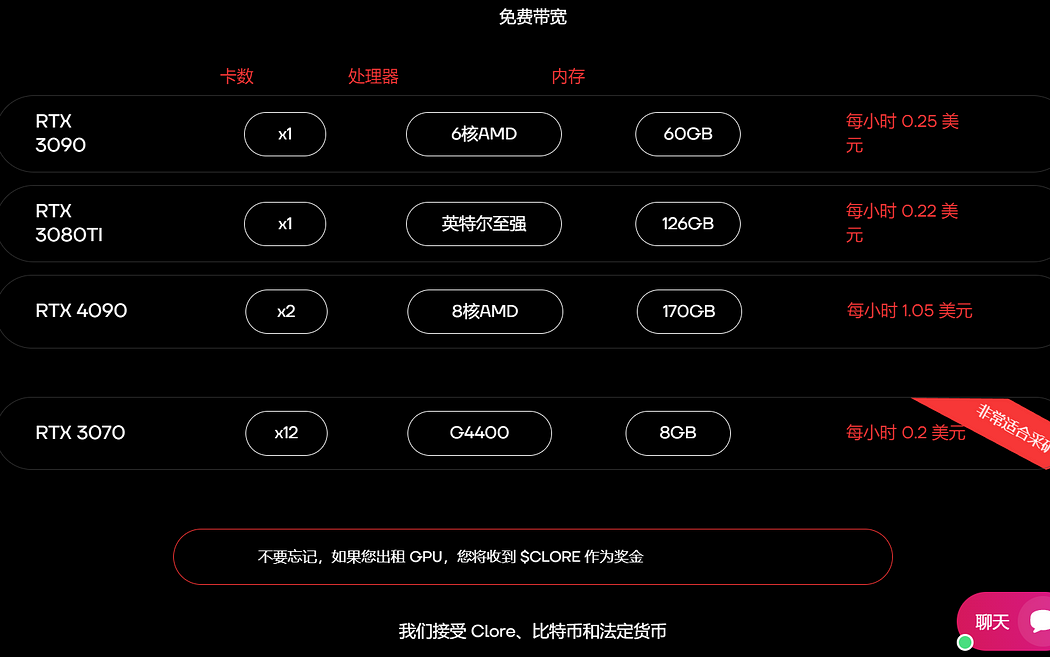
The primary chips in this market are the RTX30 and RTX40 series—NVIDIA’s high-performance graphics cards launched in 2018 featuring ray tracing, positioned in the mid-to-high-end segment of NVIDIA’s lineup. They are widely used in gaming, content creation, and rendering. The RTX40 series is branded as the "ultimate platform for gamers and creators." For large-scale AI training, however, the latest H100 and A100 chips are more commonly used. Therefore, given Clore.AI’s current computing power configuration, applications like film rendering and mining are more feasible, while AI training and large-scale computation remain weaker compared to major data centers.
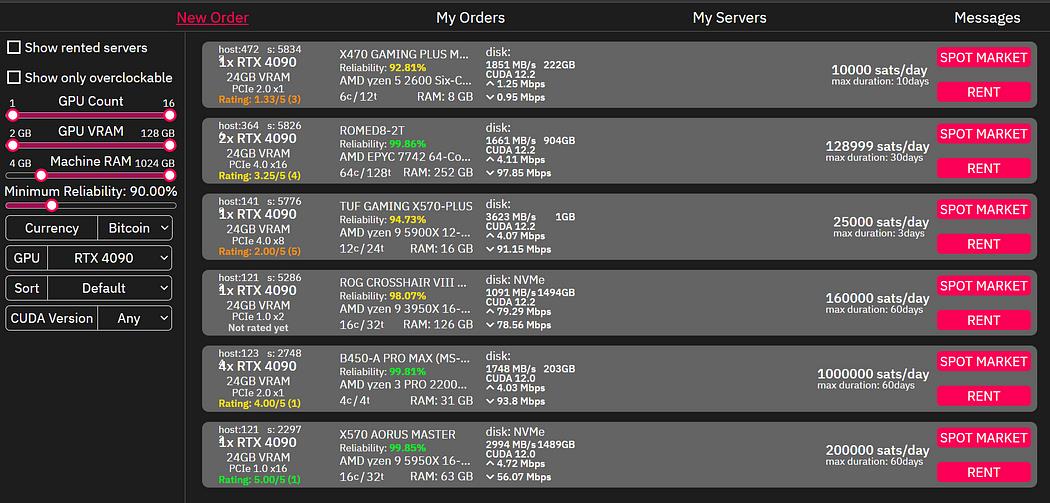
Users can check specific models, configurations, and pricing directly on the website.
Network Data
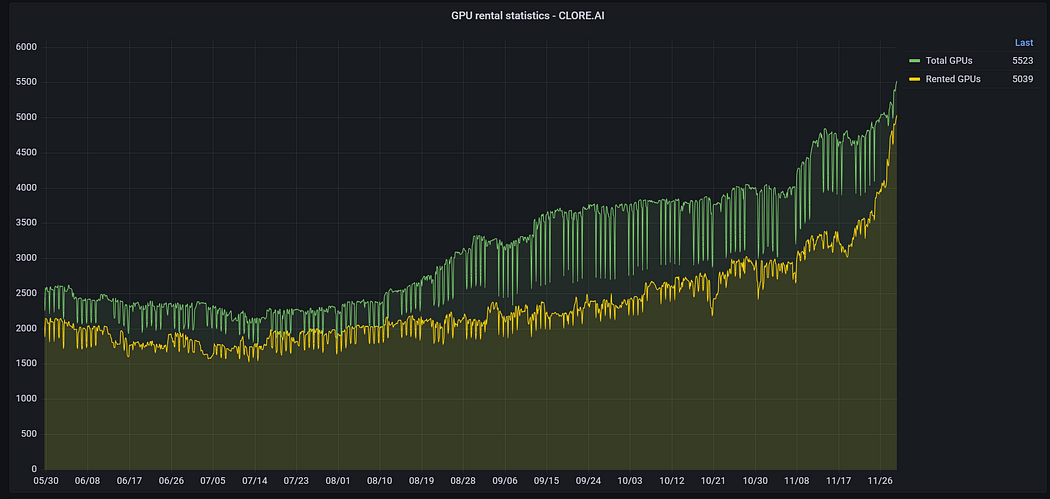
According to the official website, the network hosts over 5,500 GPUs, with approximately 5,000 rented out and nearly 30,000 orders fulfilled. The number of connected GPUs is on an upward trend, doubling from around 2,000 in July to over 5,500 in six months.
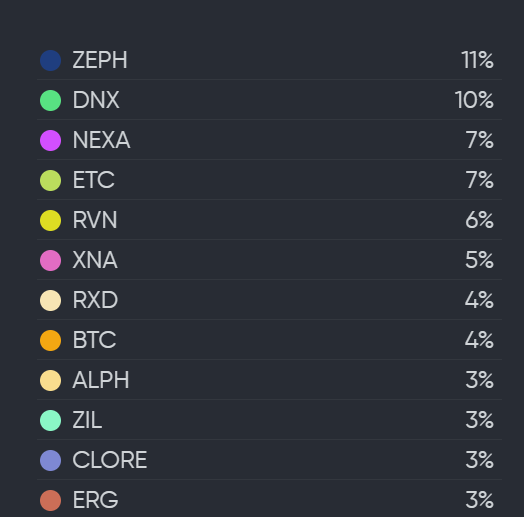
With rising token prices, miner earnings have increased, leading to a rapid rise in GPU computing power share—from around 1.6% previously to 3% in the past week.
4. Tokenomics
CLORE is a POW token using the KawPow algorithm—same as Ravencoin—and is ASIC-resistant. There was no pre-mine or ICO. Each block's reward is distributed as follows: 50% to miners, 40% to providers, and 10% to the team.
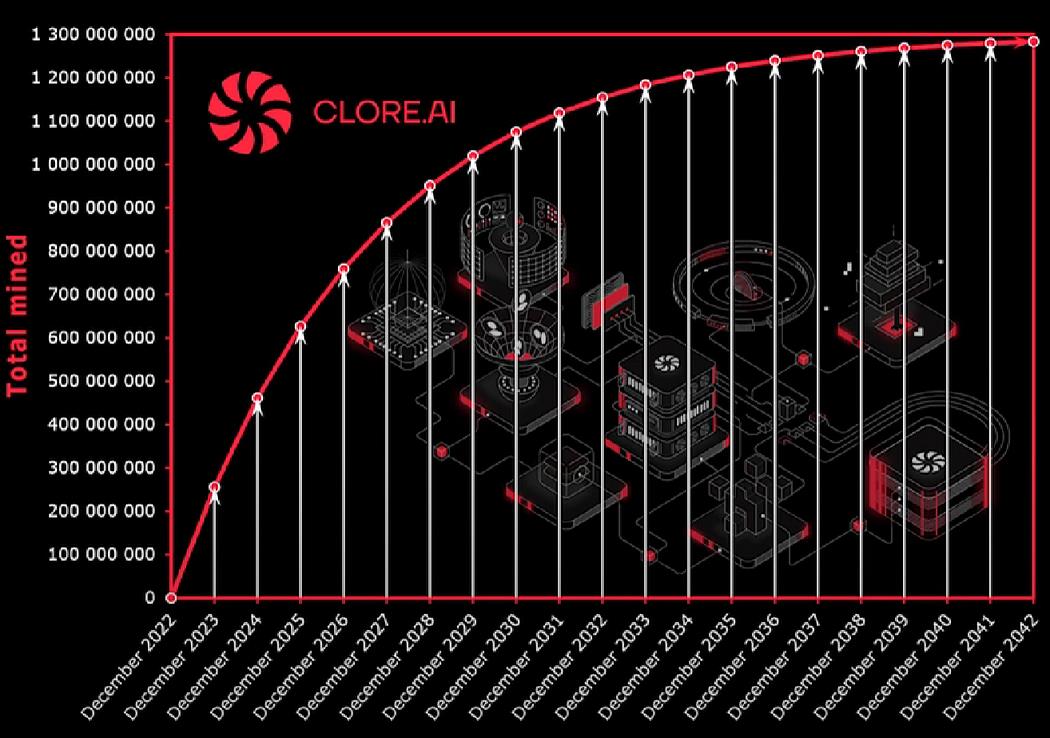
Total supply is 1.3 billion tokens. Mining started in June 2022 and will reach near-full circulation by 2042. Current circulating supply is about 220 million. By end-2023, circulation will be ~250 million (20% of total); by end-2024, ~460 million (35%); by end-2025, ~620 million (48%).
Token release schedule:
Proof of Holding (POH)
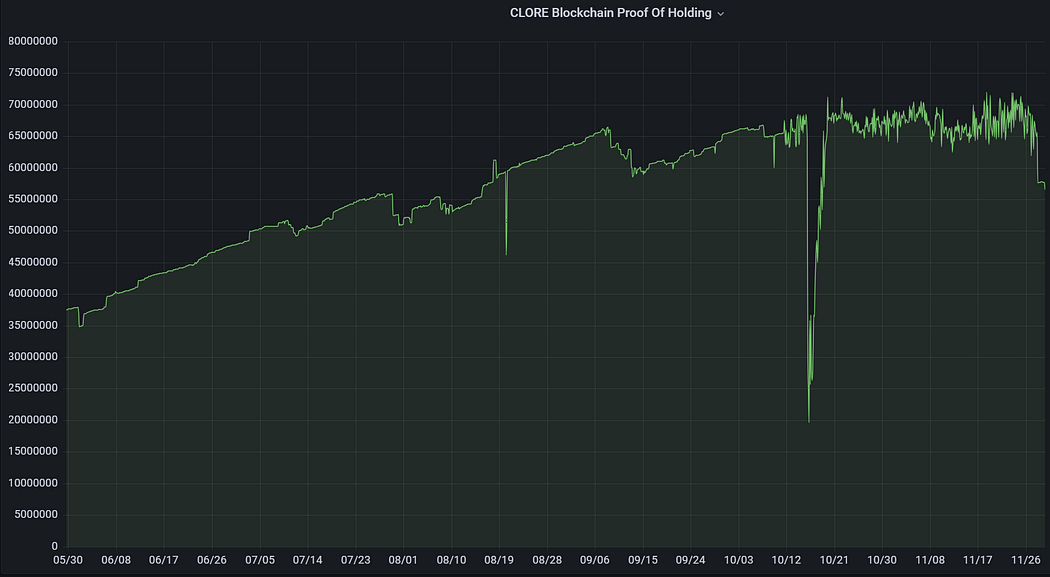
The project introduced the Proof of Holding (POH) system to incentivize CLORE holders. Participants retain full control of their tokens in personal wallets with no lock-up period. The more CLORE held, the higher the rewards when renting out devices, and users can receive up to 50% discount on rental fees. Currently, around 56 million tokens are participating in POH, representing approximately 25% of the current circulating supply.
Token Holder Distribution
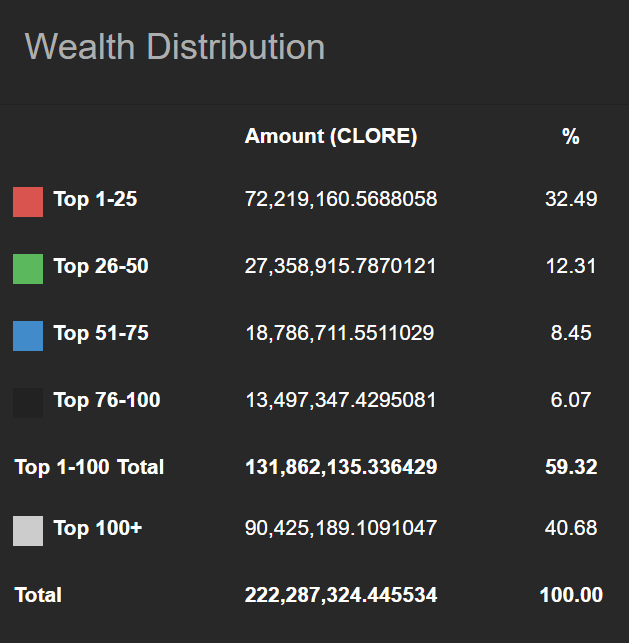
The top 100 addresses hold 130 million tokens, accounting for 59.32% of the current circulating supply. As the blockchain explorer does not label addresses, the exact distribution among holders cannot be determined.
5. Future Development
According to the team’s roadmap, key milestones for the coming year include:
December 2023: Focus on marketing, promoting exchange listings, and identifying new partners.
Q1 2024: Launch Clore Storage, enabling storage space rental and collaborative data management.
Q2 2024: Introduce Clore VPN for secure browsing; launch CLORE OS with server monitoring features to track GPU performance metrics in real time.
Q3 2024: Build a unified marketplace on CLORE OS to enable dynamic resource allocation, optimizing both heavy computational workloads and mining strategies.
6. Conclusion
From a fundamental perspective, Clore.AI fits the POW+AI dual narrative. Its GPU computing platform is already operational, forming a mid-to-high-end GPU cluster with a clear and complete business model. The team has demonstrated a well-defined development roadmap and consistent execution, delivering on previous commitments on schedule.
From a capital flow standpoint, recent market enthusiasm around POW and AI has driven investment into low-market-cap projects. Clore has achieved a tenfold gain in 30 days, indicating substantial short-term appreciation.
Going forward, key areas to monitor include sustained GPU growth, stability or expansion of computing power share, and whether the project secures partnerships or contracts with major corporations.
Join TechFlow official community to stay tuned
Telegram:https://t.me/TechFlowDaily
X (Twitter):https://x.com/TechFlowPost
X (Twitter) EN:https://x.com/BlockFlow_News
 Cycle Capital Research







