Cake War Coming Soon? A Guide to Participation Methods and Earnings Analysis
TechFlow Selected TechFlow Selected
Cake War Coming Soon? A Guide to Participation Methods and Earnings Analysis
The next 10-billion-dollar DeFi protocol on BSC might be about to emerge.
 Navigating Web3 tides with focused insights
Author: CapitalismLab
The Cake War is stirring beneath the surface—BNB Smart Chain may soon birth its next $1 billion DeFi protocol. Participants have already launched Blast-style deposit-to-earn airdrop campaigns, with additional IDO allocations on top. The IDOs featured during the Pendle War have already returned 10x. This thread will unpack the Cake War, how to participate, analyze potential returns, and teach you how to assess expected yields in any "xxx War" going forward.
First, let’s clarify: since we orchestrated the Pendle War, many in the community have asked whether we’re behind this one too. We are not—and we’d actually like to critique some of their questionable moves. However, given Cake’s prominence and the high expected value of the Cake War, it’s worth writing up an analysis of potential returns. Besides, why hand-hold project teams through their own game?
This thread is structured into four parts:
A. Introduction to Cake War
B. How to Participate in Cake War
C. Estimating Returns from Cake War and Other “xxx War” Events
D. Summary
A. Introduction to Cake War
Cake has evolved from its syrup pool system to a veTokenomics model similar to Curve’s, allowing users to lock CAKE for veCAKE to boost LP rewards and vote on incentive distributions—introducing ongoing bribe revenue streams into the ecosystem.
This naturally creates an opportunity for Convex-like protocols aiming to capture veCAKE voting power—thus giving rise to the Cake War.
Its biggest differentiator lies in Cake V3, which features concentrated liquidity pools (CLAMM), akin to Uniswap V3. Most existing DEXs combining veTokenomics with CLAMM only support Gamma Strategies-style managed positions—meaning the protocol manages your liquidity deployment and rebalancing. For CLAMMs, which are highly exposed to impermanent loss, this approach often backfires, leading to losses over time. As a result, such protocols have failed to scale.
In contrast, Cake V3 offers incentives based on concentration levels of liquidity, enabling users to freely deploy their own positions. In essence, it's a pure, tokenomics-enhanced version of Uniswap V3. Additionally, Cake supports standard Uniswap V2 and Curve V1 trading models, accommodating a broader range of liquidity needs. Therefore, Cake can serve as a comprehensive hub for nearly all types of liquidity provisioning.
B. How to Participate in Cake War
Currently, there are three main contenders:
2. Equilibria team’s incubated project, Skillet Finance;
3. Stake DAO, the historically highest participation-rate player in such wars;
4. Butter Finance, previously launched by the Aura team, has announced withdrawal.
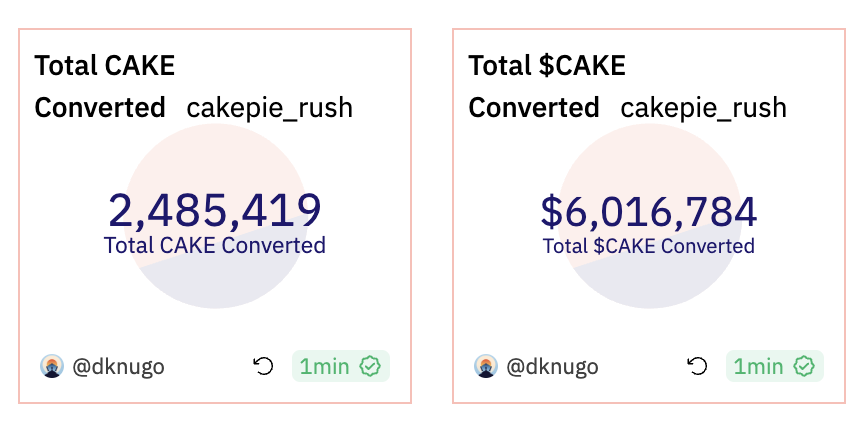
Both Cakepie and Skillet have already launched Blast-style deposit-to-earn airdrop programs, offering additional IDO allocations. Magpie, riding high on Penpie’s prior success and supporting migration of already-locked CAKE, has successfully raised over $6M worth of CAKE for Cakepie. But don’t rush in yet—these activities come with risks. Read the next section before making any decisions.

C. How to Estimate Returns from Cake War and Other “xxx War” Events
Let’s take the previous Penpie event as an example. Early participants deposited 4M PENDLE (~$1.6M at $0.4 each) via the Pendle Rush campaign. They received 200k PNP in airdrops and 600k PNP in IDO allocations. The IDO was priced at a $3M FDV ($0.3 per token). The current price has surged 10x to $3.3.
Total return for early participants: 3.3 * 200 + (3.3 - 0.3) * 600 = $2.5M. That means every $1 deposited yielded ~$1.6 in returns—a 160% ROI. Even measured in PENDLE terms, that’s a 60% gain, realized within months. Plus, those who held long-term benefited from high APRs on mPENDLE and vlPNP—adding roughly another 20% over half a year. (Pendle War details)
Of course, risks existed—primarily depeg risk. The mPENDLE tokens issued via Pendle Rush did not initially redeem 1:1 for PENDLE. The mPENDLE/PENDLE ratio opened at just 0.75 and later recovered to around 0.95 through strategic maneuvers (recently dipped again due to arbitrage). This implies potential principal loss, especially for those rushing to exit early.
Key factors for estimating early participant returns in any “xxx War”:
1. Participant TVL size;
2. Airdrop allocation;
3. IDO allocation and IDO FDV;
4. Projected total FDV;
5. Exit slippage / depeg risk.
Even ignoring complex calculations, precise numbers remain elusive now—IDO FDVs and allocations for Cake War participants haven’t been finalized. But we can make rough estimates:
-
DeFi protocol valuations typically depend on TVL and revenue, both closely tied to the underlying protocol.
-
Pancake’s TVL is about 6x that of Pendle; Cake’s daily emissions (~$100K) are roughly double Pendle’s. So, we can conservatively estimate Cakepie’s FDV at around 3x Penpie’s.
If other variables remain similar, Cakepie could generate ~3 * $2.5M = $7.5M in total value. With additional participants, early movers might collectively see over $10M in returns.
However, unlike the tightly orchestrated Pendle War, Cake War involves far more uncertainties. Underperformance is very possible—so let’s not oversell it.
Despite these uncertainties, Magpie has leveraged its track record of delivering profits via Penpie to raise over $6M in CAKE for Cakepie—similar to how Blast gained traction. The key difference? Converting locked CAKE is unlikely to be 1:1 reversible. The degree of depeg depends heavily on the team’s competence. Without strong credibility, new projects face steeper climbs.
Magpie’s subDAO model has already proven itself with Penpie. The community knows how Cakepie will distribute rewards, and early deposits come with bonuses—making it naturally attractive.
Their recent move to support migration of previously locked CAKE further strengthens their position. After all, most likely participants in a Rush-style campaign are long-term holders—whose CAKE is likely already locked. (Related thread)
For Skillet Finance, watch for the dual airdrop narrative. Based on available info, the EQB team plans to establish a parent DAO (or holding entity), under which EQB and Skillet will operate as sub-DAOs. The parent DAO’s token would then be used to incentivize growth across sub-DAOs. Details are still unclear, but this structure could offer unique advantages and alpha opportunities.

For StakeDAO and others, monitor their benefit structures closely. Also, use Defi Wars to analyze historical depeg performance of their past projects to better evaluate risk-reward trade-offs.
We’ve long argued that BD (business development) capability is a core competitive edge for DEXs—especially in veTokenomics systems reliant on bribe economies. Given that only Magpie turned a profit from Cake IFOs over the past year while others nearly went to zero, expectations for Cake-native players should be tempered. Still, Binance-affiliated resources could provide some upside. With active competition among players, this space deserves close attention.
D. Summary
1. Cake War could bring BNB Chain a Convex-like protocol with ~$1B TVL and ~$100M FDV, revitalizing the ecosystem;
2. Early participants may achieve substantial short-term gains—but must carefully weigh depeg risks;
3. Cake War remains highly uncertain—clear projections are premature.
Join TechFlow official community to stay tuned
Telegram:https://t.me/TechFlowDaily
X (Twitter):https://x.com/TechFlowPost
X (Twitter) EN:https://x.com/BlockFlow_News
 CapitalismLab