








TON Ecosystem Report: Trends and Opportunities, How to Find Your Entry Point in the TON Ecosystem?
TechFlow Selected TechFlow Selected
TON Ecosystem Report: Trends and Opportunities, How to Find Your Entry Point in the TON Ecosystem?
This report primarily organizes the early ecosystem development, public chain updates, and technical progress of TON Blockchain, analyzing data growth, narrative perspectives, and development trends within the TON ecosystem.
 Navigating Web3 tides with focused insights
In September 2023, Telegram and the TON Foundation officially announced a partnership to integrate TON’s self-custodial crypto wallet “TON Space” for Telegram users. This marks the first official collaboration between the two since Telegram abandoned its originally founded “Telegram Open Network” project in 2020 due to regulatory compliance issues. As a result, leveraging Telegram's social platform as a traffic gateway has become a core competitive advantage for TON.
The convergence of Web2 traffic, Web3 users, social media platforms, and high-performance public blockchain infrastructure has made the still-early-stage TON ecosystem highly attractive to investors. This report compiles information on the early development of the TON Blockchain ecosystem, blockchain upgrades and development progress, on-chain ecosystem data, and related funding activities, analyzing data growth, narrative angles, and development trends within the TON ecosystem for reference.
This report is jointly written and published by Starbase and Blocktempo, with special thanks to TON and TonX Studio for content suggestions and support.
I. Project Fundamentals
1. Project Overview
1.1 Team Information
Steve Yun: Chairman of the TON Foundation
The TON Foundation (formerly NewTON team) is currently led by Steve Yun, Chairman of the TON Foundation.
Steve Yun previously served as Chief Operating Officer at Koinvestor.
Bill Qian: Board Member
In September 2022, Bill Qian, former head of global M&A and Binance Labs at Binance, joined the TON Foundation as a board member.
Andrew: Board Member
Former CEO of vk.com.
John Hyman: Telegram Chief Investment Officer
John Hyman, former chief investment advisor at Telegram, was involved in Telegram’s fundraising efforts.
1.2 Funding Information
In April 2022, the TON Foundation announced the establishment of a $250 million ecosystem fund called TONcoin Fund. Investors include venture capital arms of cryptocurrency exchanges Huobi and KuCoin. The fund will support financing, incubation, hackathons, education programs, and grants for projects built on TON. (In 2023, the TON accelerator program allocated $25 million to advance ecosystem development.)
Also in April 2022, the TON Foundation announced receiving approximately 527 million Toncoins (about 10.54% of total supply) donated from the community through 176 transactions.
1.3 Code Updates
As an open-source protocol, TON has over 30 code contributors. In the past month, three members submitted 28 commits.

1.4 Product/Technical Features
(1) Positioning
The Open Network (TON) is a decentralized computing network based on blockchain, initially designed by the Telegram team and outlined in a whitepaper authored by Telegram founder Durov. It aims to become a Web3.0 network encompassing the TON blockchain, decentralized storage, I2P network, instant payments, and highly usable decentralized applications.
TON Blockchain is a tightly coupled multi-blockchain system (viewed as a collection of blockchains), supporting infinite sharding and customizable workchains.
(2) Core Features
To achieve higher TPS, TON Blockchain’s core lies in supporting parallel transaction processing and validation, along with asynchronous smart contract execution. TON Blockchain defines three structural layers: Masterchain (main chain), Workchain (work chain), and Shardchain (shard chain).
-
Masterchain (Main Chain): Contains general information about the protocol and current parameter values, validator and stake information, workchains and shard information, and most importantly, recent block hash sets from workchains and shardchains.
-
Workchain (Work Chain): Up to 2³² workchains can be registered and operated as the "main force," containing transactions and smart contracts. Different workchains can have different "rules"—such as different account address formats, transaction formats, smart contract virtual machines, and base currencies. However, they must adhere to basic interoperability standards to enable smooth interaction across workchains. (This model is analogous to Polkadot.)
-
Shardchain (Shard Chain): Each Workchain supports up to 2⁶⁰ shards and corresponding Shardchains. Shardchains follow the same rules and block format as their parent Workchain but only manage a subset of accounts—essentially a built-in homogeneous sharding mechanism.
Workchains and the Masterchain share validator nodes. By introducing a main chain for endorsement, TON shortens transaction confirmation time to just one new block generation—approximately 5 seconds.
(3) Public Blockchain Comparison
In November, TON livestreamed a new TPS record of 104,715.

1.5 Economic Model and Token Utility
TON has an initial total supply of 5 billion tokens. Between June 2020 and June 2022, miners extracted all TON via PoW, accounting for 98.55% of total supply, while the team holds the remaining 1.45%. Toncoin was initially concentrated among miners, resulting in relatively low decentralization. The top 100 whale addresses hold 49.51% of total Toncoin supply.
Currently, PoS validators on the TON network earn TON rewards through staking, operating similarly to ETH.
According to CoinMarketCap, as of November 3, TON has a circulating supply of 5.047 billion, an annual inflation rate of 0.6%, a current circulating supply of 3.431 billion, and a market cap of approximately $7.09 billion, ranking 11th globally. In 2023, the TON ecosystem voted to burn half of transaction fees to reduce circulating supply.
Further referencing other data: According to tontech.io, large miners froze a total of 1,081,391,286.092 tokens at the beginning of this year; per tonviewer data, the belever fund recently locked 1,317,379,088.44 tokens. Combined, these figures suggest approximately 2,398,770,374.53 tokens are currently non-circulating, out of a total supply of 5,097,272,074.94, leaving a current circulating supply of about 2,698,501,700.41.
(Source: https://tontech.io/stats/#/early-miners; https://tonviewer.com/Believers.ton)
Toncoin is the native cryptocurrency, directly usable within the massive Web2 social app Telegram, effectively serving as the “fiat currency” within the Telegram ecosystem. Its primary uses include:
-
Executing smart contracts and paying transaction fees, DApp payment settlements, cross-chain transaction fees.
-
Proof-of-stake consensus maintenance, lending to validators to earn interest.
-
Participating in on-chain governance of the TON network.
-
Payment for other TON network components such as domain names (with future plans including TON proxy and decentralized storage payments).
For example, users can currently get a 50% discount on Telegram premium services when paying with TON; purchase advertising services within Telegram; or pay for phone number/domain value-added services.
2. TON Development and Roadmap
2.1 Historical Milestones
-
2018: Telegram launched the Telegram Open Network project, raising approximately $1.7 billion via ICO
-
2019: Telegram faced SEC allegations of illegal fundraising
-
2020: During the waiting period for SEC judgment, TON Labs forked and released the “Free TON” version (later renamed Everscale)
-
May 2020: Telegram agreed to pay an $18.5 million fine to settle with the SEC, abandoning the Telegram Open Network project and returning funds; around the same time, developer communities took over, with the NewTON community continuing development
-
May 2021: Establishment of the TON Foundation; Telegram Open Network rebranded to The Open Network
-
April 2022: Launch of a $250 million ecosystem fund
-
June 2022: Completion of PoW mining and testnet 2 token distribution, with most token holdings unknown; during this period, the TON network fully transitioned to PoS
-
September 2023: Native wallet TON Space integrated into Telegram accounts, enabling connection to various Web3 applications built on TON
2.2 Team Development Plan
Key focus areas for TON in Q4 2023 include:
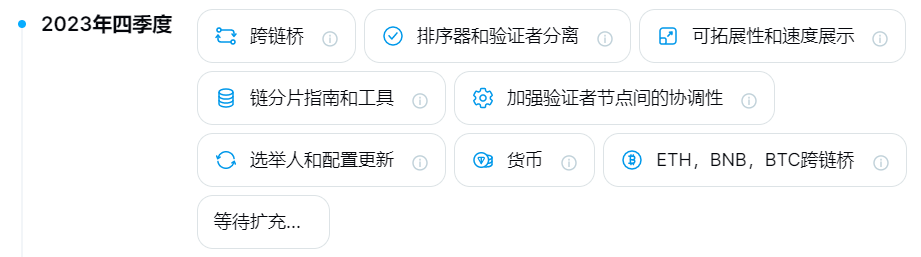
Regarding cross-chain bridges, the official TON bridge supports asset transfers between TON and ETH/BSC; official bridges to other chains are still under development.
II. TON Ecosystem Development Status
1. Developer Growth
As of November 2023, Developer Report recorded 6,279 full-time developers and 19,279 monthly active developers globally. Among them, TON has 28 full-time developers (0.45%) and 124 monthly active developers (0.64%), indicating it remains in a very early stage.
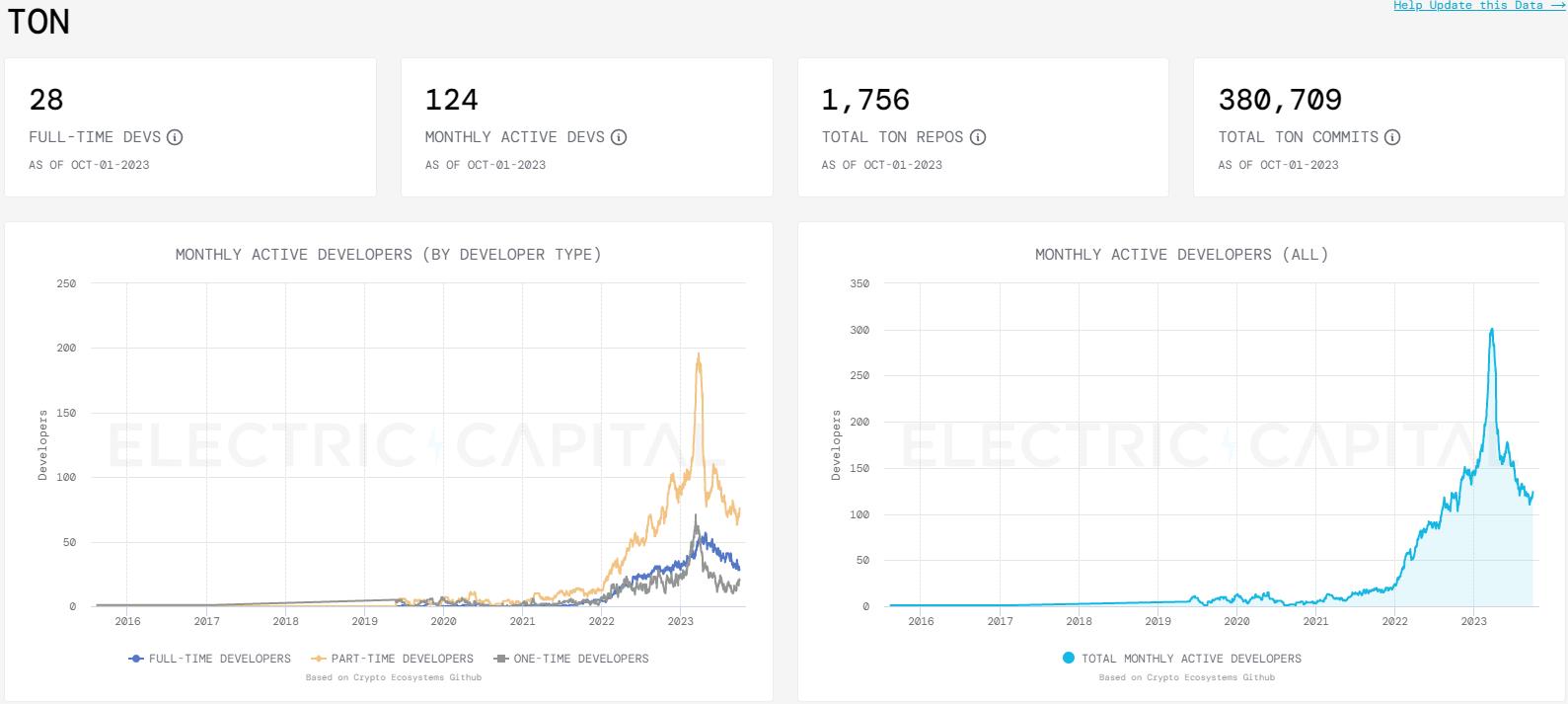
Source: https://www.developerreport.com/ecosystems/ton
2. TON Ecosystem Data Overview
2.1 Node Data
According to TonStat data, there are currently 357 validators distributed across 25 countries. Total staked amount on TON is approximately 460 million tokens, representing 9.11% of total supply.
2.2 Funding Scale
Staking Data:
According to TonStake data, total staked value on the TON network is around $3.95 million, with an APR of approximately 5.54%. There are 193 active validators out of 326 total validator slots. (The dPoS consensus algorithm divides nodes into Round A and Round B, rotating every 18 hours. Currently, 193 validators are active.) Long-term TON holders may consider staking.
TVL:
According to DeFiLlama, TON’s current TVL is approximately $9.56 million, ranking 64th among public blockchains. The top three projects are Tonstakers ($12.97M) and bemo ($8.45M) in liquid staking, and Megaton Finance ($3.38M) in the DEX sector.

2.3 On-chain Users
According to TonStat, TON has 3,650,140 accounts and 856,000 active addresses.
Newly added addresses grew rapidly from September 2022 to January 2023, primarily driven by a short-term peak in TON trading volume (reaching $2.6 on September 20); another surge occurred in May 2023, likely due to liquidity incentives from the foundation and the launch of the official cross-chain bridge. Concurrently, increased popularity of Telegram bots also boosted attention toward the TON ecosystem.
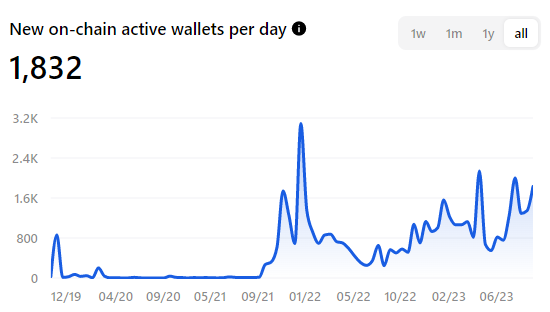
Over the past year, active addresses in the TON ecosystem have steadily increased, accelerating in early 2023. Account numbers have grown beyond 3.65 million, showing that users are entering the ecosystem faster than developers.
3. Major Sectors, Representative Projects, and Funding Status
The TON ecosystem is structured largely like an app store. Based on ton.app data, TON ecosystem categories are divided into 19 types, including wallets, games, NFTs, staking, cross-chain bridges, social, gambling, and others. Distribution is as follows:
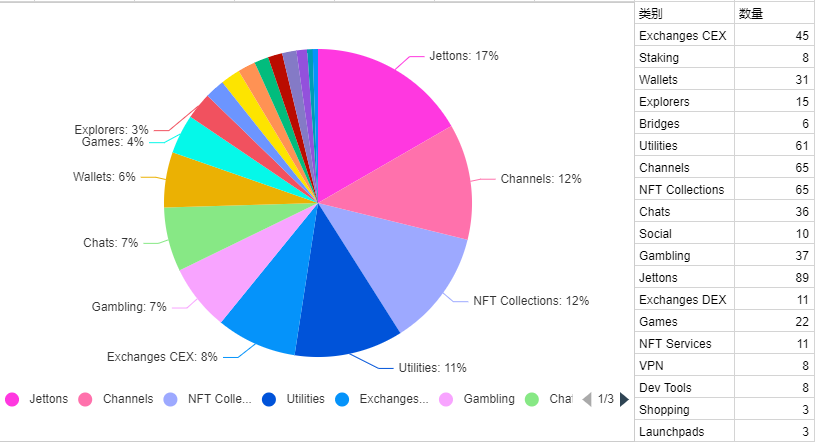
Source: https://ton.app/categories
Based on incomplete statistics, there are currently 551 projects in the TON ecosystem. The top five categories by count are Jettons (the TON network token standard), NFT collections, Telegram channels, utility tools based on TON, and centralized exchanges (CEX). Although the number appears large, many entries are simply Telegram groups. Overall, the ecosystem remains in a very early stage.
Selected representative cases and valuations for reference:
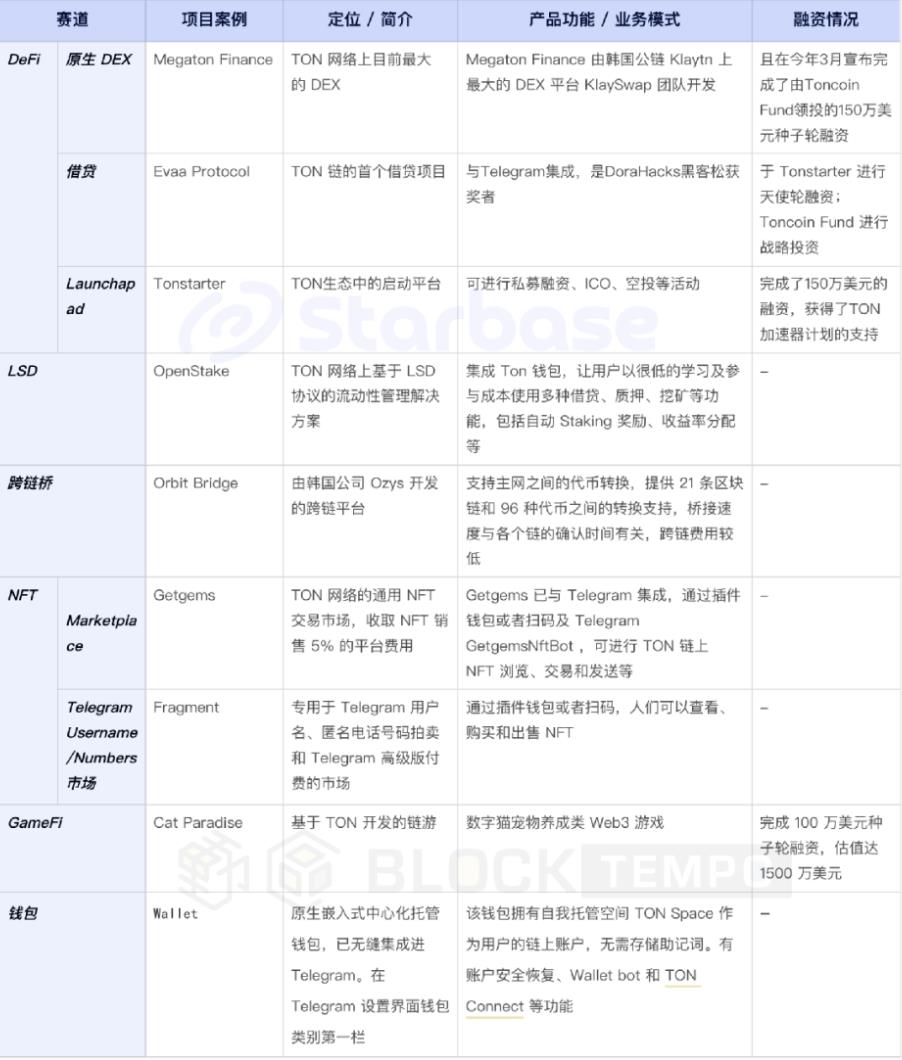
Excluding broad classifications, notable sectors in the current TON ecosystem include:
DeFi & LSD
DeFi products on TON have not yet established dominant players; LSD protocols and related offerings remain in blue ocean territory.
Game & Gambling
This sector draws inspiration from WeChat mini-games—characterized by reliance on high-traffic entry points, simple operations, easy onboarding, short gameplay cycles, and monetization features. Early game development in the TON ecosystem largely follows this model.
Anonymity & Privacy
From Telegram’s resource trading platform Fragment, we see strong user demand for anonymity and privacy services—including purchasing usernames, anonymous accounts, and secondary market trading. For instance, Telegram users leverage the Fragment platform to buy anonymous numbers using TON, allowing registration without SIM cards and receiving verification codes—greatly enhancing user privacy protection. Prices for such anonymous accounts in secondary markets are rising rapidly.
Wallets
With the release of the official custodial wallet and the built-in non-custodial wallet TON Space, earlier wallets face significant challenges. For example, Tonkeeper—an open-source, non-custodial wallet based on TON—supports both iOS and Android systems. Most TON applications currently support wallet login via QR code scanning, ensuring good ecosystem compatibility.
Cross-chain Bridges

Currently, the official TON bridge enables asset swaps between TON and ETH/BSC, though cross-chain fees are slightly high. Official bridges to other chains are still in development. Third-party bridges are gradually integrating, although their numbers remain small. However, the ecosystem leverages Telegram bot tools to offer more convenient solutions for user cross-chain needs.
Third-party bridges currently include Orbit Bridge, Wallet Bridge, Tontake Bridge, and XP.NETWORK:

Sources: https://ton.app/bridges; https://tlg.pm/channels/95101f58-ca7c-4ef8-b05f-297a963ce42c/
Regarding the TON ecosystem’s cross-chain landscape, the official stance shows limited enthusiasm for cross-chain integration or EVM compatibility. From inception, TON did not prioritize interoperability, aiming instead to cultivate its own ecosystem. Given Telegram and TON’s strong influence over traffic, internal user demands for cross-chain functionality can already be met through Telegram bots, channels, and official/third-party bridges. Especially with the rise of bots, which enable fast, low-barrier interactions aligned with user habits, cross-chain access is no longer a major hurdle.
While third-party bridges are slowly connecting to TON and remain few in number, the sheer volume of cross-chain projects means TON adds another destination. From a traffic perspective, TON + Telegram should be compared more closely to platforms like Discord or Weibo, where inbound demand from other ecosystems far exceeds outbound demand from TON itself.
It is evident that influenced by Telegram bots, bot services have widely penetrated trading, airdrops, data, communities, and cross-chain functions, directly interfacing with users within existing use cases. To some extent, this offers a solution to the long-debated issue of “mass adoption” in crypto. Bot-based solutions are expected to continue expanding within the TON ecosystem, integrating with other narratives and applications to deliver better Web3 experiences.
Additionally, beyond the TG bot model of “pure text-command interaction,” the next-generation mainstream interface will likely include TWAs (Telegram Web Apps). Future Telegram usage will resemble WeChat, with mini-program-like apps deeply embedded across platform, user, and ecosystem layers.
4. Official Ecosystem Support
The TON network ecosystem is currently led by the TON Foundation.
-
In April 2022, the TON Foundation launched the $250 million TONcoin Fund, backed by investors including Huobi, KuCoin, MEXC, and DWF. Publicly available information indicates the fund supports ecosystem-building efforts on TON, focusing investments on key projects across various domains. Individual project funding ranges from $50,000 to $250,000.
-
According to official disclosures, 31 projects were funded in 2022, 10 in Q2 2023, and 5 in Q3 2023, primarily focused on infrastructure.
-
In 2023, TON launched a DeFi liquidity incentive program and hosted the Hack-a-TON hackathon to attract top global developers to the TON ecosystem.
-
In May 2023, TONcoin Fund launched a universal accelerator program, allocating $25 million from the TONcoin Fund to advance ecosystem development.
III. Where Is the Entry Point for the TON Ecosystem?
1. Market Size Expectations
The TON ecosystem leverages Telegram’s user base. While “deployment on Telegram” and “deployment on TON” are not currently synonymous, future cooperation and traffic prioritization between the two cannot be ruled out.
In January 2023, Statista, a data and advisory firm, published what is currently the most comprehensive and reliable dataset on Telegram (data as of January 2023), supplemented with publicly available information from Telegram:
Telegram has 800 million monthly active users (MAUs), over 1.3 billion registered users, and sees more than 2.5 million new registrations daily. This figure is 1.4x that of Twitter (556 million), 61% of WeChat (1.309 billion), 86% of Facebook Messenger (931 million), and exceeds TikTok (715 million).
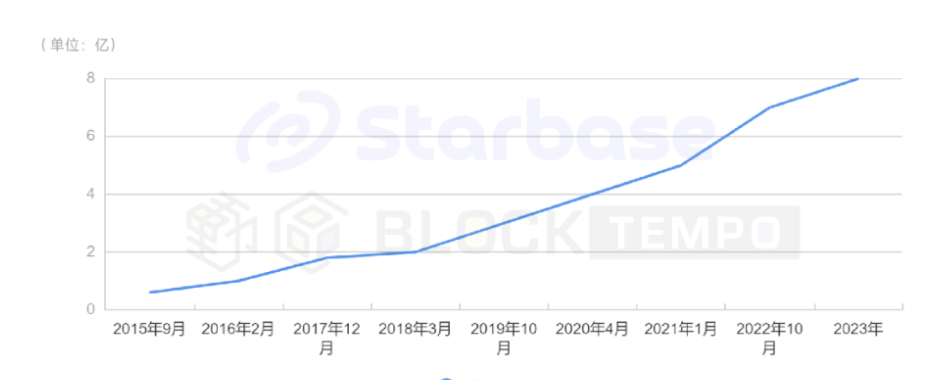
Telegram MAU Growth Trend (Monthly Active Users, unit: 100 million)
Referencing historical Telegram MAU data, user growth has been very stable, increasing annually by 15%-30%. Based on this trend, Telegram’s active user base is projected to reach 960 million, 1.15 billion, and 1.38 billion over the next three years.
The TON Foundation aims to bring 30% of Telegram users onto TON. Conservatively estimating, this would translate to approximately 288 million, 345 million, and 414 million users potentially migrating to the TON ecosystem. Currently, TON has only 3.65 million on-chain accounts, indicating enormous room for growth.
Moreover, beyond its social function, Telegram’s “e-commerce platform” attributes have become increasingly prominent in recent years. Citing report data: in 2020, Chinese exports generated $12 million in sales via Telegram; in 2021, 16% of Russian C2C buyers made purchases on Telegram. Therefore, TON’s ecosystem valuation is better benchmarked against platforms like Meta and WeChat in terms of scale and market cap.
Once the ecosystem stabilizes, different service categories—such as app stores, ad systems, privacy services, membership programs—can be individually valued. According to report data, Telegram had 257,000 paid users as of August 2022.
2. TON Ecosystem: Where Is the Entry Point?
Unlike other public blockchains, TON enters from Web2 use cases, offering extremely low barriers to end-users (C-end). The relatively passive attitude of TON officials toward EVM compatibility suggests that TON has the potential to develop independently based on Web2 scenarios, without needing to replicate the development path of native crypto blockchains. Thus, understanding the TON ecosystem should center on traffic acquisition and conversion.
Drawing parallels with WeChat’s ecosystem evolution:
The entire WeChat ecosystem is rooted in social interaction, providing information (social), then services (payments), which shape use cases like mini-programs, live streaming, etc., ultimately consolidating information, traffic, and services internally. WeChat Pay was a pivotal milestone, later unlocking numerous online and offline payment scenarios, forming a commercial closed loop.
If comparing Telegram and TON to the WeChat ecosystem, benefiting from its user base, the optimal entry points in the TON ecosystem will revolve around traffic—specifically payments, mini-apps (TWA), and content platforms. Application-layer projects will prioritize traffic acquisition and conversion, potentially diminishing the importance of traditional crypto success factors like institutional backing or team reputation. Meanwhile, compared to other Web2 traffic platforms, the Telegram and TON combination is better positioned to attract and retain Web3 users.
Relatively speaking, competitors to the Telegram and TON combo are more likely to come from platforms like Discord entering the crypto space. (Discord also has a growing bot ecosystem and massive user base, but due to security and regulatory concerns, DC has not aggressively pursued crypto.)
Revisiting Telegram user demographics from the report:
-
In terms of user behavior, the average user spent 4 hours per month on Telegram in 2022. 59.5% of Telegram users also use Twitter.
-
In content preferences: 85% follow news, 62% entertainment, 58% education, 13% adult content, and 4% engage with black/grey market channels (dark web-related).
Considering the rise of Telegram bots and similar phenomena, TON has the potential to play the role of a third- or fourth-tier—or even lower-tier—exchange within the crypto industry, attracting and retaining crypto users. Beyond bots, the next mainstream format will likely be TWAs (Telegram Web Apps), analogous to WeChat mini-programs.
Currently, the TON ecosystem is still in its infancy, with no breakout projects yet. All sectors and projects are still positioning themselves or competing for market share.
Demand for financial DeFi features (DEX, lending) may be relatively weak in the TON ecosystem. Drawing from WeChat’s analogy, user transaction habits tend to be small-amount and high-frequency. In contrast, the TON ecosystem is naturally better suited for payments, bots, gaming, and social applications—areas conducive to application-layer breakout narratives. Hence, due to urgent traffic acquisition needs, other blockchains may proactively bridge with TON in the future.
3. Risk Factors
(1) Official Support and Endorsement from Telegram
Telegram is not exclusive to the TON ecosystem and allows easier integration with various chains and protocols—for example, EVM-based trading bots. Currently, deployment on Telegram and deployment on TON remain distinct concepts. The depth of collaboration, degree of traffic prioritization, and openness of the TON ecosystem need to be carefully evaluated.
(2) TON’s Regulatory Compliance Progress
TON has sufficient users and traffic, but sustained growth requires navigating regulatory compliance. Relocating its headquarters to Zug, Switzerland, is widely seen as aligning with Swiss authorities’ generally positive stance toward the cryptocurrency industry.
(3) Degree of Centralization
TON initially faced criticism over overly centralized token distribution. Although freezing mechanisms were implemented later, concerns about centralization persist.
Join TechFlow official community to stay tuned
Telegram:https://t.me/TechFlowDaily
X (Twitter):https://x.com/TechFlowPost
X (Twitter) EN:https://x.com/BlockFlow_News






