Off-Chain Transfers: The Evolution of Bitcoin Asset Protocols
TechFlow Selected TechFlow Selected
Off-Chain Transfers: The Evolution of Bitcoin Asset Protocols
This article aims to explore the future development of Bitcoin asset protocols by reviewing the asset protocols that have emerged in BTC's history.
 Navigating Web3 tides with focused insights
Preface
Issuing assets based on BTC has always been a hot topic. From Colored Coins in 2011 to the recently popular Ordinal protocol, the BTC community continuously spawns new players and consensus mechanisms—yet few endure. However, with ambitious Lightning Labs announcing plans to build a stablecoin on Taproot Assets, and Tether declaring its choice of RGB for issuing USDT directly on Bitcoin's Layer 1, the landscape is shifting.
This marks a turning point: OmniLayer (Mastercoin), once the dominant player in the BTC ecosystem, is no longer alone at the top. Client-Side Validation (CSV) asset protocols are now entering the spotlight. Unlike traditional BTC asset protocols, these bring an added benefit—scaling capabilities for BTC. Yet given the growing number of asset protocols within the BTC ecosystem, one must ask: What differentiates them? How should we choose among them, and where can opportunities be found? This article aims to guide readers through the history of BTC asset protocols and explore their future evolution.
Colored Coins
The concept of Colored Coins was first proposed by Yoni Assia, current CEO of eToro, in an article titled "Bitcoin 2.X (aka Colored Bitcoin)" published on March 27, 2012. The article argued that Bitcoin, as underlying technology, is perfect—just like HTTP is foundational to the web. Building upon this idea, Colored Coins was designed as a token protocol reusing BTC’s infrastructure.
Yoni Assia envisioned creating a BTC 2.0 economy—where any community could issue multiple currencies using this method. Using Bitcoin as base-layer tech for transaction clearing and double-spending prevention was an audacious idea at the time.
As an asset issuance protocol built on Bitcoin, Colored Coins works by “coloring” a certain amount of bitcoins to represent other assets. These marked bitcoins remain functionally identical to regular BTC but simultaneously signify another value or asset. But how could such a system be implemented on Bitcoin?
On July 3, 2014, ChromaWay developed the Enhanced Pay-to-Order-Based Coloring (EPOBC) protocol, simplifying the development process for colored coins. It became one of the earliest protocols to leverage Bitcoin Script’s OP_RETURN feature.
The final implementation looks like this:
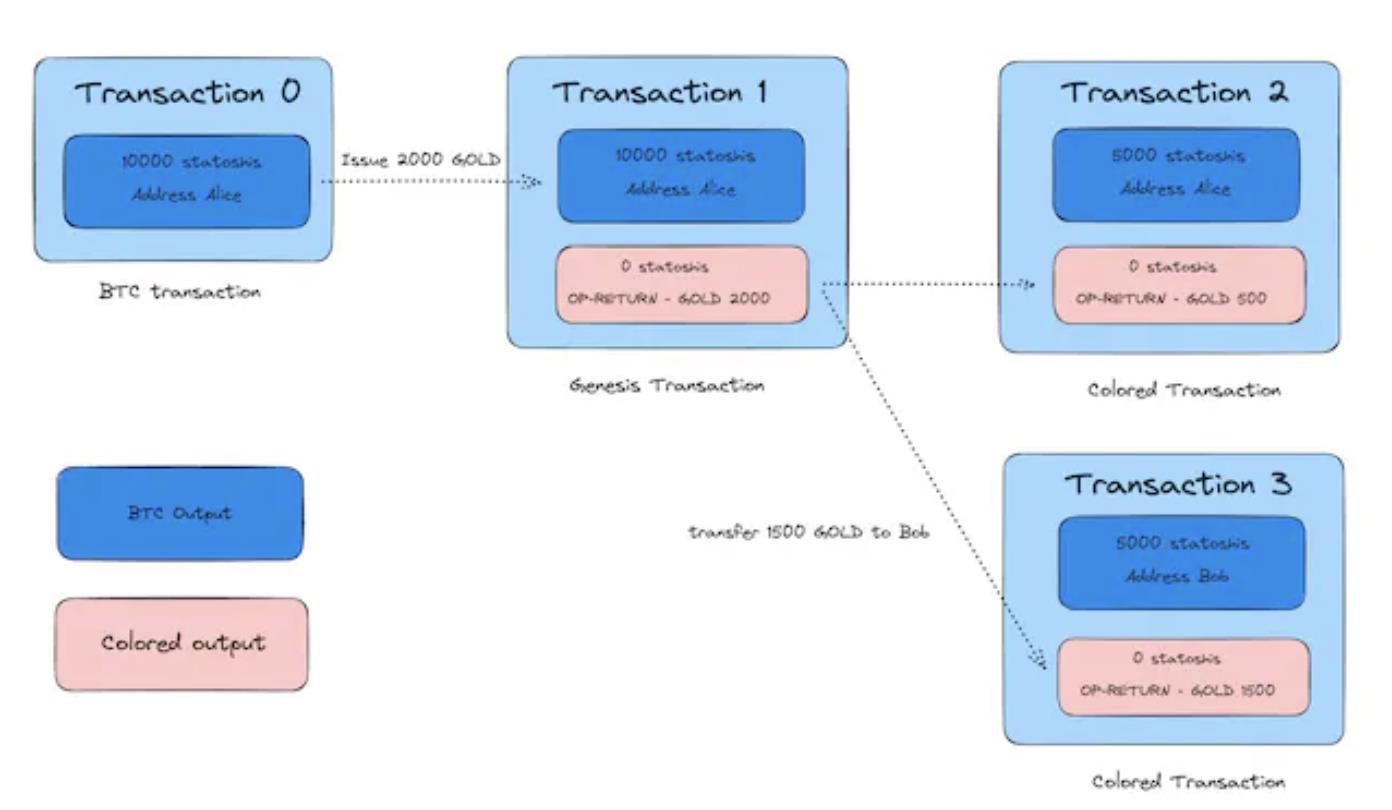
While elegant in design, this approach introduced several issues:
1. Fungible Tokens and Minimum Binding Value
If a genesis transaction binds 1,000 satoshis to a colored coin, then the smallest divisible unit of that asset becomes 1 sat. In theory, this allows splitting into up to 1,000 units. However, due to dust attacks, practical minimums were historically set higher (e.g., 546 sat), and even more so after Ordinals raised thresholds.
2. Verification Issues
To verify authenticity and ownership of a colored coin, users must trace its entire history from the genesis transaction to the current UTXO. This requires dedicated wallets, full nodes, or blockchain explorers tailored for Colored Coins.
3. Potential Miner Censorship Risk
Since Colored Transactions clearly embed metadata in outputs, they become identifiable—and thus vulnerable to miner censorship.
In essence, Colored Coins functions as an asset tracking system relying on Bitcoin’s validation rules. To prove that a specific output represents a given asset, one must provide the full chain of transfers from origin to present. This often results in long proof chains when verifying transaction validity. Some proposed solutions included OP_CHECKCOLORVERIFY, intended to validate Colored Coin transactions natively on BTC—but it never gained consensus.
The First ICO in Crypto: Mastercoin
The original concept of Mastercoin was introduced by J.R. Willett. In 2012, he released a document titled "The Second Bitcoin Whitepaper", outlining how new tokens or assets could be created atop Bitcoin’s existing blockchain—later known as “MasterCoin”, which eventually evolved into Omni Layer.

In 2013, Mastercoin conducted an early token sale—what we now call an ICO (Initial Coin Offering)—successfully raising millions of dollars. This event is widely regarded as the first-ever ICO. Mastercoin’s most notable application was Tether (USDT), the most prominent fiat-backed stablecoin, initially issued on the Omni Layer.
Interestingly, Mastercoin’s idea predates Colored Coins. It’s discussed second here because Mastercoin represents a heavier, more complex solution compared to the lightweight nature of Colored Coins. While Colored Coins focuses simply on tagging UTXOs to represent assets, Mastercoin built an entire node layer enabling advanced features such as smart contracts.
A key difference lies in data handling: Mastercoin publishes only transaction types on-chain, not asset state data. Instead, off-chain nodes scan Bitcoin blocks to maintain a separate database reflecting the protocol’s internal state.
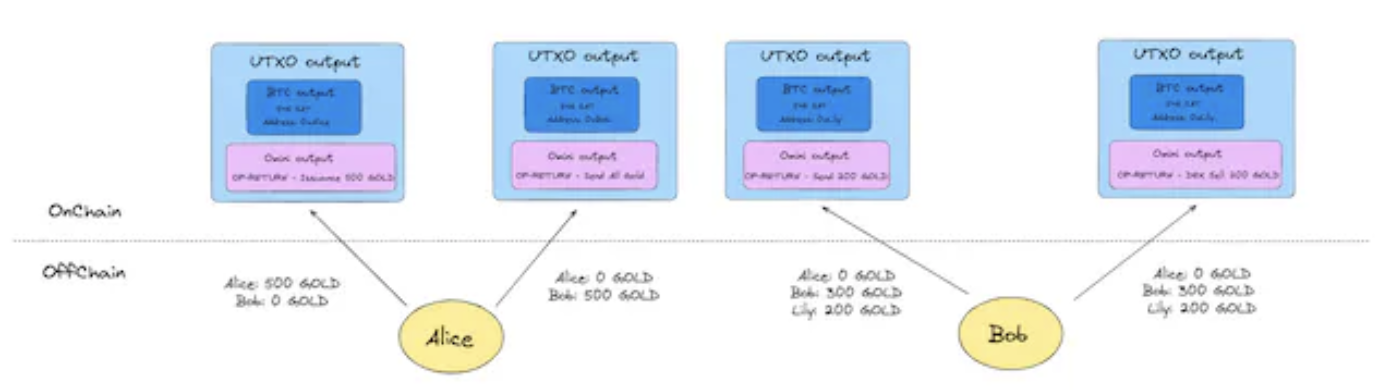
Compared to Colored Coins, Mastercoin supports more complex logic. Since it doesn’t require on-chain state recording or validation, transactions don’t need to follow sequential continuity (“continuous coloring”).
However, to achieve this complexity, users must trust either third-party nodes’ off-chain databases or run their own Omni Layer node for independent verification.
Summary
The fundamental distinction between Mastercoin and Colored Coins is that Mastercoin does not store all protocol-critical data on-chain. Instead, it parasitizes Bitcoin’s consensus system for transaction publishing and ordering, while maintaining state in an off-chain database.
According to information from OmniBolt: Omni Layer is proposing a new UTXO-Based Asset (UBA) protocol to Tether, leveraging the Taproot upgrade to encode asset information into tapleaf structures, enabling conditional payments. Meanwhile, OmniBolt is integrating Stark into Omni Layer’s Lightning Network infrastructure.
Client-Side Validation (CSV)
To understand client-side validation, we must go back to 2013—the year following the emergence of Colored Coins and Mastercoin. That year, Peter Todd published an article titled: Disentangling Crypto-Coin Mining: Timestamping, Proof-of-Publication, and Validation. Though the title seems unrelated, it contains the earliest conceptual seeds of client-side validation.
Peter Todd, an early researcher in Bitcoin and cryptography, sought ways to make Bitcoin more efficient. He expanded the timestamp concept into a broader framework of client-side validation and introduced the idea of a “single use seal”—a concept we’ll revisit shortly.
Following Peter Todd’s reasoning, let’s consider what problems Bitcoin actually solves. According to him, Bitcoin addresses three core issues:
-
Proof-of-Publication
At its heart, proof-of-publication resolves double-spending. For example, Alice wants to send BTC to Bob. Even if she signs a transaction, Bob may not physically know about it unless it’s publicly broadcast. Hence, a public place is needed to publish transactions so anyone can query them.
-
Transaction Ordering (Order Consensus)
In computer systems, there’s no universal physical time. Distributed systems typically rely on logical clocks like Lamport timestamps—not to measure real-world time, but to order events and transactions.
-
Validation (Optional)
On Bitcoin, validation involves checking digital signatures and ensuring correct BTC amounts. However, Peter Todd argues that this step isn’t strictly necessary for building token systems on BTC—it’s merely an optimization.
By now, you might recall OmniLayer: it doesn’t delegate state computation or validation to Bitcoin, yet still leverages Bitcoin’s security. Colored Coins, conversely, relies entirely on Bitcoin for state tracking. Both demonstrate that validation need not occur on-chain.
How Does Client-Side Validation Efficiently Verify Transactions?
First, identify what needs verification:
-
State (logical correctness of transactions)
-
Input validity (preventing double-spends)
It quickly becomes apparent that verifying every related transaction history for each transfer is inefficient and impractical. How can this be improved?
Peter Todd suggested shifting the focus of validation. Rather than confirming whether an output hasn’t been double-spent, the method emphasizes verifying that inputs have been published and aren’t conflicting with others. By sorting inputs per block and using Merkle trees, this verification becomes far more efficient—requiring only a small subset of data instead of the entire transaction history.
Peter Todd’s proposed commitment tree structure is:
CTxIn -> CTxOut -> <merkle path> -> CTransaction -> <merkle path> -> CT = xIn
But how do we store such a commitment tree on-chain? Herein lies the introduction of the single-use seal (SUS).
Single-Use Seal (SUS)
The single-use seal is a core concept in understanding client-side validation, analogous to physical tamper-evident seals used on shipping containers. A single-use seal is a unique object that can be closed over exactly one message. Simply put, it’s an abstract mechanism preventing double-spending.
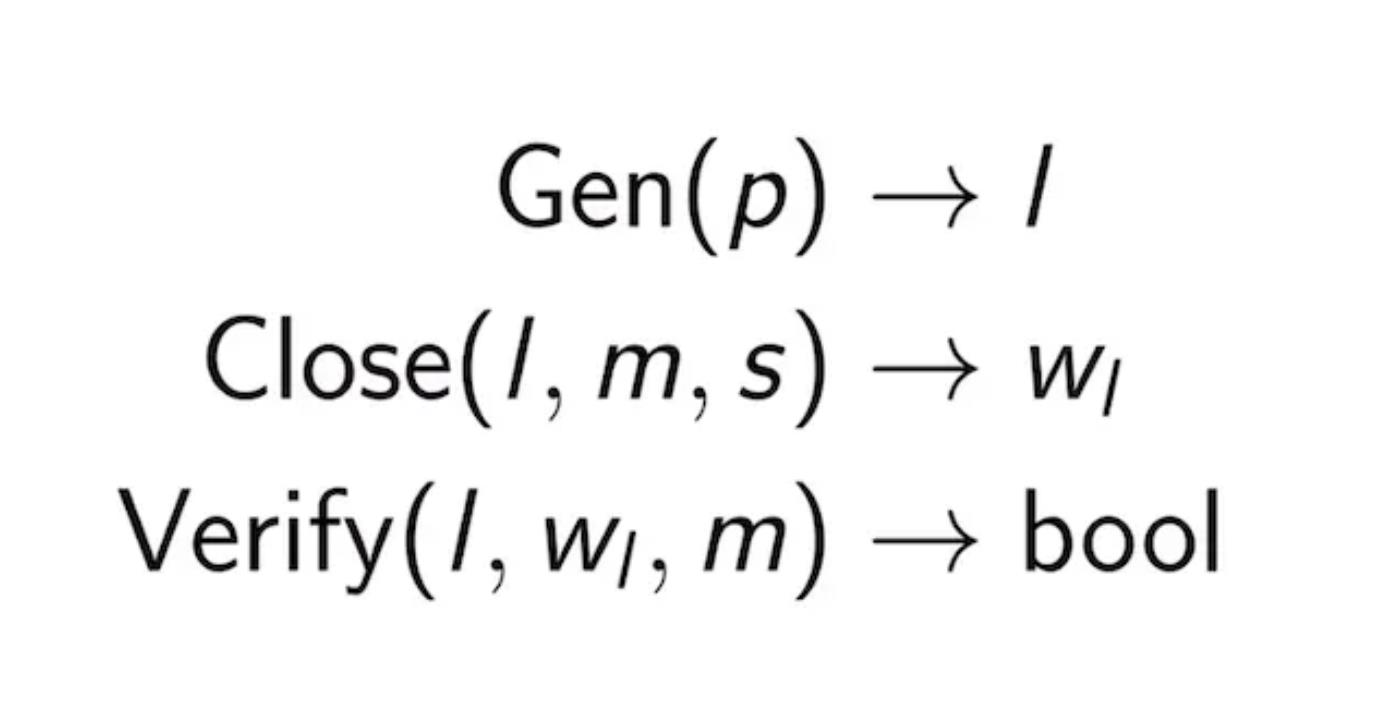
For SealProtocol, there are three elements and two operations:
Core Elements:
-
l: seal
-
m: message
-
w: witness
Basic Operations:
-
Close(l,m) → w: Close seal l over message m, producing witness w.
-
Verify(l,w,m) → bool: Verify whether seal l was closed over message m.
Security-wise, a single-use seal ensures that an attacker cannot find two distinct messages m1 and m2 such that Verify returns true for the same seal.
A single-use seal is a conceptual tool ensuring an asset or piece of data is used or locked only once. Within Bitcoin, this usually means a UTXO can only be spent once. Thus, Bitcoin transaction outputs act as single-use seals; when used as an input in another transaction, the seal is “broken” or “used.”
For CSV assets on BTC, Bitcoin itself acts as the “witness” for the single-use seal. Nodes must check that each transaction input references a valid, unspent UTXO. Any attempt to double-spend a used UTXO will be rejected under Bitcoin’s consensus rules by honest network participants.
Can it be simpler?
Single-use seal means treating any blockchain as a database. We commit a message via some method into this database and maintain a status indicating whether it’s spent or pending.
Yes, it really is that simple.
In summary, client-side validated assets have the following characteristics:
-
Off-chain Data Storage: Transaction histories, ownership records, and related data are primarily stored off-chain. This drastically reduces on-chain storage demands and enhances privacy.
-
Commitment Mechanism: Although data resides off-chain, changes or transfers are recorded on-chain via commitments. These allow on-chain transactions to reference off-chain states, preserving integrity and immutability.
-
On-Chain Witness (not necessarily BTC): Despite most data and validation occurring off-chain, embedded commitments enable reliance on the base chain’s security—proof-of-publication and transaction ordering.
-
Validation Performed Client-Side: Most validation occurs on user devices. There’s no need for all network nodes to validate every transaction—only involved parties verify validity.
One caveat for users of client-side validated assets:
When conducting off-chain transactions and validating client-side assets, users must present both the private key proving ownership and the complete Merkle path proving the asset’s state history.
Pioneer of Client-Side Validation: RGB
The concept of RGB was introduced around 2015 by Giacomo Zucco, a well-known figure in the crypto community. With Ethereum’s rise and the surge of ICOs, many attempted to innovate beyond Bitcoin—projects like Mastercoin and Colored Coins being prime examples.
Giacomo Zucco expressed disappointment, believing these projects fell short of Bitcoin’s potential and that previous attempts to implement tokens on Bitcoin were flawed. During this period, he encountered Peter Todd and became fascinated by his ideas on Client-Side Validation (CSV). This inspired him to propose RGB.
Beyond the general traits of CSV assets, RGB introduces a virtual machine (VM) for Turing-complete contract execution. Additionally, to ensure contract data security, RGB incorporates Schemas and Interfaces. Schemas resemble Ethereum’s contract definitions, declaring functionalities, while Interfaces define actual implementations—akin to interfaces in programming languages.
These schemas restrict VM-executed contracts from deviating beyond expected behavior. Examples include RGB20 and RGB21, governing rules for fungible and non-fungible tokens respectively.
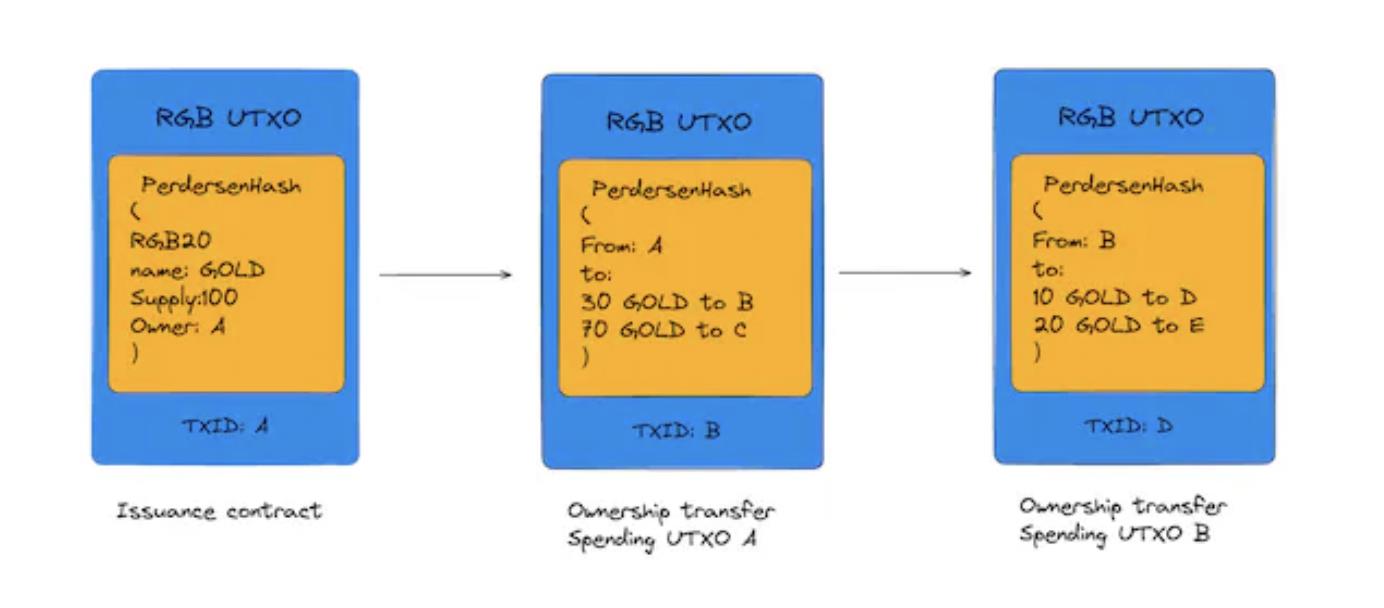
RGB’s Commitment Mechanism: Pedersen Hash
From a commitment standpoint, RGB uses Pedersen hashing. Its advantage lies in committing to values without revealing them. Using Pedersen hashes in Merkle trees enables privacy-preserving structures where leaf values remain hidden—ideal for anonymity-focused cryptocurrencies. However, it may not be optimal for CSV assets, as discussed further in comparison with Taproot Assets.
RGB’s VM Design: Simplicity → AluVM
RGB aims not just to be a CSV asset protocol but also to support Turing-complete contract execution. Initially, RGB claimed to use a language called Simplicity, designed to generate execution proofs and facilitate formal verification (reducing bugs). However, Simplicity failed to mature and stalled development, nearly killing the project. Eventually, RGB adopted AluVM, developed by Maxim, aiming to eliminate undefined behaviors—similar to Simplicity’s goals. Future versions of AluVM plan to replace Rust with a new language called Contractum.
RGB’s Layer 2 Scaling Direction: Lightning Network or Sidechain?
Client-side validated assets cannot guarantee secure continuous off-chain trading. They still depend on L1 for transaction publication and ordering. Without L2 scaling, transaction speed remains limited by the L1’s block interval. Direct RGB transactions on Bitcoin would face a maximum 10-minute gap between consecutive operations (BTC’s average block time). Clearly, this pace is unacceptable for most applications.
RGB and the Lightning Network
The Lightning Network works by having two parties sign multiple off-chain contracts (commitment transactions), ensuring that if one party breaches, the victim can submit evidence to Bitcoin for settlement and penalty enforcement. Thus, Lightning achieves off-chain security through protocol and game-theoretic design.
RGB could theoretically build its own Lightning-style payment channel infrastructure by designing custom channel rules. However, developing such a system is extremely complex. Compared to Lightning Labs, which has years of experience and dominates the market with LND (>90% share), RGB lacks comparable maturity.
RGB’s Sidechain: Prime
LNP-BP, the current maintainer of RGB, saw Maxim publish a proposal in June 2023 named **Prime**, a modular proof-publishing layer designed for scaling client-side validated assets. He criticized existing sidechains and Lightning extensions as overly complex to develop. According to Maxim, alternatives like NUCLEUS multi-node channels or Ark/Enigma factory channels would take over two years to build, whereas Prime could be completed in just one year.
Prime is not a traditional blockchain but a modular proof-publishing layer tailored for client-side validation, consisting of four components:
-
Timestamp Service
Finalizes transaction sequences within 10 seconds. -
Proofs
Stored via PMT format and published alongside block headers. -
Single-Use Seal
Abstract anti-double-spend protocol. On Bitcoin, it maps to UTXOs—similar to current RGB designs. -
Smart Contract Protocol
Sharded contracts—RGB (replaceable)
To address slow confirmation times, Prime employs a timestamp service to rapidly finalize off-chain transactions, packaging them with IDs into blocks. These Prime transaction proofs can later be aggregated via PMT and anchored to Bitcoin like checkpoints.
Taproot-Based CSV Protocol: Taproot Assets
Taproot Assets is a client-side validated asset protocol built on Taproot, enabling issuance of assets on the Bitcoin blockchain that can transact instantly, at high volume, and low cost via the Lightning Network. At its core, it leverages Bitcoin’s security and stability along with Lightning’s speed, scalability, and low fees. Designed and developed by Lightning Labs’ CTO roasbeef—who may be the only person to have led development of both a Bitcoin client (BTCD) and a Lightning client (LND)—the protocol reflects deep expertise in BTC architecture.
Taproot transactions carry only the root hash of the asset script, making it difficult for external observers to detect Taproot Assets usage—since hashes are generic and can represent any data. With the Taproot upgrade, Bitcoin gained smart contract capabilities via TapScript. Building on this, Taproot Assets encodes assets similarly to ERC20 or ERC721 tokens. This gives Bitcoin not only asset definition functionality but also foundational smart contract infrastructure.
Taproot Assets encoding structure:
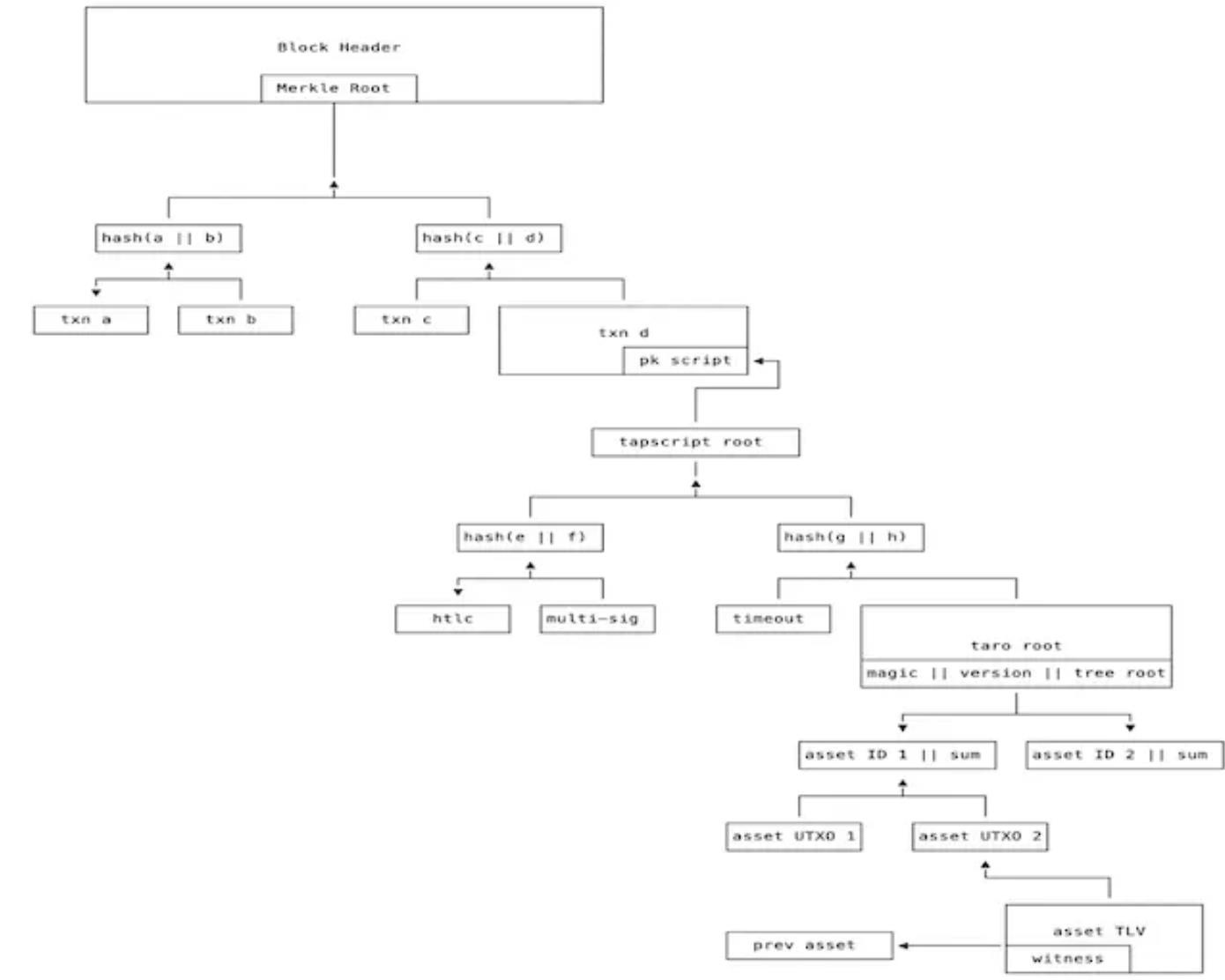
Image credit: Lightning Labs CTO roasbeef

Like RGB, Taproot Assets is a CSV protocol—but significantly simpler in design. It maximally leverages recent BTC ecosystem advancements: Taproot upgrades, PSBT standards, etc. The biggest divergence from RGB in terms of extensibility lies in the execution VM. Taproot Assets uses Bitcoin’s native TaprootScript VM. Much recent BTC infrastructure research centers on TapScript, though slow upgrades delay adoption. Taproot Assets is poised to become a testing ground for these innovations.
Differences Between Taproot Assets and RGB
1. Transaction Verification and Light Node Friendliness
Thanks to its sum-tree implementation, Taproot Assets offers high verification efficiency and security—state can be verified and transactions executed using only possession proofs, without traversing full transaction histories. In contrast, RGB’s use of Pedersen commitments prevents efficient input validation, forcing users to replay transaction histories—an increasingly heavy burden over time. The Merkle sum design also enables lightweight node verification, a capability previously absent in BTC-based asset protocols.
2. Execution VM
Born alongside the Taproot upgrade, Taproot Assets uses Bitcoin’s native TaprootScript VM. Its vPSBT format mirrors BTC’s standard PSBT. Once Taproot Assets’ payment channel mechanism is complete, it can immediately reuse all existing LND infrastructure and Lightning Labs’ product stack (LND holds over 90% of the Lightning market). Moreover, cutting-edge proposals like BitVM are based on TaprootScript, meaning future improvements could directly benefit Taproot Assets.
In contrast, RGB’s VM and validation rules (SCHEMAS) form a self-contained ecosystem—relatively isolated and less integrated with the broader Bitcoin stack. For instance, RGB’s only meaningful integration with Taproot is encoding commitment data into witness tapleaves.
3. Smart Contracts
In current implementations, smart contracts and VMs are central to RGB. Taproot Assets currently lacks visible smart contract capabilities. However, RGB hasn’t clarified how global state updates synchronize across individual contract shards (UTXOs). Furthermore, while Pedersen commitments secure total asset supply, mechanisms to detect unauthorized modifications to other states remain unclear. Taproot Assets, though minimalist, currently stores only balance states and lacks richer state models required for smart contracts. That said, Lightning Labs has indicated plans to enhance smart contract functionality next year.
4. Sync Centers
As previously noted, holding the proof is as critical as holding the private key in CSV systems. But proofs stored locally risk loss. How to mitigate this? Taproot Assets uses Universe—a publicly auditable MS-SMT structure covering one or more assets. Unlike Taproot asset trees, Universe doesn’t host assets. Instead, it commits to subsets of asset histories.
In RGB, Storm handles this role, synchronizing off-chain proofs peer-to-peer. However, due to fragmented development histories, current proof formats across RGB teams are incompatible. DIBA, an RGB ecosystem team, announced plans to develop carbonado to resolve this—but progress remains uncertain.
5. Engineering Implementation
All libraries used by Taproot Assets are battle-tested, thanks to Lightning Labs’ ownership of BTCD, LND, and extensive wallet library implementations. In contrast, RGB relies heavily on internally developed libraries, placing its engineering maturity firmly in the experimental phase by industrial standards.
On the Future of BTC Scaling
By now, it should be clear that client-side validated asset protocols have moved beyond mere protocol design—they’re evolving toward computational scaling.
Many argue Bitcoin will exist solely as digital gold, with other chains hosting applications. I disagree. Just look at BTC forums filled with discussions about altcoins and their fleeting lifespans. These altcoins’ rapid collapses turn capital and effort into bubbles. We already have Bitcoin—a powerful consensus foundation. There’s no need to build new L1s for every application. Our task is to better utilize Bitcoin’s robust infrastructure to build a sustainable decentralized world.
Less On-Chain Computation, More On-Chain Verification
From an architectural perspective, Bitcoin early on chose not to prioritize on-chain computation but rather focused on verification. (Turing completeness and state for smart contract). Blockchains are essentially replicated state machines. If consensus depends on recomputing everything on-chain, requiring all nodes to repeat those computations is neither efficient nor scalable. A verification-first model—validating off-chain transactions—may be the best path forward for BTC scaling.
Where Verification Happens Matters
For developers building on Bitcoin, deciding how to use Bitcoin for critical verification—or even moving verification off-chain—is a design choice independent of the base layer. The chosen verification strategy shapes different BTC scaling approaches.
From a verification-centric view, we see three scaling directions:
-
Verification On-Chain (OP-ZKP)
Implementing OP-ZKP directly in TaprootScriptVM would grant Bitcoin native zero-knowledge proof verification, enabling ZK-Rollups inheriting BTC’s security when combined with covenant-based settlement. However, unlike deploying a contract on Ethereum, adding such specialized, potentially upgrade-dependent opcodes to BTC faces significant hurdles due to slow consensus processes.
-
Verification Semi-On-Chain (BitVM)
BitVM is not designed for general transaction logic. As Robin Linus stated, BitVM’s future lies in enabling cross-chain markets between sidechains. It’s considered semi-on-chain because most verification occurs off-chain. However, crucial fallbacks rely on Taproot’s scripting engine (TapScriptVM) for final dispute resolution, theoretically inheriting BTC’s security. This creates an optimistic trust model: only one honest verifier among many is needed—akin to Optimistic Rollups.
Can BitVM improve efficiency with ZK fraud proofs? No—because ZK fraud proofs require on-chain ZKP verification, bringing us back to the OP-ZKP dilemma.
-
Verification Off-Chain (Client-Side Validation, Lightning Network)
Full off-chain verification includes CSV asset protocols and the Lightning Network. As discussed, CSV cannot fully prevent collusion, but cryptographic and protocol design can limit damage scope, making malicious actions unprofitable.
Off-chain verification has clear trade-offs: minimal on-chain resource usage and massive scalability potential versus inability to fully inherit BTC’s security. This limits permissible transaction types and methods. Additionally, since data lives off-chain and is user-managed, software security and reliability become paramount.
Trends in Scaling Evolution
Today’s dominant Ethereum Layer 2 paradigm involves Layer 1 verifying the correctness of Layer 2 computations—pushing state computation off-chain while retaining verification on-chain. Looking ahead, we may push even verification off-chain, further unlocking blockchain performance.
Join TechFlow official community to stay tuned
Telegram:https://t.me/TechFlowDaily
X (Twitter):https://x.com/TechFlowPost
X (Twitter) EN:https://x.com/BlockFlow_News
 @wooooer