Taproot VS Drivechain: Different Approaches to Bitcoin Scaling
TechFlow Selected TechFlow Selected
Taproot VS Drivechain: Different Approaches to Bitcoin Scaling
Compared to Taproot, Drivechain's layered, "off-chain scaling" solution has greater potential and lower costs.
 Navigating Web3 tides with focused insights
Taproot vs Drivechain: Divergent Paths for Bitcoin Scaling
In November 2021, Bitcoin underwent its first code upgrade since 2017: the Taproot upgrade. This update acted like quicklime dropped into a still lake—slowly heating the waters and causing continuous bubbling.
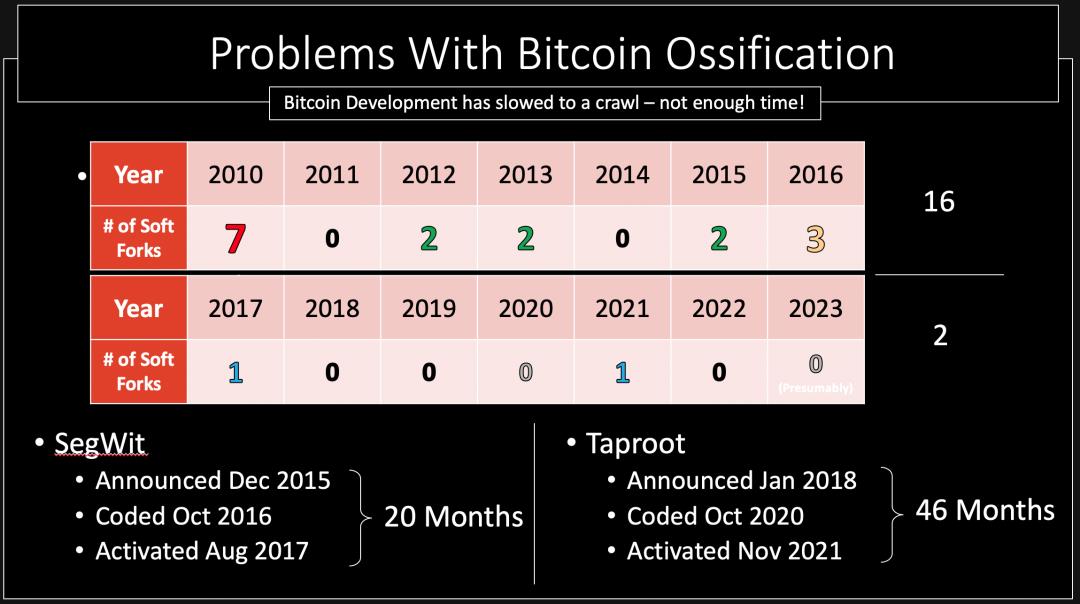
The first seven years of Bitcoin saw 16 soft upgrades; the subsequent seven years saw only two. The SegWit soft fork took 20 months to activate, while Taproot required 46 months.
In 2023, the Bitcoin ecosystem has become unusually vibrant. Innovations have sprung up like mushrooms after rain—from the Ordinals protocol in March, to the entire Bitcoin community discussing Drivechain in September, to BitVM and Taproot Assets emerging in October. The ecosystem appears to be gathering momentum to return to center stage, demonstrating both the enduring appeal of the king of crypto and the possibilities inherent in open-source software.
Recent Major Developments in the Bitcoin Ecosystem
1. Ordinals
Ordinals leverages the Segregated Witness (SegWit) upgrade to inscribe data—such as images, text, audio, video, or even code—into the witness section of Bitcoin transactions, provided it is under 4MB in size. By assigning each satoshi a unique number and using an indexer to track them, users can issue and trade NFTs directly on the Bitcoin mainnet. Later, BRC-20 tokens emerged based on this standard. In April, speculation around Ordinals-based NFTs and BRC-20 tokens peaked, drawing widespread attention across the crypto space.
2. Babylon
Babylon aims to extend Bitcoin’s security to PoS networks and decentralized applications (DApps). It enables Bitcoin holders to stake their BTC to enhance the security of PoS chains and earn yield in return.
Babylon’s Bitcoin staking protocol uses cryptographic techniques to ensure that if a staker attempts to attack the consensus of a PoS network, their staked Bitcoin will be fully or partially slashed. Crucially, slashing occurs only when an actual attack takes place, ensuring the absolute safety of honest participants’ assets. This allows Bitcoin to function as a staking asset equivalent to native PoS tokens—without requiring cross-chain bridges.
At the core of this system lies a technology called "Extractable One-Time Signatures" (EOTS), where a private key can only sign once. If used twice, the key becomes decryptable. The underlying signature algorithm builds upon Bitcoin’s native signing mechanism, making it compatible with the existing Bitcoin network.
3. BitVM
Recently proposed by Robin Linus of the Zerosync team, BitVM is described as a way to “enable arbitrary computation on Bitcoin without changing the current consensus or requiring any upgrades.” According to the whitepaper, this is achieved through Op-Rollups, fraud proofs, Taproot leaves, and Bitcoin Script.
As noted by crypto analyst @tmel0211, the core idea behind BitVM is using a matrix of Taproot addresses—or taptrees—to represent binary circuit-like program instructions. When combined, these form complete contract executions. Each minimal instruction unit is verified by full Bitcoin nodes, and by stacking infinite combinations of Taproot addresses, highly complex computations become theoretically possible. In some sense, calling BitVM Turing-complete isn't far-fetched. However, the cost of stacking countless Taproot addresses makes such implementations impractical despite theoretical feasibility.
Currently, BitVM remains in the discussion phase.
4. Taproot Assets
Recently launched by Lightning Labs, Taproot Assets is a new protocol built on the Bitcoin blockchain that leverages Bitcoin’s latest upgrade—Taproot—to deliver enhanced privacy and scalability. It provides developers with core functionality for issuing, sending, receiving, and discovering assets on Bitcoin. These assets can be deposited into Lightning Network channels and transferred via the existing Lightning infrastructure.
Taproot Assets operates entirely within the UTXO model, embedding “simple code” into the script of a Taproot address, which then acts as a spending condition. In asset issuance scenarios, this opcode can encode rules such as total supply, issuance time, recipient addresses, and more. A multi-signature setup can also be used to jointly trigger the operation.
It's clear that the emergence of these ecosystems rests fundamentally on the SegWit and Taproot upgrades.
SegWit and Taproot Upgrades
Taproot was a major upgrade to the Bitcoin network, activated on November 14, 2021. Alongside Schnorr signatures, it had been one of the most anticipated advancements since the introduction of SegWit.
The Taproot upgrade consists of three Bitcoin Improvement Proposals (BIP340, BIP341, BIP342), including Taproot, Tapscript, and at its core, a new digital signature scheme known as “Schnorr signatures.” Taproot redefines how Bitcoin scripts operate, improving privacy, scalability, and security. Benefits include increased transaction confidentiality, lower fees, and the ability to execute more complex transactions—expanding Bitcoin’s use cases and allowing it to better compete with Ethereum, particularly in supporting smart contracts, DeFi, and NFTs.
In many ways, combined with the earlier SegWit upgrade, Taproot has opened the door to more sophisticated contract capabilities on Bitcoin.
SegWit, introduced in 2017, effectively split Bitcoin transactions into two parts by adding a separate “witness data” section capable of storing arbitrary data.
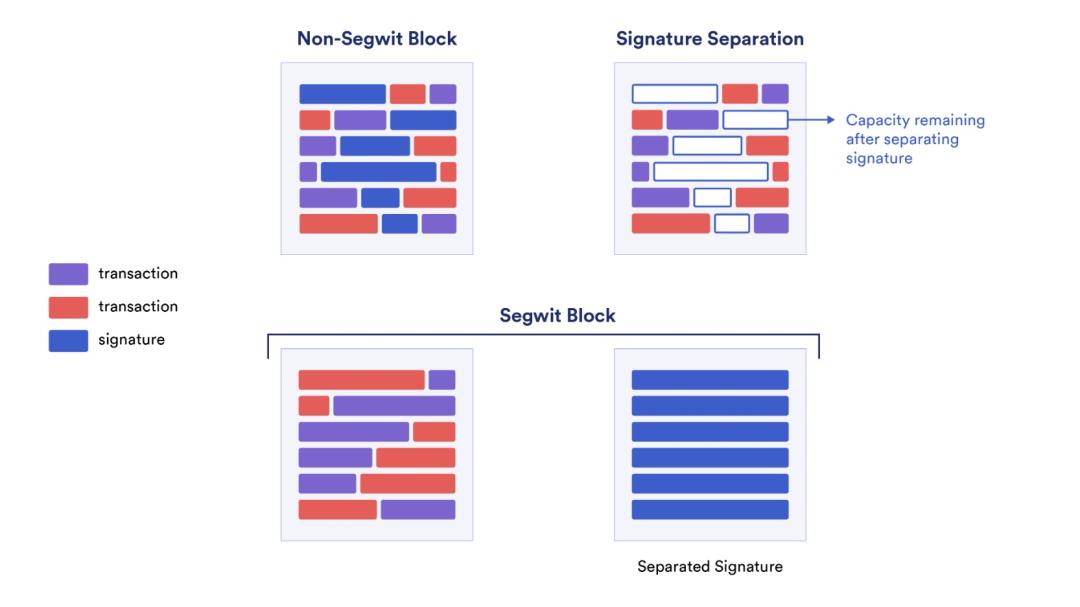
Comparison of Non-SegWit and SegWit Block Structures
Technically, implementing SegWit means transactions no longer need to include witness data within the original 1MB block space. Instead, an additional segregated space is created at the end of each block specifically for witness data. This supports arbitrary data transfers and uses a discounted “block weight” metric, cleverly keeping overall data within Bitcoin’s block size limits—and avoiding the need for a hard fork.
SegWit brought two major changes to the Bitcoin network:
-
Signature data, which typically accounts for 65% of block data, is removed from the main “base” block and stored separately, freeing up space for more transactions per base block.
-
SegWit introduced “block weight,” technically increasing Bitcoin’s effective block size from 1MB to 4MB—comprising 3MB of signature data and 1MB of transaction data.
SegWit & Taproot vs Drivechain
In simple terms, SegWit and Taproot expand Bitcoin’s capabilities by modifying block data structure and signature methods, enabling richer data storage within UTXOs or blocks. Combined with off-chain operations, they enhance Bitcoin’s ability to support more complex contracts.
However, an undeniable fact remains: Bitcoin’s functionality is constrained by its underlying scripting language, as well as block size and block time limitations—severely restricting its scalability potential.
We saw this problem clearly during the Ordinals boom, when massive volumes of BRC-20 transactions congested the Bitcoin network, driving transaction fees to hundreds of dollars per transaction and sparking community backlash.
While BitVM envisions Turing-completeness on Bitcoin by treating individual Taproot address scripts as minimal programming units, it cannot escape Bitcoin’s execution logic framework—such as hashlocks and timelocks—or exceed limited storage conditions. Implementing complex contracts requires constructing vast taptrees composed of numerous addresses, resulting in high costs and slow performance.

Compared to on-chain scaling solutions like Taproot, Drivechain offers greater potential with significantly lower costs through its layered, “off-chain scaling” approach.
Similarly not requiring changes to Bitcoin’s consensus, Drivechain only needs six new block messages defined in BIP300, along with mining托管 addresses and BIP-301’s blind merged mining scheme, to enable low-cost, large-scale sidechain expansion for Bitcoin. These sidechains inherit Bitcoin’s security while offering high flexibility and customizability. Theoretically, the possibilities enabled by Drivechain are limitless.
Logically speaking, Taproot Assets follows a similar philosophy—assets reside on the Bitcoin main chain, but transactions occur off-chain via the Lightning Network. In practice, both could instead be implemented as Drivechain sidechains, unlocking far more functionality beyond simple transfers. Layer 2 Labs is already advancing the development of seven Drivechain sidechains, and projects like RSK have expressed interest in migrating into the Drivechain framework once activated.
Adam Back, founder of Blockstream and inventor of Proof-of-Work (PoW), stated during a Layer 2 Labs Twitter Space: "If we can introduce some new functionalities and scalability at Layer 1, Bitcoin can become somewhat hardened, while innovation continues at Layer 2. Bitcoin needs scalability and modularity to accelerate innovation and adoption of new features. Technologies like Lightning Network help, but there’s still more work to do in addressing scalability and user demands. We need technical solutions that give users better options—like accessing real UTXOs on sidechains or drivechains. We recognize Bitcoin adoption could grow rapidly, and the technology must keep pace with rising demand. I’m very excited to see how Drivechain performs."
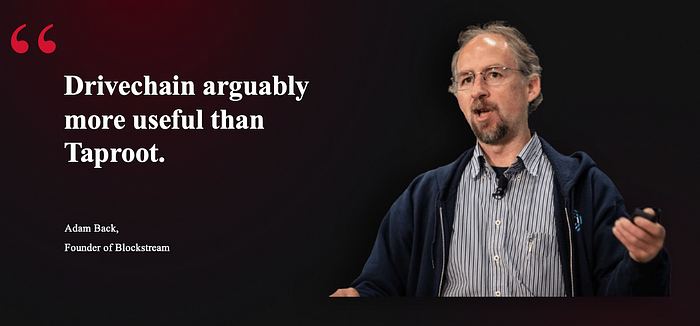
From Adam Back’s perspective, Taproot represents new functionality and modest expansion at Layer 1, while Drivechain embodies Layer 2 innovation. BIP300 has now been formally submitted as a pull request by Bitcoin core developer Luke-jr.
Bitcoin is a security-first cryptocurrency and a programmable software application. The BTC community shows resilience. After years of innovation stagnation, even minor openings in block space and support for richer data types have sparked renewed experimentation and intense market interest. With even greater potential ahead, one can only imagine the scale at which Bitcoin might transform the world.
As strong advocates of Bitcoin, Layer 2 Labs eagerly anticipates this future and looks forward to collaborating closely with developers across the Bitcoin ecosystem to achieve mass adoption.
Join TechFlow official community to stay tuned
Telegram:https://t.me/TechFlowDaily
X (Twitter):https://x.com/TechFlowPost
X (Twitter) EN:https://x.com/BlockFlow_News
 LayerTwo Labs