
DeFi "Old Farmer" on Today's Risks and Opportunities: Has DeFi Valuation Already Dropped Into a Golden Pit?
TechFlow Selected TechFlow Selected
DeFi "Old Farmer" on Today's Risks and Opportunities: Has DeFi Valuation Already Dropped Into a Golden Pit?
The market's confidence in DeFi seems to have hit rock bottom.
 Navigating Web3 tides with focused insights
Author: Jiang Haibo, PANews
With TVL declining and token values sharply reduced, today’s DeFi “old farmers” often reminisce about that summer in 2020.
Back then, numerous new projects emerged in the DeFi space. Fueled by the liquidity mining craze, annual percentage rates (APR) reaching triple or even quadruple digits delivered substantial returns to early participants, further attracting new users and capital inflows. However, with the onset of the bear market, TVL—the key metric measuring liquidity and scale in DeFi—has plummeted from its peak of $179.1 billion in November 2021 to $37 billion as of October 16, 2023.
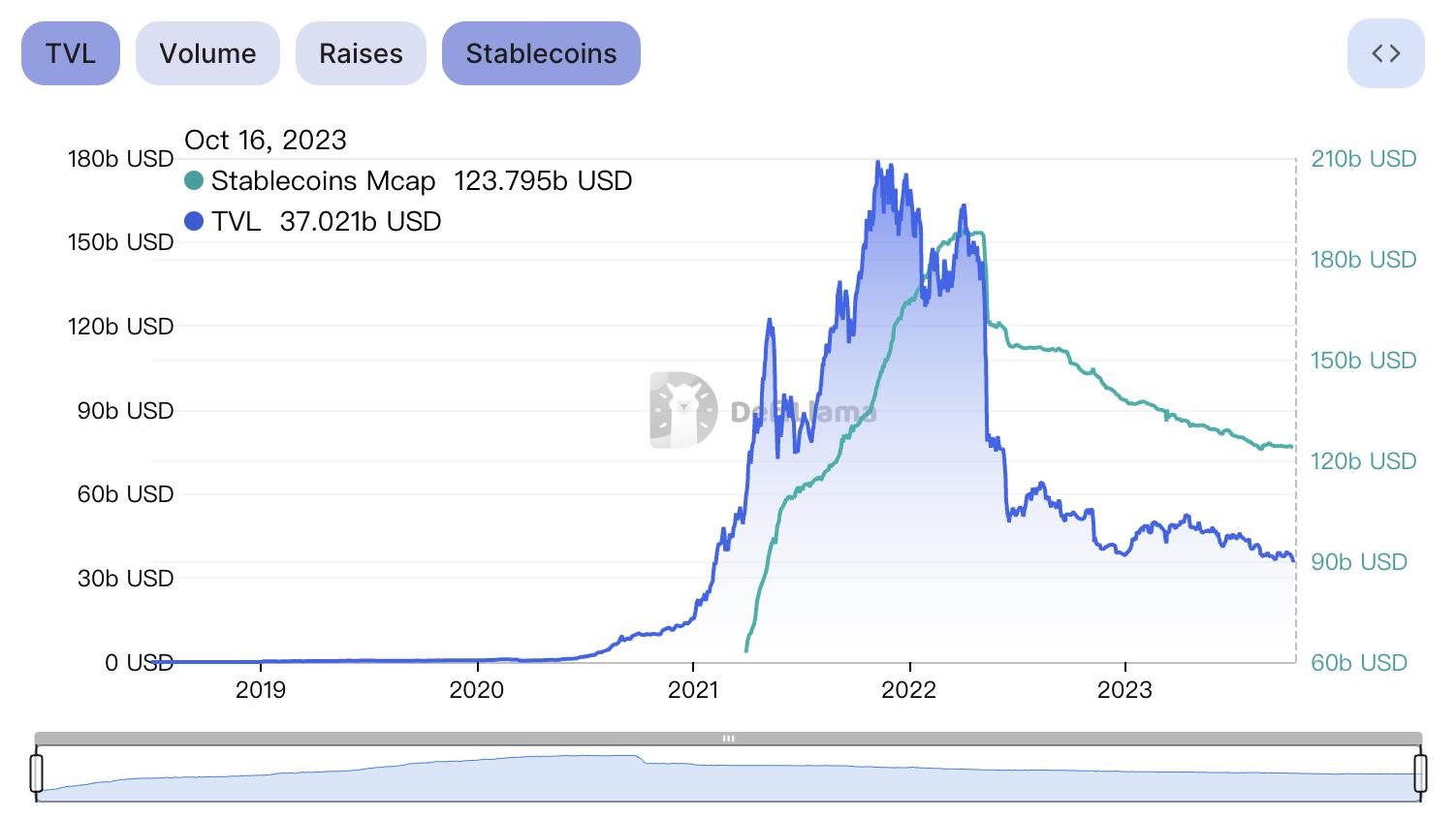
Source: DefiLlama
Even governance tokens of top-tier DeFi projects like UNI have dropped around 90% from their all-time highs. Some projects capable of generating real yield appear to have already fallen into a reasonable valuation range.
What caused the sharp decline in DeFi tokens? Has DeFi’s valuation already entered a "golden pit"? Which DeFi sectors are still promising for the future? And what opportunities remain for market participants?
PANews interviewed multiple industry insiders deeply involved in DeFi to gather their insights.
After enjoying high premiums, DeFi projects face falling volumes and prices, with some shutting down
As DeFi projects experience declining TVL, their governance token prices are also continuously dropping, accompanied by falling yields. Even platforms widely considered among the safest, such as Curve and Balancer, have encountered issues one after another, accelerating capital outflows.
Against this backdrop, some projects have proactively initiated liquidation and shutdowns, including Saddle Finance—a former competitor to Curve on Ethereum—Algofi, a lending, trading, and stablecoin project within the Algorand ecosystem, and Friktion, an automated portfolio manager on Solana.
Market confidence in DeFi appears to have hit rock bottom.
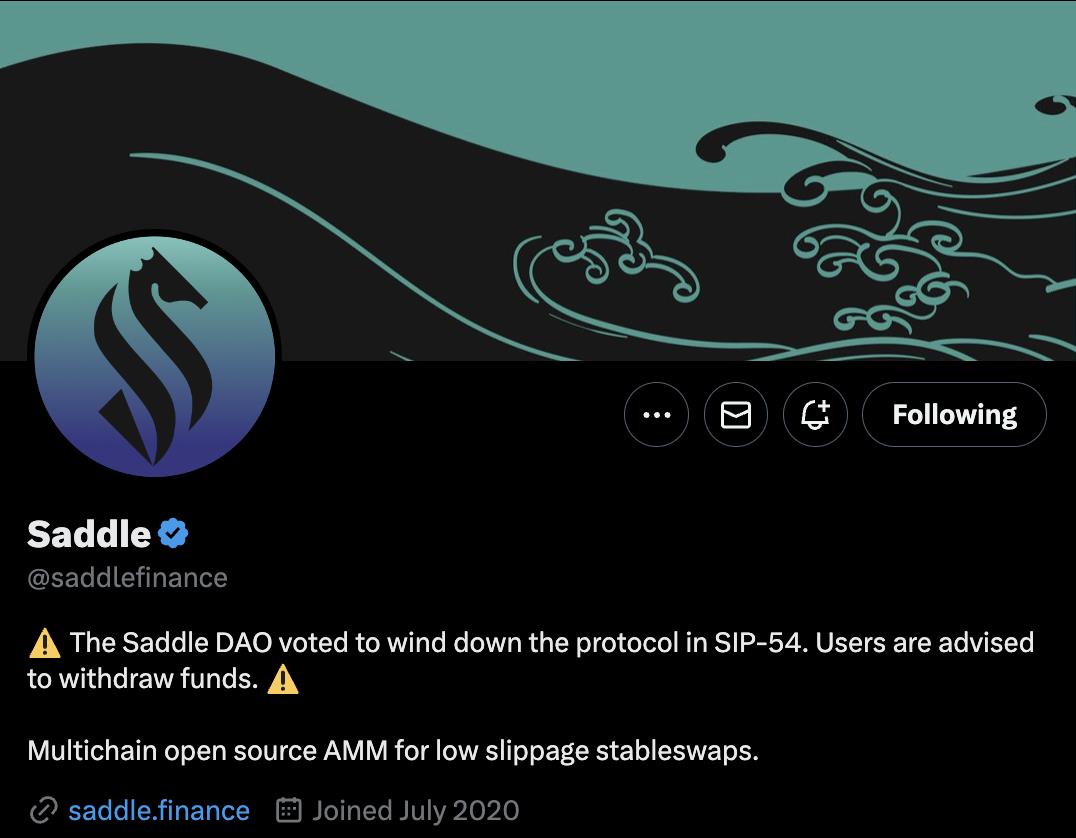
Source: Saddle Finance official Twitter
Regarding the drop in DeFi project TVL, Mindao, founder of dForce, believes TVL does not accurately reflect actual development. A more reasonable indicator is stablecoin supply, which has declined moderately from a peak of $190 billion to $125 billion—down 34%. Compared to the steeper fall in DeFi TVL, this suggests much capital remains within the market.
On the topic of falling governance token prices, he cites several reasons:
-
First, the DeFi Summer starting in 2020 marked the first cycle for the DeFi category. Most projects were founded after 2020, and now face significant selling pressure due to token unlocks.
-
Second, this period has been one of business model validation, during which many Ponzi-like projects (e.g., Luna) have been exposed and their bubbles burst.
-
Lastly, regulatory pressures—particularly severe for teams operating in the U.S.—have significantly impacted project operations and are clearly reflected in DeFi token prices.
Todd, partner at Nothing Research, points out that DeFi tokens performed well during bull markets primarily because they enjoyed a liquidity premium—in simple terms, “since ETH was expensive, investors bought leading projects across various sectors on the Ethereum network.” During bear markets, however, capital perceives ETH itself as undervalued and flows back into it, eliminating the liquidity premium. Thus, despite DeFi protocols launching better products than ever before, their token prices have declined.
Haibo, research director at PANews, observes that due to liquidity mining, DeFi tokens are inherently prone to either upward spirals or death spirals.
-
When governance token prices rise, APRs from mining increase, attracting more capital and further driving up token prices.
-
Conversely, during market downturns, falling yields prompt capital withdrawals, exacerbating declines in governance token prices.
Has a "golden pit" emerged? Projects with real yield gain favor
DeFi tokens have been among the hardest-hit assets in this bear market, yet DeFi remains one of the few areas capable of generating real yield. As the market corrects, metrics such as fees and price-to-earnings ratios are receiving increased attention. With certain projects now producing verifiable revenue, does this mean DeFi valuations have entered a "golden pit"?
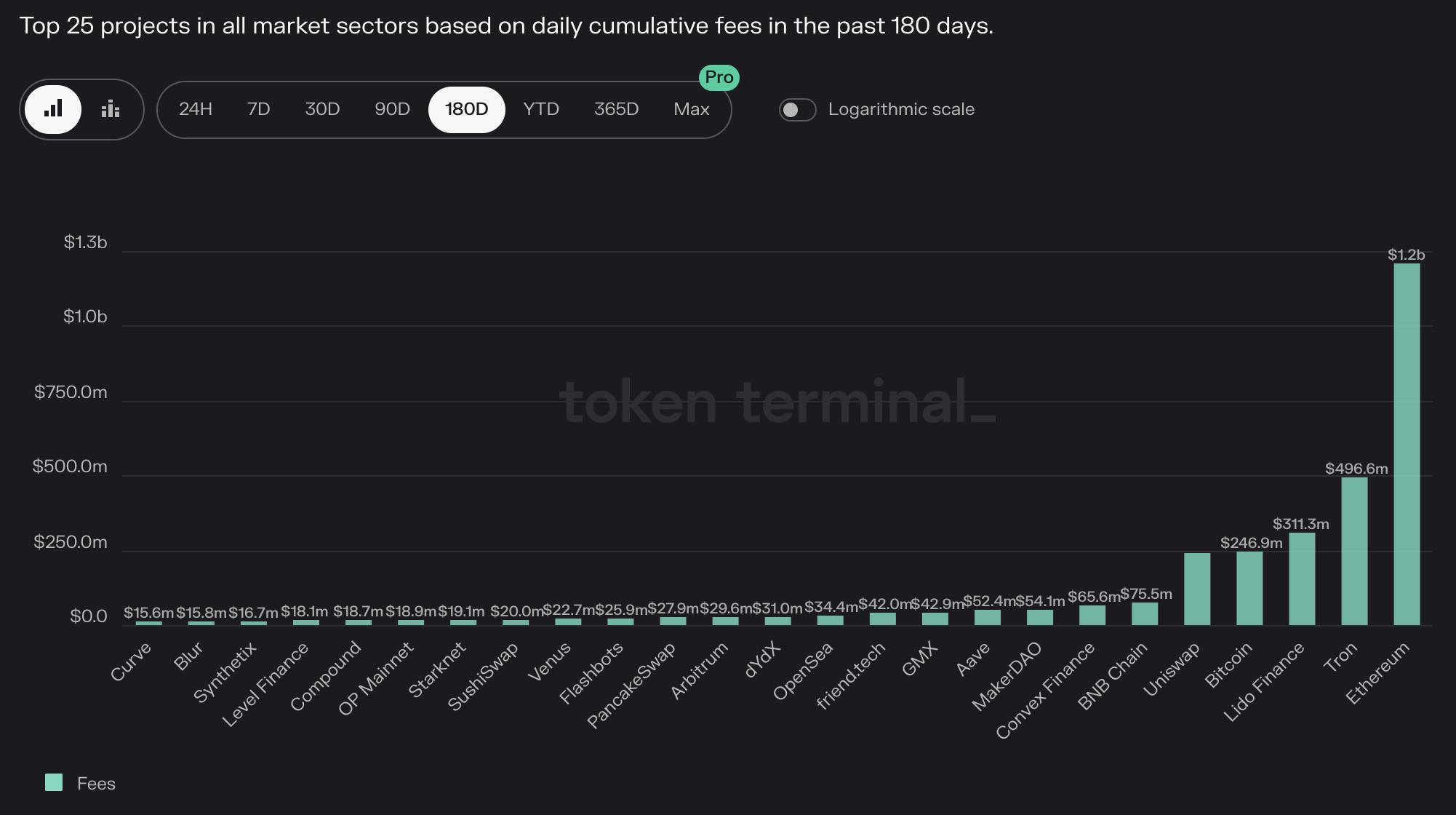
Source: Token Terminal
Mindao notes that after years of development, there's now greater emphasis on real yield in evaluating protocols. For example, the recent surge in interest in the RWA sector—bringing U.S. Treasury yields into DeFi—is a logical evolution.
From a valuation standpoint, secondary market prices for many projects are indeed attractive. However, most have yet to find sustainable paths forward. Therefore, not every project represents a "golden pit" created by valuation drops.
According to Haibo, using traditional financial metrics like P/E ratios to evaluate projects marks progress over earlier models based solely on TVL or future expectations. Only a few projects—primarily in DeFi—can currently calculate meaningful P/E ratios.
Among PoS blockchains, ETH stands out under this framework: it has a deflation rate of 0.2%, and staking ETH offers approximately 4% annual yield. In contrast, nearly all other native PoS tokens see negative net returns when subtracting inflation from staking rewards.
In the DeFi space, assets like MKR maintain P/E ratios below 25. With stricter valuation standards, investing in such real-yield-generating assets offers greater certainty. This raises the bar for comparable projects—those unable to generate income or running continuous losses may suffer deeper declines during bear markets.
Hedy, chief researcher at OKLink, points out that given the relatively small overall market size, sentiment easily distorts prices, causing short-term over-enthusiasm or excessive pessimism that decouples asset prices from fundamentals.
Moreover, in Web3, culture, consensus, and emotional value are amplified. Due to DeFi’s decentralized nature, project success often hinges on community support and shared belief. These cultural and social dynamics can drive emotional value fluctuations, further impacting asset prices.
Current practical strategies: Opportunities in ETH Staking and Maker DSR
During bear markets, safe avenues for generating yield become scarce. Maker’s DAI Savings Rate (DSR) presents a compelling opportunity. Maker invests collateral backing DAI issuance into short-term U.S. Treasury instruments, distributing the resulting yield to DAI holders. As of October 16, DAI’s total supply reached $5.55 billion, but only $1.69 billion was deposited into the DSR contract. Even at a 5% yield, after costs, Maker could still earn around $70 million in net profit annually. Following Maker’s lead, Frax introduced sFRAX in its V3 update this month, offering a similar mechanism with a current yield of 6.85%.
Given that USDC and DAI can be swapped at zero cost via Maker’s Peg Stability Module (PSM)—and with initial DSR yields set at 8%—strategies combining ETH liquid staking with Maker DSR have emerged.
-
On August 7, Shen Yu shared a strategy: stake ETH through Lido to obtain wstETH, use wstETH as collateral in MakerDAO to mint DAI, then deposit DAI into DSR. With 1,000 ETH invested, this strategy could generate annual returns of 50 ETH and 25,000 DAI.
-
Todd shared his own portfolio and yield strategy, stating that most of his capital is currently in SparkDAO, followed by ETH staking, with major positions in ETH and USDT, both yielding average returns of around 4–5%.
Beyond the widely watched Maker DSR, Haibo notes other yield-generating options. For instance, Frax’s sFRAX offers competitive returns. For higher yields, consider providing liquidity for ETH liquid staking derivatives such as wstETH/ETH or sfrxETH/frxETH on mature DEXs like Velodrome. For stablecoins, explore opportunities on newer chains—for example, Thala’s MOD stability pool or providing MOD/USDC liquidity on Aptos—though higher returns come with correspondingly higher risks.
Additionally, following the proven profitability of Maker’s business model, many new projects claiming to offer real-world yield (RWA) have appeared. Since participating in these requires trusting off-chain entities, investors must carefully distinguish legitimate projects from fraudulent ones. Undoubtedly, long-standing projects with strong track records like Maker are more trustworthy.
Promising future sectors: Native yield, RWA, stablecoins, infrastructure
Starting from lending and trading, DeFi has evolved into multiple sectors, each facing unique opportunities and challenges. For example, even Uniswap—one of the most widely used DEXs—fails to generate any direct revenue for its protocol or UNI token holders. While on-chain derivatives exchanges are seen as having vast growth potential, they currently rely heavily on trading incentives to capture market share.
Todd particularly emphasizes projects capable of generating native yield. While bringing traditional yields into crypto helps retain existing capital, the ability to generate intrinsic, on-chain yield will be the key differentiator for attracting new users in the future.
Mindao focuses instead on decentralized stablecoins, arguing that as the financial infrastructure of crypto, DeFi’s core lies in decentralized stablecoins. “We’re seeing decentralized stablecoins increasingly integrate RWA-generated yields. The combination of decentralized stablecoins with real-world asset yields and LSD assets—that’s where I see the most opportunities.”
Hedy believes that as DeFi evolves, certain infrastructure layers are becoming increasingly critical. He maintains a positive outlook on Web3 wallets, cross-chain solutions, and on-chain data analytics. These foundational components play a vital role in advancing the DeFi ecosystem and realizing its full potential. Additionally, RWA deserves attention as a bridge connecting the external world to DeFi. Integrating RWAs will further fuse DeFi with the real economy, opening broader application scenarios and opportunities.
The value of DeFi projects has already become evident. Surviving the bear market is paramount. As one of the fastest-evolving sectors, nearly all leading DeFi projects are actively iterating and upgrading. Perhaps some of today’s surviving projects will become the engines powering the next bull run.
Join TechFlow official community to stay tuned
Telegram:https://t.me/TechFlowDaily
X (Twitter):https://x.com/TechFlowPost
X (Twitter) EN:https://x.com/BlockFlow_News
 PANews