








Uniswap Labs' New Fee Policy: Aiming for Sustainability, but Potentially Harming UNI and User Interests
TechFlow Selected TechFlow Selected
Uniswap Labs' New Fee Policy: Aiming for Sustainability, but Potentially Harming UNI and User Interests
Uniswap Labs charging fees on front-end transactions could be a negative impact for UNI token holders.
 Navigating Web3 tides with focused insights
Author: Jiang Haibo, PANews
Holders of Uniswap’s governance token UNI have not yet seen the activation of the protocol fee switch, but instead are greeted with news that the protocol developer, Uniswap Labs, will begin charging fees on certain token trades.
In the early hours of October 17, Uniswap founder Hayden announced on X that Uniswap Labs is committed to being a transparent and sustainable company. Starting tomorrow (due to time zone differences, charges began on October 17), a 0.15% fee will be applied to trades involving certain tokens. This fee applies only to users trading via the Uniswap front-end interface; users accessing through aggregators, other interfaces, or direct smart contract interactions will not be charged.
Uniswap Labs believes their front-end interface is the best available and that significant effort has been invested in its development. Charging fees for front-end usage will enable Uniswap Labs to continue researching, developing, and improving cryptocurrency and DeFi.
Uniswap Labs' Fee Structure
The Uniswap documentation was updated simultaneously in the early morning of October 17. According to the latest version, starting October 17, a fixed 0.15% "interface fee" will be charged on a set of tokens. This means fees apply only when users trade through Uniswap Labs’ “interaction interface” on Ethereum mainnet and L2s.
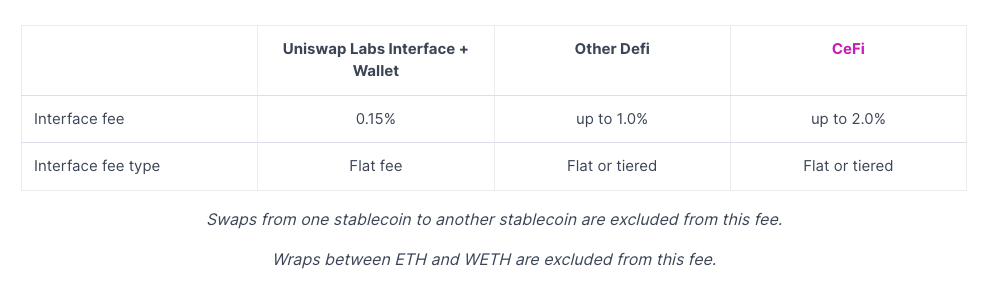
Tokens subject to the interface fee include: ETH, USDC, WETH, USDT, DAI, WBTC, agEUR, GUSD, LUSD, EUROC, and XSGD—essentially WBTC, WETH, ETH, and major stablecoins. Fees are only applied when both input and output tokens are on the fee list. Additionally, trades between WETH and ETH, as well as trades between stablecoins, are exempt from fees.
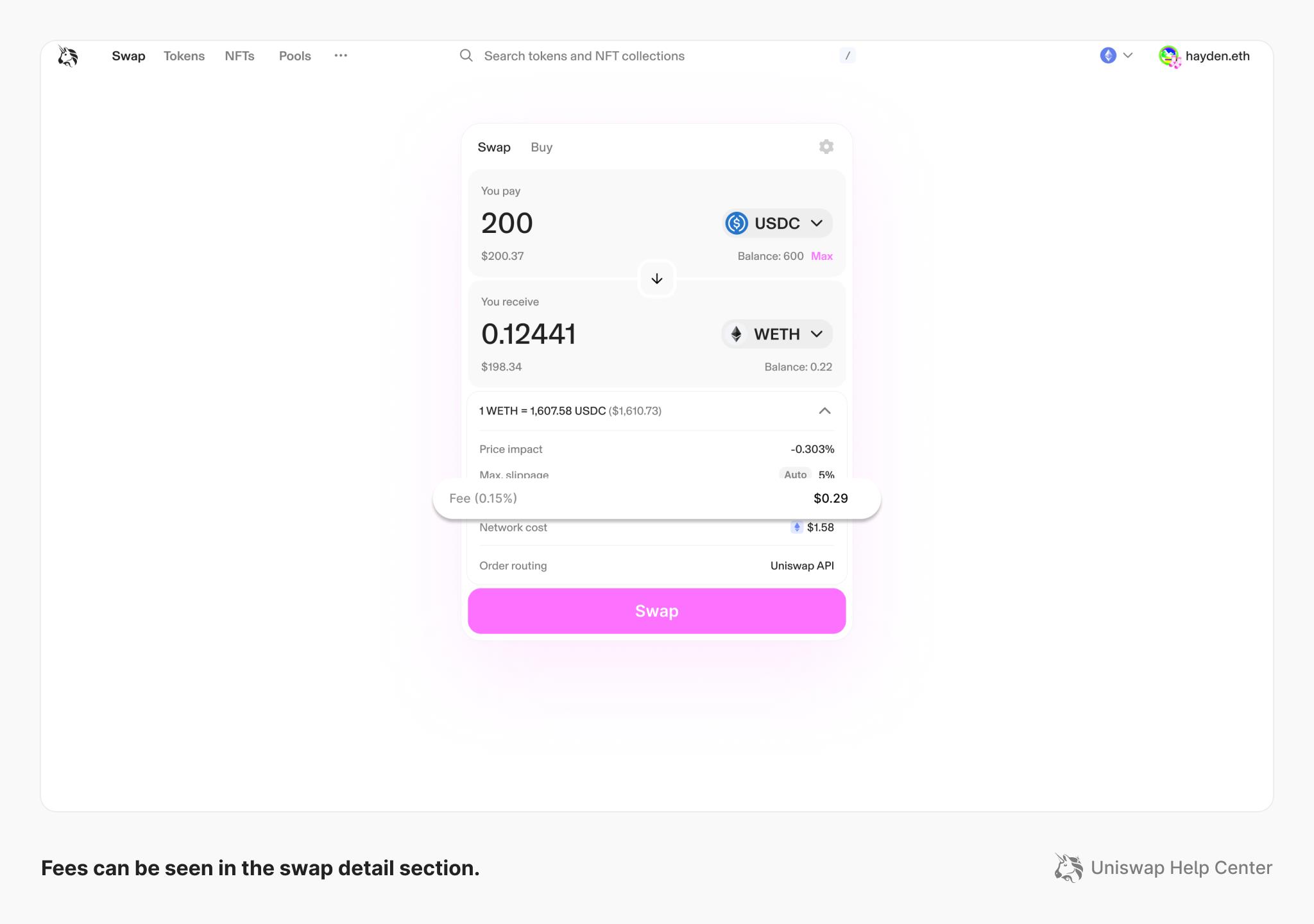
According to official documentation, transactions subject to fees will clearly indicate the charge during execution, as shown in the image below. However, as of 11:00 AM Beijing time on October 17, the fee mechanism had not yet taken effect.
Clarifying the Relationship Between Uniswap Protocol, Uniswap Labs, and Uniswap Foundation
Following the announcement, some community members questioned why fees were necessary, especially after the foundation recently requested substantial funding. To understand this, it's important to clarify the relationship among Uniswap Protocol, Uniswap Labs, and Uniswap Foundation.
On October 10, news emerged that the Uniswap Foundation proposed allocating $46.2 million to support operations over the next two years. Could these funds be used to support Uniswap Labs?
In reality, according to official statements, these entities operate independently. The Uniswap Foundation's expenditures do not show allocations to Uniswap Labs and are primarily directed toward grants and operational support.
Key distinctions between Uniswap, Uniswap Labs, and Uniswap Foundation:
-
Uniswap is a decentralized exchange (DEX) protocol built on the Ethereum blockchain, enabling permissionless token swaps and liquidity provision. Its goal is to serve as a liquidity layer, offering a permissionless alternative to traditional financial exchanges.
-
Uniswap Labs is a company responsible for laying the groundwork for the Uniswap protocol and building products to enhance its usability. It can be considered the core development team behind the protocol. Uniswap Labs charges fees on transactions conducted through the Uniswap front end, suggesting they view the front end as a product developed by their centralized team rather than part of the Uniswap protocol itself. Moreover, these fees are separate from any potential future protocol fees determined by Uniswap governance.
-
The Uniswap Foundation (UF) is a non-profit organization established to support the growth, decentralization, and sustainability of decentralized finance (DeFi), particularly the Uniswap protocol. Created with approval from the Uniswap community via a governance proposal, UF operates independently from other entities within the Uniswap ecosystem—including Uniswap Labs—and focuses on building a robust ecosystem for the long-term development, improvement, and maintenance of the Uniswap protocol.
These entities collectively contribute to the growth and sustainability of the Uniswap protocol while maintaining a degree of independence to preserve the ecosystem’s decentralized nature.
Impact on UNI Holders
Uniswap Labs’ decision to charge front-end fees may negatively impact UNI token holders. The ongoing debate and continued delay around activating the protocol fee switch—where fees would go directly to the protocol—suggests that introducing front-end fees could make activating the protocol fee even more difficult or amplify its negative consequences once implemented.
One major reason the protocol fee switch remains inactive is that enabling it would divert trading fees away from liquidity providers, whose profits are already slim and who also face impermanent loss. Such a change risks reducing Uniswap’s liquidity, harming the protocol’s long-term viability.
While front-end fees are not unprecedented in DeFi—Liquity, for example, does not offer an official front end, and third-party interfaces may charge fees—such cases remain rare, and multiple free third-party options usually exist.
In fact, charging front-end fees is not the only way to sustain Uniswap Labs’ operations. During the initial UNI token distribution, 21.27% was allocated to the team and future employees, while 60% went to the community treasury, which could potentially provide funding if needed. Additionally, the 1 billion UNI tokens distributed were intended only for the first four years, with a permanent 2% inflation rate thereafter.
Perhaps the groundwork for front-end fees was laid during the original token allocation. The original announcement outlined various rights for UNI holders, including control over uniswap.eth ENS and the default token list, but made no mention of the front end.
Uniswap Labs may be seeking a sustainable revenue stream to fund operations. However, at a time when DEXs are aggressively lowering trading fees to capture market share, charging front-end fees risks capturing value that might otherwise benefit UNI holders. Furthermore, the move could incentivize the emergence of more free third-party Uniswap front ends or push users toward alternative aggregators. How much revenue Uniswap Labs will actually generate from this initiative remains uncertain.
Join TechFlow official community to stay tuned
Telegram:https://t.me/TechFlowDaily
X (Twitter):https://x.com/TechFlowPost
X (Twitter) EN:https://x.com/BlockFlow_News
 PANews






