









The Rise of SocialFi: How friend.tech Is Redefining Web3 Social Finance?
TechFlow Selected TechFlow Selected
The Rise of SocialFi: How friend.tech Is Redefining Web3 Social Finance?
When talking about SocialFi today, what are we actually discussing?
 Navigating Web3 tides with focused insights
Author: Root
Unlike sectors such as GameFi and DeFi, which have already enjoyed market booms and gradually stabilized, SocialFi has largely remained a conceptual idea. Over the years, numerous developers have attempted to launch applications in this space, yet none have achieved explosive growth.
Since the launch of friend.tech, nearly 80% of Web3 application discussions over the past two months have centered on SocialFi, with a wave of copycat projects emerging rapidly.
As enthusiasm for SocialFi continues to rise, we may now be able to take a more comprehensive look at the future of SocialFi products.
When We Talk About SocialFi Today, What Are We Actually Talking About?
If within your means, you could pay a relatively small amount to have lunch with Warren Buffett, would you do it?
What if instead of Buffett, it was a KOL you admire or an industry expert you look up to?
What if instead of lunch, it was joining their private discussion group—and you could leave anytime and get your investment back?
And what if that entry ticket became a financial product that might generate substantial—or even outsized—returns?
And what if the KOL, expert, or Buffett themselves could also benefit from every ticket sold?
If your answer to all these is yes, then you’re already a potential user of these SocialFi products. Nearly all current SocialFi projects revolve around these questions, continuously iterating to find optimal solutions through market feedback.
Project Status
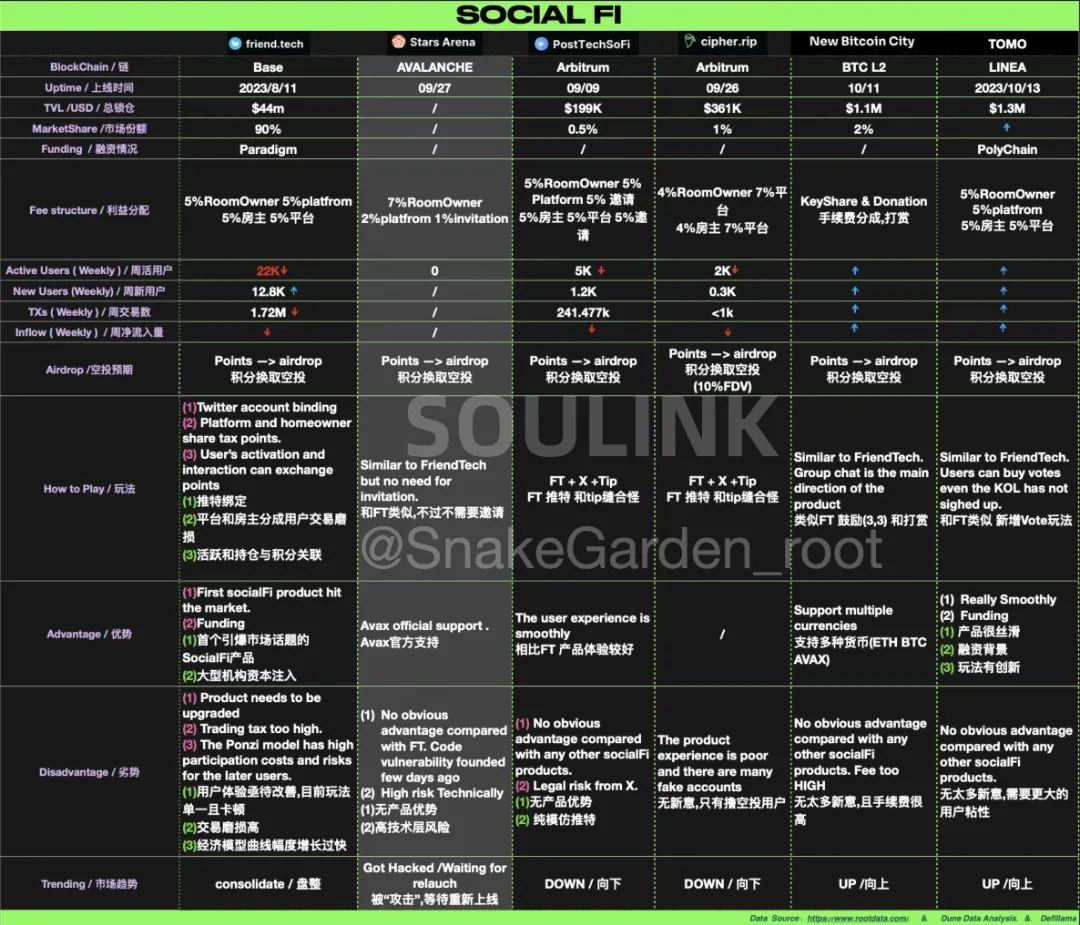
Recent data comparison between friend.tech and some of its clones
Timeline
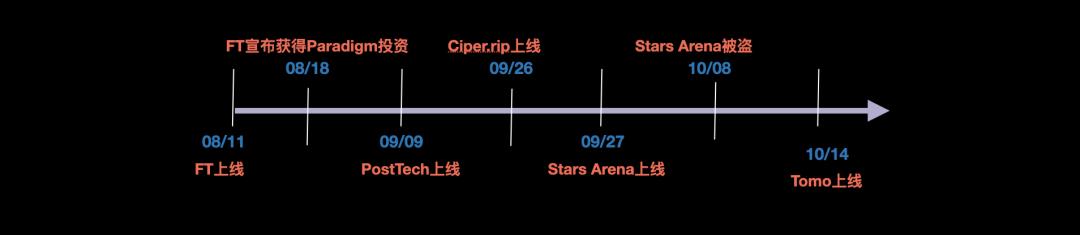
In mid-August, friend.tech served as the first spark to ignite the SocialFi market. Prior to launch, it received little market attention. However, everything changed when the well-known investment firm Paradigm was revealed to be part of the seed round. Overnight, conversations about friend.tech exploded. Users scrambled for invite codes, tutorials and profit screenshots flooded social media, and FOMO swept across the market. The protocol’s TVL peaked at $52 million on October 2nd, surpassing established DeFi protocols like Curve and Compound. At that time, the entire Base chain’s total TVL was only slightly over $300 million.
Great narratives attract imitators. Soon, a flood of new SocialFi projects emerged, heavily promoted by KOLs. It wasn’t until last week, when StarArena on Avalanche suffered a smart contract vulnerability that allowed a hacker to steal approximately $3 million worth of AVAX, that the market began to cool down slightly.
What Innovation Did friend.tech Actually Bring?
SocialFi is not a new concept. So why did friend.tech manage to trigger FOMO during a stagnant bear market?
Setting aside the support from Paradigm and Base, we believe friend.tech’s biggest breakthrough lies in using Bonding Curves to solve liquidity in SocialFi. From issuance to trading and exit, there's no need for market makers or order books. Users buy and sell a KOL’s KEY, with the price determined by the curve—the more people who buy, the higher the KEY’s value. Every transaction generates fees for the platform. Owning a KEY grants access to the KOL’s private chat or group room, enabling direct communication. This is a perfect fusion of Social + Fi.
By contrast, earlier SocialFi projects either lacked financial (Fi) components—focusing too much on technical foundations like ownership and privacy—or went wrong in their financial design (e.g., "Chat-to-Earn" projects inevitably fell into the “mine-sell-dump” death spiral).
Additionally, friend.tech partially addressed KYC and user-friendly login issues by integrating Twitter authentication and custodial wallets. Of course, due to blockchain’s transparent nature, it cannot prevent on-chain bots from front-running and arbitraging via scripts.
Airdrop Expectations
A good product designer is always an excellent student of human psychology. Most successful products today master one key tactic: ambiguity—keeping users guessing endlessly about potential token airdrops.
Currently, both FT and its clones reward users with Points based on holding Keys and community activity. These Points may later translate into token airdrops. This gamified incentive drives user acquisition. However, the token model remains unknown. Will FT and its clones integrate tokens into a sustainable, circular economy—or will they simply launch a token and fall into the familiar “mine-sell-dump” spiral? Only time will tell.
Economic Model
Almost all such products adopt the S²/N pricing curve, where N is a constant—simple and efficient.
Originating from financial markets, the elegant Ponzi-like curve is often the default choice for financial derivatives. As seen in the curve, when the number of holders reaches 500, the price per Key can soar to 15 ETH. Latecomers face extreme difficulty finding new buyers to break even. Early entrants profit; latecomers become bagholders—making FOMO and cascading collapses highly likely.
Take friend.tech as an example:
The economic model is: Y(price) = S² / 16000

With a 10% transaction fee on all trades, a buyer must see prices increase by at least 22% just to break even.
However, as @0xLoki pointed out:
“(1) Confusing EV with book value, creating wealth illusions; (2) Using later participants’ EV to fund earlier users’ profits.” Since a single KEY’s EV equals the protocol’s TVL, once the number of keys exceeds 20, the real EV drops to just 30% of the nominal value after fees.
Y = X² / 16000 (X-axis: KEY supply, Y-axis: price)
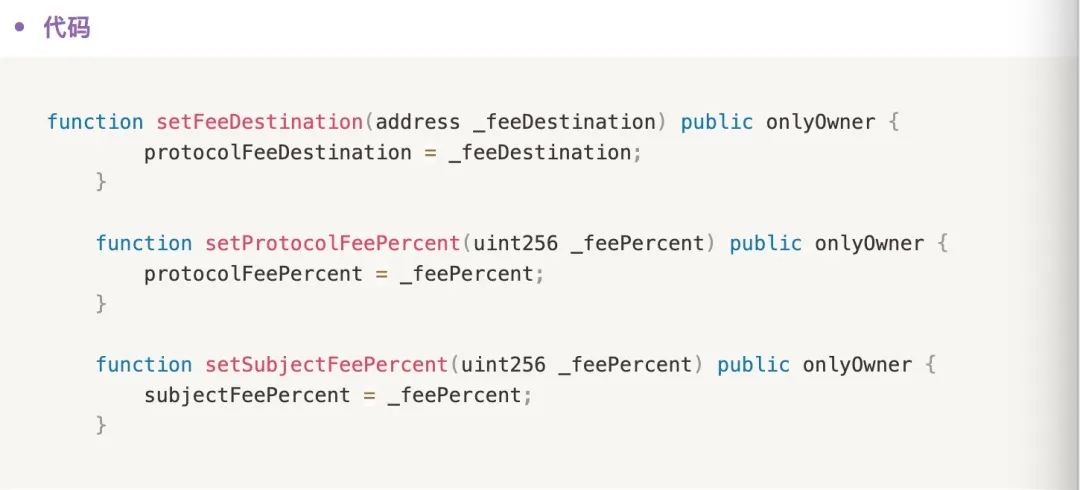
In friend.tech, each trade incurs a 10% fee, split equally (5% each) between the KOL (“room owner”) and the platform. The downside: high friction for users, insufficient earnings for creators, and a continuous net outflow of funds to friend.tech itself. Such aggressive revenue extraction risks killing the ecosystem. However, examining friend.tech’s contract code reveals that FeePercent is adjustable. Future iterations may lower fees to attract users. Similarly, most competing platforms retain modifiable fee parameters, suggesting the market will eventually converge on an optimal balance.
Industry Analysis and Reflections
Perhaps due to extreme lack of market liquidity and hunger for fresh narratives, friend.tech was quickly crowned the king of SocialFi.
When discussing the “Social” aspect of SocialFi, current products seem focused on upward mobility. Many view them as ideal models for knowledge monetization—users pay for access to reduce information asymmetry and accelerate career advancement. On the surface, these designs address certain pain points. But from any angle, their social functionality is severely lacking—falling short of even basic Web2 social app standards. Moreover, if friendship is purely transactional, isn't that paradoxical?
Does having lunch with Buffett or joining his chat group really constitute genuine upward networking?
Potential Development Directions
At its core, SocialFi represents a deconstruction of value in Web2 centralized social platforms—a form of data ownership. While value redistribution is beginning to take shape, true data ownership remains underdeveloped. Integration with protocols like Lens could help secure and protect user-generated content.
The right Web3 social product should enable fair value flow among creators, platforms, and users. Ponzi-driven financial mechanics will inevitably lead to collapse—the tragic triangle. Beyond improving service quality and aligning output with value, exploring diverse value curves could be promising—for instance, allowing different economic models (constant function à la OnlyFans, linear y=NX, exponential y=S^N) within the same platform, letting users choose.
Beyond knowledge monetization, introducing new features and revenue streams—such as aggregating NFTs, music, videos, and paid services—could broaden appeal.
Bonding curve mechanisms could be integrated with existing Web2 social platforms to drive mass adoption.
Returning to the fundamental question: Do we actually need SocialFi?
Join TechFlow official community to stay tuned
Telegram:https://t.me/TechFlowDaily
X (Twitter):https://x.com/TechFlowPost
X (Twitter) EN:https://x.com/BlockFlow_News






