
ETH Liquidity Challenges and Opportunities: A Brief Analysis of Futures ETFs and Market Dynamics
TechFlow Selected TechFlow Selected
ETH Liquidity Challenges and Opportunities: A Brief Analysis of Futures ETFs and Market Dynamics
The significant drop in Ethereum gas fees is closely related to the adoption of Layer 2 (Layer2) scaling solutions.
 Navigating Web3 tides with focused insights
Author | Ebunker
Translation | HuoHuo
Amid an ongoing cryptocurrency bear market, six different Ethereum futures financial instruments officially began trading starting October 2. However, these instruments have yet to spark enthusiasm among institutional investors for ETH. The total trading volume on the first day of ETH futures ETFs was less than $1.5 million. For context, when the Bitcoin futures ETF (BITO) debuted in 2021, its first-day trading volume exceeded $1 billion. This means that on its debut, capital inflows into ETH futures ETFs amounted to less than 2% of BITO's initial total.
Duong, a financial analyst at Coinbase Research, analyzed several key reasons behind this disparity:
First, the timing of the ETF launches differs significantly. ProShares launched the BTC futures ETF during the 2021 cryptocurrency bull market, when market liquidity was abundant, whereas the ETH futures ETFs were introduced during the current bear market marked by severe capital shortages. (Note: ProShares is a U.S.-based asset management company specializing in developing and managing exchange-traded funds, or ETFs.)
Second, differences in familiarity among investment advisors play a role. Investment advisors are generally more familiar with Bitcoin, as it integrates more easily into client portfolios. ETH is often seen as a more complex investment, not yet fully understood or accepted within traditional finance circles.
Finally, regulatory expectations have shifted. In a recent court ruling in the case of Risely v. Uniswap, Judge Katherine Polk Failla classified ETH as a crypto commodity. This may have heightened market anticipation for a spot ETH ETF, leading to relatively muted interest in ETH futures ETFs.
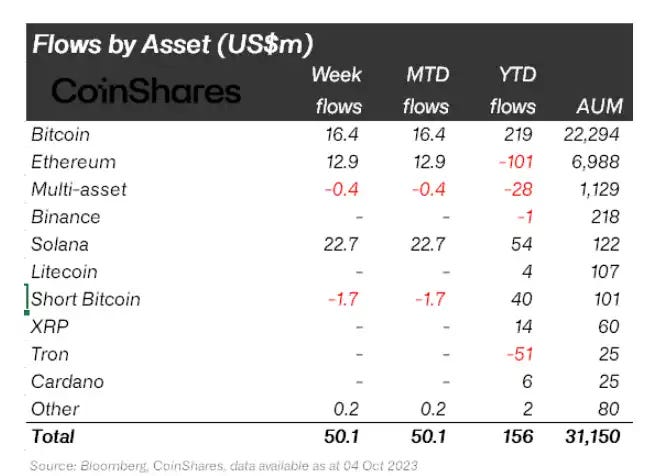
In terms of capital flows, the prolonged crypto bear market has had a significant impact on institutional capital. According to CoinShares data, during 61.5% of the past 39 weeks since 2022, there has been a net outflow of funds.
Recent data reflect shifting institutional interest in crypto assets. As of October 4, over $101 million has flowed out of ETH this year, while BTC attracted $219 million over the same period. However, in recent weeks, both BTC and ETH have seen similar weekly net inflows—$16.4 million for BTC and $12.9 million for ETH.
In summary, although ETH futures ETFs have not garnered the level of attention some expected, their trading volumes fall within the normal range for newly launched ETFs. They still represent a positive development for institutional interest. However, factors such as the current bear market may continue to hinder substantial institutional capital inflows until the broader crypto market recovers.
Potential Risks Associated with Ethereum Staking
On October 5, JPMorgan released a research report detailing concerns about centralization issues within the Ethereum network. The report noted that ETH staking reward rates have declined from 7.3% before the Shanghai hard fork to 5.5%. This yield decline, especially against the backdrop of rising yields in traditional financial markets, weakens Ethereum’s appeal as an investment asset.
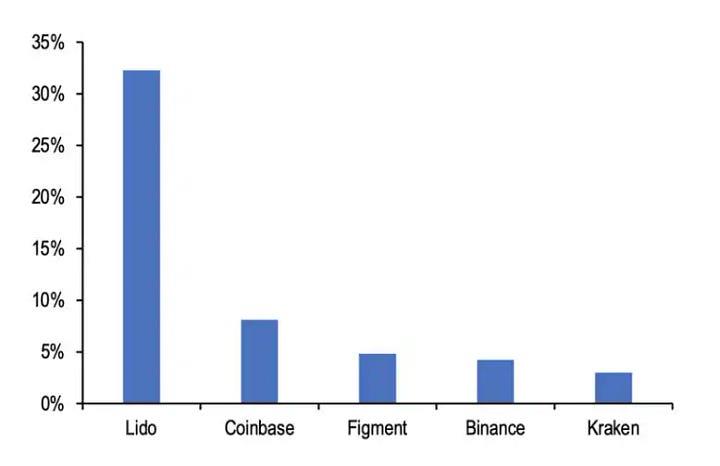
The report emphasized that the top five liquid staking providers—Lido, Coinbase, Figment, Binance, and Kraken—collectively control 50% of all staked ETH. Notably, Lido alone holds nearly one-third of the total staked ETH, raising concerns about centralization.
Regarded by the crypto community as the best alternative to centralized exchange (CEX) staking platforms, Lido has been actively expanding its list of node operators. This expansion aims to reduce centralization risks by preventing any single entity from controlling a majority of staked ETH.
Moreover, to address centralization within the Ethereum blockchain, the Ethereum community is promoting Distributed Validator Technology (DVT), including solutions like SSV and Obol. These DVT solutions allow multiple node operators to collaboratively run a single validator. This approach reduces validator-related risks without compromising core blockchain functionality.
JPMorgan also expressed concern about the practice of reusing assets as liquidity, which involves repeatedly using liquid staking tokens as collateral across various DeFi protocols. If the value of staked assets suddenly plummets or becomes compromised due to malicious attacks or protocol vulnerabilities, this practice could trigger cascading liquidations.
Ethereum Gas Fees Hit a Year-Low
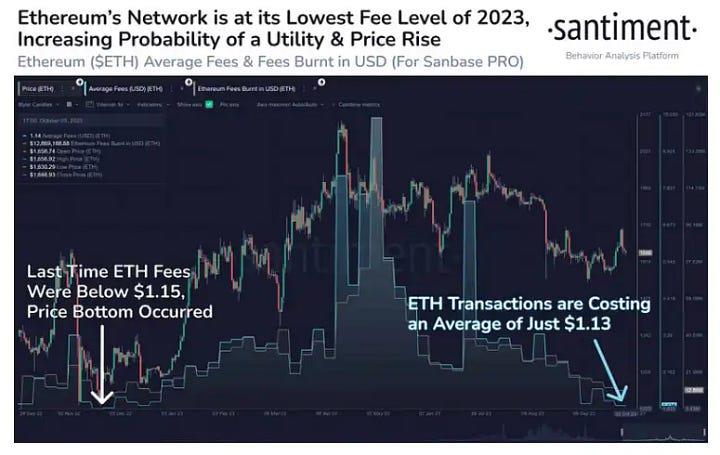
According to data from blockchain analytics platform Santiment, Ethereum gas fees have dropped to their lowest level in nearly a year. Over the past week, the average cost of an Ethereum transaction was just $1.13, a sharp decline from early May. Notably, the last time gas fees fell below $1.15, Ethereum’s price had already bottomed out.
Layer 2 Solutions Pave the Way for Ethereum Scaling
The significant drop in Ethereum gas fees is closely tied to increased adoption of Layer 2 (L2) scaling solutions. Driven by cost efficiency, a large number of users have migrated to L2 solutions, resulting in a substantial rise in block space demand on these platforms.

According to L2Beat data, transaction activity on L2 scaling solutions surged noticeably in 2023. Recent figures show that transactions per second (TPS) on L2s have reached 5.78 times that of the Ethereum mainnet.
Essentially, L2s are fulfilling their intended role: alleviating transaction load on Ethereum’s mainnet and enhancing its scalability. Santiment believes lower gas fees can boost Ethereum’s network utilization, attracting more decentralized applications and smart contracts. In the long run, as Ethereum sees greater adoption, this could positively impact ETH’s price.
Recently, Grayscale’s research report also pointed out that L2 solutions are paving the way for Ethereum’s scalability. Functionally, L2s enhance Ethereum’s scalability and reduce network costs for users by approximately 100x. In August, Coinbase launched Base, an Ethereum L2 blockchain—a major endorsement of the Ethereum ecosystem—aiming to open its decentralized applications to Coinbase’s 100 million users.
Coinbase is actively working to drive mass adoption of dApps on its Ethereum L2, BASE. If certain alternative Layer 1 chains struggle to gain broad acceptance due to security and liquidity concerns, integration with Ethereum L2s may become a more attractive option.
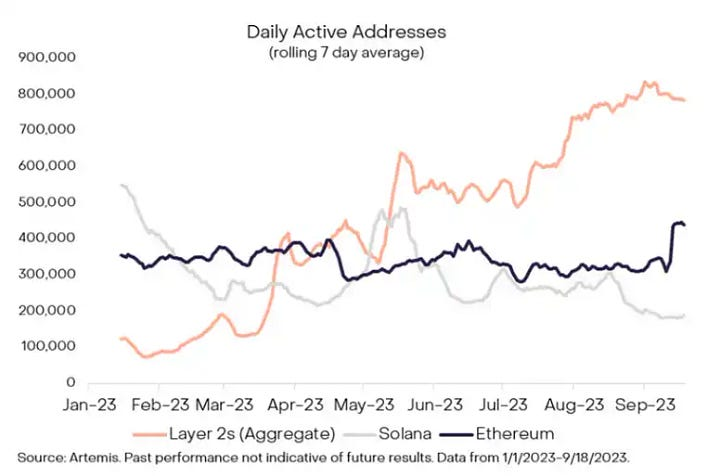
Usage of Ethereum L2 scaling solutions has steadily grown over the past year, with the total number of daily active addresses on L2 surpassing those on leading L1 competitors.
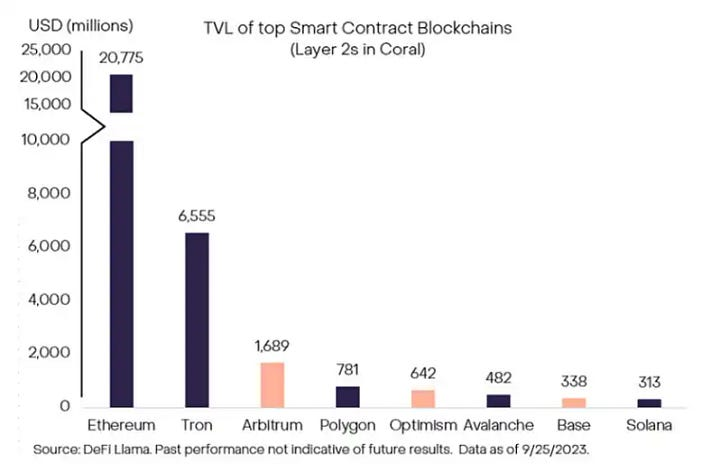
Beyond active addresses, Total Value Locked (TVL) is also critical, as it reflects the degree to which users entrust their funds to a given blockchain. Top-performing L2 solutions, including Arbitrum and Optimism, have already surpassed Ethereum’s L1 rivals such as Solana and Avalanche, underscoring broad market confidence in the Ethereum ecosystem and the appeal of its scaling solutions.
As the network expands, more activity will shift toward cost-effective L2 solutions.In return, L2s directly contribute value back to Ethereum. Specifically, users pay transaction fees for every L2 transaction. L2s retain a portion of these fees (currently averaging around 1/4), while Ethereum network validators receive the remaining 3/4.
For each transaction sent to an L2, a small fraction of ETH supply is also consumed by the Ethereum network. Therefore, increasing activity on Ethereum L2s directly enhances the value of ETH. If Ethereum’s L2 ecosystem continues its positive trajectory, it will solidify Ethereum’s position as the leading Layer 1 blockchain.
ETH Balances on Centralized Exchanges Hit a Five-Year Low

According to Santiment data from October 5, the amount of ETH held on exchanges has decreased to 10.66 million, the lowest level since May 2018. In contrast, the amount of ETH held outside exchanges stands at 115.88 million, a record high.
On October 4, approximately 110,000 ETH (worth over $180 million) were withdrawn from CEXs, marking the largest single-day outflow from these platforms since August 21. Such trends are typically viewed as long-term bullish indicators for Ethereum’s valuation, reflecting enduring investor confidence.
Join TechFlow official community to stay tuned
Telegram:https://t.me/TechFlowDaily
X (Twitter):https://x.com/TechFlowPost
X (Twitter) EN:https://x.com/BlockFlow_News
 @ebunker_eth