Exclusive Interview with Douro Labs (Pyth) CEO: Building the Missing Infrastructure for DeFi, All Financial Data in the World Will Flow Through Pyth
TechFlow Selected TechFlow Selected
Exclusive Interview with Douro Labs (Pyth) CEO: Building the Missing Infrastructure for DeFi, All Financial Data in the World Will Flow Through Pyth
In this interview, we discuss why Pyth chose the oracle赛道, the current issues with oracles, and its future relationship with competitors.
 Navigating Web3 tides with focused insights
ZK, RWA, Intent... More and more projects are aligning themselves with these trending directions. Some projects make well-considered strategic decisions, while many others simply chase short-term trends. In less-discussed sectors, there are still numerous unresolved issues—such as oracles. On September 12, Google Cloud Oracle partnered with LayerZero, offering services to all LayerZero applications, bringing oracles back into the market spotlight.
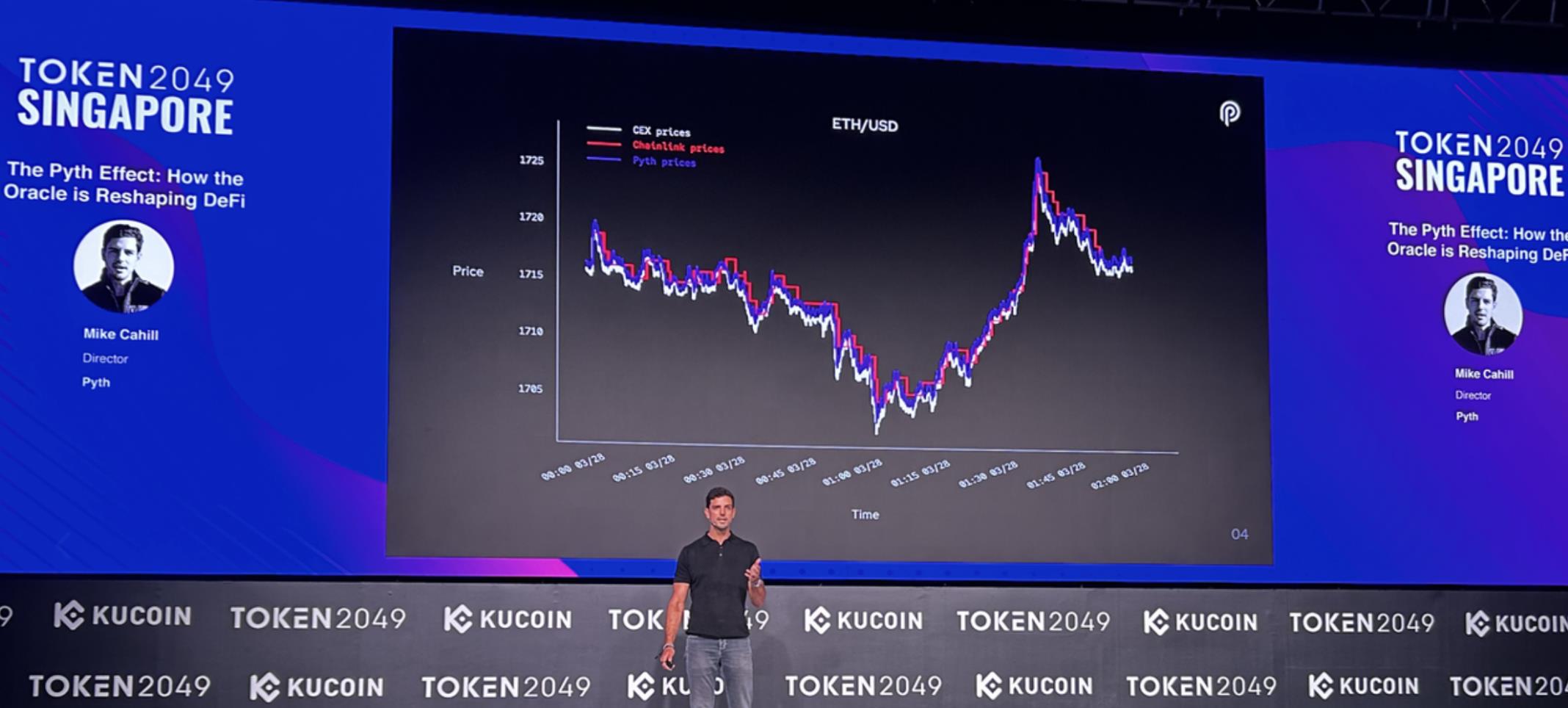
At the recently concluded TOKEN 2049, Mike Cahill, CEO of Douro Labs (Pyth Network), delivered a talk titled "The Pyth Effect: How the Oracle is Reshaping DeFi," sharing Pyth’s insights on the oracle sector and its current challenges. After his session, we sat down with Mike for an exclusive interview to discuss why Pyth chose the oracle space, the existing problems in today’s oracle landscape, and its future relationship with competitors.
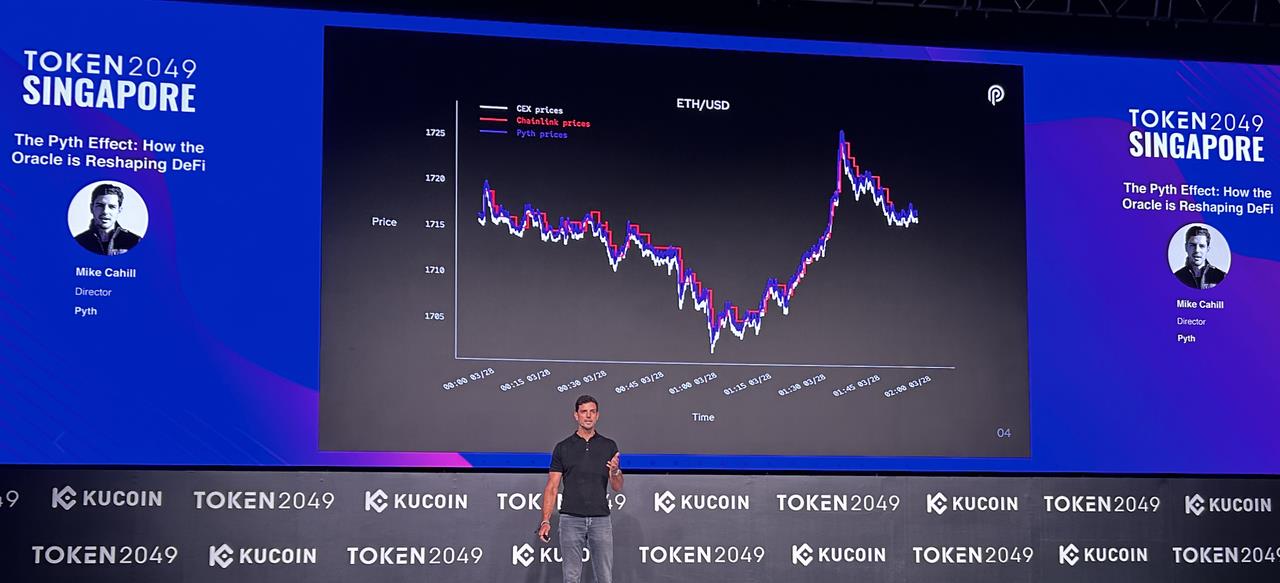
Pyth Network is an oracle built specifically for DeFi and holds a leading position in the high-throughput DeFi world. It currently ranks second in the number of supported protocols among oracle providers (just behind ChainLink). Below is the full transcript of our interview.
Launching Pyth: A Determined Bet on Oracles, Reclaiming a Missing Piece of DeFi
TechFlow: Great to have you here. I just attended your presentation—it was insightful and compelling. To start, could you introduce Pyth Network, your role, and what you focus on at the company?
Mike Cahill: Sure. I'm Mike, CEO of Douro Labs. Douro Labs is building a suite of tools and supporting development efforts for Pyth. Pyth is the largest first-party oracle network, with a mission to bring all financial data on-chain—much like how all the world’s music flows through Spotify. We believe that in the future, all global financial data will flow through Pyth.
Pyth operates in the oracle space. Blockchain applications cannot access real-world data; they can only read blockchain state. Oracles bridge this gap by bringing external data onto the chain. Pyth is a permissionless oracle with extremely fast performance. Our goal is to be the fastest and most trusted oracle, delivering price feeds across financial markets, cryptocurrencies, equities, foreign exchange, metals, interest rates, and more.
TechFlow: Thank you. Another question—we know oracles fall under infrastructure. What made you choose this particular赛道? Was there a specific reason?
Mike Cahill: It goes back to the beginning. I used to work at a trading firm where we invested in various projects and tried to understand the vision of DeFi. The idea that always excited me was building a decentralized trading platform—like Robinhood in the U.S. or Interactive Brokers globally—but one that would allow everyone equal access to investable assets.
As I dug deeper into the space, we realized one major bottleneck was the oracle problem. As I mentioned earlier, you need reliable data. But when we looked closely at existing solutions, we found them painfully slow. There were several reasons: most oracles scrape data from the internet, which is already delayed. Having worked at a trading firm, I know that latency is fatal. Slow data means losing money. We realized this was a critical missing piece in DeFi and infrastructure overall.
That’s when we began working on Pyth Network. We believed that without Pyth, DeFi couldn’t break through to the next level. We thought it could enable applications to compete with centralized counterparts in a very short time. Today, certain types of derivative trading apps have already achieved this, and we expect more global asset management solutions to follow.
TechFlow: As you said, price feeds are crucial in DeFi—we need fast, seamless data delivery. Pyth has introduced several innovations in this area. Could you highlight some key features of Pyth and their impact on the oracle sector?
Mike Cahill: There are three main innovations.
First, Pyth is a first-party oracle network with over 90 data publishers today. Each is a financial institution—either a trading firm or an exchange—that owns its own data and is incentivized to publish directly to the network. This gives Pyth unprecedented access to diverse data—not just free or easily purchasable data, but also premium datasets. For example, U.S. asset data is typically expensive, but Pyth’s publishers can provide it. That’s the first innovation.
Second is Pythnet, a blockchain built on the Solana Virtual Machine (SVM) with the same transparency as Solana. You can see all price data created on-chain and monitor each of the 90 publishers. This is crucial because we now support 350 symbols (trading pairs), a number that keeps growing—up from around 200 in January. Every symbol updates every 400 milliseconds and is bridged via Wormhole to over 30 blockchains. This is a massive innovation. We call it the complete oracle. All data is published on Pythnet, and any of these 30+ chains—like Optimism, Solana, Sui, or Aptos—can pull any symbol they need. It’s truly groundbreaking.
Third is Confidence Intervals, something no other oracle team has done. The point is, to accurately represent the market, you must quote a specific price X, but at any given moment there's actually a range of acceptable prices. Bitcoin doesn't have a single price. It has different prices on Binance, Coinbase, Upbit—and sometimes those diverge. So if you’re trying to scale as a high-speed oracle but your prices conflict, trust becomes hard to build. Confidence intervals accelerate our growth because we provide more context—for instance, “the price is X, but within an acceptable range, it could be ±y.”
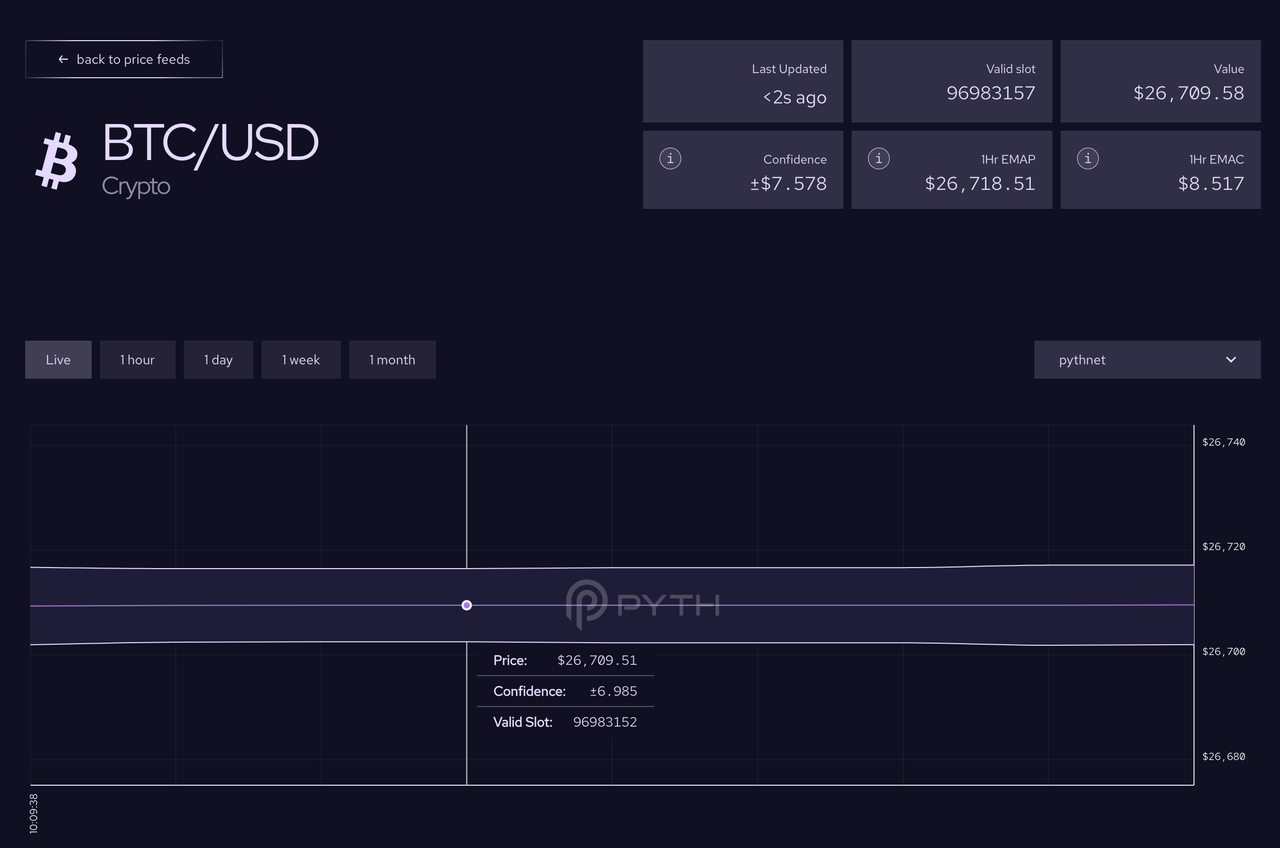
These are the three core innovations enabling Pyth to maintain both speed and trustworthiness in data transmission.
TechFlow: Thanks. I thought you might mention Push vs. Pull models. How do you view the difference between them? I think this is also a significant innovation.
TechFlow note: Currently, oracles mainly use two pricing models:
Push model: In this model, oracles continuously push price updates to each blockchain, paying gas fees for every update. This becomes a fundamental scalability issue—the more symbols, chains, and frequent updates, the exponentially higher the cost.
Pull model: A demand-driven price update model (“pull” model), this innovative design allows users (apps, liquidators, arbitrageurs) to fetch on-chain price data only when needed.
Mike Cahill: The Push model has various issues. Let’s first acknowledge its benefits: as an app builder, you don’t need to worry about the oracle’s inner workings—external participants keep updating data at fixed intervals, which is convenient. But someone has to pay for it.
So the business model becomes murky. Typically, Push-based oracles charge protocols or end-users: “Pay us next year’s data fee, plus some gas costs.” If you do, we’ll keep publishing. But now there’s a conflict between profit maximization and data quality. To maximize profits, they’ll minimize update frequency. If gas fees rise, their budget may not cover sustained updates—making this model unsustainable.
With the Pull model, the economics become transparent—users pay directly for the data they use. In this model, you pull prices on-chain, but you can see all available prices. On Pythnet, we have 350 symbols updating every 400ms, with no added cost per new symbol. To maximize the oracle’s profit potential, we just adjust pull fees—users then decide whether it’s worth paying. It’s fairer and more sustainable because price updates never degrade in volume. So I believe the Pull model clearly demonstrates a sustainable business model.
TechFlow: So is the Pull Model the best choice for DeFi projects?
Mike Cahill: Yes, absolutely. The challenge with Pull today is more integration work and keeping up with expansion across networks. Synthetix is a great example—it abstracts the complexity from end users. If you trade on Synthetix, part of the execution includes a “Pyth price” message, but users don’t even notice because it’s embedded in the backend code. The developers had to do extra work initially, but now Pyth enables greater scalability.
TechFlow: Next question is about Douro Labs. We know Douro Labs is a newly formed organization. Can you explain why this independent entity was created, and how it will affect Pyth’s future development and ecosystem growth?
Mike Cahill: This is a major milestone in Pyth’s evolution. Before Douro Labs, contributors from various entities worked on Pyth, not necessarily full-time. Douro Labs provides Pyth with a full-time engineering team—talented individuals dedicated to protocol development and commercial expansion. The team has 19 members, many from Jump Trading, with core backgrounds from Goldman Sachs, BNP Paribas, AWS, and Chorus One. It’s a highly capable team now focused solely on Pyth. In the future, we might explore areas beyond Pyth, but for now, Pyth remains our central focus.
TechFlow: Thank you. As mentioned on social media, you’re moving toward token-based governance. Can you share any future plans regarding the Pyth token?
Mike Cahill: The whitepaper mentions that eventually there will be token-led governance. We’re building the necessary tools, though no timeline has been announced yet. Token-led governance means users can decide how the network should operate—things like fee structures, whether to charge fees, onboarding new publishers or symbols. Consider the 200+ projects already integrated with Pyth—they require many different symbols, which could eventually be managed by the Pyth token holder community. For us, a truly community-owned and operated decentralized Pyth oracle network would be remarkable.
Competitive Landscape: Growing the Ecosystem Means Everyone Wins
TechFlow: Let’s move to part two—competition. With many oracles in the market, and Pyth ranking second in supported protocols, how does Pyth view its relationship with other oracles? Where do you stand out?
Mike Cahill: The three innovations I described earlier are quite unique—something we take pride in. We're riding a wave of low-latency oracles expanding from crypto to traditional assets. Of today’s 350 symbols, 25% are real-world assets. This sets Pyth apart—most other oracles focus only on crypto.
I view our relationship with other oracle providers as friendly. We appreciate what others do that Pyth doesn’t. Pyth is laser-focused on getting the best financial data on-chain as quickly as possible. We don’t offer random products like RNGs, sports results, or weather data. Others cover those areas—we respect their efforts.
Some oracles have branched into different products—for example, Chainlink’s CCIP suite uses Wormhole as a bridge but may adopt others in the future. I see bridges and oracles as distinct verticals. We’re still early. We must support industry peers because if the ecosystem grows, we all succeed.
TechFlow: Pyth currently focuses on DeFi protocols. Will you expand into other domains?
Mike Cahill: It’s too early to say. There are many definitions of success.
For Pyth, since DeFi uses financial data, we aim to become the best-in-class solution in this vertical before branching out. I can imagine exciting innovations using other data types, but we have no plans to enter non-financial data spaces yet.
TechFlow: Thank you. Another recent development—Google Cloud partnering with Layer Zero in the oracle space. What are your thoughts on this collaboration and its potential impact?
Mike Cahill: Since it was just announced, I don’t know the specifics. Layer Zero is a bridge, Google Cloud is a cloud provider. If I were to speculate, in Pyth’s model we use Wormhole as our bridge. But Pyth’s data sourcing is unique—we have 90 publishers. Google Cloud doesn’t strike me as a data source, nor does it have a competitive edge to incentivize protected financial market data onto the chain. It seems more likely they’ll focus on non-financial data—open-source data like “What’s the temperature in Singapore right now?” Public domain data fits well with Layer Zero. I find it hard to believe Google Cloud can source financial market data without a clear business model.
Future Vision: All Financial Data Will Flow Through Pyth
TechFlow: A personal question—over the next decade, which DeFi protocol do you think will stand out the most?
Mike Cahill: That’s hard to predict. But Synthetix has proven enduring. It’s one of the earliest and largest derivatives protocols on-chain. Recently launching V3, their team has weathered multiple cycles and gained immense experience. It’s hard to see them fail.
TechFlow: Another question—there are many oracles now. Long term, the market landscape will shift. What market share do you envision for Pyth in the oracle space?
Mike Cahill: Hard to predict. But from a financial data perspective, we believe all the world’s financial data will flow through Pyth—just like all the world’s music flows through Spotify. That’s not unreasonable. In our vertical—DeFi and financial data—we aim for 100% of data to go through us.
TechFlow: Cool. Final question—many users might be interested in the whitepaper, especially regarding Pyth token utility and mechanisms. Other oracles have launched tokens. Can you share what makes Pyth’s token approach unique, its advantages, or future plans?
Mike Cahill: The token is a governance token. It will let users shape Pyth’s direction. Like other governance tokens, it may also be used for fee payments, publisher rewards, and potentially staking by publishers to enhance network security.
No token launch date has been announced. But as I said, we’re actively building tools to enable token-led governance. These are in development, and we’re excited to see how the community will elevate Pyth to new heights.
TechFlow: So the token will be community-driven?
Mike Cahill: Yes, it will be a community-driven project—a community-governed token is exactly the goal.
TechFlow note: To learn more about Pyth’s mechanics, check out: Deep Dive into Pyth V2: A Key Shift in Price Feeding Models, Cross-chain Expansion, and Surging Product Capabilities
Join TechFlow official community to stay tuned
Telegram:https://t.me/TechFlowDaily
X (Twitter):https://x.com/TechFlowPost
X (Twitter) EN:https://x.com/BlockFlow_News
 深潮TechFlow