How to attract global developers through Hacker House?
TechFlow Selected TechFlow Selected
How to attract global developers through Hacker House?
Hacker House: A place where hackers live, learn, and build together.
 Navigating Web3 tides with focused insights
Author: Harry Liu
Long-term community living and participation in various hackathons have shown me the powerful catalytic effect of extended co-living on creativity and collaboration. Compared to short-term hackathons, Hacker Houses hold unique significance. They provide participants with a sufficiently long period to communicate, enabling the development of more mature ideas, finding partners whose skills and personalities complement each other, and sufficient time to validate their concepts.
My experience at Hacker House revealed a special environment: a space filled with free-flowing intellectual exchange, serving as both an experimental ground for innovation and a cradle for co-creation. I believe that compared to hackathons, the long-term model of co-living, co-learning, and co-building offered by Hacker House is more likely to give rise to breakthrough ideas and projects.
— ren
The main content of this article is adapted from a talk delivered at Shanhaiwu on August 30, 2023, with some additions and revisions.
This article also happens to be published on the first anniversary of our Hacker House, serving as a summary of our explorations over the past year.
Community itself is a broad concept, so I can only discuss it from a very narrow perspective based on our own experiences: sharing insights as a community organizer on how to attract global developers through Hacker House. I hope our efforts can offer new perspectives to practitioners.
From an organizer's standpoint, Hacker House is a well-balanced format in terms of input and output:
• Flexible duration: Can be organized for anywhere from several days to several weeks.
• Minimal staffing requirements: Can be run by just 1–2 people.
• High composability: Hacker House can be hosted in nearly any context—standalone, alongside conferences, or integrated with hackathons.
• Reasonable financial investment: Depending on location, typical costs range from $5,000 to $15,000 USD.
• Community recognition: Developers inherently desire deep interaction and collaboration.
• Brings together people interested in the same topics for in-depth discussions.
• Strong promotional value: The event naturally generates publicity; when hosted alongside major conferences, organizers often support side events and help promote them; plus, Hacker House itself is seen as a cool format, attracting even more attention.
Given these characteristics, Hacker House has become an increasingly popular format among communities and organizations.
What Is a Hacker House?
I define Hacker House as "a place where hackers co-live, co-learn, and co-build."
Hacker Houses have existed for a long time—typically as fixed residential spaces where hackers pay rent to live, organize tech events, and work on projects. The emphasis here is on "living space" and the activities happening within it.
The Hacker House we refer to centers around the “event”—including co-living, co-learning, and co-building—with temporary housing serving merely as a vessel to support the event. Funding primarily comes from sponsorships.
Some may not clearly distinguish between Hacker House, hackathon, and Pop-up City. Here’s a quick comparison:
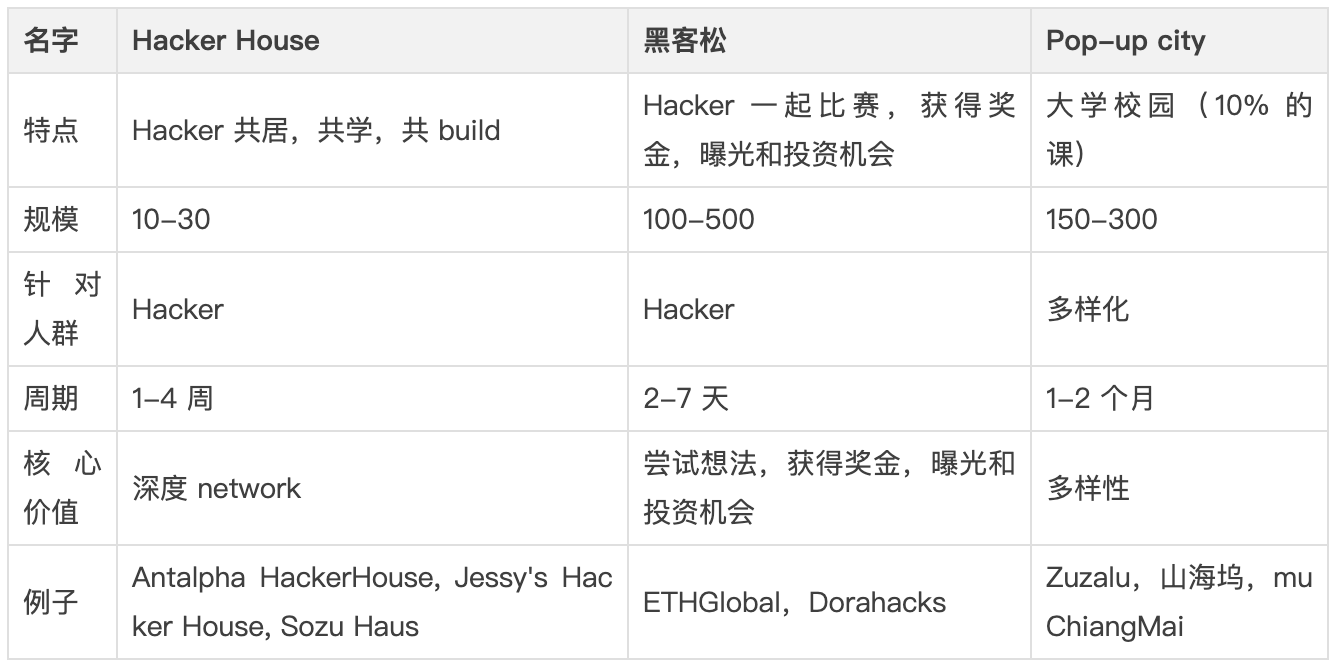
Both Hacker Houses and hackathons produce projects, but due to the longer duration, projects from Hacker Houses tend to be more complete—though still generally not at a commercial-ready stage.
Our Experiments
We started organizing Hacker Houses in Dali from October 2022, completing nine editions in total—six overseas—and producing over 50 projects. Several of these projects won prizes at hackathons and received grants.
Initially, we planned to run three sessions before expanding internationally in April 2023. At that point, we had zero experience building overseas developer communities—we didn’t know how to find developers or whether the Hacker House format would resonate. We simply decided to start close to home, focusing on Southeast Asia.
After completing our second domestic session, we gained some organizational experience. Then, by chance, we discovered ETHDenver. We realized this could be a great opportunity to solve the developer sourcing problem. So we changed plans and decided to host our Hacker House around the ETHDenver conference in February 2023. This strategy proved highly successful—we received over 50 applications, and even after closing registration, people continued emailing us asking to join. During this time, we also met several exceptional individuals who later helped us organize future Hacker Houses. Since then, we’ve hosted Hacker Houses in Chiang Mai, Japan, Montenegro, South Korea, and France.
Following ETHDenver, we gained community recognition, making sponsorship discussions easier. Hackers enjoyed our events and expressed interest in joining and supporting us continuously.
Later, we noticed growing interest in Hacker House from domestic communities. As a result, we launched Global Hacker House, partnering with six communities to run Hacker Houses across multiple cities and themes. At the time of writing (September 3, 2023), the events were still ongoing. Our biggest takeaway: multiple hackers expressed interest in hosting Hacker Houses in their own cities. This is exactly what we hope to achieve—empowering more people to launch their own Hacker Houses, even opening their homes. With just 3–5 people, you can form a Hacker House. If such initiatives emerge globally, it would be deeply meaningful.
Additionally, we are experimenting with gradual decentralization by empowering community members to run Hacker Houses. We’ve introduced the role of "Hacker House Curator," responsible for local operations, while we provide support. Our goal is to empower more curators in the future.
Next, let’s dive into how to organize a Hacker House overseas.
How to Organize an Overseas Hacker House
This guide doesn't cover every detail, but aims to provide a general understanding of how to organize a Hacker House.
Preparation Phase
1. Define the Theme
Choose a focused theme, ideally one you personally care about and understand well. For example, we've hosted several zkp-themed events because our community is deeply engaged in that area.
Good themes:
• zkp
• zkml
• account abstraction
Weak themes:
• Infra
• Layer2
• Web3
A focused theme enables deeper discussions among participants. Broad themes hinder conversation and make recruitment harder.
2. Choose the Location
Consider transportation, visa accessibility, local cost of living, and infrastructure quality.
If you're facing cold-start challenges in attracting developers, consider hosting near a major conference or hackathon to leverage existing foot traffic.
However, a downside is that hackers’ attention may be pulled toward the main event, reducing their engagement with your house.
Alternatively, you can choose an independent location. Our April Hacker House in Chiang Mai wasn’t tied to any conference. While recruitment was more challenging, this setup allowed developers to focus entirely on our event, fostering deeper interaction and higher output.
3. Promotion and Outreach
In addition to your own channels, use official websites and partner events for promotion—especially important early on when your reach is limited. Collaborators can also assist with outreach and recruitment. Once your community gains visibility, developers will start noticing your events organically.
4. Interviews and Finalizing Participants
Depending on the theme, set specific criteria for applicants. After applying, candidates go through a one-on-one video interview to ensure mutual fit. Requirements vary—for example, a zkp theme might require familiarity with zkp protocols, while app development themes may only require programming experience and basic Web3 knowledge.
Start recruiting early—ideally two months ahead—to allow selected participants 2–4 weeks to arrange visas and flights.
5. Securing Sponsors and Partners
Partnerships are relatively easy to establish and typically include developer communities, media outlets, and relevant projects. Their main contribution is promoting the event within their networks.
Sponsors come from various organizations—VCs, public blockchain teams, and projects related to the current theme are often willing to support.
6. Finding Accommodation
We primarily use Airbnb and personal connections to find housing. Two models exist: fully bundled (entire hotel or guesthouse rented out) or split (separate living and working spaces). Bundled setups keep work and life in one place, increasing spontaneous interactions. Split setups should keep locations within one kilometer. We prefer bundled setups for better engagement, though split models have also yielded strong results—choose based on your needs.
You can begin searching for housing in parallel with interviews. Just finalize the venue before locking in the final participant list, since capacity depends on the space.
During the Event
Here’s a typical three-week schedule:
0. Kickoff
Typical kickoff agenda:
• Organizer introduction
• Personal introductions from all participants
• Sharing of initial project ideas
1. Week One
Goal: Foster interaction. Host various talks and workshops to encourage idea formation. End the week with a group sync—usually on the weekend—where participants present their project ideas using slides or whiteboards.
2. Week Two
By now, participants have formed project ideas and gotten to know each other. Teams begin forming and development kicks off. A few talks may still be scheduled. Weekend sync focuses on progress updates.
3. Week Three
Final week is dedicated to development sprints and preparing for demo day. No additional talks—everyone focuses on final presentations.
On demo day, everyone presents their project.
“Anything that becomes competitive kills the exploration of knowledge.”
— Antifragile, Nassim Nicholas Taleb
[US] Nassim Nicholas Taleb
Unlike hackathons, we do not award prizes. Our goal is to encourage discussion and gather feedback to further refine the projects.
Post-Event
Publish recap articles and videos—they’re both valuable. These materials serve as excellent summaries and help secure support for future events.
We also conduct retrospectives to identify areas for improvement. In practice, this reflection happens throughout the process, with ongoing discussions about optimizing workflows and enhancing future iterations.
Final Thoughts
We run Hacker Houses partly to fulfill our own needs—to deeply connect and collaborate with like-minded individuals. Conferences and hackathons alone cannot satisfy this need. Now we realize this desire is universal, shared across the globe. Positive human interactions create lasting impact, and we hope this ripple effect continues through new Hacker Houses worldwide.
Join TechFlow official community to stay tuned
Telegram:https://t.me/TechFlowDaily
X (Twitter):https://x.com/TechFlowPost
X (Twitter) EN:https://x.com/BlockFlow_News
 @Antalpha_Labs