
TaxDAO's Response to the U.S. Senate Committee on Finance Regarding Digital Asset Taxation
TechFlow Selected TechFlow Selected
TaxDAO's Response to the U.S. Senate Committee on Finance Regarding Digital Asset Taxation
Lenient and flexible tax policies will benefit industry growth. While regulating taxation on digital asset transactions, it is essential to ensure simplicity and convenience in tax operations.
 Navigating Web3 tides with focused insights
On July 11, 2023, the U.S. Senate Committee on Finance issued a request for information to the digital asset community and other stakeholders seeking input on how digital asset transactions and income should be appropriately treated under federal tax law. The letter raised several questions, including whether digital assets should be marked-to-market and how lending of digital assets should be taxed.
Guided by the principle that tax policy should be lenient and flexible, TaxDAO has provided corresponding responses to these questions and submitted its response document to the Committee on September 5. We will continue to monitor developments on this important issue and look forward to maintaining close collaboration with all stakeholders.
Below is the full response from TaxDAO:
TaxDAO’s Response to the U.S. Senate Committee on Finance Regarding Taxation of Digital Assets
September 5, 2023
To the Committee on Finance:
TaxDAO is pleased to have the opportunity to respond to the key issues raised by the Committee on Finance at the intersection of digital assets and tax law. Founded by former tax directors and financial officers from unicorn blockchain companies, TaxDAO has handled hundreds of Web3-related tax and finance cases totaling tens of billions of dollars in value. It is a rare organization with deep expertise in both Web3 and taxation. TaxDAO aims to help the community better address tax compliance challenges, bridge the gap between tax regulators and the industry, and conduct foundational research and development during this early stage of industry regulation to support future compliant growth.
We believe that at this nascent stage of digital asset development, lenient and flexible tax policies will benefit industry growth. Therefore, while regulating digital asset transactions, it is essential to ensure tax compliance remains simple and accessible. We also recommend establishing a unified definition of digital assets to facilitate regulatory and tax administration. Based on these principles, we provide the following responses.
We look forward to collaborating with the Committee and supporting its efforts to bring positive changes to digital asset taxation and promote sustainable economic development.
Sincerely,
Leslie TaxDAO Senior Tax Analyst
Calix TaxDAO Founder
Anita TaxDAO Head of Content
Jack TaxDAO Head of Operation
1. Marking-to-Market for Traders and Dealers (IRC Section 475)
a) Should digital asset traders be allowed to mark-to-market? Why?
b) Should digital asset dealers be allowed or required to mark-to-market? Why?
c) Should the answers to the above questions depend on the type of digital asset? How should it be determined whether a digital asset is actively traded (under IRC Section 475(e)(2)(A))?
Overall, we do not recommend allowing digital asset traders or dealers to mark-to-market. Our reasons are as follows:
First, actively traded crypto assets are characterized by significant price volatility. As a result, marking-to-market would increase taxpayers’ tax burdens.
Under a mark-to-market regime, if a taxpayer fails to liquidate their crypto assets before year-end, they may end up recognizing taxable gains higher than their actual proceeds upon disposal. (For example, a trader purchases 1 BTC on September 1, 2023, at $10,000; on December 31, 2023, BTC is valued at $20,000; the trader sells the BTC on January 31, 2024, at $15,000. In this case, the trader realizes only $5,000 in profit but recognizes $10,000 in taxable gain.)
Even if losses on the same digital asset could offset previously recognized gains after such recognition, this accounting method would complicate tax reporting and discourage trading activity. Therefore, we do not recommend applying mark-to-market treatment to digital asset traders or dealers.
Second, determining the (average) fair market value of crypto assets is inherently difficult. Actively traded crypto assets are often listed across multiple exchanges—such as Binance, OKX, and Bitfinex—unlike securities, which typically trade on a single centralized exchange. Prices vary significantly across platforms, making it impractical to determine fair value through hypothetical “sales.” Moreover, non-actively traded digital assets lack a reliable market price and are therefore unsuitable for mark-to-market treatment.
Finally, in emerging industries, tax policies are typically designed to be simple and stable to encourage growth. The crypto industry is precisely such an emerging sector requiring encouragement and support. Mark-to-market taxation would unduly increase administrative costs for traders and dealers, hindering industry development. For these reasons, we do not recommend adopting this tax approach.
We recommend continuing to use the cost basis method for taxing digital asset traders and dealers. This method is operationally simple and policy-stable, making it well-suited for the current state of the crypto market. Furthermore, since taxation would be based on cost basis, there is no need to assess whether a digital asset is “actively traded” under IRC Section 475(e)(2)(A).
2. Trading Safe Harbor (IRC Section 864(b)(2))
a) Under what circumstances should the policy rationale behind the trading safe harbor (encouraging foreign investment in U.S. investment assets) apply to digital assets? If these policies should apply (at least partially) to digital assets, should digital assets fall within the scope of IRC Section 864(b)(2)(A) (securities trading safe harbor) or IRC Section 864(b)(2)(B) (commodities trading safe harbor)? Or should it depend on the specific regulatory status of the digital asset? Why?
b) If a new, standalone trading safe harbor were created for digital assets, should additional restrictions apply to qualifying transactions? Why? If so, how should terms like “organized commodity exchange” and “transactions customarily closed” (under IRC Section 864(b)(2)(B)(iii)) be interpreted across different types of digital asset exchanges?
The trading safe harbor rule does not apply to digital assets—not because digital assets should be excluded from tax benefits, but due to the inherent nature of digital assets. A key characteristic of digital assets is their borderless nature, meaning the jurisdiction of many digital asset traders is difficult to determine. Consequently, it is challenging to ascertain whether any given transaction qualifies as “trading conducted within the United States,” as required under the safe harbor provision.
We believe that tax treatment of digital asset trading should begin with taxpayer residency. If a trader is a U.S. resident taxpayer, they should be taxed under resident rules. If not, they generally have no U.S. tax liability, and thus the trading safe harbor need not apply. This approach avoids the administrative burden of determining transaction location and is simpler, promoting the growth of the crypto industry.
3. Treatment of Digital Asset Lending (IRC Section 1058)
a) Please describe various types of digital asset lending.
b) If IRC Section 1058 explicitly applied to digital assets, would firms that allow customers to lend digital assets establish standardized lending agreements to comply with the requirements? What challenges would compliance pose?
c) Should IRC Section 1058 cover all digital assets or only certain types? Why?
d) If a digital asset is lent to a third party and undergoes a hard fork, protocol change, or airdrop during the loan period, should the borrower recognize income from such events, or should the lender defer recognition until the asset is returned? Please explain.
e) During the loan period, might other events similar to hard forks, protocol changes, or airdrops occur? If so, who should recognize income—the borrower or the lender? Please explain.
(1) Digital Asset Lending
Digital asset lending works by one user providing their cryptocurrency to another user in exchange for fees. The exact mechanics vary by platform. Users can access crypto lending services on both centralized and decentralized platforms, though the core principle remains unchanged. Digital asset lending can be categorized as follows:
Collateralized Loans: These require borrowers to pledge a certain amount of cryptocurrency as collateral to obtain a loan in another cryptocurrency or fiat currency. Such loans are typically facilitated through centralized crypto exchanges.
Flash Loans: A novel lending mechanism in decentralized finance (DeFi), flash loans allow borrowers to withdraw a specified amount of cryptocurrency from a smart contract without posting collateral, provided the loan is repaid within the same transaction. Flash loans leverage the “atomicity” of smart contracts—meaning the sequence of “borrow-execute-repay” either completes fully or reverts entirely. If repayment fails, the entire transaction is undone, and funds are automatically returned, ensuring capital safety.
Provisions similar to IRC 1058 should apply to all digital assets. IRC 1058 ensures that taxpayers who lend securities maintain similar economic and tax positions as if they had not lent them. Similar rules are needed in digital asset lending to preserve financial stability. The UK’s recent DeFi consultation draft states: “The staking or lending of liquidity tokens or of other tokens representative of rights in staked or lent tokens will not be seen as a disposal.” This aligns with the principles of IRC 1058.
We can adapt existing IRC 1058(b) provisions for digital asset lending. A lending transaction would not trigger income or loss recognition if it meets the following four conditions:
① The agreement must stipulate that the transferor receives back identical digital assets at the end of the term;
② The agreement must require the transferee to pay the transferor all interest and other income equivalent to what the owner would have received;
③ The agreement must not reduce the transferor’s risks or opportunities related to holding the digital asset;
④ The agreement must meet any additional requirements prescribed by Treasury regulations.
It should be noted that applying rules analogous to IRC 1058 to digital assets does not imply that digital assets are securities, nor does it mean they should be taxed identically to securities.
Once such rules are adopted, centralized lending platforms could draft compliant lending agreements for users. Decentralized platforms could adjust their smart contract designs to meet the requirements. Thus, implementation would not impose significant economic burdens.
(2) Income Recognition
When a digital asset undergoes a hard fork, protocol change, or airdrop during a loan, the borrower should recognize income. Our reasoning is as follows:
First, according to market practice, rewards from forks, protocol changes, and airdrops belong to the borrower, reflecting real-world market conditions and contractual terms. The digital asset lending market is highly competitive and free, allowing lenders and borrowers to negotiate terms based on risk and return preferences. Many lending platforms explicitly state in their terms that any new assets generated during a loan period belong to the borrower. This prevents disputes and protects both parties' interests.
Second, U.S. tax law requires taxpayers to include the fair market value of newly acquired digital assets from hard forks or airdrops in gross income. Thus, when a borrower acquires control of new assets via a fork or airdrop, they must recognize income at that time and later report gains or losses upon sale or exchange. The lender does not receive new assets and thus incurs no taxable income or gain/loss.
Third, protocol changes may alter a digital asset’s functionality or attributes, affecting its value or tradability—such as supply, security, privacy, speed, or fees. These changes impact borrowers and lenders differently. Borrowers generally have greater control and bear more risk during the loan period, so they should capture resulting gains or losses. Lenders regain control and risk exposure only upon return of the asset and should recognize gain or loss based on its value at that time.
In conclusion, when a digital asset undergoes a hard fork, protocol change, or airdrop during a loan, the borrower should recognize income from such events.
4. Wash Sales (IRC Section 1091)
a) Under what circumstances might taxpayers consider the economic substance doctrine (IRC Section 7701(o)) applicable to wash sales involving digital assets?
b) Are there best practices for reporting digital asset transactions that are economically equivalent to wash sales?
c) Should IRC Section 1091 apply to digital assets? Why?
d) Does IRC Section 1091 apply to assets beyond digital assets? If so, which ones?
For this group of questions, we believe IRC 1091 should not apply to digital assets. Our reasons are as follows: First, the liquidity and diversity of digital assets make tracking transactions extremely difficult. Unlike stocks or securities, digital assets trade across multiple platforms and come in numerous forms, making it hard for taxpayers to track whether they’ve purchased “substantially identical” assets within 30 days. Additionally, price discrepancies and arbitrage opportunities across platforms lead to frequent transfers and swaps, increasing enforcement complexity.
Second, defining “identical” or “substantially identical” digital assets is problematic. For example, NFTs are considered unique. Consider a scenario where a taxpayer sells an NFT and later buys another with a similar name—whether these constitute substantially identical assets is legally ambiguous. To avoid such complications, IRC 1091 should not apply to digital assets.
Finally, excluding digital assets from IRC 1091 would not create serious tax issues. Cryptocurrency markets experience rapid price fluctuations, leading investors to frequently trade rather than hold long-term. Moreover, major cryptocurrencies often move in tandem—“rising together, falling together.” Thus, the utility of wash sale rules is limited: even if a taxpayer sells low and buys back, they will still recognize taxable gains when prices rise again.
The chart below shows the price trends of the top 10 cryptocurrencies by market cap on September 4, 2023. Aside from stablecoins, most exhibit similar price movements, indicating limited potential for indefinite tax avoidance through wash sales.
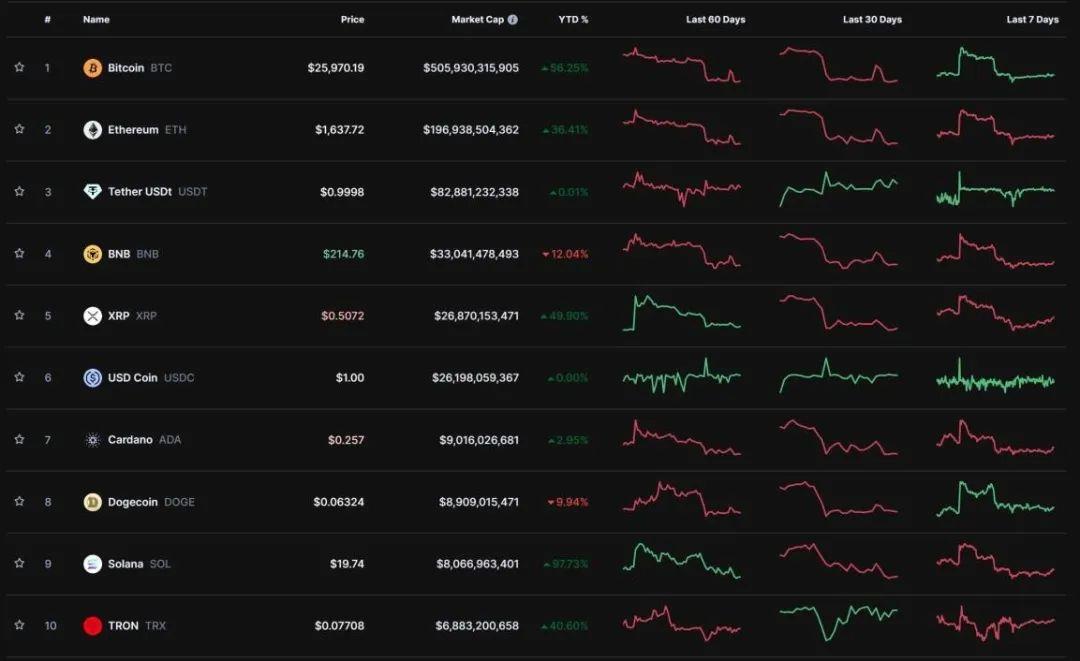
In sum, we conclude that excluding digital assets from IRC 1091 would not result in significant tax concerns.
5. Constructive Sales (IRC Section 1259)
a) Under what circumstances might taxpayers consider the economic substance doctrine (IRC Section 7701(o)) applicable to constructive sales involving digital assets?
b) Are there best practices for reporting digital asset transactions that are economically equivalent to constructive sales?
c) Should IRC Section 1259 apply to digital assets? Why?
d) Should IRC Section 1259 apply to assets beyond digital assets? If so, which ones? Why?
For this set of questions, we believe digital assets should not be subject to IRC 1259. The reasoning parallels our previous response.
First, as with the prior question, it is difficult to define “identical” or “substantially identical” digital assets. For example, in NFT trading, an investor holds one NFT and establishes a short position on the same class of NFTs via options. Applying IRC 1259 here would be problematic due to uncertainty over whether the two NFTs qualify as “identical.”
Similarly, excluding digital assets from IRC 1259 would not create serious tax issues. Cryptocurrency markets shift rapidly between bull and bear phases, discouraging long-term holdings. Therefore, applying constructive sale rules offers little benefit, as the triggering event (actual sale) would occur quickly anyway.
6. Timing and Sourcing of Income from Mining and Staking
a) Please describe the various types of rewards offered through mining and staking.
b) How should rewards from validation (mining, staking, etc.) be taxed? Why? Should different consensus mechanisms be treated differently? Why?
c) Should the nature and timing of income from mining and staking be the same? Why?
d) What factors are most important in determining whether an individual is engaged in the mining business or mining activities?
e) What factors are most important in determining whether an individual is engaged in the staking business or staking activities?
f) Please provide examples of arrangements involving participation in staking pool protocols.
g) Please describe appropriate tax treatments for various types of income and rewards received by individuals who stake for others or within pools.
h) What is the correct source of staking rewards? Why?
i) Please provide feedback on the Biden administration’s proposal to impose an excise tax on mining.
(1) Mining and Staking Rewards
Mining rewards primarily consist of block rewards and transaction fees.
Block Reward: This refers to newly minted digital assets awarded to miners for creating a new block. The amount and rules vary by blockchain—for example, Bitcoin’s block reward halves every four years, from an initial 50 BTC down to the current 6.25 BTC.
Transaction Fee: Fees paid by users for transactions included in a block, distributed to miners. The fee structure varies by network—for example, Bitcoin fees are set by senders based on transaction size and network congestion.
Staking rewards refer to returns earned by participants who support blockchain consensus mechanisms. They include:
Base Rewards: Distributed based on the amount and duration of staked assets, at fixed or variable rates.
Additional Rewards: Based on a validator’s performance and contributions—such as block validation, voting, or liquidity provision. These vary by network but generally include:
· Dividend Rewards: A share of profits or revenue from projects or platforms. For example, stakers in Binance Smart Chain’s DEX earn a portion of trading fees.
· Governance Rewards: Governance tokens or other incentives for participating in project governance. For example, Ethereum validators earn ETH 2.0 tokens.
· Liquidity Rewards: Tokens or incentives for providing liquidity to platforms. For example, stakers in Polkadot’s cross-chain messaging protocol (XCMP) earn DOT tokens.
The nature of mining and staking rewards is fundamentally the same. Both involve earning tokens through blockchain validation. The difference lies in inputs—mining uses hardware and computational power, while staking uses cryptocurrency—but both rely on the same on-chain validation mechanism. Thus, the distinction is merely structural. We believe entities should treat such income as ordinary business income, while individuals may treat it as investment income.
Given the similar nature of mining and staking rewards, income recognition timing should be consistent. Income should be recognized when the taxpayer gains control over the rewarded digital assets—i.e., when they can freely sell, exchange, use, or transfer them.
(2) Business Activities
We interpret the question “determining when an individual participates in mining/staking as a business” as assessing whether someone operates mining/staking as a trade or business, potentially subjecting them to self-employment tax. Key indicators include:
Purpose and Intent: The individual engages in mining/staking with the intent to earn income or profit on a continuous and systematic basis.
Scale and Frequency: The individual uses substantial computing resources and electricity and conducts mining/staking regularly or frequently.
Results and Impact: The individual earns significant income or profit and makes meaningful contributions to the blockchain network.
(3) Staking Pool Protocols
A staking pool protocol typically includes:
Pool Creation and Management: Typically operated by one or more pool operators responsible for running validator nodes and managing registration, deposits, withdrawals, and distributions. Operators usually charge a fee or commission for services.
Participation and Exit: The protocol allows anyone to join or leave with any amount of digital assets, subject to rules. Participants deposit assets to a pool address or smart contract and can exit via withdrawal requests. They typically receive a token representing their share (e.g., rETH, BETH).
Reward Distribution: Rewards—newly issued assets, transaction fees, dividends, governance tokens—are calculated and distributed periodically based on node performance and network rules. Distributions are proportional to each participant’s share, net of operator fees.
(4) Response to Excise Tax Proposal
The Biden administration’s proposal to impose a 30% excise tax on mining is overly harsh, especially during bear markets. A reasonable rate should reflect average profitability across market cycles and should not exceed tax rates applied to cloud computing or data center services.
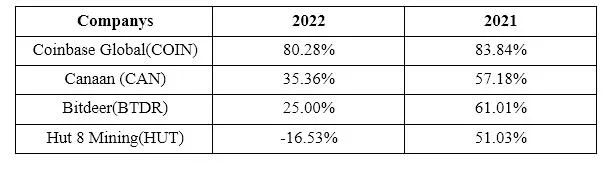
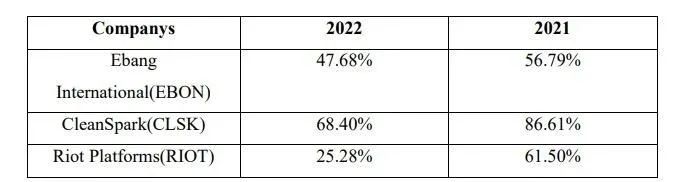
The table below shows gross margin data for major Nasdaq-listed mining companies during a bear market (2022) and a bull market (2021). In 2022, average gross margin was 37.92%; in 2021, it was 65.42%. Since excise tax applies directly to mining revenue—not profit—it would severely impact operations, especially in downturns. A 30% excise tax during a bear market would be devastating for mining firms.
Another justification for taxing mining is its high energy consumption. However, mining does not necessarily cause environmental harm if renewable energy is used. Imposing a uniform excise tax on all mining companies would unfairly penalize those using clean energy. Instead, governments should use pricing mechanisms to incentivize environmentally responsible practices.
7. Nonfunctional Currency (IRC Section 988(e))
a) Should the de minimis non-recognition rule under IRC 988(e) apply to digital assets? Why? What threshold would be appropriate, and why?
b) If the non-recognition rule applies, do existing safeguards prevent tax avoidance? What reporting mechanisms would help ensure compliance?
The de minimis non-recognition rule under IRC 988(e) should apply to digital assets. Like securities transactions, digital asset trades often involve foreign currency conversions. Requiring reporting of every minor foreign exchange gain or loss would impose excessive administrative burdens. We believe the threshold established under IRC 988(e) is appropriate.
Applying this rule to digital assets could enable tax avoidance. To mitigate this, we suggest adopting practices from other jurisdictions: taxpayers need not report minor FX gains/losses per transaction, but a random audit at year-end verifies a sample of transactions. Failure to accurately report results in penalties. This design encourages compliance while reducing reporting burden.
8. FATCA and FBAR Reporting (IRC Sections 6038D, 1471–1474, 6050I, and 31 U.S.C. Section 5311 et seq.)
a) When should taxpayers report digital assets or digital asset transactions on FATCA forms (e.g., Form 8938), FBAR FinCEN Form 114, and/or Form 8300? If some categories are reported and others not, please explain which categories should be reported or omitted.
b) Should FATCA, FBAR, and Form 8300 reporting requirements be clarified to resolve ambiguity about applicability to all or certain digital asset classes? Why?
c) Given the policy goals behind FBAR and FATCA, should digital assets be more explicitly included in these reporting regimes? Are there obstacles? What are they?
d) How should stakeholders evaluate wallet custody when determining FATCA, FBAR, and Form 8300 compliance? Provide examples of custody arrangements and indicate which types should or should not trigger reporting.
(1) Reporting Rule Recommendations
Overall, we recommend creating a new form specifically for reporting all digital assets. This would support industry growth, as fitting digital assets into existing forms is cumbersome and may discourage active trading.
However, if reporting must occur within existing forms, we recommend the following:
For FATCA (e.g., Form 8938): Taxpayers should report all foreign-held or controlled digital assets, regardless of linkage to USD or fiat. This includes cryptocurrencies, stablecoins, tokenized assets, NFTs, and DeFi protocols. Foreign holdings should be converted to USD using year-end exchange rates, and reporting thresholds should determine filing obligations.
For FBAR (FinCEN Form 114): Taxpayers should report foreign-hosted custodial or non-custodial digital asset wallets deemed financial accounts if aggregate value exceeds $10,000 at any point. Values should be converted to USD using year-end rates, and account details should be disclosed.
For Form 8300: Taxpayers should report cash or cash equivalents exceeding $10,000 received from the same payer or agent, including cryptocurrency. Crypto amounts should be converted to USD using the transaction date’s exchange rate, with relevant transaction details reported.
(2) Custody Arrangements
Our views on wallet custody are as follows:
A crypto wallet is a tool for storing and managing digital assets, categorized as custodial or non-custodial:
Custodial Wallet: Private keys are held by a third-party provider—such as an exchange, bank, or professional custodian—who manages the assets.
Non-Custodial Wallet: Users retain full control of their private keys—via software, hardware, or paper wallets.
We believe taxpayers must report all digital assets on Form 8938 or Form 8300 regardless of wallet type. However, for FBAR (Form 114), it must be clarified whether crypto wallets constitute foreign financial accounts. We propose: custodial wallets hosted abroad should be treated as foreign financial accounts; non-custodial wallets require further analysis.
Some non-custodial wallets may not qualify as foreign financial accounts if no third party is involved—for example, hardware or paper wallets fully controlled by the user. These represent personal property, not financial accounts, and may not require FBAR reporting.
Conversely, some software wallets may function as foreign financial accounts if they connect to foreign exchanges or offer cross-border services.
Moreover, any wallet linked to a foreign financial account—e.g., used for cross-border transfers—may require FBAR reporting due to its connection to such accounts.
9. Valuation and Appraisal Rules (IRC Section 170)
a) Digital assets currently do not qualify for the exception under IRC 170(f)(11) for assets with readily available valuations on exchanges. Should substantiation rules be updated to include digital assets? If so, how and for which types? Specifically, should publicly traded digital assets be treated differently?
b) What characteristics should exchanges and digital assets possess to qualify for this exception, and why?
We believe IRC 170 should be amended to include digital asset donations. However, only common, publicly traded digital assets should qualify for tax deductions—not all digital assets. NFTs and other assets lacking reliable fair market values should not qualify under IRC 170(f)(11), as their prices may be manipulated. Additionally, such illiquid assets impose extra costs on recipients. Policy should encourage donations of easily liquidated cryptocurrencies.
Specifically, we believe digital assets that meet the criteria outlined in Notice 2014-21—such as being traded on at least one platform against real currency or other virtual currencies, and having a published price index or verifiable valuation source—should qualify for the IRC 170(f)(11) exception.
Join TechFlow official community to stay tuned
Telegram:https://t.me/TechFlowDaily
X (Twitter):https://x.com/TechFlowPost
X (Twitter) EN:https://x.com/BlockFlow_News
 TaxDAO