








Penguin CEO: Six Key Points to Building a Globally Renowned Brand NFT
TechFlow Selected TechFlow Selected
Penguin CEO: Six Key Points to Building a Globally Renowned Brand NFT
If you want to be part of the new era of culture, community, and intellectual property, then NFTs are your battlefield.
 Navigating Web3 tides with focused insights
Author: Luca Netz
Translated by: Azuma, Odaily Planet Daily
On August 5, Twitter KOL Gary posted that investors should realize commercial expansion of PFP-type NFTs only benefits project teams financially, but brings no returns to holders—thus, PFPs should not be viewed as stocks.
In response, Luca Netz, CEO of the NFT project "Pudgy Penguins," published a long rebuttal article.
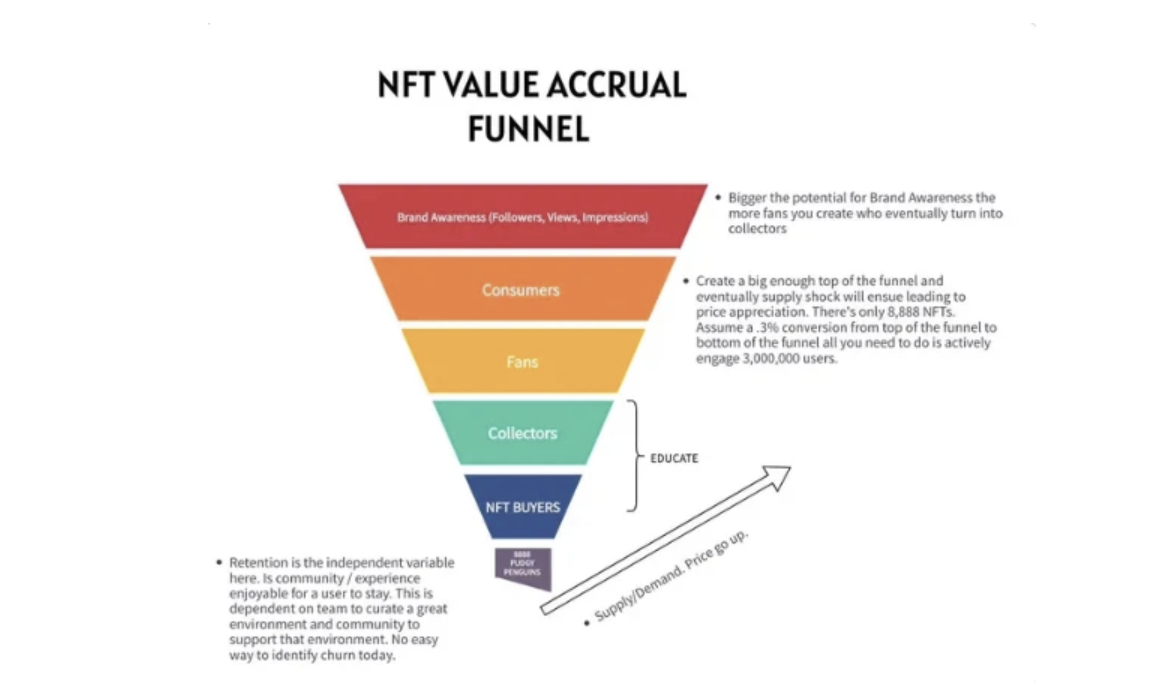
In the article, Luca Netz systematically explained, across six dimensions, the critical importance of brand commercialization for NFT project development. This includes using a "funnel" model to illustrate how revenue ultimately flows back to NFT holders, and analyzing supply-demand dynamics to explain why some blue-chip NFT projects gradually trend toward zero.

As one of the standout NFT projects during the bear market, since Luca Netz took over Pudgy Penguins in February last year, the project has not only emerged from its past shadows but also, while other PFP projects saw their floor prices steadily decline, briefly reached an all-time high in ETH terms. Because of this, Luca Netz's reputation in the NFT space has continued to rise, with many project teams regarding him as a role model, hoping to replicate Pudgy Penguins' success through imitation and learning.
Given that Luca Netz’s recent article comprehensively outlines his thinking on NFT development, it may offer valuable reference for peers in the same sector. Below is the full translation of Luca Netz’s original text, translated by Odaily Planet Daily.
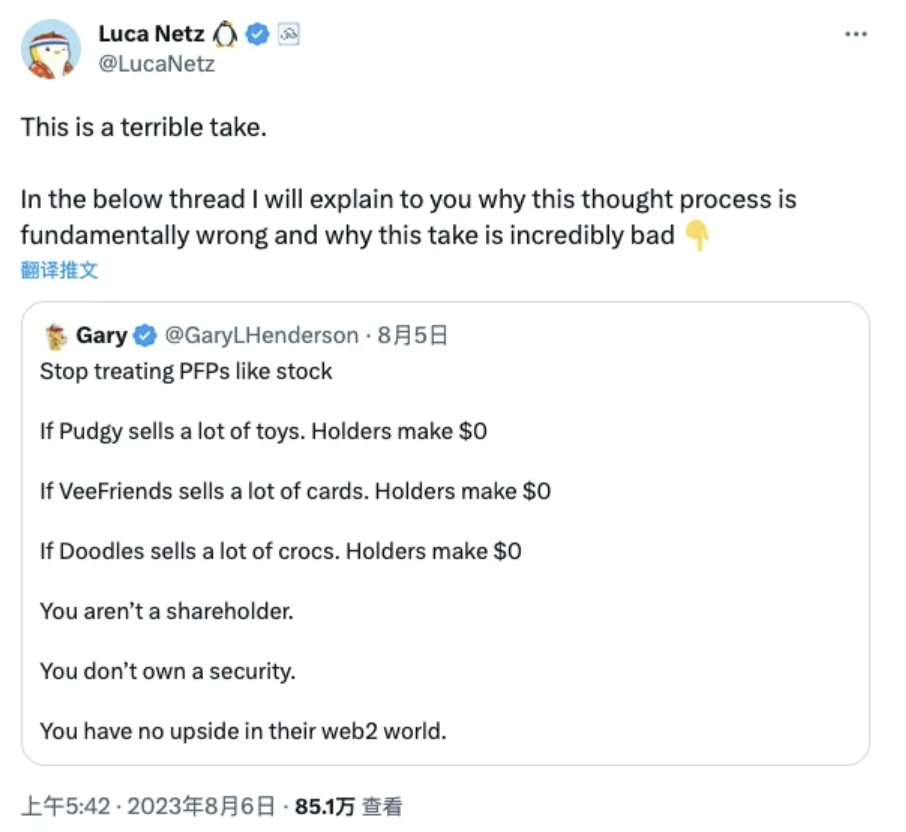
Gary’s view is terrible.
Below, I will explain why this way of thinking is fundamentally flawed, and why this perspective is so harmful.
To clearly articulate my position, I’ll list six key points directly supporting why building a global brand is the best path to accumulating value for NFT holders.
Point 1: Marketing
NFTs are a finite resource; as interest and demand grow, the NFTs you hold naturally accumulate value.
NFTs require marketing to succeed. Everyone wants instant value conversion, but that’s impossible during a deep bear market. When NFTs were in a hype phase, certain announcements could generate massive interest and demand, rapidly increasing NFT value. Today, the same actions would be far less effective.
Is this unique to NFTs? No. Many strong Layer 2 projects are making major announcements that, two years ago, might have quickly boosted market cap—but today, even important announcements barely impact secondary markets.
In a bear market, every asset class shares the same characteristics—we’re not special.
As shown in the funnel model below, marketing expands the top of the funnel—the starting point for NFT demand and value accumulation. Over time, value flows down the funnel and eventually reaches NFT holders.
Point 2: Emotional Connection
Before we begin, consider this data point about collectibles: today, the global collectibles market is worth $426 billion. This market isn’t built on liquidity or instant dopamine hits—it’s built on emotional connection.
To increase your NFT’s value, you need to optimize two things:
-
Demand, which can be increased through various marketing initiatives that gradually raise project visibility.
-
Holding, which is driven by emotional connection. This includes connections among community members, and between holders and interactive experiences, content, and characters. If we build strong enough emotional bonds between holders and NFTs, the emotional value will eventually surpass monetary gain, making them priceless.
If you can generate sufficient demand and create compelling emotional connections, you’ve built the world’s best value-creation mechanism.
Look at the image below. If you saw your child react this way to a Pudgy Penguin toy, would you still sell it and chase another shitcoin? Wouldn’t this reaction make you more confident that the project is executing its long-term vision?

Point 3: Sustainability
This point is often the most overlooked.
Understanding sustainability helps explain what killed your favorite blue-chip projects from 2020–2021: dilution. Dilution occurs when a project cannot generate external revenue, forcing it to mint more NFTs.
Unfortunately, when supply growth outpaces demand growth, the ecosystem trends toward zero.
Building a sustainable brand effectively reduces the biggest risk for NFT holders: unnecessary dilution required to sustain and advance operations.
-
Demand > Supply = NFT value rises;
-
Supply > Demand = NFT trends toward zero.
-
Build a sustainable revenue model → Invest in marketing → Generate more demand → NFT value grows.
It’s not hard to understand.
Point 4: Touchpoints
At its core, this is basic work—but I believe that if you create enough touchpoints (opportunities for users to engage with the project’s IP), they will translate into maximum upward momentum when market conditions improve.
Take Pudgy Toys as an example. I often hear skepticism: “Luca, no one will buy your toys and then go buy your NFT—what benefit does that bring to holders?”
True, they won’t today—and I don’t need them to right now. But when the NFT bull market returns and traders start accumulating collectibles, which NFT do you think they’ll most likely buy? I believe they’ll favor the ones they’ve seen most frequently. Once they have capital, they’ll buy those.
More brand collaborations, more products, and more content—all are excellent ways to create more touchpoints.
Point 5: Experiences
Within NFT culture, everyone craves free perks. Unfortunately, with royalty erosion, this is no longer sustainable.
If I fail to generate real external cash flow by building a successful brand, I cannot create more and better experiences for holders without diluting their interests. But if I build a successful brand that generates steady income to replenish treasury reserves, I can use those funds to provide richer, better experiences for the community.
The entire value transmission process works like this:
-
Create memorable free experiences for holders → FOMO among non-holders → They want to join → They buy NFTs → NFT value rises → Holder value increases.
Point 6: Institutional Game
One thing is obvious to me: 90% of NFT traders don’t understand what’s actually happening in this space or where the real upside lies.
This is both a retail and institutional game. If you believe BAYC’s 150 ETH floor is driven by retail demand, you’re clearly mistaken.
What most people don’t know is that the world’s largest funds are making massive investments in intellectual property. IP is a strong hedge against economic downturns and has proven to be an excellent asset class for portfolio diversification.
You need to ask yourself: how can your project attract funds that currently or in the future seek to include NFTs in next-generation IP portfolios? Do you really think game theory and Ponzi economics excite institutional capital? If so, you don’t understand the true potential of these assets or this game.
-
Attracting arbitrageurs = short-term success;
-
Attracting institutions = long-term success.
In my view, future funds will seek Web3 IPs that meet existing IP demand and leverage blockchain technology to create entirely new models.
Attracting one institution is far more valuable than attracting 500 arbitrageurs.
Conclusion
I know these arguments may seem biased, as I’m defending from my own position. But remember, we bought Pudgy Penguins for $2.5 million, and our sole purpose in acquiring this project was to become number one—to set the benchmark for the NFT space.
With that in mind, we spent many months critically thinking about the best approach to achieve this goal. Ultimately, this is the conclusion we reached.
If you want a Ponzi shitcoin, go launch a better one.
If you want to be part of a new era of culture, community, and intellectual property, then NFTs are your battlefield.
I published this article specifically to refute the claim that brand commercialization doesn’t benefit NFT holders. I believe that over time, the NFT space will recognize this as the correct way to incubate the next generation of NFTs.
Join TechFlow official community to stay tuned
Telegram:https://t.me/TechFlowDaily
X (Twitter):https://x.com/TechFlowPost
X (Twitter) EN:https://x.com/BlockFlow_News
 @LucaNetz






