The Rise and Fall of ICP: Independent Technology and a Sparse Ecosystem
TechFlow Selected TechFlow Selected
The Rise and Fall of ICP: Independent Technology and a Sparse Ecosystem
ICP's own slogan, "decentralized AWS," is particularly eye-catching, luring countless people to invest real money in anticipation of the next milestone paradigm surpassing Ethereum and EOS.
 Navigating Web3 tides with focused insights
Author: Titanio, GeekerWeb3
Introduction: Since 2022, as new public chains like Solana have gradually declined and Ethereum Layer 2 solutions continue to thrive, the story of "Ethereum killers" seems to have been forgotten by the world. The once vibrant era of "hundreds of schools contending" has vanished. Yet, looking back in history, the narrative of new public chains starting from EOS remains an undeniable and brilliant chapter in the development of Web3.
When discussing new public chains, Dfinity (ICP) is an unavoidable topic. Backed by nearly $200 million in funding, a stellar team of cryptographers, and unconventional technology, ICP was once celebrated by countless enthusiasts. However, after launching at a high valuation in 2021, ICP's price plummeted relentlessly, transforming it from a highly anticipated "king project" into a widely ridiculed "doomed project," leaving many investors disheartened. Moreover, its sparse and underdeveloped ecosystem makes ICP appear embarrassingly weak compared to competitors like Solana.
Looking back at history and reflecting on the past, what factors truly influenced the development of ICP’s ecosystem? Can unique technology alone drive ecosystem growth? Is there any hope for revival for this so-called “doomed project”? This article will begin by analyzing ICP’s technical features, then examine flaws in its NNS governance system and lack of a unified token standard, briefly unpacking the challenges throughout its development journey to clearly illustrate why this once-prominent “king project” ultimately declined.
ICP's Technical Characteristics: A Decentralized AWS
First, let's introduce ICP’s smart contract system—Canister (referred to domestically as “containers” or “tins”), which serves as the carrier for dApps. It allows WebAssembly (WASM) bytecode to run within, supporting programs written in multiple programming languages.
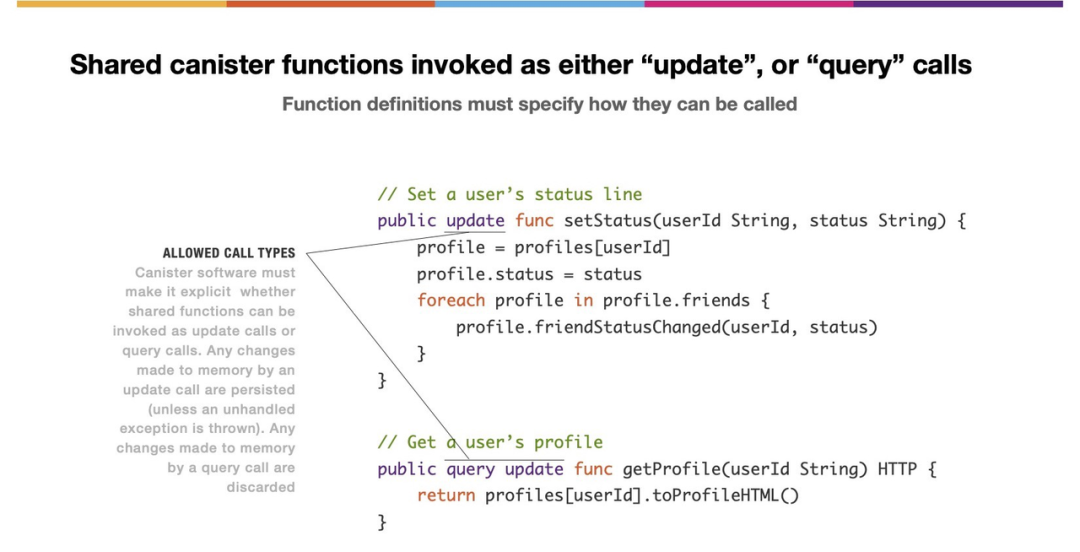
ICP allocates dedicated memory to each Canister. If we imagine ICP as a supercomputer, then each Canister functions like a process within that computer, with its own runtime memory. Developers can encapsulate data related to their smart contracts within specific containers. This is ICP’s unique data storage approach—Canisters allow you to store program state, databases, and even frontend data (such as game assets) all within a single container, aiming to enable further scalability for dApps. In essence, ICP operates as a platform hosting numerous Canisters through containerization technology deployed across ICP nodes.
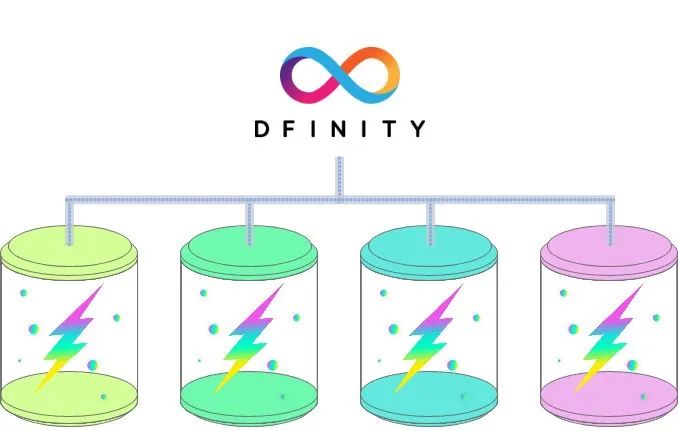
Additionally, Canisters support gas fee sponsorship, allowing users to interact without holding native tokens—the project sponsor pays the transaction fees instead. This mechanism mirrors the “gas fee abstraction” feature pursued by many low-barrier wallets on Ethereum. As such, many believed ICP had strong potential for mass adoption—users could enjoy Web2-level UX without needing to purchase native tokens upfront (especially avoiding high gas fees during network congestion).
However, ICP suffers from one major flaw: lack of global state. Ethereum maintains a concept of “global state,” where all account states are publicly visible to every smart contract, managed via a globally accessible State Trie structure. ICP, however, operates completely differently. Specifically, programs (smart contracts) on ICP reside in their own individual Canisters, with data isolated inside separate containers. External entities cannot view internal data details—they can only access data through interfaces exposed by the Canister.
In other words, ICP lacks Ethereum’s “globally visible” state storage architecture. Interactions between different Canisters are asynchronous, making simultaneous calls to multiple contracts impossible. This clearly creates significant friction for DeFi protocols, effectively excluding ICP from meaningful participation in the DeFi space. Some argue that while Ethereum acts as a simple asset-trading “world computer,” ICP is more accurately described as a “decentralized AWS” designed for complex web applications.
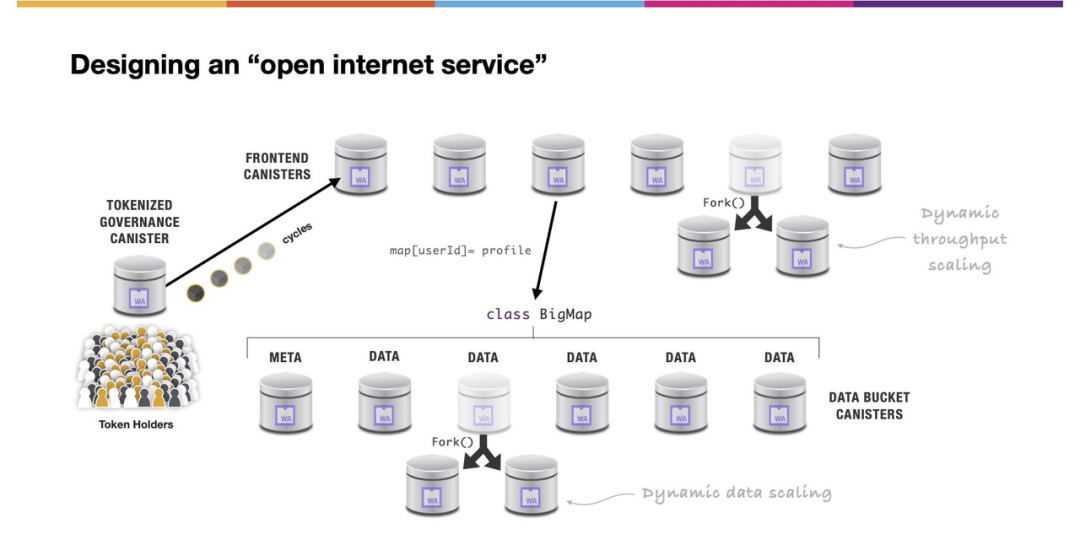
Beyond its unique Canister design, ICP adopts a layered architecture consisting primarily of Canisters, subnets, nodes, and data centers. We can view ICP as a system composed of multiple subnets, with each subnet essentially functioning as a standalone public chain. Each subnet hosts multiple Canisters—these are the interoperable building blocks of ICP, each containing user-uploaded code and state.
At the lowest level, independent data centers host specialized hardware. Running atop these are nodes responsible for processing data and state transitions within subnet-hosted Canisters. This hierarchical design grants ICP higher scalability and flexibility, enabling it to serve diverse application needs and giving it a feel closer to cloud infrastructure.
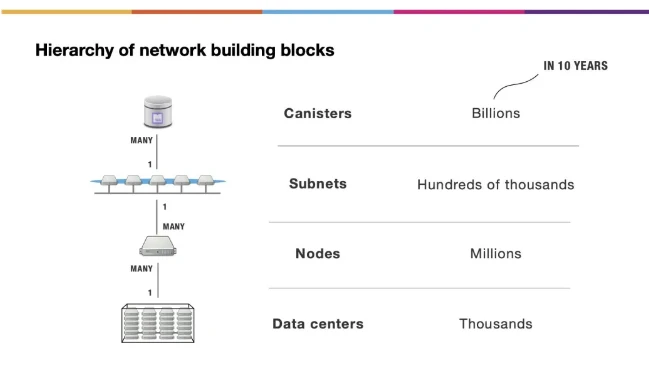
Some believe ICP achieved sharding from day one through its subnet model. Currently, ICP operates around 40 subnets, with the largest containing 13 validator nodes and the smallest having just one. Given the asynchronous communication between Canisters mentioned earlier, ICP’s overall design enables efficient performance and cross-subnet interoperability.
Collectively, all subnets currently produce approximately 20 blocks per second. However, due to the small number of nodes per subnet, concerns about theoretical security persist. Becoming an ICP node requires approval from the ICP Foundation and demands extremely high-end hardware specifications—far exceeding those of chains like Solana or Sui. Consequently, ICP’s degree of decentralization has drawn widespread criticism.
Regarding this issue, a project builder within the ICP ecosystem candidly admitted: since most applications running on ICP are general-purpose apps rather than financial transactions involving assets, stringent security requirements aren’t deemed necessary. In practice, ICP functions more like a cloud platform with slightly greater decentralization than AWS.
Setting aside these concerns, ICP has successfully integrated BTC directly into its system. Using proprietary cryptographic algorithms such as Chain Key and threshold ECDSA, along with a special indexing mechanism, ICP achieves direct integration with Bitcoin, enabling ICP smart contracts to hold real BTC—not wrapped representations. The implementation works as follows:
At the network layer, a BTC adapter randomly connects to eight nodes on the Bitcoin network, pulls BTC blocks into the ICP network, and updates the full set of UTXOs based on transactions included in those blocks. This allows Canisters on ICP to stay aware of Bitcoin’s latest chain state and verify/retrieve BTC blocks and UTXOs programmatically.
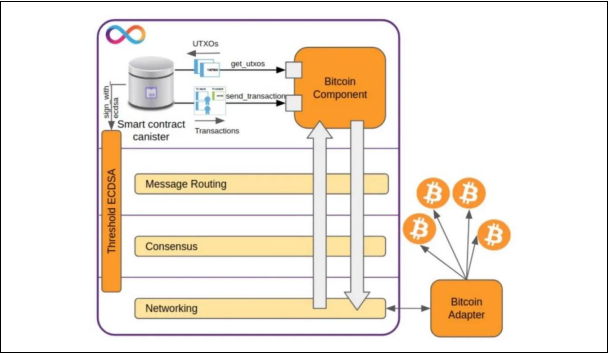
Meanwhile, threshold ECDSA is the key technology enabling ICP smart contracts to receive and send BTC transactions. It extends the standard ECDSA signature algorithm using techniques similar to MPC (multi-party computation), distributing shards of private keys associated with a smart contract across designated signing nodes in a subnet, ensuring heightened security. In short, ICP smart contracts delegate private key management to multiple nodes instead of relying on a single entity or self-control. When a contract initiates a BTC transaction, over two-thirds of the nodes in the subnet must collaborate to generate a complete ECDSA signature before the transaction can be broadcast.
ICP’s asset integration approach goes beyond typical cross-chain bridge models. Most bridges offer only mapped versions of BTC and heavily depend on third-party operators’ nodes, creating various security risks. ICP, by contrast, allows native BTC to be stored directly inside Canisters—even storing private keys corresponding to BTC addresses on-chain.
Compared to traditional cross-chain methods reliant on third-party bridge nodes, ICP’s BTC ledger runs securely across distributed subnets with sufficient node counts. So long as the subnet itself remains secure, ICP’s BTC ledger inherits that same level of security.
The Rational Actor Trap: Token Price and Lockups
Yet history shows that even superior or distinctive technology cannot compensate for weak ecosystem development. From mainnet launch until today, projects on ICP remain stuck in an embarrassing state of “no actual users,” spiraling into a vicious cycle of “ecosystem scarcity → loss of quality projects → further erosion of participants.” Rather than focusing solely on specific shortcomings in ecosystem cultivation, the author aims to explore another perspective to explain how ICP ended up in its current predicament.
One theory suggests that within hours of listing, ICP underwent price manipulation by certain actors (ICP’s founder insists this was orchestrated by SBF and FTX). As the token price surged, ICP’s market cap briefly exceeded $230 billion, ranking third only behind BTC and ETH. But once the pump concluded, prices collapsed sharply—within just six weeks, ICP’s market cap dropped by 90%.
This crash severely damaged ICP’s reputation and that of the Dfinity Foundation, inviting further attacks from bearish forces who accelerated the downward spiral, driving the price far below its perceived intrinsic value. (It’s rumored that long-termist firm a16z has already exited its ICP holdings.)
The author does not intend to assess the validity of these claims but presents them as one possible viewpoint. (Another interesting theory argues that ICP founder Dominic Williams’ series of investor-unfriendly behaviors were key reasons behind the dump and ecosystem isolation.) In reality, the primary driver affecting token price dynamics lies in its vesting mechanism—designed to prevent early investors from dumping tokens immediately but resulting instead in prolonged lockup periods (up to eight years), leading to consistent selling pressure upon neuron unlocking. See the chart below:
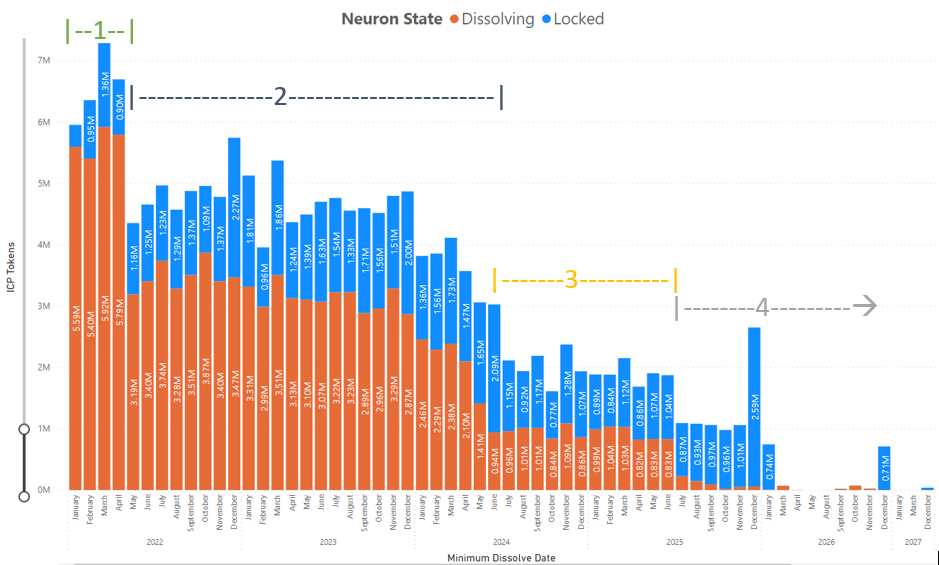
In practice, Dfinity Foundation’s attempt to lock early investors’ tokens failed to achieve its intended effect. The presence of large quantities of low-cost tokens, combined with extreme price inflation at launch, created a massive gap between peak prices and dense holder concentration zones. Aside from early backers, almost no one would have incentive to push prices upward through that range. At this stage, early investors still profit—whether they reinvest staking rewards into NNS neurons or sell them outright. But when the token falls below a certain threshold, opportunity costs mean early holders enter a “locked-in loss” state. Under these conditions, they’re more inclined to sell off accrued interest and, upon neuron maturity, may dump their positions at a loss—further accelerating the decline.
This “sell more as it drops, sell even harder at lower levels” death spiral severely hampers ICP’s recovery and ecosystem growth. Due to Canister limitations, DeFi has long been absent from ICP (and thus stablecoins too), meaning most participants can only hold ICP tokens themselves. Loyal holders eventually realize a harsh truth: returns from contributing to the ecosystem fail to offset token depreciation!
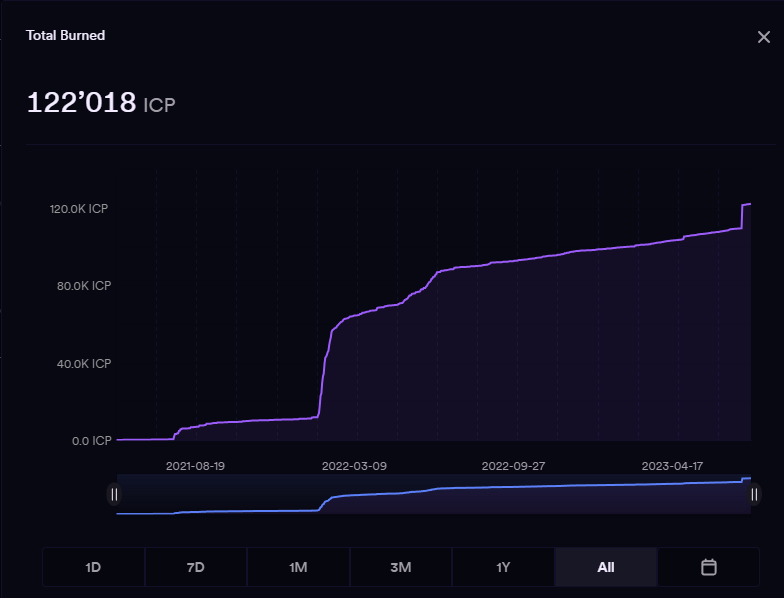
Game theory under rational actor assumptions intensifies further: retail users and project teams migrate toward ecosystems they perceive as more promising (taking liquidity with them), reducing the number of burned Cycles (i.e., ICP) on-chain. Meanwhile, early investors locked in for eight years become powerless and resign themselves to passive “coasting.”
Although potentially triggering further price drops, the author believes resolving this death spiral requires a full clearance—unlocking all long-term staked neurons at once to fully release liquidity. Prolonging the current status quo merely deepens the wound.
Governance Challenges in NNS
When VCs evaluate investments, a key criterion is whether tokens carry governance rights, and retail users also value governance as a form of utility. Dfinity’s NNS system enables token holders to actively participate in protocol governance—but how effective is on-chain governance in practice?
Before diving into blockchain governance analysis, it helps to understand the system itself. Here’s a brief overview of Dfinity’s NNS: NNS is an on-chain governance framework allowing all community members to submit and vote on proposals. Voting power scales linearly with ICP holdings, and voting weight increases with longer staking durations. Participants earn ICP tokens as rewards (“NNS rewards”) and can vote manually or follow other neurons’ decisions when staking ICP in a neuron.
By comparison, governance in many blockchain projects is much more centralized—only whales, investors, or core teams can propose changes, while retail users often only get to vote.
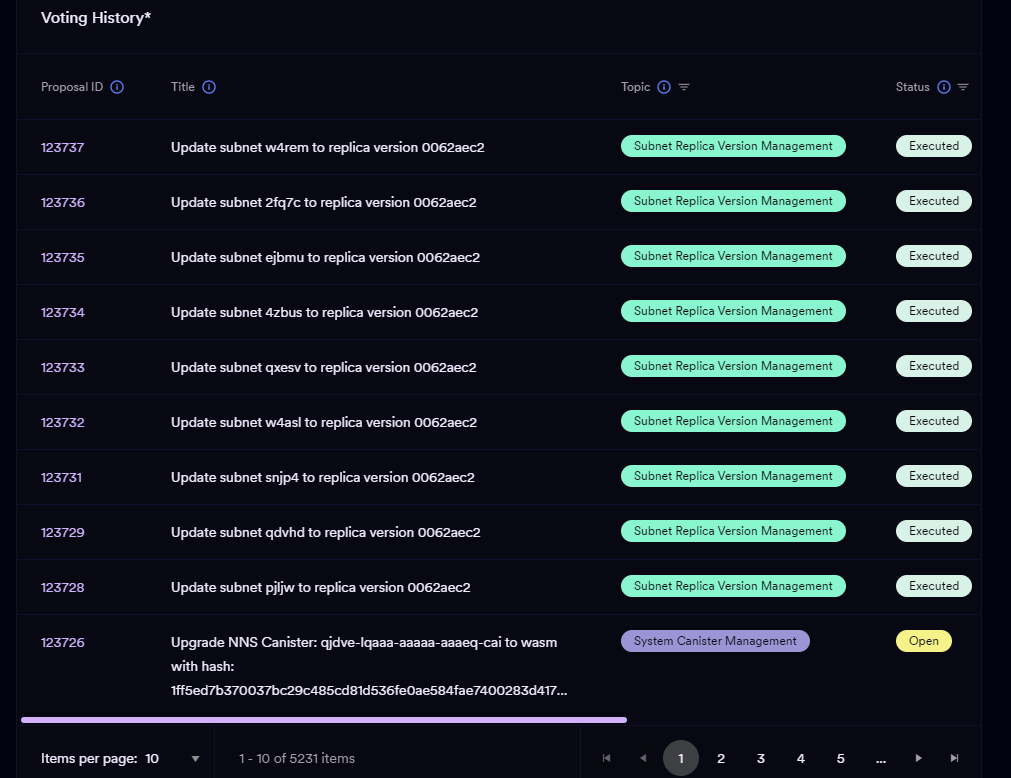
A few years ago, the Dfinity Foundation adjusted NNS governance parameters to incentivize active voters, significantly reducing rewards for passive stakers who don’t engage in governance. Additionally, the Foundation ceased active voting, further lowering yields for nodes that defaulted to following official neurons without custom settings.
Nevertheless, the governance system faces two core issues:
First, because NNS imposes no restrictions on proposal submission—any neuron can propose and vote—this has led to an influx of spam proposals. Neurons supporting these junk proposals still earn higher token rewards simply for participating actively in governance (analogous to Filecoin storage providers deliberately uploading garbage data). In a sense, this behavior mocks the very idea of decentralized governance.
Second, excessive democratization leads to inefficiency and inevitable community fragmentation. A prime example: the ecosystem still lacks a unified token standard! While developers can choose standards based on preference, poor communication and mutual misunderstanding between Eastern and Western developer communities make unification seem distant. This adds yet another obstacle to ecosystem growth. Liquidity becomes severely fragmented; even if DEXs exist, swapping assets becomes problematic. There have even been incidents of lost NFTs when transferring between wallets using different token standards.
Finding balance within governance systems—maintaining democracy while ensuring efficiency—is a timeless debate spanning eras and domains, from ancient politics to modern Web2 and Web3. Dfinity leaned heavily toward democratization, granting broad participatory rights. But given the nascent economic incentives, this choice appears detrimental rather than beneficial—resulting in half-hearted interventions by the Foundation and growing frustration among existing users.
Resolving this dilemma is extremely difficult. Hoping for a short-term emergence of a charismatic leader akin to Andre Cronje to galvanize progress is tantamount to waiting for a “great man” to descend from the heavens.
Project Exodus and Stagnant Circulation
All blockchains lacking user engagement and liquidity inflow inevitably fall into a rug spiral:
Projects exit scam → Retail confidence and finances suffer, leading to exodus → Liquidity deteriorates further, legitimate projects earn less or nothing → More projects exit scam.
This situation is particularly severe on Dfinity. Taking the NFT sector as an example, early NFT trading on the ecosystem relied solely on Entrepot. Entrepot used a curation-based listing model—NFTs underwent review before scheduled sales on-platform—which fostered relatively healthy initial growth and impressive price appreciation. For instance, in February 2022, Entrepot was performing reasonably well:
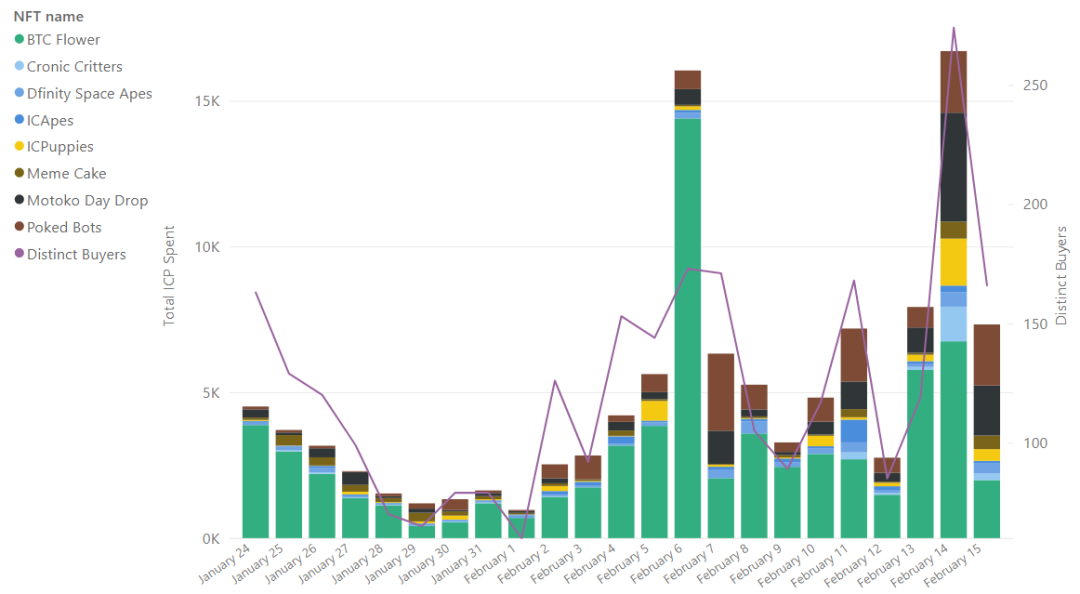
However, platform constraints allowed numerous scam projects to flood in, quickly undermining the nascent NFT scene. As CCC, Yumi, and others entered the NFT exchange race, Entrepot loosened its NFT review standards to retain market share. Newly launched projects shifted from instant sell-outs to being completely ignored.
Even legitimately operating projects eventually seek alternatives due to the chain’s declining momentum. For example, Dmail, which initially remained committed to the Dfinity ecosystem, eventually pivoted to a multi-chain strategy after repeated unsuccessful attempts, later partnering with Sei, Worldcoin, and others.
Compared to other blockchain ecosystems, Dfinity stands out in that its DeFi segment lags furthest behind. Several reasons contribute to this:
First, Dfinity does not integrate EVM compatibility, preventing easy forking of established projects like Avalanche or Fantom;
Second, the ecosystem still lacks a unified token standard, significantly fragmenting internal liquidity;
Third and most importantly, Dfinity’s unique architecture lacks the global transaction atomicity found in traditional blockchains. With asynchronous interactions between Canisters and no globally visible ledger, developing DeFi applications becomes extremely challenging.
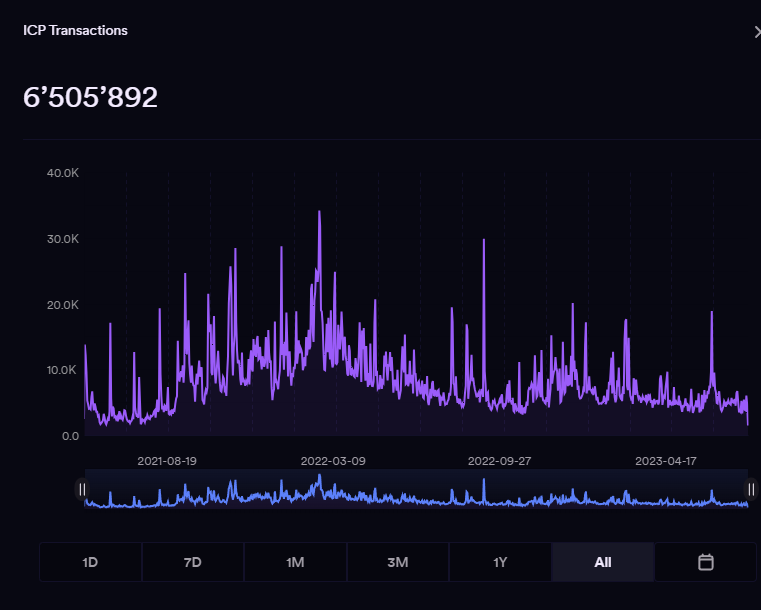
Judging from burned ICP volume and total transaction activity, ICP’s ecosystem finds itself in a deeply awkward position:
Conclusion
We can easily understand the public enthusiasm for Dfinity in 2021. After all, ICP assembled the largest team of cryptographers among all public blockchain projects, boasting an elite roster including talent from Intel, IBM, Coinbase, Facebook, Google WebAssembly, and more.
Moreover, ICP attracted investment from top-tier VCs such as a16z, Polychain, and Multicoin. Its slogan, “decentralized AWS,” captured imaginations and lured countless individuals to invest real money, hoping for the next paradigm-shifting milestone surpassing both Ethereum and EOS.
Yet, Dfinity’s technology did not translate into ecosystem success. Despite possessing uniquely advanced features even by today’s standards—reverse gas models, Canister scalability, horizontally expandable architecture—these advantages failed to deliver expected results in the competitive blockchain landscape.
Furthermore, Dfinity’s governance system faces ongoing challenges, including spam proposals and excessive democratization, as previously discussed. As a former strong contender for “Ethereum killer,” ICP still holds untapped potential and unique strengths unmatched by many other chains. However, both the ICP Foundation and its ecosystem must confront existing hurdles head-on and actively seek new paths forward.
Join TechFlow official community to stay tuned
Telegram:https://t.me/TechFlowDaily
X (Twitter):https://x.com/TechFlowPost
X (Twitter) EN:https://x.com/BlockFlow_News
 @godrealmx