Interpreting Binance Research's RWA Report: U.S. Treasury Yields Drive Sector Growth, Protocol Ecosystem Matures
TechFlow Selected TechFlow Selected
Interpreting Binance Research's RWA Report: U.S. Treasury Yields Drive Sector Growth, Protocol Ecosystem Matures
The tokenization of real-world assets provides a compelling use case for blockchain technology, potentially enabling the next wave of users to enter the cryptocurrency space.
 Navigating Web3 tides with focused insights
Author: Jie Xuan Chua, Binance Research
Translation: TechFlow
Introduction
The RWA narrative has been gaining momentum recently.
As the user base expands, tokenization of real-world assets (RWA) is experiencing rapid growth. In an environment of sustained Federal Reserve rate hikes, investors are earning substantial returns through tokenized U.S. Treasuries.
Recently, Binance Research released a report on the RWA market, providing an in-depth analysis of the current state of RWA development, its ecosystem, and key participants.
The report reveals that traditional financial institutions are actively entering the RWA market. Companies such as Goldman Sachs and Fidelity Investments have launched related services, with some establishing private blockchains for asset tokenization. Regulators are also exploring frameworks for overseeing RWA.
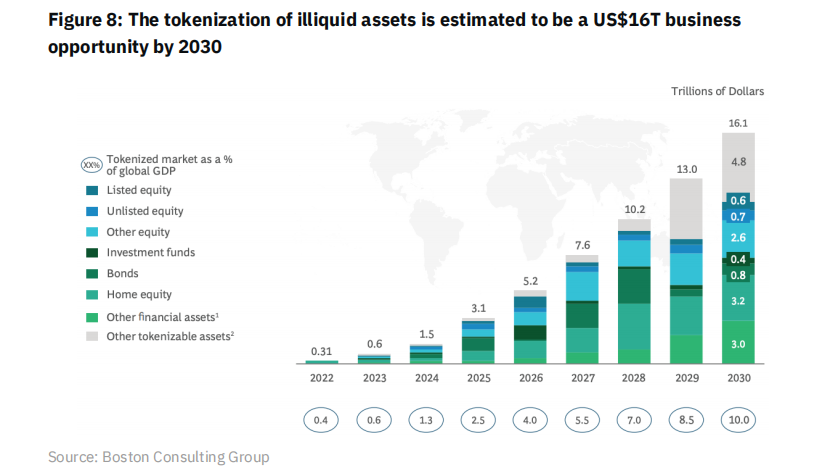
The report projects that by 2030, the total value of tokenized assets could reach $16 trillion, indicating vast growth potential. RWA is profoundly transforming how assets circulate, ushering in a new era of integration between traditional and digital assets.
TechFlow has translated, compiled, and interpreted this report, systematically outlining the development trends of RWA to provide readers with a comprehensive understanding of this emerging and rapidly growing market.
Key Takeaways:
-
With increasing adoption and participation from large institutional investors, tokenization of real-world assets (RWAs) continues to gain momentum;
-
Amid relatively low decentralized finance (DeFi) yields, rising interest rates have driven growth in RWAs, particularly tokenized government bonds.
-
Investors are currently lending over $600 million effectively to the U.S. government through tokenized Treasury markets, earning annualized returns of approximately 4.2%.
-
The tokenized asset market is projected to reach $16 trillion by 2030, a significant increase from $31 billion in 2022, demonstrating immense growth potential.
-
Many protocols have already integrated RWAs or are actively participating in their growth. This report briefly introduces MakerDAO, Maple Finance, and Ondo Finance.
RWA Definition and Market Overview
Definition of RWA: Assets backed by real-world collateral and brought onto the blockchain via tokenization, including real estate, bonds, commodities, etc.
Types of RWA:
-
Tangible assets: real estate, commodities, collectibles
-
Intangible assets: bonds, stocks, carbon credits, etc.
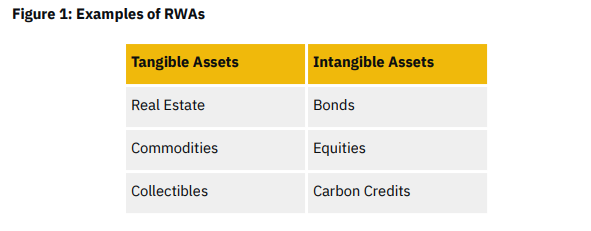
By tokenizing RWAs, market participants can benefit from higher efficiency, greater transparency, and reduced human error, as these assets can be stored and tracked on-chain.
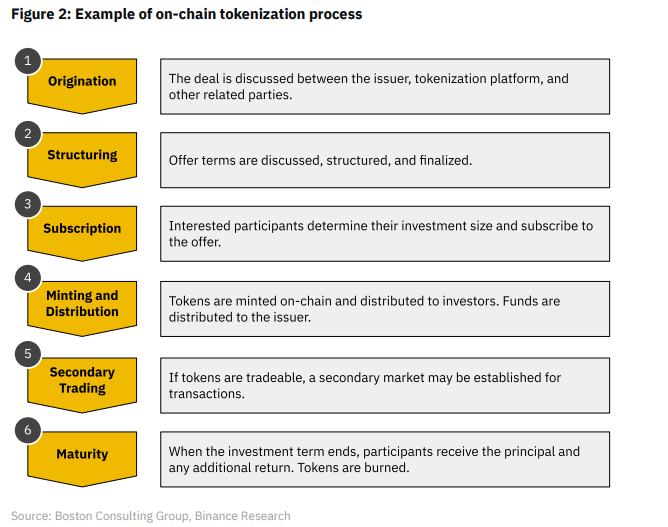
General Process of Onboarding RWA to Blockchain:
-
Origination: Asset issuers, token platforms, and relevant parties discuss onboarding details;
-
Design: Terms of the offering are discussed, designed, and finalized;
-
Subscription: Interested participants decide on investment amounts and subscribe to the asset;
-
Minting and Distribution: Tokens are minted on-chain and distributed to investors. Raised funds are disbursed to the asset issuer;
-
Secondary Trading: If tokens are tradable, secondary markets may form to facilitate liquidity;
-
Maturity: At the end of the investment term, participants receive principal and returns. Tokens are then burned.
RWA Ecosystem Landscape:
The RWA ecosystem is becoming increasingly diverse and steadily expanding. The report categorizes RWA-related projects into two broad categories:
-
RWA Rails: Provide the regulatory, technological, and operational infrastructure upon which RWAs depend—referred to as "rails" (infrastructure or pathways)
-
Asset Providers: Focus on originating and creating demand for various types of RWAs, including real estate, fixed income, equities, and others
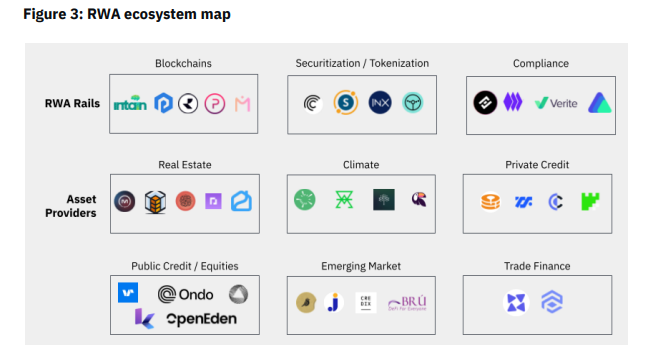
Within the ecosystem landscape, each category can be further broken down as follows:
-
Blockchain Infrastructure: Permissioned and public blockchains dedicated to RWAs, providing foundational architecture.
-
Securitization/Tokenization Services: Services that bring RWAs onto the blockchain.
-
Compliance Services: Ensure investors and issuers meet regulatory requirements.
-
Real Estate: Develop and create demand for real estate-backed RWAs.
-
Climate Assets: Develop and create demand for climate asset-backed RWAs.
-
Private Credit: Develop and create demand for private credit-backed RWAs.
-
Public Credit/Equities: Develop and create demand for public credit and equity-backed RWAs.
-
Emerging Markets: Develop and create demand for emerging market RWAs.
-
Trade Finance: Develop and create demand for trade finance-backed RWAs.
Growth and Outlook of the RWA Sector
Overall Status:
The RWA market is still in its early stages of development but has already seen increasing adoption and rising total value locked (TVL).
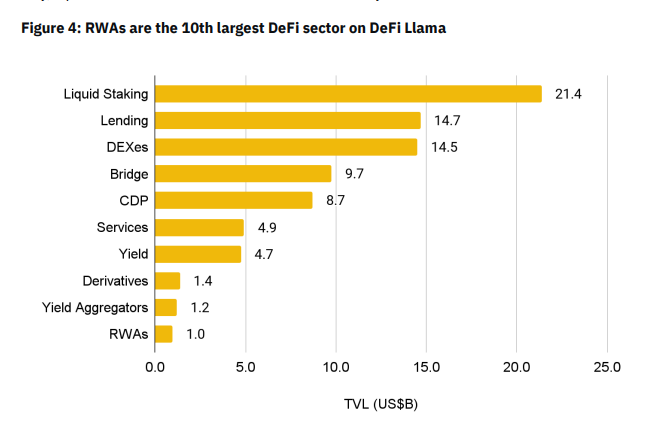
According to protocols tracked by DeFi Llama, RWA has become the 10th largest category in DeFi, with a total value locked of approximately $6 billion. At the end of June, RWA ranked 13th. A major contributor to this rise was stUSDT, launched in July, which allows USDT stakers to earn RWA-based yields.
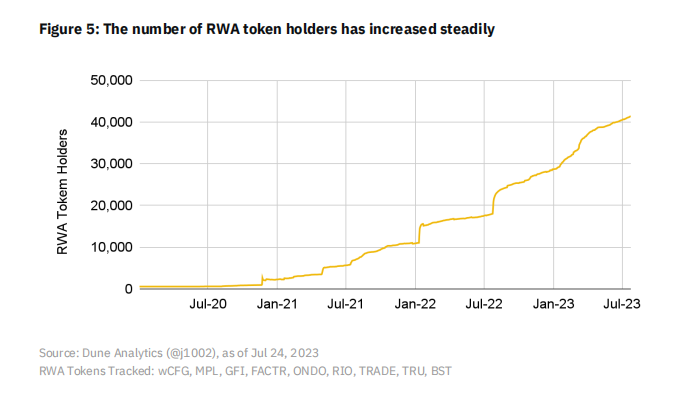
Currently, there are over 41.3K RWA token holders on the Ethereum blockchain. While this number may seem small, it represents a significant increase—more than doubling—from about 17.9K a year ago.
Rise of U.S. Treasuries:
Yield as Key Driver: U.S. Treasuries are widely regarded as the benchmark for risk-free assets in traditional financial markets. Against a backdrop of rising interest rates, Treasury yields have been steadily increasing,
and now easily exceed DeFi yields.
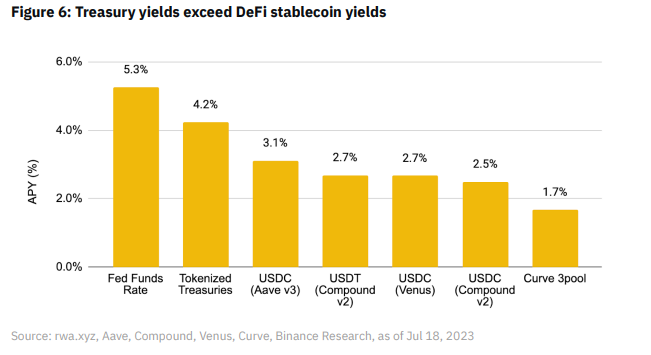
Capital naturally flows to where returns are highest. To demonstrate RWA’s utility, today’s investors can invest in tokenized Treasuries without leaving the blockchain, thereby accessing real-world yields.
Market Size and Returns: The tokenized U.S. Treasury market is currently valued at approximately $603 million, with investors effectively lending this amount to the U.S. government at an APY of around 4.2%.
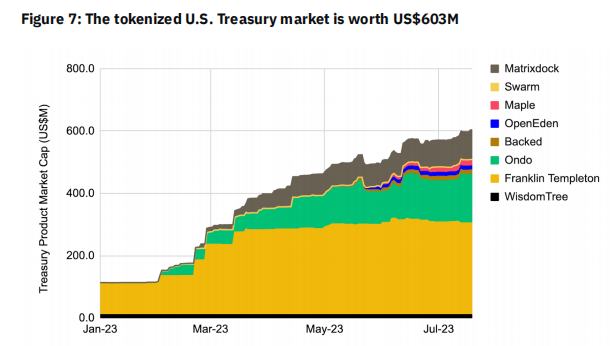
Product Types: Protocols and companies active in the Treasury market include Franklin Templeton, Ondo Finance, Matrixdock, among others. Robert Leshner, founder of Compound, recently announced the launch of a new company called “Superstate,” which has filed documents with the U.S. Securities and Exchange Commission to establish a short-term government bond fund using the Ethereum blockchain as an auxiliary record-keeping system.
(TechFlow previously covered this in a podcast recap: Podcast Notes | Conversation with the Founder of Compound: How Will Superstate Bring RWA into Crypto?)
Future Outlook for RWA
Market Size Forecast: According to a report by Boston Consulting Group, the market size of tokenized assets is expected to reach $16 trillion by 2030.
By the end of this decade (2030), this would account for 10% of global GDP, a significant increase from $31 billion in 2022.
This estimate includes both on-chain asset tokenization (more relevant to the blockchain industry) and traditional asset securitization (e.g., ETFs, REITs). Given the potential scale, capturing even a small portion of this market would be highly beneficial for the blockchain industry.
Protocols Active in the RWA Space
-
Maple Finance:
Business Model:
-
Maple Finance is an institutional capital network that provides infrastructure for credit specialists to run on-chain lending businesses.
-
Connects institutional borrowers and lenders.
-
Three key participant types: borrowers, lenders, and pool delegates.
Market Scale:
-
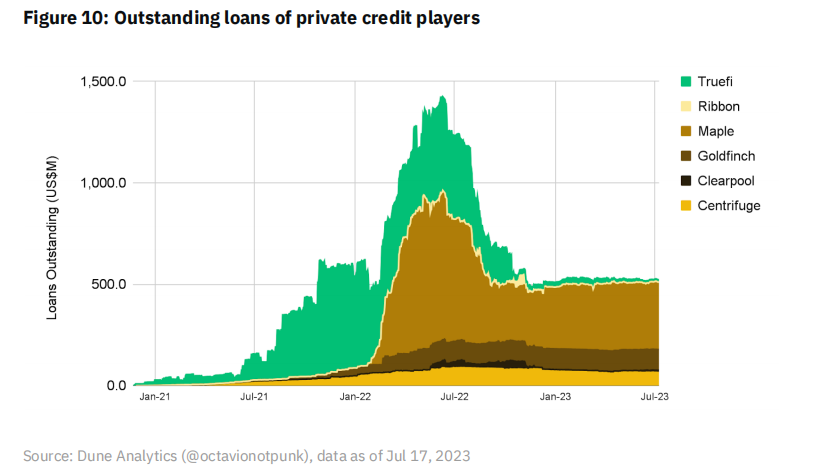
Maple Finance is one of the market leaders in private credit.
-
It has issued over $300 million in outstanding loans to date.
Product Yields:
-
Launched a product backed by U.S. Treasuries in April.
-
Targets an annualized yield equal to 1-month T-bill rate minus a 1% fee.
-
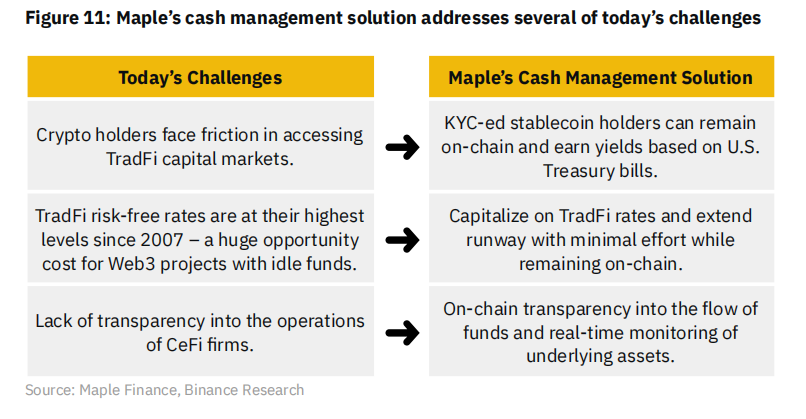
Provides cash management solutions for stablecoin holders.
Business Value:
-
Users can earn on-chain U.S. Treasury yields without leaving the blockchain for traditional markets.
-
High on-chain transparency enables real-time monitoring of asset status.
-
Helps expand the scope of decentralized finance.
-
Provides a yield-generating outlet for stablecoins.
-
MakerDAO:
Business Model:
-
MakerDAO issues DAI stablecoins against collateral.
-
Borrowers deposit collateral into Vaults to receive DAI loans.
-
Collateral types include crypto assets and RWAs.
Market Scale:
-
MakerDAO is one of the leading protocols in DeFi, ranking third in total value locked.
-
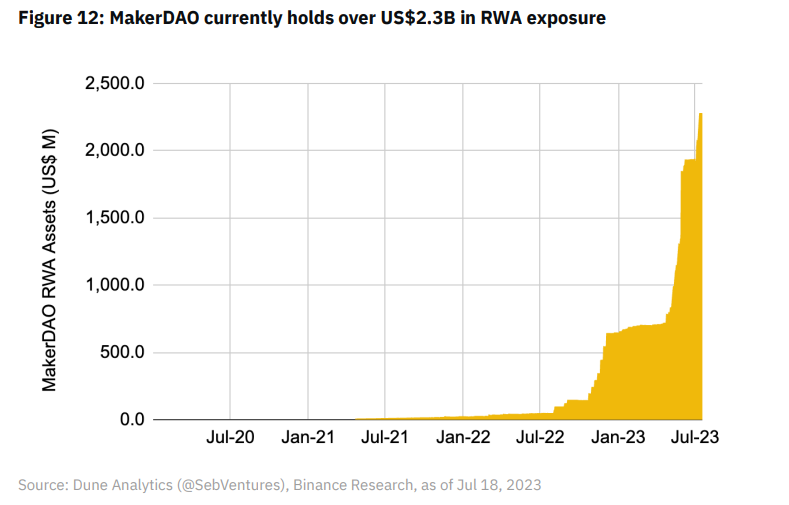
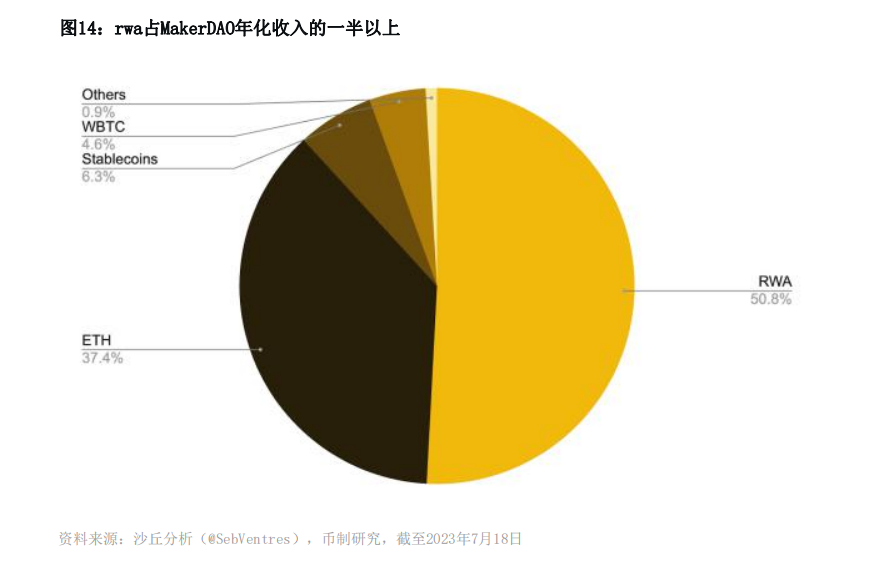
RWA assets account for nearly half of total assets, approximately $2.3 billion.
Key Data:
-
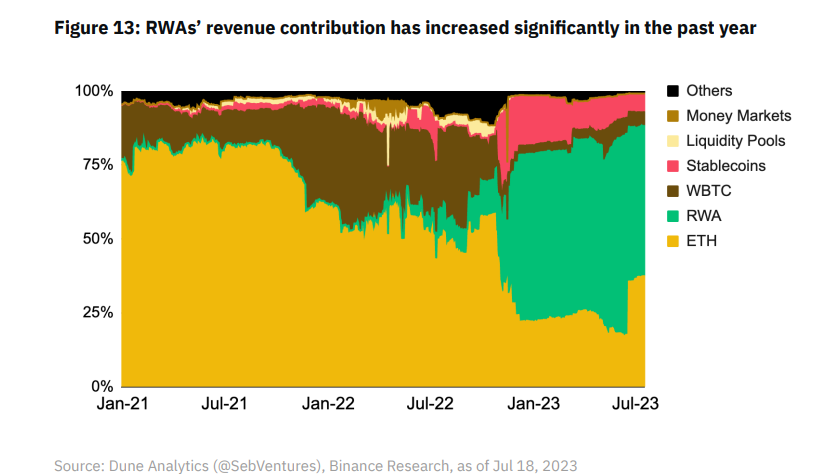
RWA revenue contribution has significantly increased to around 50% over the past year.
-
In June, it purchased $700 million worth of Treasuries, bringing its total holdings to $1.2 billion. This diversified collateral base enables MakerDAO to capitalize on the current yield environment while diversifying risk.
-
Ondo Finance:
Business Model:
-
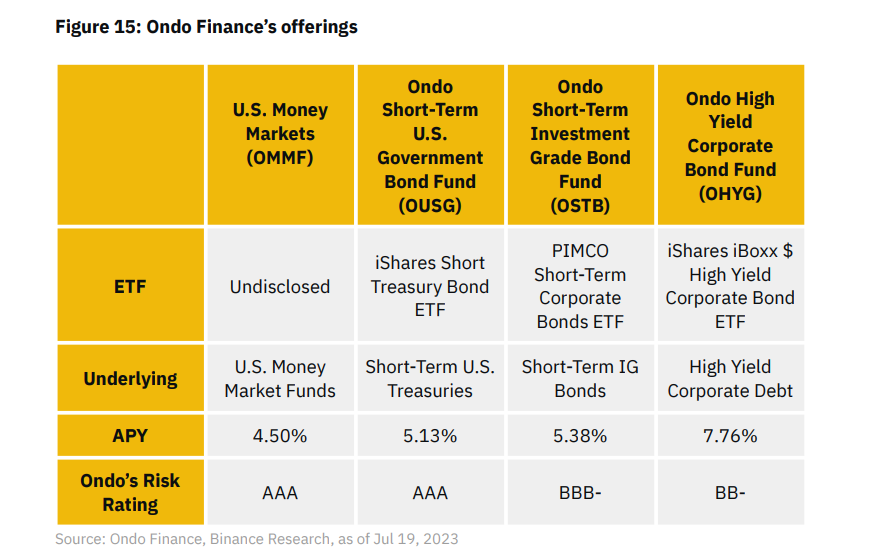
Offers blockchain-based investment products and services for institutional investors. Investors deposit USDC to purchase products like bond funds, receiving equivalent tokens; tokens are burned upon redemption to return USDC.
-
Provides four real-asset-backed products, such as money market funds and short-term government bonds.
-
Products offer annualized yields ranging from 4.5% to 7.76%.
Market Scale:
-
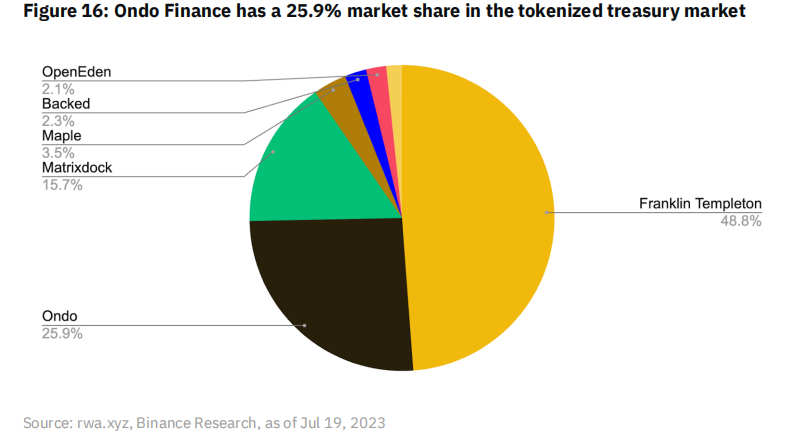
Holds nearly 26% share of the tokenized U.S. Treasury market, ranking second.
Business Value:
-
Enables investors to access blockchain-based institutional-grade investment products, expanding the investor base for traditional assets.
-
Users can earn yields from on-chain bonds and money market products, with tokenization improving asset liquidity.
Notable Developments in RWA
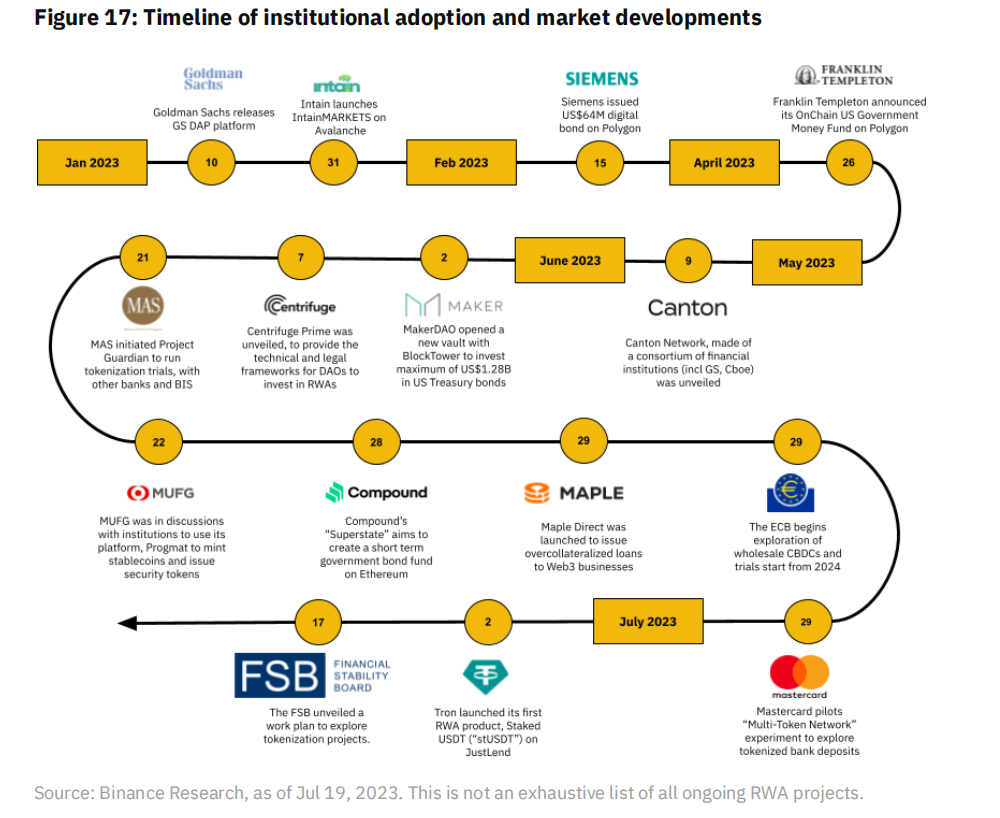
Asset tokenization, dubbed a “killer app for TradFi” by JPMorgan, has become a buzzword. 2023 was called “the next generation of markets” by BlackRock CEO Larry Fink.
Interestingly, beyond DeFi protocols, traditional financial institutions are also showing increasing acceptance of RWA tokenization:
First, global asset manager Franklin Templeton has launched its own fund on a public blockchain. Additionally, institutions are beginning to explore building private blockchains for asset tokenization. Looking ahead, it's not unimaginable that traditional exchanges will help foster secondary markets. As adoption grows, trading of tokenized RWAs could become widespread.
Key events and timeline for RWA are summarized below:
Conclusion
Tokenization of real-world assets provides a powerful use case for blockchain technology, potentially driving the next wave of users into cryptocurrency.
By offering greater transparency and efficiency, tokenization may serve as an attractive alternative to existing mechanisms. We are already seeing early signs of institutional adoption: traditional companies are exploring a technology that can address inefficiencies in today’s solutions. The rise of RWA is also positive for crypto investors, who now have access to more opportunities beyond the crypto ecosystem. Beyond leveraging higher Treasury yields, the integration of risk-weighted assets has brought more stable assets into DeFi and enhanced collateral diversity. Looking ahead, we expect continued innovation in RWA, opening up new use cases and helping drive broader cryptocurrency adoption.
Original report link:
https://research.binance.com/static/pdf/real-world-assets-state-of-the-market.pdf
Join TechFlow official community to stay tuned
Telegram:https://t.me/TechFlowDaily
X (Twitter):https://x.com/TechFlowPost
X (Twitter) EN:https://x.com/BlockFlow_News
 Binance Research