Solana Ecosystem Analysis Under Dual Narratives: On-Chain Data and Ecosystem Projects Overview
TechFlow Selected TechFlow Selected
Solana Ecosystem Analysis Under Dual Narratives: On-Chain Data and Ecosystem Projects Overview
This article will review the current state of Solana from the perspectives of on-chain data and ecosystem projects.
 Navigating Web3 tides with focused insights
Author: Jaden, LD Capital
Amid the unfolding FTX saga and the classification of XRP as a non-security, Solana—closely tied to FTX and whose governance token SOL has been deemed a security by the SEC in lawsuits against Coinbase and Binance—has once again drawn market attention under this dual narrative. This article reviews Solana’s current state from the perspectives of on-chain data and ecosystem projects.
Summary
According to on-chain data, Solana's TVL increased by approximately 47% since January, ranking second only to Arbitrum, Optimism, and Mixin among major blockchains and Layer 2 networks. Transaction volume saw two peaks following the FTX collapse, highly correlated with BTC NFTs, SMB NFTs, and broader market trends. In July, Solana averaged around 20 million daily transactions, remaining relatively stable. Developer activity is heavily influenced by part-time contributors, resulting in low overall development engagement.
Currently, liquid staking dominates Solana’s ecosystem, led by Marinade, which holds 46% of Solana’s liquid staking market share. Recent TVL growth across other liquid staking protocols has mainly been driven by the rise in SOL token price. The two leading lending protocols on Solana have fund utilization rates of about 16% and 21%, significantly lower than Ethereum’s. Native DEX operations remain conservative with little innovation. The NFT sector shows an overall shrinking trading volume, recently concentrated on SMB collections. Overall, while some established protocols have introduced new initiatives, there has been limited impact, and ecosystem activity shows no signs of reversal.
On-Chain Data
1. TVL
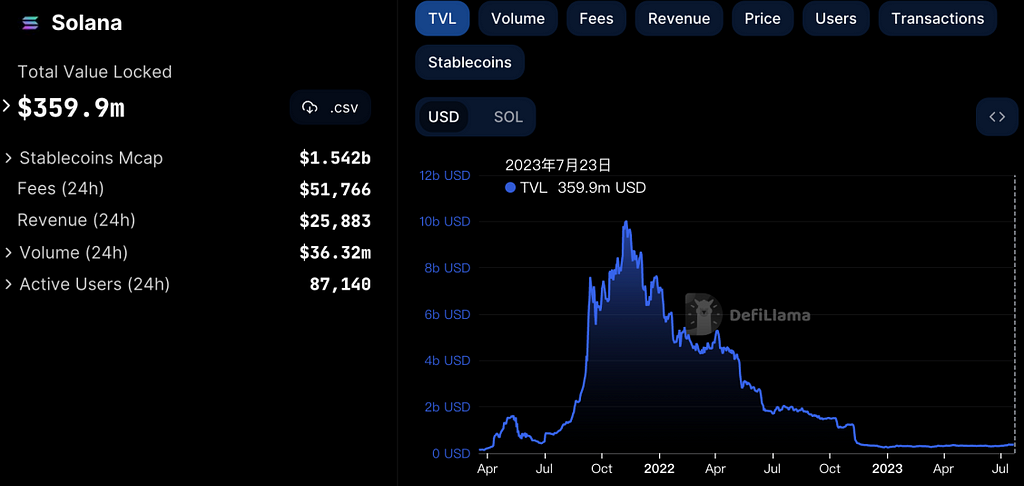
As of July 23, Solana’s TVL stands at $359.9M, ranking 10th among all blockchains and Layer 2 networks. Compared to its peak, TVL has dropped over 95%. Relative to pre-FTX collapse levels, it remains down more than 70%. Its historical low was approximately $244M (January 2023), representing a rebound of about 47% since then. Among the top 10 chains and L2s, only Arbitrum, Optimism, and Mixin have seen faster TVL growth.
2. Transaction Volume
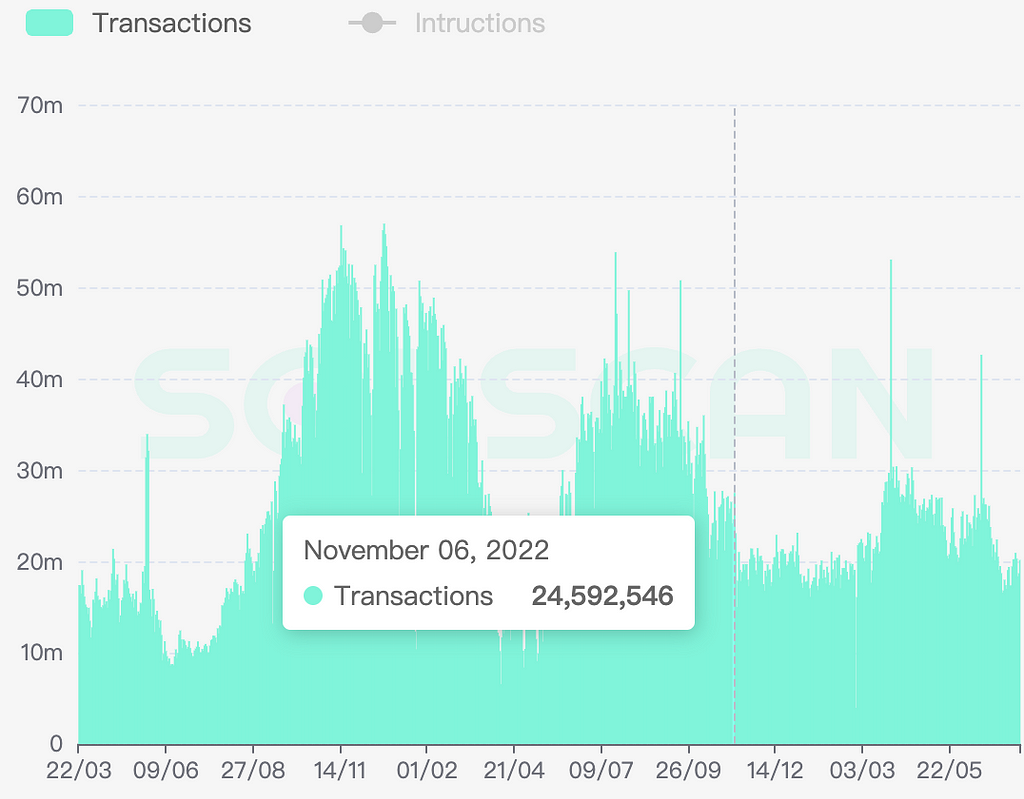
Following the FTX collapse, transaction volume remained stagnant for nearly two months before experiencing two distinct peaks: one between March 21 and May 15, 2023, and another around June 19, with daily volumes exceeding 25 million transactions. Current daily volume fluctuates around 20 million. The March–May surge was largely driven by BTC NFT trading, while the June 19 peak may be attributed to broader market movements.
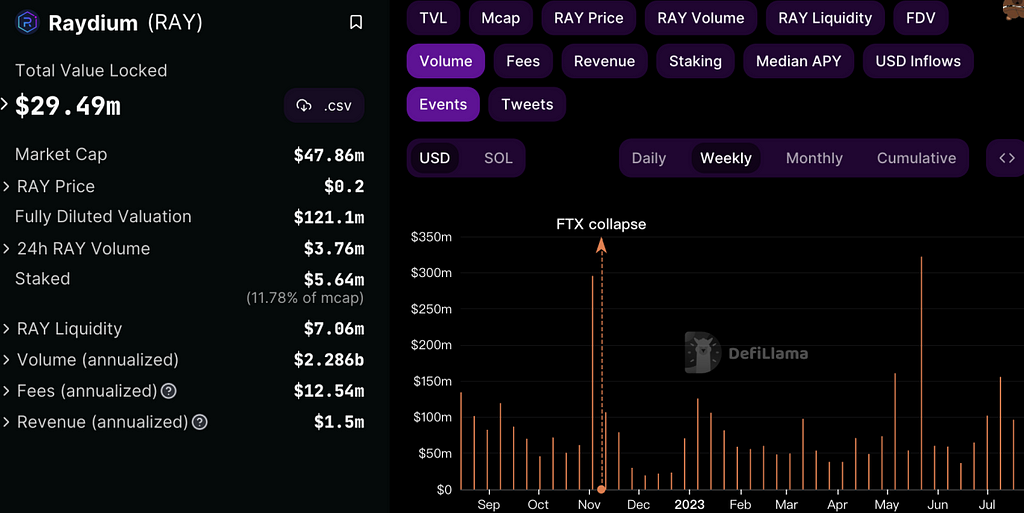
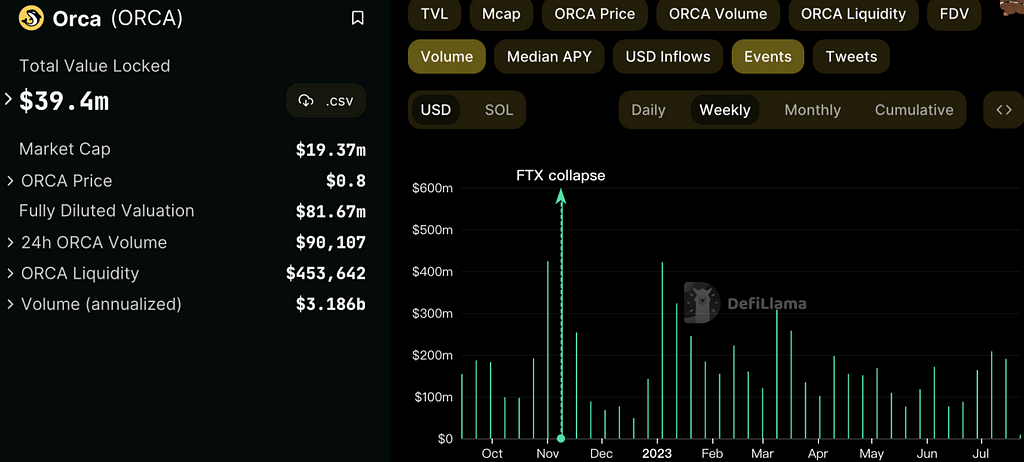
The leading DEXs by TVL on Solana are Orca and Raydium. On transaction data, DEX volume spiked noticeably during the week of the FTX collapse, followed by a month-long slump. Trading volume began recovering at the start of 2023 and has since stabilized at relatively consistent levels.
3. Development Activity
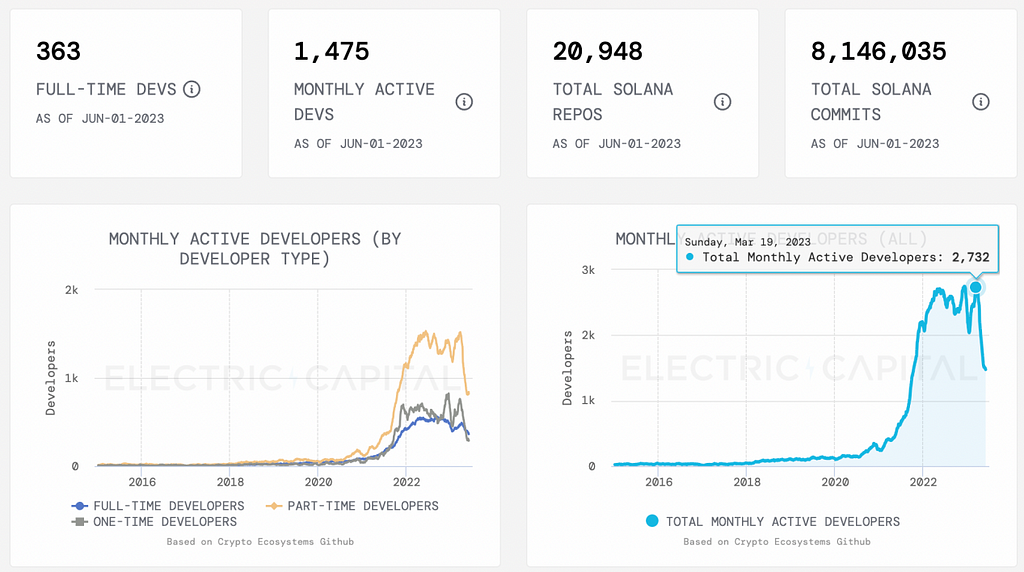
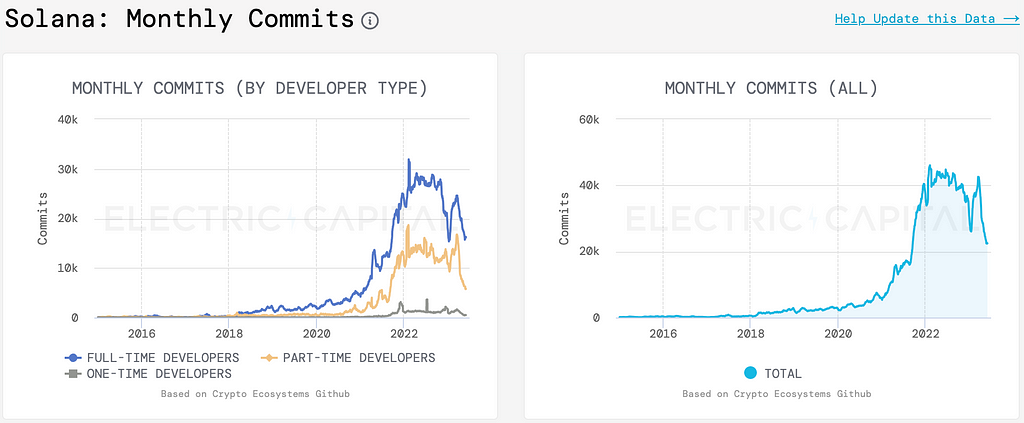
After the FTX collapse, Solana’s development activity rose in March, reaching 2,732 monthly active developers. By June 1, this number had declined to 1,475—a nearly 50% drop. Code commit volume followed a similar trend, peaking in March and declining sharply thereafter. The high volatility in 2023 is primarily due to fluctuations among non-full-time developers, while the number of full-time developers has remained relatively stable. Overall development activity has decreased since March.
* Developers who commit code for more than 10 days per month are counted as full-time; only original code commits are included in developer counts.
4. Users
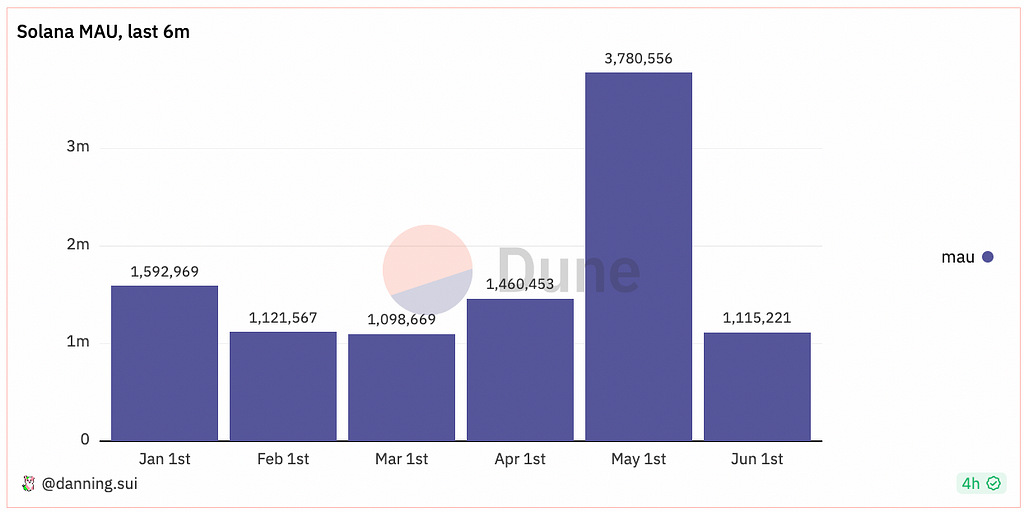
New wallet address creation on Solana surged rapidly from late April to May, increasing by 3 million addresses within a month. Active address count also rose sharply in May, surpassing all other periods. This was primarily driven by Magic Eden, Solana’s leading NFT marketplace, launching its Bitcoin NFT marketplace in March. During the peak of Ordinals NFT trading, Magic Eden became one of the primary trading platforms.

Ecosystem Projects
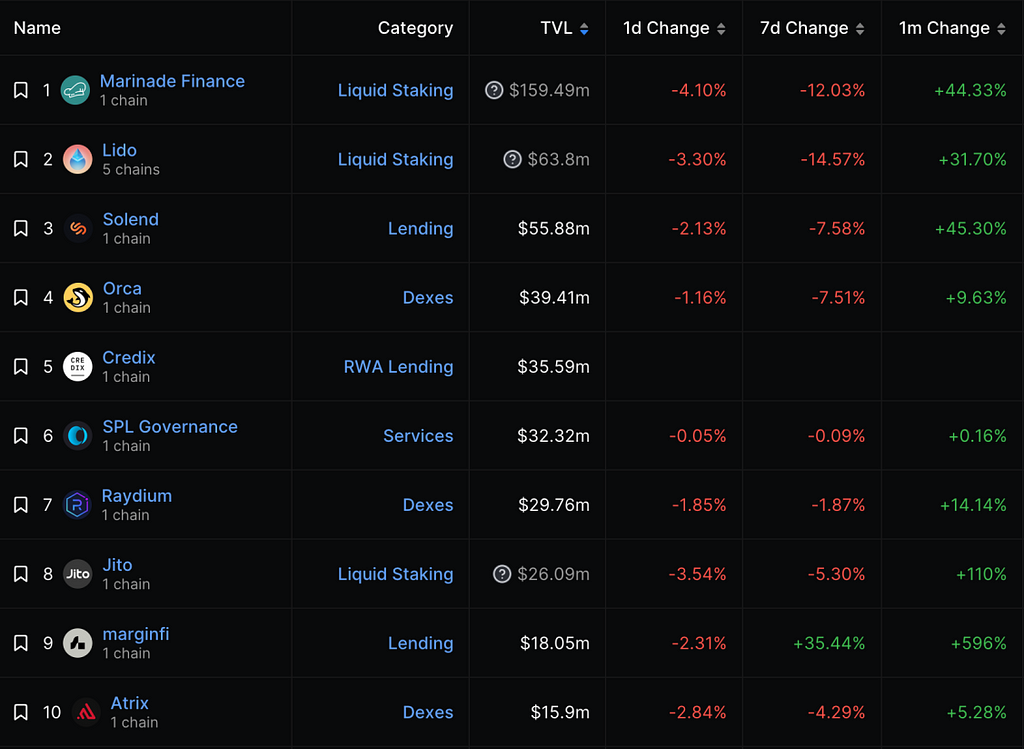
Defillama tracks 98 dApps on Solana, with 19 having TVL exceeding $10 million, primarily distributed across liquid staking, lending, and decentralized exchanges.
Marinade Finance is Solana’s largest liquid staking protocol, with $159M TVL, capturing approximately 43% of Solana’s market. It allows users to stake SOL and receive mSOL, which can be used as underlying collateral in DeFi protocols like Solend. While mSOL is listed on centralized exchanges such as Coinbase and Kraken, most trading occurs on decentralized platforms. Other liquid staking protocols have also seen TVL increases, primarily driven by rising SOL prices.
Solend, a well-established decentralized lending protocol launched in 2021, rolled out Phase 1 of its v2 upgrade in April, restarting liquidity mining for mSOL. On June 2, it enabled users to convert staked SOL into mSOL within the protocol to earn additional yield. Since June, its TVL has grown from $28M to $44M, currently standing at $55.28M. Fund utilization on Solend is 16.19%.
Marginfi, a new lending protocol launched in 2023, has seen nearly 600% TVL growth over the past month, reaching $17.93M. It raised $3 million in 2022 from Multicoin and Pantera. The protocol has not yet issued a token but launched a points system on July 3, rewarding users for deposits, borrowing, and referrals—likely the main driver behind its recent TVL surge. Marginfi’s lending utilization rate is 21.7%. In contrast, Aave v3 on Ethereum has $2.11B in TVL and a utilization rate nearing 35%, highlighting Solana’s relatively lower leverage and capital efficiency.
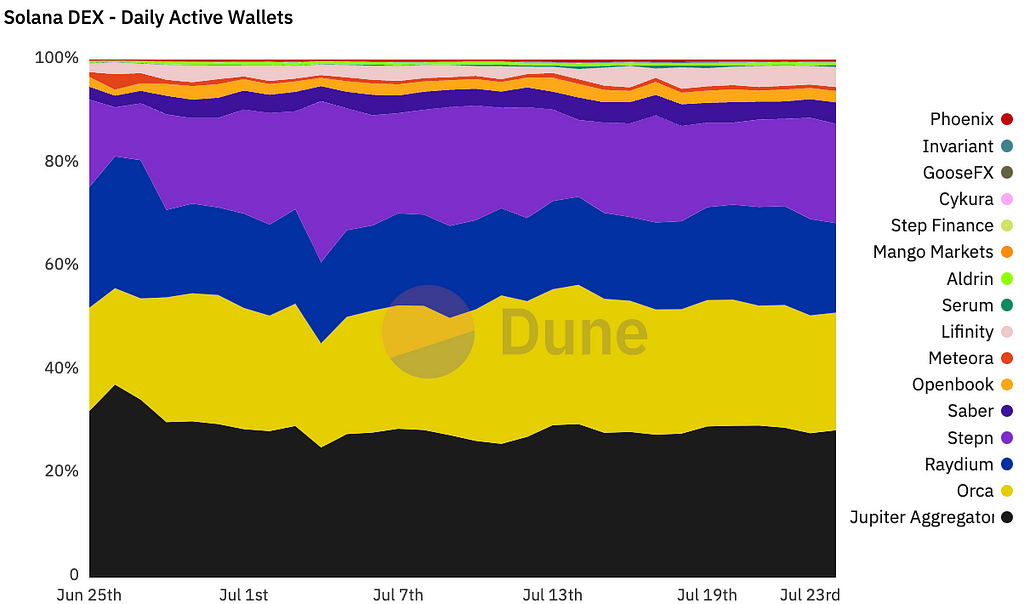
Most trading on Solana occurs through Raydium, Orca, and Jupiter Aggregator. Raydium, one of Solana’s earliest AMM DEXs, has maintained a TVL around $28M post-FTX collapse, showing modest recovery. Orca’s TVL rebounded from a low of $30M to $38M, becoming Solana’s largest DEX. Overall, DEX operations on Solana remain relatively conservative and underwhelming.
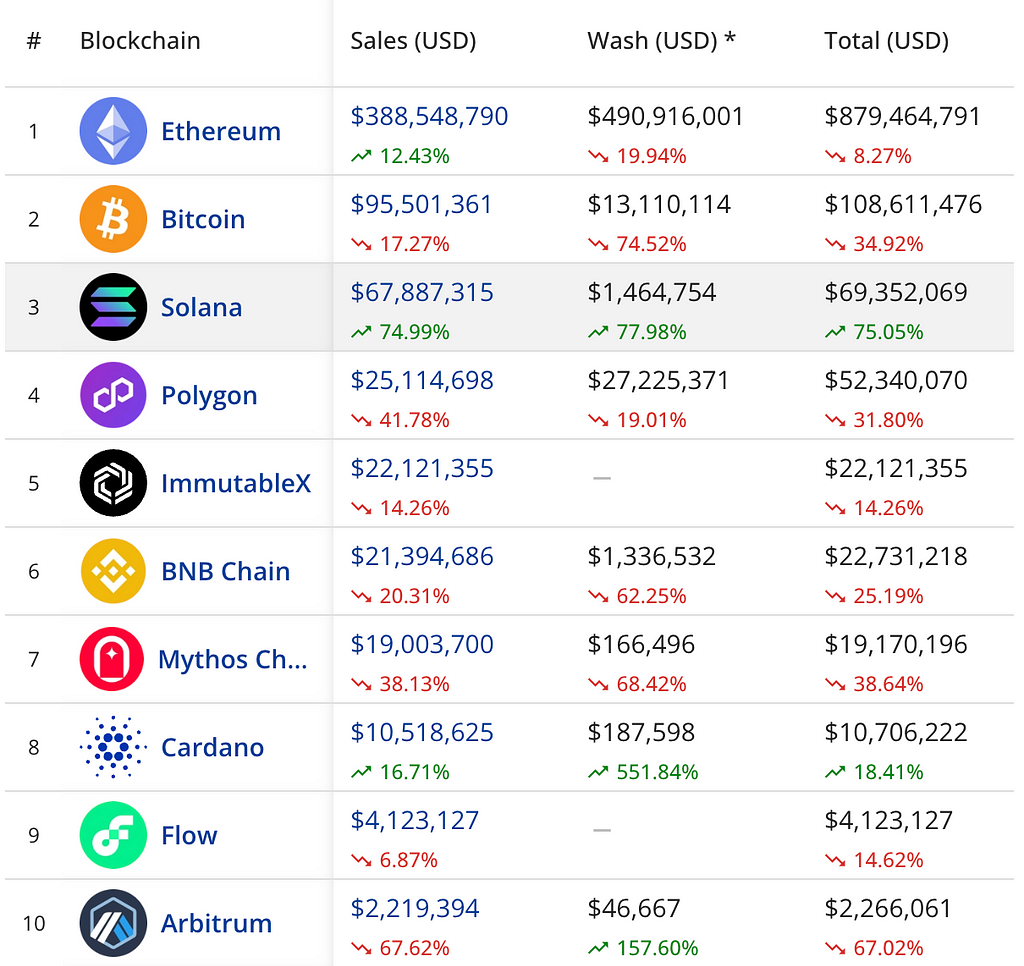
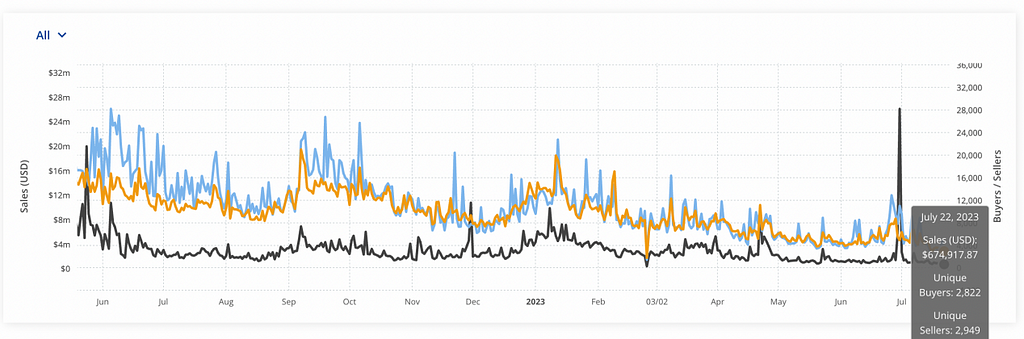
Solana ranks third in NFT trading volume, behind Bitcoin and Ethereum. Its 30-day trading volume surged 75%, primarily due to short-term popularity of the SMB series launched in June. However, daily trading volume overall shows a declining trend.
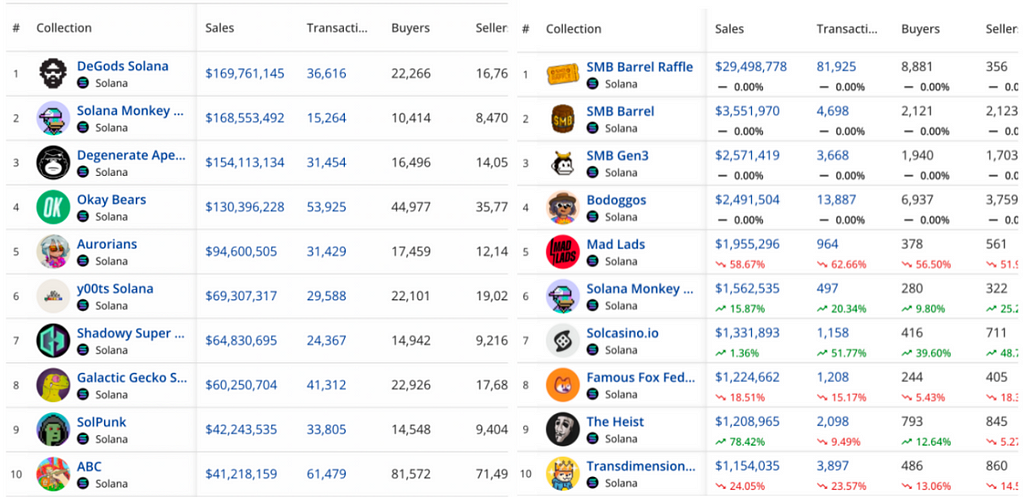
In terms of NFT categories, there is low overlap between historically top-traded and recent top-performing NFT collections on Solana. Current NFT trading activity is heavily concentrated on Smart Monkey Business (SMB).
SMB is an algorithmically generated pixelated monkey NFT series, with Gen1 and Gen2 released in June and August 2021. In late June 2023, the team launched a raffle for SMB Barrel tokens to mint SMB Gen3. That month, SMB accounted for over 90% of Solana’s NFT trading volume. Aside from SMB, the only other project with over $2M in monthly volume is Bodoggos, an NFT collection co-launched by Nifty Protocol and @EasyEatsBodega. Both SMB and Bodoggos show declining daily trading volumes after initial launches. Short-lived spikes in individual projects have failed to revive Solana’s overall NFT market.
Join TechFlow official community to stay tuned
Telegram:https://t.me/TechFlowDaily
X (Twitter):https://x.com/TechFlowPost
X (Twitter) EN:https://x.com/BlockFlow_News
 Cycle Capital Research