








Vitalik: Do NFTs need to be bound?
TechFlow Selected TechFlow Selected
Vitalik: Do NFTs need to be bound?
Transferability shifts governance power away from those most likely to provide valuable contributions to governance, toward those most hungry for power and most likely to cause problems.
 Navigating Web3 tides with focused insights
Author: Vitalik Buterin, Ethereum co-founder
Translation: Block unicorn
One feature of World of Warcraft that players take for granted but rarely discuss outside gaming circles is the concept of soulbound items—items that, once picked up, cannot be transferred or sold to other players.
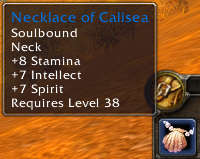
Most of the most powerful in-game items are soulbound and typically require completing complex quests or defeating extremely difficult monsters, often with help from four to thirty-nine other players. Therefore, to get your character equipped with the best weapons and armor, you have no choice but to personally participate in defeating these highly challenging bosses.
The mechanism's purpose is quite clear: it maintains the game’s challenge and fun by ensuring that obtaining top-tier items requires actually doing the hard work—figuring out how to slay the dragon. You can't just spend ten hours a year killing pigs, earn thousands of gold coins, and then buy epic magical armor from someone else who killed the dragon for you.
Of course, this system isn't perfect: you could pay a team of professionals to accompany you on a dragon kill so you can collect the loot, or even directly purchase an entire character on a secondary market—all using real-world money, so you don’t even need to kill pigs. But even so, it’s still far better than if every item always had a price.
What if NFTs could be soulbound?
NFTs in their current form share many properties with rare and epic items in MMORPGs. They carry social signaling value: owners can show them off, and there are increasingly more tools helping users do exactly that. Recently, Twitter began rolling out integration allowing users to display their NFTs in their profile pictures.
But what exactly are these NFTs signaling? Part of the answer is certainly some skill in acquiring NFTs and knowing which ones to acquire. However, because NFTs are tradable goods, another large part of the answer inevitably becomes that NFTs signal wealth.
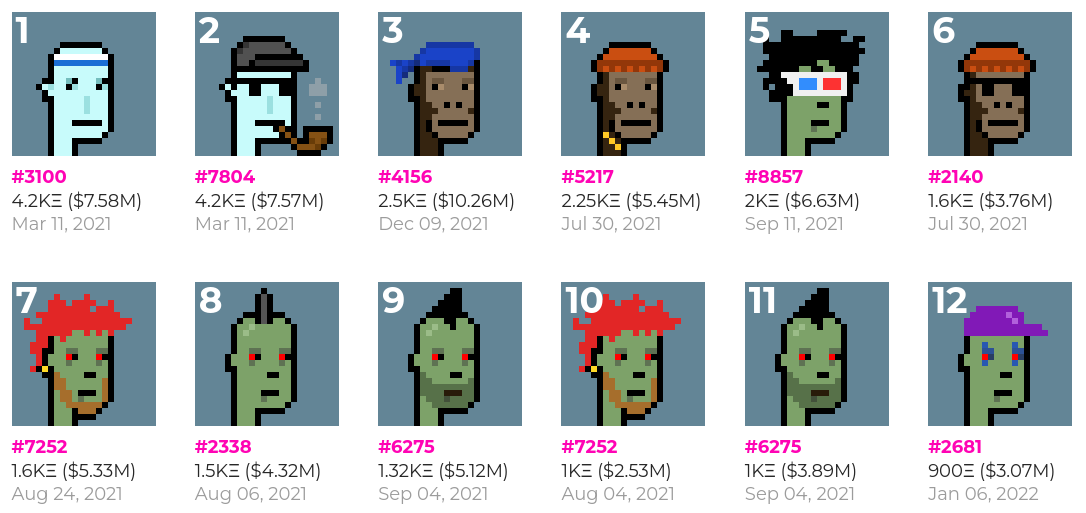
CryptoPunks now frequently sell for millions of dollars
If someone shows you an NFT that can be obtained by doing X, you can’t tell whether they did X themselves or simply paid someone else to do X. Sometimes this doesn’t matter: for an NFT supporting a charity, someone buying it secondhand is sacrificing their own funds for the cause, contributing to the motivation behind others purchasing the NFT, so there’s no reason to discriminate against them. In fact, charitable NFTs alone can bring significant benefits. But what if we want to create NFTs that aren’t just about who has the most money, but actually try to signal something else?
The best example of such a project is probably POAP—the "Proof of Attendance Protocol." POAP is a standard through which projects can send NFTs representing an individual’s personal participation in certain events.
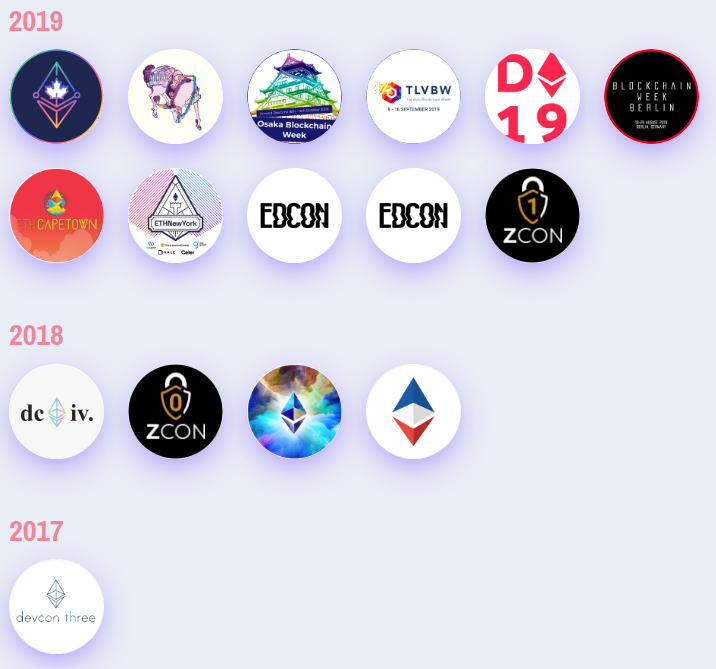
A portion of my own POAP collection, most of which come from events I’ve attended over the years.
POAP is a great example of an NFT that would work better if it were soulbound. If someone is looking at your POAPs, they’re not interested in whether you paid someone else to attend an event. They care whether *you* personally attended. Proposals to put credentials (like driver’s licenses, university degrees, age verification) on-chain face a similar issue: if unqualified individuals can simply buy credentials from qualified ones, their value plummets.
While transferable NFTs have their place and are very valuable for supporting artists and charities, there remains a vast, underexplored design space around non-transferable NFTs.
What if governance rights were soulbound?
I've written five other articles on this nauseatingly important topic—"Nathan Schneider on the Limits of Crypto-Economics," "Beyond Token Voting Governance," "Coordination, Good and Bad," "On Collusion," and "Governance, Part 2: Plutocracy is Still Bad"—but it bears repeating: if governance mechanisms are easily manipulable due to easily transferable governance rights, very bad outcomes become likely. There are two main reasons:
-
If the goal is broad distribution of governance power, transferability backfires because concentrated interests are more likely to buy governance rights from others.
-
If the goal is to assign governance rights to competent people, transferability also backfires because nothing prevents determined but incompetent individuals from acquiring governance power.
If you take seriously the adage that “the people who most want to rule are the least suited to do it,” you should be skeptical of transferability precisely because it shifts governance power away from those most likely to contribute meaningfully toward those most eager—and potentially harmful—in their pursuit of control.
So what if we tried making governance rights non-transferable? What if we attempted to build a CityDAO where people actually living in the city have greater voting power, or at least ensure fair democracy and prevent whales from accumulating excessive influence via hoarding citizen NFTs? What if DAO governance in blockchain protocols could somehow condition governance rights on active participation? Again, a large and fruitful design space opens up—one currently difficult to access.
Implementing Non-Transferability in Practice
POAP has made a technical decision not to prevent the transferability of POAPs themselves. There are good reasons: users may have legitimate needs to migrate all their assets from one wallet to another (e.g., for security), and naively implemented non-transferability isn’t very secure anyway, since users can wrap an NFT inside a smart contract account and then sell ownership of that account.
In fact, there are numerous cases where POAPs have been bought and sold when economic incentives exist. Adidas recently gave fans a free POAP that granted priority access to merchandise sales. What happened? Well, naturally, many POAPs were quickly transferred to the highest bidders.
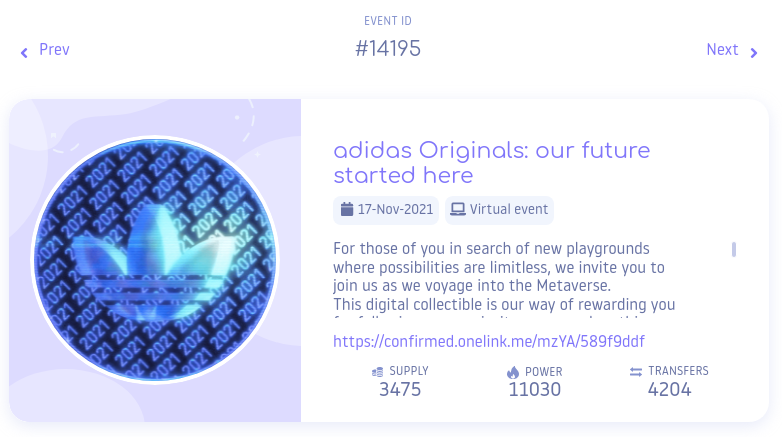 Transfers outnumbered items, and this wasn't the only time.
To address this, the POAP team suggests developers focused on non-transferability implement their own checks: verifying on-chain whether the current owner matches the original owner’s address, and adding more sophisticated checks over time if needed. For now, this is a more forward-looking approach.
Perhaps today’s strongest example of a non-transferable NFT is Proof-of-Personhood (PoP). In theory, anyone could create a PoP profile using a smart contract wallet with transferable ownership and then sell it. But PoP protocols include revocation mechanisms: the original owner can submit a video request to delete the profile, and a Kleros court determines whether the video comes from the same person as the original creator.
After successfully deleting a profile, the user can reapply to create a new one. Thus, if you buy someone else’s proof-of-personhood, your asset could be revoked at any moment, rendering transfers impractical. PoP profiles are effectively soulbound, and infrastructure built atop them could allow on-chain items to generally bind to specific humans.
Can we limit transferability without relying entirely on proof-of-personhood? It becomes harder, but for certain use cases, medium-strength methods might already suffice. Binding NFTs to ENS names is a simple option, assuming users care enough about their ENS names that they won’t transfer them. For now, we may see a spectrum of approaches limiting transferability, with different projects choosing different tradeoffs between security and convenience.
Non-Transferability and Privacy
Cryptographically strong privacy for transferable assets is fairly straightforward: take your coins, deposit them into tornado.cash or a similar service, then withdraw to a new account. But how do we add privacy for soulbound items if you can’t even transfer them to a new account—or even a smart contract? If proof-of-personhood gains wider adoption, privacy becomes even more critical, as the alternative would be mapping all our activities directly on-chain to real identities.
Fortunately, several relatively simple technical options are possible:
-
Store the item at an address that is the hash of (i) index, (ii) recipient address, and (iii) a secret belonging to the recipient. You can reveal your secret to an interface, which then scans for all items possibly yours, while others without your secret cannot see which items belong to you.
-
Publish hashes of a batch of items and give each recipient their Merkle branch.
-
If a smart contract needs to verify you own a certain type of item, you can provide a ZK-SNARK.
Transfers can occur on-chain; the simplest technique might just involve calling a factory contract to invalidate the old item and activate the new one, using a ZK-SNARK to prove the operation is valid.
Privacy is a crucial component for such ecosystems to function well. In some cases, the underlying thing represented by the item is already public, so adding privacy makes little sense. But in many others, users don’t want to disclose everything they own.
If someday vaccination records become POAPs, one of the worst things we could do is create a system where POAPs are automatically visible to everyone, forcing people to make medical decisions based on what seems cool within their specific social circle. Treating privacy as a core design principle avoids these negative outcomes and increases our chances of building truly meaningful systems.
Getting From Here to There
A common critique of today’s “web3” space is that everything is money-oriented—the celebration of massive wealth, outright waste—which limits the cultural appeal and long-term sustainability of communities forming around these objects. Certainly, even financialized NFTs can deliver important benefits, such as funding artists and charities that would otherwise go unrecognized.
Yet this approach has limitations, and there are many underdeveloped opportunities in trying to move beyond financialization. Creating more “soulbound” items in the crypto space could be a path toward alternatives where NFTs represent more about who you are, rather than just what you can afford.
However, doing so presents technical challenges and creates an uneasy “interface” between the desire to restrict or block transfers and the blockchain ecosystem, which until now has designed all standards around maximum transferability. Attaching items to “identity objects” that users either cannot (e.g., proof-of-personhood profiles) or will not (e.g., ENS names) exchange appears to be the most promising path forward, though significant challenges remain in making such usage easy, private, and secure.
We need to think harder and work harder to solve these challenges. If we succeed, it could open much broader doors for blockchains to become centers of collaboration and engaging ecosystems—not just money.
Join TechFlow official community to stay tuned
Telegram:https://t.me/TechFlowDaily
X (Twitter):https://x.com/TechFlowPost
X (Twitter) EN:https://x.com/BlockFlow_News
 @VitalikButerin









