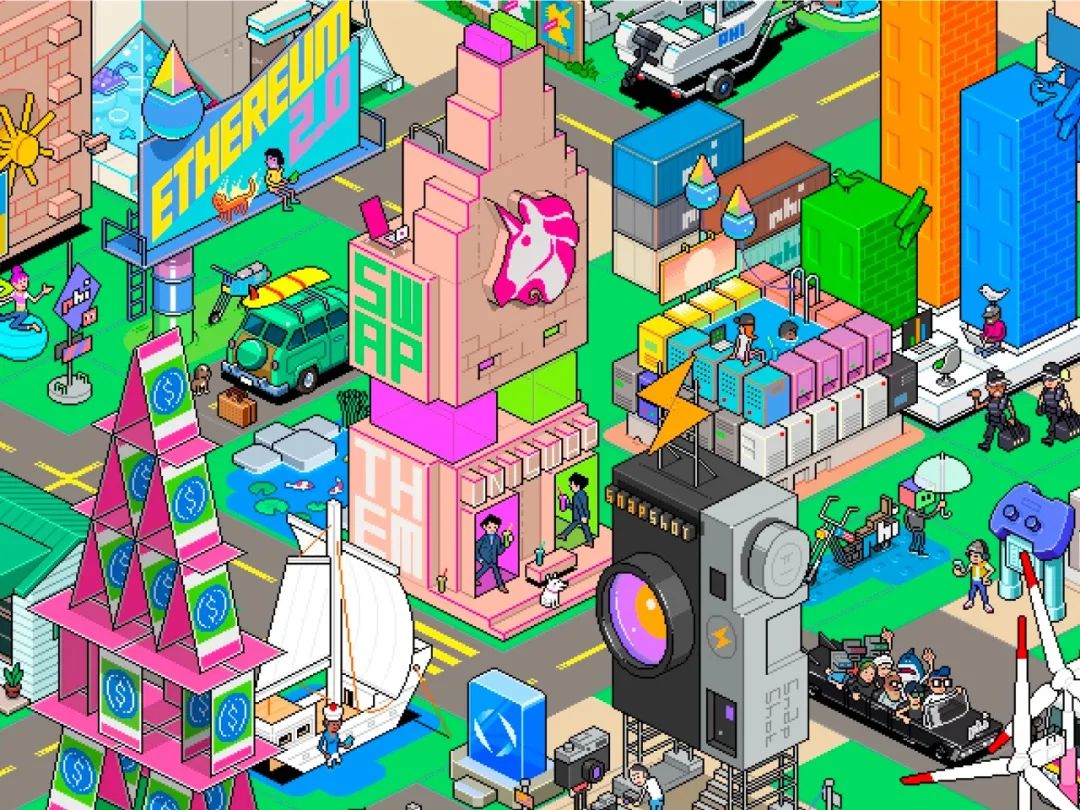
Welcome to Ethereum, a bustling virtual "metropolis"
TechFlow Selected TechFlow Selected
Welcome to Ethereum, a bustling virtual "metropolis"
In this article, we will explore this bustling digital metropolis together, understanding its unique architecture and future blueprint.
 Navigating Web3 tides with focused insights
Author | Hjsoh
Translation | HuoHuo
Welcome to Ethereum, a bustling virtual metropolis and a fully functional digital civilization. Here, transactions take place, contracts are signed, applications are developed, and art is bought and sold—all without physical presence in the real world.
Developed by Vitalik Buterin in 2015, Ethereum is significantly more advanced than Bitcoin's original architecture. Today, Ethereum resembles ancient Rome—its "Turing completeness" means it can solve any computational problem given sufficient resources and correct instructions, forming the foundation for its unique programming language, "Solidity," enabling developers to build sophisticated applications on its blockchain.
In this article, we’ll explore this thriving digital metropolis, understanding its unique architecture and future roadmap.
The Foundation of Ethereum City
Just as infrastructure supports a city, the foundation of Ethereum City is its blockchain technology. Think of the blockchain as a city’s road network, connecting everything within Ethereum. This infrastructure is open, transparent, and decentralized—it belongs to all residents, not to any single entity.
In Ethereum City, the native currency Ether ("ETH") functions like the city’s standard money. ETH is used in transactions such as purchasing goods or paying for services. Block producers (formerly known as miners) earn ETH by validating transactions, much like workers earning wages.
Just as laws are essential for maintaining order in a city, smart contracts facilitate transactions in Ethereum City. Like impartial judges, these digital contracts automatically execute when conditions are met, eliminating intermediaries. Stored on the decentralized Ethereum blockchain, they ensure transparency and immutability, making them highly trustworthy.
How does Ethereum City keep running?
Just as a city needs workers to maintain its systems, Ethereum relies on specialized labor called block producers. However, instead of mining underground for precious minerals, these block producers are computational workers who validate transactions and add them to the Ethereum blockchain. Whenever citizens of Ethereum City conduct a transaction—such as sending ETH or interacting with a smart contract—block producers perform their duties, verifying these transactions and ensuring everything proceeds as intended.
Just as all workers require compensation, block producers must be rewarded for securing the Ethereum network. They receive payments from gas fees paid during transaction execution. These gas fees are denominated in ETH. While simple transactions cost less than complex ones, gas fees fluctuate based on current network usage. During periods of high demand, as users compete to include their transactions in the next block, gas prices may surge sharply—analogous to traffic congestion in a physical city.
The work of block producers is vital to the city’s functionality. By preventing fraudulent activities and maintaining order, they provide security for Ethereum. Much like police or security personnel in a city, block producers protect Ethereum from potential "bad actors." Without them, Ethereum City would be vulnerable to attacks and misconduct, leading to chaos and disruption.
Features of Ethereum City
1. DeFi: The Financial District
Just as a city’s financial district hosts banks, investment firms, and insurance companies, decentralized finance ("DeFi") encompasses a suite of financial applications—all built on Ethereum’s blockchain. Unlike traditional financial systems, however, DeFi operates without central authorities, managed entirely by smart contracts. Below, we examine some popular DeFi use cases:
Lending Platforms — These platforms replace traditional banking services by allowing users to lend and borrow directly from one another. Smart contracts automate the loan process and enforce terms, eliminating cumbersome KYC ("Know Your Customer") procedures. Prominent lending platforms today include Aave and Compound.
DEXs — Decentralized exchanges act as marketplaces where users trade digital assets directly, without intermediaries. Designed to replace centralized exchanges (CEXs) like Binance and Kraken—equivalents of the NYSE or Nasdaq in crypto—popular DEXs include Uniswap and Balancer.
2. DAOs: The City Council
Within Ethereum’s urban landscape, among countless structures, exist organizations without central authority—known as decentralized autonomous organizations (DAOs). Like governing a republic in the physical world, DAOs operate based on rules encoded in smart contracts. Members of a DAO vote on decisions, with voting power typically proportional to their token holdings, bringing democracy, transparency, and autonomy to the forefront.
DAOs can fundamentally transform how businesses operate, ensuring all stakeholders have a voice and removing the need for centralized control. This democratic, transparent decision-making model contrasts sharply with traditional hierarchical structures—akin to the difference between republics and monarchies.
Like buildings in a city, DAOs serve diverse purposes. They can manage decentralized venture funds where investment decisions are made collectively, or govern decentralized networks and applications. Examples include ApeCoin DAO and BitDAO.
3. NFTs: Unique Artifacts
Consider how cities house unique artifacts—like one-of-a-kind sculptures or rare historical documents in museums. In Ethereum City, these artifacts become NFTs. Unlike fungible tokens such as ETH, NFTs are unique and possess individual characteristics. It’s like owning an original painting that can be copied, but only the original holds unique value.
These unique NFTs leverage the transparency and security of the Ethereum blockchain. When bought or sold, transactions are recorded on the Ethereum blockchain—just like property deeds at a city registry office. This blockchain record proves ownership of the NFT, and because the blockchain is transparent and immutable, ownership is clear and indisputable—ensuring the uniqueness and provenance of each NFT.
NFTs can represent various unique items or content. Digital art remains one of the most popular uses, with artists creating and selling digital artworks as NFTs. Yet NFT applications extend far beyond digital art. They can signify ownership of virtual real estate in digital worlds, unique in-game items in video games, or even real-world assets (RWA). It’s akin to the diverse landmarks and properties found in any city, each with its own story and value.
Upgrades to Ethereum City
Despite its inherent strengths and achievements, like any major city, Ethereum faces challenges—the key being scalability. As the city grows and more citizens join, the current infrastructure struggles to handle transactions quickly and cost-effectively. This mirrors urban traffic congestion caused by population growth. Another challenge is complexity: Just as new residents may struggle to adapt to a large city, new users often find Ethereum difficult to understand and use.
As Ethereum continues to expand and welcome more citizens, it is addressing these issues to ensure a sustainable and inclusive future for all. Layer 2 solutions (L2) have emerged as the answer.
1. Development of Layer 2
Ethereum’s scalability challenge resembles managing traffic congestion in a physical city. Just as additional roads or public transit systems accommodate more vehicles or passengers, Layer 2 functions like adding extra lanes or high-speed trains to Ethereum’s infrastructure to handle more transactions. Sitting atop Ethereum’s main blockchain (Layer 1), L2 processes transactions off-chain. Only when users decide to settle on Layer 1 are these transactions added to the main Ethereum blockchain—like taking a fast, direct express train that stops at the terminal only when needed.
Layer 2 enables Ethereum to process more transactions at higher speeds and lower costs. By moving transactions off the main chain, they reduce network load and increase efficiency—similar to how bypass highways shorten travel time by avoiding crowded downtown areas. Some L2s can handle hundreds or even thousands of transactions per second, far exceeding Ethereum’s current capacity.
This increased capacity not only boosts speed but also lowers transaction fees, making interactions within Ethereum City more affordable for citizens.
Ethereum is developing and deploying various Layer 2 solutions. One type is the "roll-up," which bundles multiple transactions into one, greatly increasing capacity—like a super-efficient bus system carrying many passengers at once. Another is "state channels," which allow participants to exchange multiple transactions off-chain before settling the final state on-chain, similar to opening a tab at a bar and paying the total bill later.
Notable L2 projects currently include Arbitrum, Polygon, and Optimism. These solutions are helping Ethereum manage its growth and remain a vibrant, efficient, and inclusive digital metropolis.
2. The Merge: From PoW to PoS
When Ethereum was created, it used a proof-of-work (PoW) consensus mechanism to validate new blocks. While revolutionary at the time, PoW consumed vast amounts of energy, posing sustainability concerns. To address this, the Ethereum Foundation successfully executed "the Merge" in September 2022, transitioning to proof-of-stake (PoS) consensus. One of its greatest advantages is reducing energy consumption by approximately 99.95%, while maintaining network security.
3. The Upgrade Roadmap
Beyond the upgrades already implemented, the Ethereum Foundation still has a long journey ahead to achieve its ultimate vision. To realize this, Vitalik proposed a series of upgrades, setting the team on a multi-year evolution path:
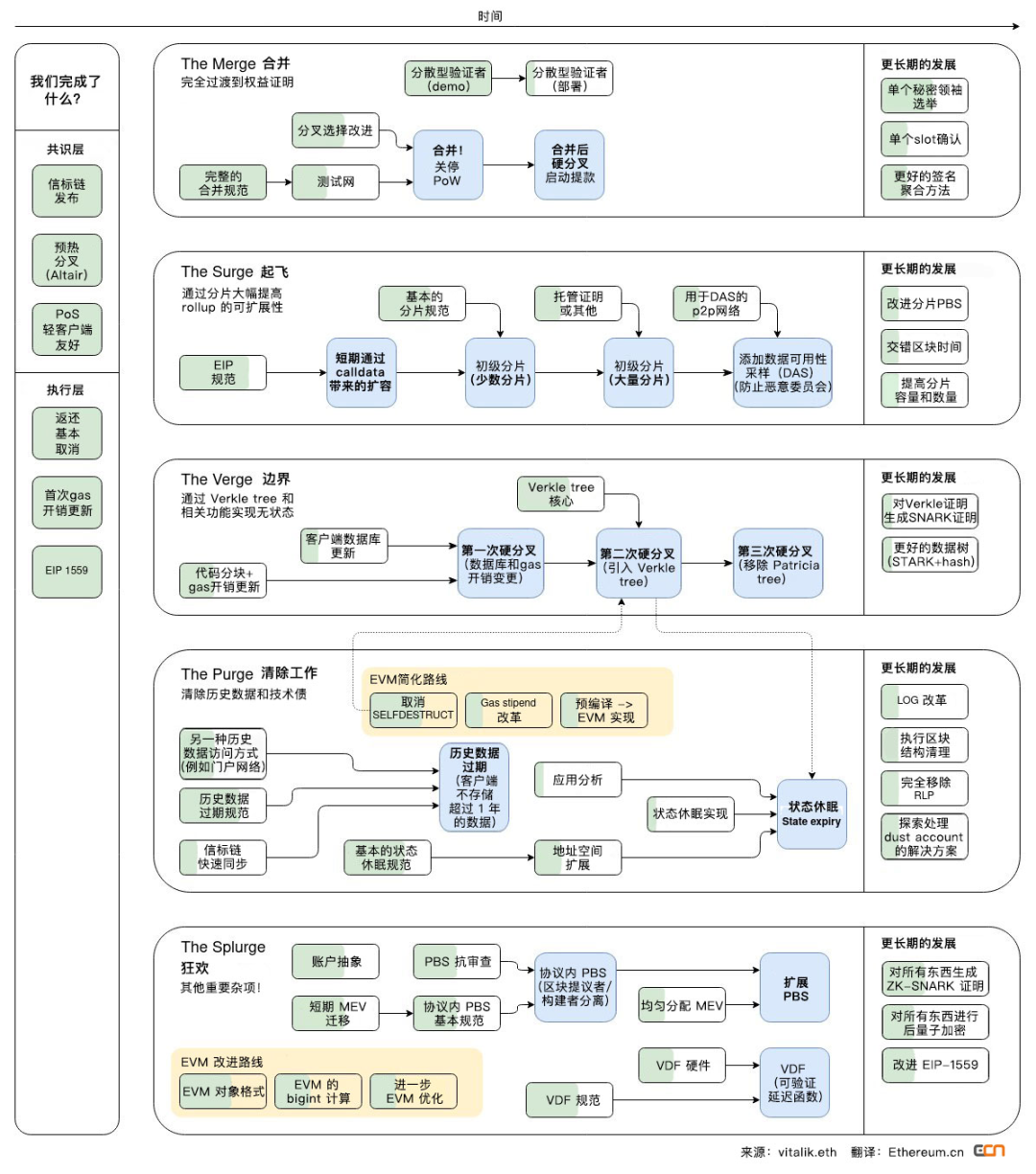
The Surge: Scalability-focused upgrades via rollups and data sharding
The Scourge: Upgrades related to MEV resistance, decentralization, and protocol-level risks
The Verge: Upgrades enabling easier block verification
The Purge: Upgrades aimed at reducing node operation costs and simplifying the protocol
The Splurge: Miscellaneous upgrades that don’t fit into previous categories
Conclusion
As we conclude our tour of Ethereum, this digital city, we see it has evolved from a simple cryptocurrency project into a thriving metropolis of the blockchain world. Built on its solid foundation of Turing completeness, Ethereum has attracted countless developers and companies to innovate and build groundbreaking applications and services on its platform.
Like Rome, Ethereum wasn't built in a day. It continuously grows and evolves, with a dedicated developer community tirelessly improving its infrastructure, capacity, and security. The journey toward Ethereum 2.0—with its PoS consensus, sharding, and scaling solutions—marks the beginning of a new era in Ethereum’s history, much like Rome’s transition from Republic to Empire was a pivotal moment in its past.
It’s important to note, however, that our tour has only scratched the surface. Just as Rome holds centuries of history and culture, Ethereum too contains layers of complexity and innovation still being discovered and developed.
Join TechFlow official community to stay tuned
Telegram:https://t.me/TechFlowDaily
X (Twitter):https://x.com/TechFlowPost
X (Twitter) EN:https://x.com/BlockFlow_News
 白话区块链
白话区块链