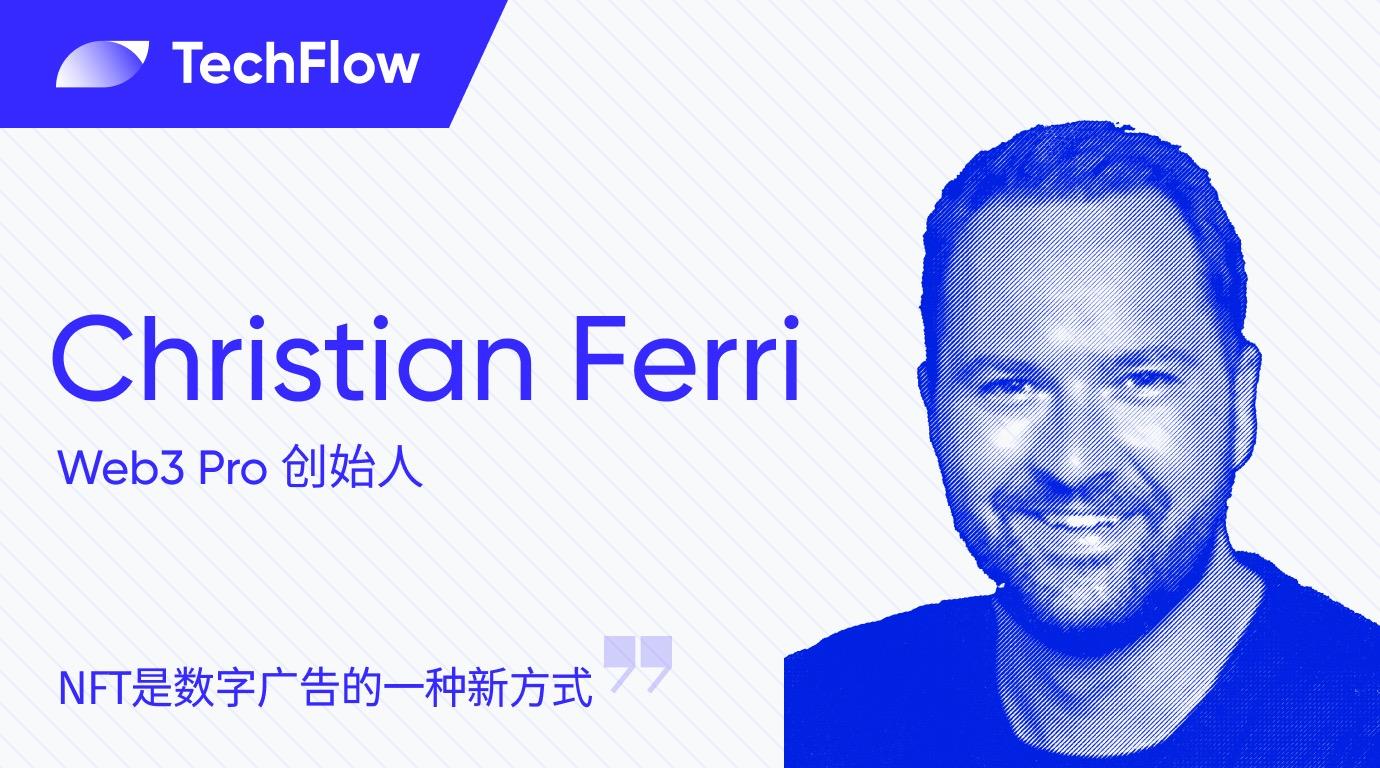
Interview with Web3Pro Founder Christian: NFTs as a New Form of Digital Advertising
TechFlow Selected TechFlow Selected
Interview with Web3Pro Founder Christian: NFTs as a New Form of Digital Advertising
Web3 Pro is a Web3 SaaS company focused on leveraging the power of NFTs to help Web2 industry giants and users decentralize marketing and data ownership.
 Navigating Web3 tides with focused insights
Interviewer: Sunny
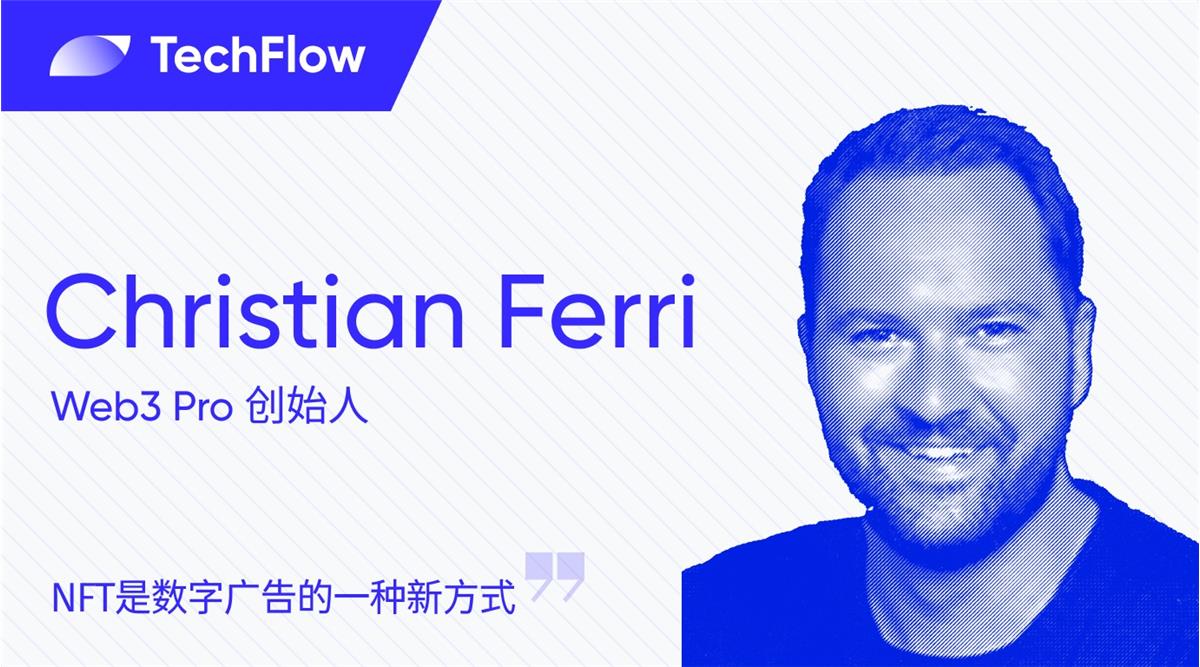
At an open lunch event hosted by Consensus, TechFlow reporter Sunny met Christian Ferri, co-founder and CEO of Web3 Pro.
Web3 Pro is a Web3 SaaS company focused on leveraging the power of NFTs to help Web2 industry giants and users decentralize marketing and data ownership.
Christian’s story is fascinating. He was an early adopter of cryptocurrency, purchasing his first Bitcoin back in 2011. Later, he joined PwC, one of the Big Four consulting firms, where he provided strategic blockchain advisory services to numerous Fortune 500 companies.
Christian has worked with some high-profile clients such as Lamborghini, Adidas, Ducati, and major football clubs. Hearing him position Web3 as a solution to Web2 marketing bottlenecks is truly refreshing.
As someone deeply immersed in the technology, Christian understands the potential of blockchain and how it will disrupt traditional advertising models.
Summary:
- Web2 companies are more risk-averse, while Degens are more willing to explore and embrace new technologies without considering the risks or consequences.
- Traditional companies care less about the technology itself and more about the value it brings—such as sustainability, returns, and revenue.
- Digital advertising has hit a bottleneck with declining conversion rates, while NFTs offer an intriguing path to monetize IP rights and interact directly with customers.
- NFTs represent the pinnacle of personalized marketing, enabling individualized experiences and mass-scale personalization through direct links and API layers.
- The U.S. has more capital, allowing projects to scale faster.
- Europe’s fragmented market structure—divided by countries, languages, and cultures—poses challenges for scaling.
- European founders develop stronger adaptability and perseverance due to these environmental challenges.
- Cryptocurrency will change our view of society by building a trustless system. We no longer rely on trust for transactions but on tools and protocols.
- A common misconception about blockchain is that it increases trust in transactions. In reality, blockchain itself has no trust—it's simply a tool that executes transactions without requiring human trust.
- To help people understand and adopt this technology, we need to simplify its use and emphasize its value. The real value of NFTs lies in data ownership—users can profit from owning and controlling their own data, instead of letting companies exploit cookies for profit.
- The potential of blockchain is to empower individuals and create a trustless society. By owning one’s identity, wallet, and digital assets, people can interact directly with companies and services, enabling personalized engagement and transactions.
- Achieving this cultural shift and technological adoption will take time—and likely a disruptive event—to make people realize the serious consequences of not owning their own assets and identities.
TechFlow: Today, we’re honored to have Christian here. Christian is the CEO and co-founder of Web3Pro. Christian, could you briefly introduce yourself and share how you got into crypto, and then went on to found Web3Pro?
Christian:
I’m Christian Ferri, co-founder and CEO of Web3Pro. I started investing in Bitcoin and entering the blockchain space back in 2011. Later, I joined one of the Big Four consulting firms, leading their blockchain strategy division for five years.
Through that experience, I realized NFTs and Web3 could help businesses better engage with customers and fans, significantly improving conversion rates. That massive opportunity inspired me to launch Web3Pro.
Blockchain in Traditional Consulting vs. Web3
TechFlow: Drawing from your expertise in both Web2 and Web3, what differences do you see between how traditional companies understand Web3 versus how blockchain pioneers like yourself perceive it?
Christian:
Yes, great question. I do believe Degens (early blockchain adopters) understand Web3 much deeper than most Web2 individuals and companies.
We’re willing to explore the nuances of this technology—what’s new, what comes next. We’re more open-minded and think more expansively.
Because we’re actually using the tools of the web, and almost without considering the risks or consequences of using these technologies compared to others.
When it comes to consulting firms and traditional companies, I think they differ in two key aspects.
First, they are far more risk-averse. Any new project deployment could significantly impact their brand and reputation.
If a campaign fails or ROI is low, it could severely damage their brand.
The second aspect is that they don’t care about the technology itself—they care about the value it brings to their business.
So things like transactions per second (TPS), zk-rollups, or which blockchain it runs on aren’t relevant. They care about sustainability.
That’s the value they focus on—return on investment, revenue, conversion rates. So you need to communicate with them in a language that fits the Web2 world. Only then will they start listening.
Then they’ll begin opening their minds and adopting Web3, just like our clients at Web3Pro—Lamborghini, Ducati, Sotheby’s, and others. It takes time, but it works.
NFTs: The Ultimate Peak for Marketers
TechFlow: What motivated you to create Web3Pro? What’s your story?
Christian:
Part of the answer lies in my consulting days—I noticed executives showing strong interest in Web3, especially around 2016 and 2017 when crypto began gaining traction.
However, I observed that traditional industries were being shaped primarily by very smart but closed-minded developers.
They couldn’t effectively bridge traditional companies with real Web3 applications. So I wanted to become a catalyst for this transition—that seemed incredibly compelling.
Secondly, in 2017, my marketing team noticed digital advertising had hit a wall.
We all know today that digital advertising is no longer effective—conversion rates are dropping, and we’re facing the deprecation of cookies.
Without cookies, companies can’t accurately target or deliver effective ads. This is a real problem.
So in 2017 and 2018, many CMOs struggled as ad conversions declined!
My CMO asked me: “Why are we using all the right tools, yet seeing no conversions, while still paying huge sums to Facebook, Instagram, TikTok?”
That’s when I thought: NFTs might be an interesting way to monetize IP rights—not just selling pictures of cats and dogs—but more like a tool to gain first-party data or interact directly with customers.
If every company gave their customers an NFT, they could communicate directly—without relying on social networks, distributors, or intermediaries for advertising.
So I saw this as a powerful new marketing strategy—one that fosters two-way dialogue, empowers communities, users, and customers, and makes their voices heard.
It also allows companies to listen to customer needs and personalize their experiences.
That’s the story behind why I founded Web3Pro.
TechFlow: In Web2, merchants and users are isolated from each other in terms of data. But in Web3, thanks to blockchain’s open standards and interoperability, data among users, merchants, and other businesses becomes interconnected.
Christian:
NFTs are all powered by smart contracts.
Here’s an interesting angle—there are two ways this works.
First, there’s a direct connection. And you can deliver personalized user experiences.
And if you layer on an API, you can start learning more about users—their preferences, dislikes, and tailor experiences accordingly.
So when you think about it, NFTs are the ultimate peak for marketers because they enable mass personalization.
In Web2, personalization and scale were inversely related—you always had to compromise.
So to me, what NFTs achieve is simultaneously delivering scale and personalization.
Essentially, NFTs give companies a direct link to users—enabling large-scale personalization, which leads to better conversions, higher sales, and improved customer loyalty overall.
TechFlow: What was your journey like in building Web3Pro? I’d love to know how you gradually built relationships with top-tier clients like Lamborghini, Porsche, and Bugatti after leaving consulting.
Christian:
First, I want to ensure we’re aligned on the commercial use cases of NFTs.
I’m not talking about NFTs in art and collectibles.
NFTs are an agent, a vehicle, a production system.
So fundamentally, I see it as a powerful system from a marketing tech perspective that drives user engagement.
What’s Web3Pro’s journey been like?
We’ve been around for about four years now. We’re a 25-person team headquartered in the San Francisco Bay Area, with an office in Milan, Italy. We have about two dozen clients, including some of the world’s top brands.
You know, I think our journey has always been the same—bridging Web2 and Web3.
We’re building a suite of tools that meet enterprise-grade requirements—compliance, security, scalability—while also delivering real-world use cases, KPIs, added value, and ease of use that enterprises demand.
So this combination—enterprise-grade, white-label SaaS—is what we offer, ready to launch immediately.
We have an NFT marketplace application, and a loyalty and engagement platform similar to Starbucks Odyssey or Nike Swoosh.
Depending on client needs, we can activate these modules for them.
Spending on this type of technology is growing at about 80% CAGR—this is huge. It’s one of the fastest-growing markets.
Even though AI may seem more advanced than blockchain right now, blockchain tech continues to iterate and evolve daily.
We’re seeing demand surge—three times higher than last year.
I believe the first mass-market use case for this technology is marketing, engagement, connection, and conversion.
Google is essentially a massive ad company—30 different businesses, but ultimately all ads. If ads stop working, economies stall, companies collapse or exit. So the question becomes: how do you market now?
Now the trend is for companies like Starbucks and Nike to bring community engagement in-house.
They provide their own user environments, their own apps, where users can chat, vote, stay engaged, earn rewards.
And companies can use AI to personalize engagement and boost conversion. This is a new form of advertising.
Startup Ecosystem: Europe vs. U.S.
TechFlow: From a startup perspective, did you raise funds first, or did you build market validation before fundraising for Web3Pro?
Christian:
Great question. We did the latter. As a founder, I self-funded initially. We only raised capital after achieving tangible results to scale the company. I’m originally from Venice, Italy—where our mindset is different: We don’t raise funds until we have something to show.
TechFlow: You have experience in both Europe and the U.S.—what are your thoughts on the differences between European and American tech ventures?
Christian:
In the U.S., we have access to more capital.
More capital means you can do more—or do the same things faster.
Yes, I think capital markets in Europe are not as developed.
I think the second difference is that it’s harder to scale projects in Europe. Europe is highly fragmented—with many small countries, unlike the U.S., which is one large market.
From a sales perspective, you can sell more and scale faster in the U.S.
In Europe, you have different countries, languages, and cultures. Just like Asia.
It’s highly fragmented.
That’s a challenge. But I believe there’s a lot of innovation happening in Europe—in Switzerland, Berlin… There’s strong infrastructure and deep-tech expertise.
France, for example, has showcased many brand-focused projects—they’re doing well. Obviously, France has many luxury brands, almost as many as Italy. So I think they’re making the most of their limited resources.
European founders, facing these environmental challenges, develop greater adaptability and resilience—the kind needed to survive a company’s toughest periods.
Crypto Will Change How We See Society
TechFlow: What drew you into crypto back in 2011?
Christian:
I guess many people might have a similar story. A friend who invested in crypto told me about it. At first, I didn’t believe it—I thought it was crazy, magical money. I didn’t understand its value. But my friend insisted I put money into it.
Because I trusted him, I invested $1,000—and forgot about it. Six months later, I checked the account—12 to 13 times growth.
So I started researching—how does Bitcoin actually work?
That led me to read Satoshi Nakamoto’s whitepaper.
From there, things unfolded in my mind—I began seeing how this could solve inefficiencies across every industry and sector of society—from lawyers and accountants to governments, financial institutions, mortgage providers, ownership services, and insurance.
Crypto will change how we see society.
It can truly create a trustless society—where we don’t have to rely on trust to execute transactions, whether it’s marriage or anything else.
Instead, we can trust tools and protocols.
But a big misconception about blockchain is that it increases trust in transactions. Blockchain itself has no trust—it’s not a trust machine. It’s a machine that executes transactions without requiring human trust.
How to Achieve Mass Adoption?
TechFlow: Looking back, you were part of crypto’s first wave. Now, enterprise executives see the value of NFTs in delivering personalized products to customers. But going forward, how do you think NFTs will overcome the challenge of mass consumer adoption?
Christian:
First, we need to stop calling them NFTs.
We don’t go around saying Gmail is an email client based on TCP/IP. We just say, hey, it’s where you send emails, and it’s free.
So I think wording matters—the words we use can scare people.
Second, how easy is it for people to use this technology? Why should they use it? What’s the value? The second "F" in NFT is "ownership"—data ownership that users can profit from.
Instead of letting companies track your behavior via cookies and profit from your journey, you could say: I’ll sell my API for $10/month, or selectively share certain data—maybe not let my kids’ info in, or my browsing history—just my name, or address, and decide how much to charge.
That’s exactly what Amazon started doing last year—paying customers $2/month to incentivize sharing model data instead of raw data. I think that’s the trend—understanding the value of data.
But digital assets also have value. We come from a world where we only think about physical assets—phones, wallets, jackets, cars. We don’t fully grasp digital assets, yet they’re equally important.
For me, this cultural shift—changing how we think about non-physical ownership—is becoming critically important.
Right now, if you ask someone: Do you care about owning a digital asset? They don’t get it. But if you ask: Do you care about owning it so you can resell it?
That sparks understanding—because now I can leverage my data, or feel a sense of purpose.
Ownership only matters if you can do something with it—if you can control it.
Right now, wallet usage is still too complex.
No one wants to download a 16-, 19-, or 20-word hash and write it down somewhere.
Everyone wants to use their phone number and email. People are getting lazier—we’re not getting smarter, we’re getting lazier. So they want to use Web3 tools like they use Alexa.
- Like, Alexa, give me access to my wallet. Your wallet contains your passport, identity, medical records, digital assets, ability to move digital assets, and connect directly with companies.
- If you’re a Lululemon fan, maybe there’s a place to connect your wallet to their community—interact, transact, give feedback, join the group.
- You could go to a hospital where your wallet holds all your medical records—you own them, or grant doctors access only to what you allow.
- Same when applying for a loan—banks can run zero-knowledge proofs, knowing only that you’re over 18, without knowing you’re 37.
This will transform society—shifting more power into the hands of users, people, and communities. This is one of blockchain’s greatest potentials—redistributing power, democratizing access, simplifying processes by removing intermediaries and enabling peer-to-peer interactions.
But it starts with everyone owning their identity, their wallet, their digital assets, and their history.
Each of us must own these—not Facebook, not Google.
These companies currently own our identity, our history, our assets. Banks hold our money—we don’t own it, we just have access.
So it begins with ownership—of assets and identity. That’s why wallets are so important.
Through understanding and genuine cultural shift, people will grasp the importance of ownership. But I believe we’ll need some form of disruption—a major event—to get there.
Related Links:
Join TechFlow official community to stay tuned
Telegram:https://t.me/TechFlowDaily
X (Twitter):https://x.com/TechFlowPost
X (Twitter) EN:https://x.com/BlockFlow_News
 深潮TechFlow