








Interpreting the Details and Misconceptions of the SEC vs. Binance Hearing: Why Did Prices Fall Despite a Ruling Favorable to Binance?
TechFlow Selected TechFlow Selected
Interpreting the Details and Misconceptions of the SEC vs. Binance Hearing: Why Did Prices Fall Despite a Ruling Favorable to Binance?
"The key point of today's hearing is that 'completely shutting down Binance US would have significant impacts not only on the company but on the entire digital asset market.'"
 Navigating Web3 tides with focused insights
The hearing regarding the "SEC's application to freeze Binance.US assets" took place early this morning at 2 a.m. By analyzing the content of the hearing, related media reports, and court documents, it becomes clear that this hearing was only the first step in Binance.US's long journey ahead. During the process, Binance.US and the SEC reached an agreement aimed at ensuring Binance.US could continue normal operations while safeguarding user funds. Crypto analyst Phyrex will provide a detailed breakdown of the specifics and clarify common misunderstandings. Below is the main content:
This morning, I woke up to many messages and comments asking why the price continued to drop despite the overnight hearing appearing to deliver a favorable "ruling" for Binance. Something I didn’t initially think much of has now become necessary to explain carefully.There is actually no positive outcome here. Many people may have watched the hearing or seen shared updates but missed several key details—so let’s go through them one by one.
First, the most discussed point: the U.S. District Court judge in Washington, D.C., did not reject the SEC’s request to freeze Binance.US assets. The idea that the motion was “rejected” is entirely fabricated by media outlets dramatizing the situation. In reality, Binance.US and the SEC reached a mutual agreement on how to handle Binance.US’s assets. Some may be confused because the SEC’s goal isn’t to freeze Binance.US assets—on the contrary, the SEC is concerned that Binance.US does not have sufficient assets to repay users. The entities targeted for asset freezing are Binance.US’s U.S.-based parent company and market maker BAM Trading, with the intention of securing BAM Trading’s funds to return to all Binance.US users.
Binance.US shares this concern—if BAM Trading’s accounts are frozen, Binance.US would collapse. This leads to the second pitfall, often unmentioned in news reports: SEC lawsuits are never measured in days; they’re calculated in months or even years. Of course, outcomes depend heavily on legal expertise. As we mentioned yesterday, Binance.US has hired a lawyer who previously served as a prosecutor at both the SEC and the Department of Justice—a true insider. The fact that such a seasoned attorney took on this case suggests confidence—not necessarily of victory, but of gaining certain strategic advantages. And time itself is one of those advantages.
Returning to the earlier point: the SEC’s lawsuit aims to ensure Binance.US has enough funds to return money to investors. Currently, no investor has encountered issues receiving their funds. In plain terms, Binance.US is not experiencing a run. Under these circumstances, if the court had approved freezing BAM Trading—the de facto controlling entity of Binance.US—it would cause real harm, including making it impossible to compensate users. In fact, yesterday, Binance.US’s legal team submitted a court filing stating that without the ability to pay employees, suppliers, operational costs, and professionals, Binance.US would quickly cease operations. Furthermore, if associated company assets are frozen, banking partners are likely to stop processing any fund transfers—including customer redemptions.
This is factual and clearly stated. Indeed, one banking partner has already notified Binance.US that support will end starting June 14, while another has temporarily frozen assets in Binance.US-related accounts until the court rules on the SEC’s application.
At this point, many should realize: if the goal is protecting user assets, freezing Binance.US—or more precisely, BAM Trading—is the most foolish action possible. Such a freeze would trigger a bank run. To clarify: many Binance.US users aren’t trading crypto-to-crypto, but rather USD-paired trades. While Binance.US may hold ample cryptocurrency, converting to USD requires bank support. Therefore, freezing assets is precisely what would create a run and prevent payouts—and this is just one of the reasons.
Another reason: the SEC is alleging Binance.US is violating regulations, but until a court ruling, Binance.US cannot be deemed guilty. Freezing its assets now would force Binance.US into immediate collapse—employees wouldn’t get paid, suppliers and operators would suffer losses, creating broader social consequences. And if Binance.US is ultimately found not to have violated laws, how would the SEC compensate a now-“dead” Binance.US?
Thus, the outcome was almost inevitable. The SEC does not—and never intended to—destroy Binance.US. This was our initial analysis: the SEC cares about industry stability and establishing rules. Ensuring user fund safety was therefore the primary issue to resolve before formal litigation begins.
Be clear: this happened *before* actual litigation commenced. We haven’t even entered the adversarial phase yet—this was merely the first step, focused on protecting Binance.US user assets during the lawsuit. That’s why I said there’s no need to overreact right now. The first hearing is just the beginning; the road ahead is long. However, this stage did establish how Binance.US can remain operational throughout litigation while securing user funds. As a result, the SEC and Binance.US’s legal teams reached a consensus—with minimal contention—to transfer U.S. customer crypto assets into newly generated wallets, with private keys controlled solely by Binance.US’s U.S. management team.
Now you understand: it wasn’t a rejection of the freeze request, but rather a recognition that Binance.US must not be allowed to fail. Moreover, control of the assets must remain under American oversight. This is why my initial assessment of the SEC’s lawsuit was “de-CZ-ification.”
In fact, the judge in this case explicitly stated that a complete shutdown of Binance.US would have significant impacts—not only on the company but on the entire digital asset market. This statement was the real takeaway from today’s hearing.
Now you should understand why, despite claims of a dismissed motion, prices didn’t rebound—because the Chinese-language narrative was fundamentally incomplete.
Without understanding the U.S. judicial system and without reviewing full details, drawing conclusions based on partial information leads to FUD—whether intentional or not. The truth is, this is only the first step in Binance.US’s long battle. Once again: winning isn’t essential for ultimate victory—time is.
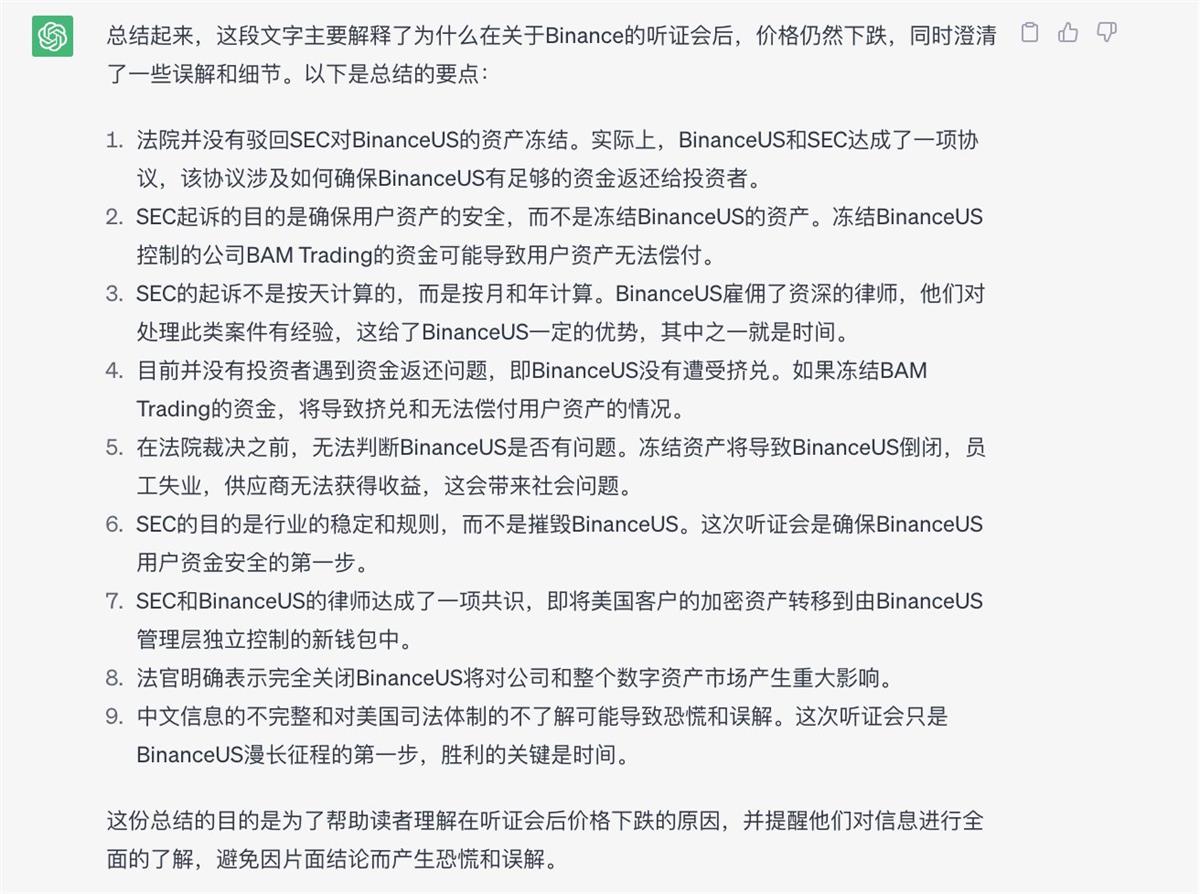
Below is the summary generated by ChatGPT:
Join TechFlow official community to stay tuned
Telegram:https://t.me/TechFlowDaily
X (Twitter):https://x.com/TechFlowPost
X (Twitter) EN:https://x.com/BlockFlow_News
 Phyrex






