








Crypto Morning Brief: Charles Schwab Launches Cryptocurrency Trading Service; Josh Stark, Ethereum Foundation Project Manager, Resigns
TechFlow Selected TechFlow Selected
Crypto Morning Brief: Charles Schwab Launches Cryptocurrency Trading Service; Josh Stark, Ethereum Foundation Project Manager, Resigns
Binance Futures will launch perpetual contracts for Microsoft, Broadcom, and Alibaba—three U.S. stocks—on April 20.
 Navigating Web3 tides with focused insights
Author: TechFlow
Yesterday’s Market Updates
Trump: Israel and Lebanon Agree to 10-Day Ceasefire
U.S. President Trump stated: “I just had a very good conversation with the President of Lebanon and Israeli Prime Minister Netanyahu. Both leaders have agreed that, in pursuit of peace between their two nations, they will formally begin a 10-day ceasefire at 5 p.m. Eastern Time.”
U.S. Launches “Economic Fury” Campaign Against Iran
U.S. Secretary of Defense Hegseth announced at a press conference that the U.S. Department of the Treasury has launched an operation codenamed “Economic Fury,” designed to impose “maximum economic pressure on Iran.”
U.S. Initial Jobless Claims for Week Ending April 11: 207,000 vs. Expected 215,000
Initial jobless claims in the U.S. for the week ending April 11 totaled 207,000, below the consensus estimate of 215,000. The prior week’s figure was revised upward from 219,000 to 218,000.
Kalshi vs. Nevada Regulatory Jurisdiction Dispute May Reach U.S. Supreme Court
According to Cointelegraph, the legal dispute between prediction market platform Kalshi and the state of Nevada over regulatory authority for event-based contracts may ultimately be appealed to the U.S. Supreme Court. Before the Ninth Circuit Court of Appeals, Kalshi argued that its event contracts qualify as “swaps” regulated exclusively by the U.S. Commodity Futures Trading Commission (CFTC), rather than falling under state-level gambling regulation. Previously, Nevada barred Kalshi from offering such contracts unless it obtained a state gambling license. Coinbase Chief Legal Officer Paul Grewal noted that the Supreme Court may rule on whether sports-related contracts traded on designated contract markets fall within the CFTC’s exclusive jurisdiction.
Ethereum Foundation Project Manager Josh Stark Announces Departure
Josh Stark, a key researcher and project manager at the Ethereum Foundation, announced that after five years of service, he has decided to step down and complete his transition—his decision was made in early March and his tenure at the Ethereum Foundation will conclude by the end of April.
Stark said he currently has no concrete plans for the future and intends first to take an extended break and spend time with family and friends. He expressed deep honor at having contributed to Ethereum at the Foundation and extended gratitude to numerous leadership team members and community partners for their long-term collaboration. Stark also highlighted how the Ethereum ecosystem has repeatedly achieved goals once deemed “impossible” by outsiders—including network launch, decentralized finance (DeFi) adoption, and the successful transition to proof-of-stake.
Earlier reports indicated that Foundation contributor Trent Van Epps also resigned last week.
CoW Swap Publishes Attack Incident Report: Domain Compromised via Social Engineering; cow.fi Domain Control Restored
CoW Swap tweeted that it has regained control of the cow.fi domain and has been operating normally on cow.finance for some time, now gradually transitioning back to the original domain.
The official statement explained that attackers gained control of the cow.fi domain on April 14 by submitting forged documents to the DNS registrar. They then deployed a highly convincing phishing site in two stages: first tricking users into signing malicious transactions via a wallet injector, then stealing seed phrases and passwords through fake wallet pop-ups. This attack targeted the domain registrar—not CoW Swap’s infrastructure or private keys. Affected users are advised to revoke all approvals using tools like Revoke.cash and consider transferring funds to new wallets.
Binance Futures to Launch Perpetual Contracts on Microsoft, Broadcom, and Alibaba Stocks on April 20
Per the official announcement, Binance Futures will roll out three USDT-denominated perpetual contracts—MSFTUSDT, AVGOUSDT, and BABAUSDT—on April 20, 2026, tracking the stock prices of Microsoft (Nasdaq: MSFT), Broadcom (Nasdaq: AVGO), and Alibaba (NYSE: BABA). Each contract offers up to 10x leverage, a funding rate cap of ±2%, funding settlements every 8 hours, 24/7 trading, and multi-asset margin support.
Tether to Contribute Up to $127.5 Million to Support Data Recovery After Drift Protocol Exploit
According to CoinDesk, Drift Protocol—the largest decentralized perpetual futures exchange on Solana—announced it has secured up to $147.5 million in total financial support following a hack exceeding $270 million. Of this, Tether contributes $127.5 million, with $20 million coming from other partners. Funds will be used to restore user assets and relaunch the protocol. The attack—carried out on April 1 by a North Korea–linked group posing as a quantitative trading firm after infiltrating the protocol for roughly six months—caused DRIFT token value to plummet ~70%.
Funding is structured as a hybrid of revenue-linked credit, ecosystem subsidies, and market maker loans, aiming to cover approximately $295 million in user losses. Upon relaunch, the protocol will replace USDC with USDT as its core settlement layer, with Tether simultaneously providing fee waivers, user incentives, and liquidity support.
Circle Introduces New Cross-Chain USDC Payment Mechanism Enabling Unified Settlement for High-Frequency Use Cases
Per Crowdfund Insider, Circle has introduced a new solution for high-frequency cross-chain USDC payments. Developers can use the Cross-Chain Transfer Protocol (CCTP) to enable local fulfillment agents to front-pay recipients on their specified destination chain, followed by unified cross-chain settlement later. This model reduces operational overhead associated with individual cross-chain transfers and suits platforms processing large volumes of payments daily. Unlike traditional CCTP workflows—which require per-transaction USDC burning and minting—the new approach supports batch settlement, reducing burn operations on the source chain and eliminating the need for signature infrastructure on the destination chain. Circle also demonstrated the workflow on Arc Testnet and Ethereum Sepolia.
Tempo Launches Privacy Solution “Zones,” Enabling Permissioned Parallel Blockchains
Per The Block, Layer 1 blockchain Tempo has launched “Zones,” a privacy solution tailored for institutional use cases including payroll disbursement, fund management, and payment settlement. Zones operate as parallel blockchains connected to the Tempo mainnet, providing private execution environments where transactions are confidential by default—but assets remain interoperable with the Tempo mainnet, other Zones, fiat on/off-ramps, and liquidity pools. Tempo states each Zone will be managed by a trusted entity, whose operators may monitor activity and enforce access controls—but do not hold custody of underlying assets. Users retain full control and may withdraw funds locked in mainnet smart contracts at any time.
Charles Schwab Announces Launch of Spot Crypto Trading Service Supporting Direct Bitcoin and Ethereum Trading
Per The Wall Street Journal, Charles Schwab officially announced Schwab Crypto™—its spot cryptocurrency trading service—on April 16, rolling it out to retail clients in phases over the coming weeks. The service supports direct trading of Bitcoin and Ethereum, accompanied by educational resources and dedicated customer support. It is fully integrated into Schwab’s existing investment, trading, wealth management, and banking platforms.
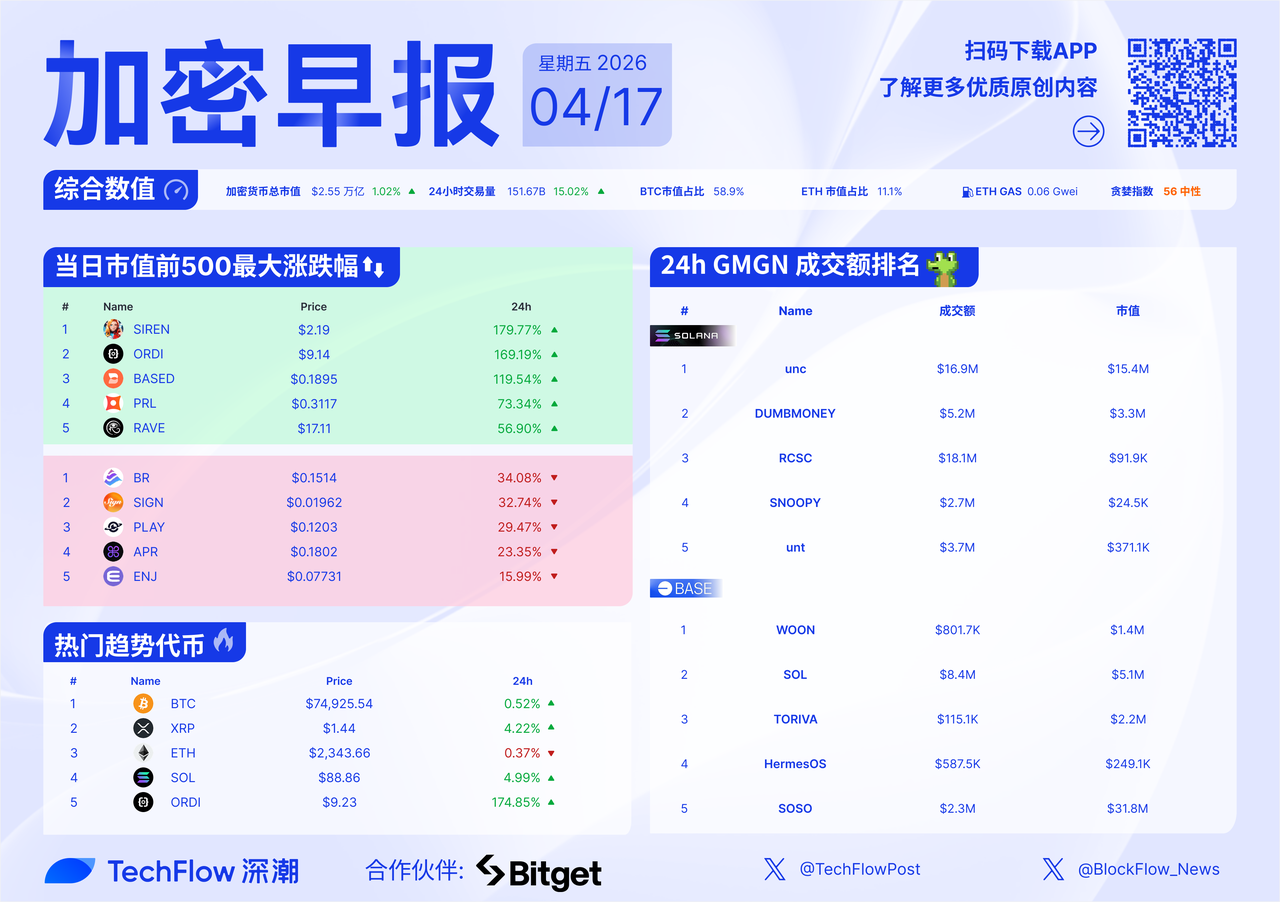
Market Data
Recommended Reading
Is the U.S. Stock Market in the “Largest Bubble in History”? Four Valuation Metrics Flash Red Simultaneously
https://www.techflowpost.com/zh-CN/article/31154
This article analyzes current U.S. equity market valuations, noting multiple key indicators suggest the market may be at a historic bubble peak—while also highlighting divergent views among Wall Street participants. Bearish analysts warn of bubble risks, while bulls argue robust earnings growth could justify current valuations. The piece further examines how geopolitical developments and macroeconomic conditions are influencing market dynamics.
Kalshi CEO Calls on U.S. DOJ to Prosecute Insider Trading—A Strategic “Self-Referral” Amid Survival Battle
https://www.techflowpost.com/zh-CN/article/31155
This article explores divergent strategies adopted by prediction market leaders Kalshi and rival Polymarket amid intensifying insider trading scrutiny and regulatory pressure. Kalshi CEO Tarek Mansour publicly urged the U.S. Department of Justice to prosecute violations on the platform and advocated for a unified federal consumer protection framework to replace fragmented state-level regulation. The article details both companies’ responses—including litigation, lobbying efforts, and investigative cooperation—as well as their competitive positioning in the prediction market space.
From Shoe Sales to Bankruptcy, Then a Name Change to “AI”—Allbirds’ Stock Surges 5x Overnight in Wall Street’s Relentless “Rebranding Game”
https://www.techflowpost.com/zh-CN/article/31156
This article recounts how eco-friendly footwear company Allbirds—after losing 99% of its peak market capitalization—rebranded as “NewBird AI” to pivot into AI compute infrastructure, triggering an intraday stock surge of 582%. It analyzes the economics behind such rebranding maneuvers and speculative market behavior, exploring how companies package themselves around trending concepts to attract capital—and the associated risks.
Freezing Satoshi Nakamoto’s Bitcoins? BIP-361 Proposal Ignites the Community’s Most Heated “Quantum Threat” Debate
https://www.techflowpost.com/zh-CN/article/31158
This article examines Bitcoin developer Jameson Lopp and others’ submission of BIP-361—a proposal to phase out legacy cryptographic signatures in three stages and freeze bitcoins held in wallets that fail to migrate to quantum-resistant addresses. Designed to mitigate potential threats posed by quantum computing’s ability to break current encryption algorithms, the proposal affects roughly 1.7 million BTC—including ~1.1 million BTC attributed to Satoshi Nakamoto. Its implementation could influence market sentiment; if quantum threats are validated, it may trigger widespread panic.
a16z’s 10,000-Word Essay: AI’s Next Frontier Lies Not in Language—but in the Physical World—A Triple Flywheel of Robotics, Autonomous Science, and Brain-Computer Interfaces
https://www.techflowpost.com/zh-CN/article/31162
This article explores the next stage of AI development—expanding beyond language and code into the physical world—through general-purpose robotics, autonomous science (“AI scientists”), and brain-computer interfaces (BCIs) as novel human-machine interfaces. These three domains represent critical vectors for future AI disruption, forming a mutually reinforcing flywheel effect driven by advances across five foundational primitives—accelerating AI’s real-world application and value creation.
Join TechFlow official community to stay tuned
Telegram:https://t.me/TechFlowDaily
X (Twitter):https://x.com/TechFlowPost
X (Twitter) EN:https://x.com/BlockFlow_News
 深潮TechFlow









