A Brief Analysis of Recursive Inscriptions: The LEGO Blocks of Ordinals
TechFlow Selected TechFlow Selected
A Brief Analysis of Recursive Inscriptions: The LEGO Blocks of Ordinals
What are recursive inscriptions?
 Navigating Web3 tides with focused insights
Author: veDAO Research Institute
Amid the ongoing bear market sentiment, Bitcoin's Ordinals protocol has introduced a noteworthy update—recursive inscriptions. By using special syntax to reference other inscriptions, it enables smaller inscription sizes and lower costs. But what exactly are recursive inscriptions? This article explores the most significant innovations behind them.
What Are Ordinals Recursive Inscriptions?
On June 12, Raph, the new lead maintainer of the Bitcoin Ordinals protocol, merged "Recursive Inscriptions #2167"—proposed by Ordinals creator Casey Rodarmor—into the official Ordinals codebase on GitHub. Shortly after, one of the anonymous developers of Ordinals, Leonidas.og, explained the concept of “recursive inscriptions” in a tweet.
Recursive inscriptions represent a new method of engraving data on the blockchain that breaks away from the previous limitation where each inscription was isolated and unconnected. With self-referential capabilities, recursive inscriptions open up possibilities for free combination. In short, a recursive inscription is one that requests content from another inscription.
Key Features and Breakthrough Innovations of Recursive Inscriptions
According to developer Leonidas.og, inscriptions can now use a special syntax "/-/content/:inscription_id" to request content from other inscriptions. This allows users to create inscriptions on the Bitcoin chain with significantly reduced data size—and therefore much lower transaction fees.
-
Previously: To create an inscription for a PFP collection, users had to upload full images, which were then downloaded on-chain. As image quality improved (higher resolution, more detail), file size and storage requirements grew, increasing both cost and fees.
-
Now: The unique ID syntax used in recursive inscriptions essentially uses text-based code to locate images. Creating a PFP collection inscription now involves uploading only features corresponding to the image, such as pattern (monkey), color (green background), or action (raising hand). These elements are then assembled by referencing existing on-chain components, eliminating the need to repeatedly upload/download entire images.
-
Immediate advantage: Since this method relies on calling textual code, the resulting inscription size is extremely small—not only drastically reducing creation costs but also allowing inscriptions to exceed Bitcoin’s 4MB block size limit.
-
Expansion potential: Thanks to their high flexibility, composability, and low cost, recursive inscriptions unlock infinite new possibilities—enabling complex content like images, videos, and even 3D games to be stored on-chain (with new inscription types including “JS” and “CSS”).
-
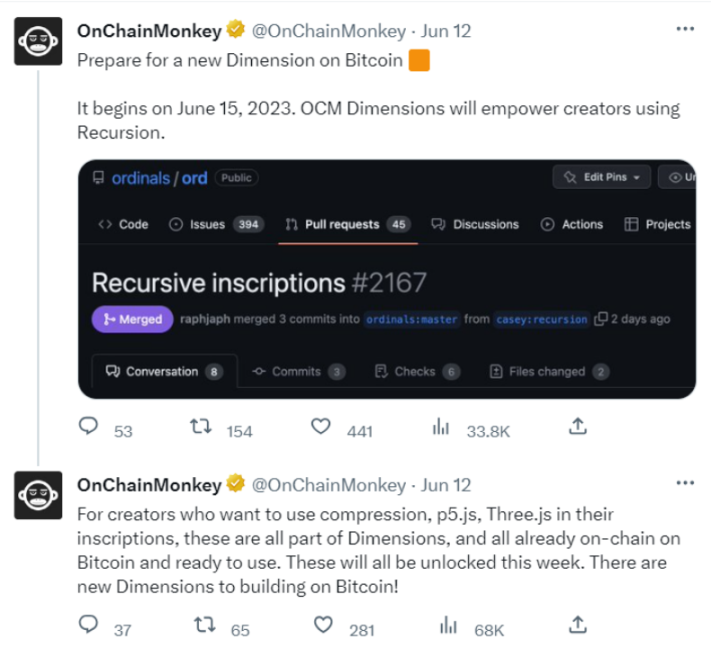
OnChainMonkey: The team has already inscribed two fully on-chain npm packages onto Bitcoin. Using recursion, these packages will be called from upcoming Dimensions collection inscriptions to generate beautiful 3D artworks with less than 1 KB of data. OnChainMonkey plans to launch its recursive inscription project OCM Dimensions on June 15, after which these resources will become public commons—like a shared asset library available for anyone to reference via recursive inscriptions.
-
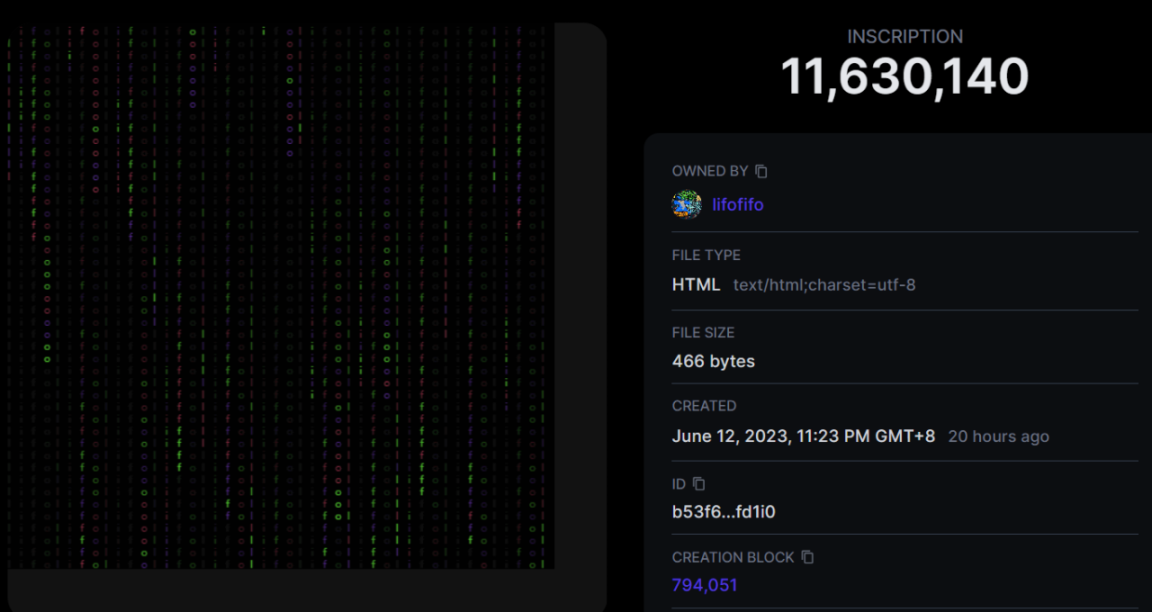
Ord.io: The Bitcoin inscription exploration and discovery platform Ord.io officially began supporting recursive inscription creation and display on June 12. Its official Twitter account expressed amazement that someone had already created a dynamic art inscription using just 466 bytes through recursion.
Infinite Possibilities on the Bitcoin Chain
Thanks to the characteristics of recursive inscriptions, building an internal internet within the blockchain becomes possible. Here, every file can request data from other files on the Bitcoin chain, enabling repositories to access each other. This means we could store far more valuable information directly on Bitcoin.
Creator Casey Rodarmor has confirmed community inquiries, stating that new inscription types related to web development—“JavaScript” and “CSS”—have been added. This implies we may soon see dynamic websites hosted entirely on decentralized networks, never disappearing;
Even more possibilities include:
-
Secondary creation of inscriptions: The composable nature of recursive inscriptions—and potentially future splitability—alongside increasingly rich public assets, will surely inspire greater creativity in inscription design.
-
Decentralized GitHub: Some in the community suggest leveraging composability and potential future fragmentation to move GitHub codebases onto the Bitcoin chain, achieving full decentralization.
-
NFT Combinatorics and Fragmentation: This is undoubtedly the most exciting prospect. If recursive domains enable splitting inscriptions, NFTs could achieve free assembly and disassembly. This technology could also inspire innovative NFT applications beyond Bitcoin.
Conclusion
Recursive inscription code has only recently been merged, and its emergence marks a significant enhancement in programmability at the application level for the Ordinals protocol—an important milestone for Bitcoin. From richer content expression and reduced costs to limitless combinatorial potential, the future of recursive inscriptions is incredibly promising. However, it's important to note that with any new technology come uncertainties and unknown risks, including potential bugs in the code. While exploring opportunities, investors should remain cautious and manage risk prudently.
Ordinals GitHub code:
https://github.com/ordinals/ord/pull/2167#issuecomment-1586342841
Leonidas.og Twitter:
https://twitter.com/LeonidasNFT/status/1668098460766052353
Join TechFlow official community to stay tuned
Telegram:https://t.me/TechFlowDaily
X (Twitter):https://x.com/TechFlowPost
X (Twitter) EN:https://x.com/BlockFlow_News
 @TrendX_official