Triplebyte founder: How to find and hire key engineers to build your product?
TechFlow Selected TechFlow Selected
Triplebyte founder: How to find and hire key engineers to build your product?
How to compete with tech giants like Google and Facebook for engineers?
 Navigating Web3 tides with focused insights
Compiled by TechFlow
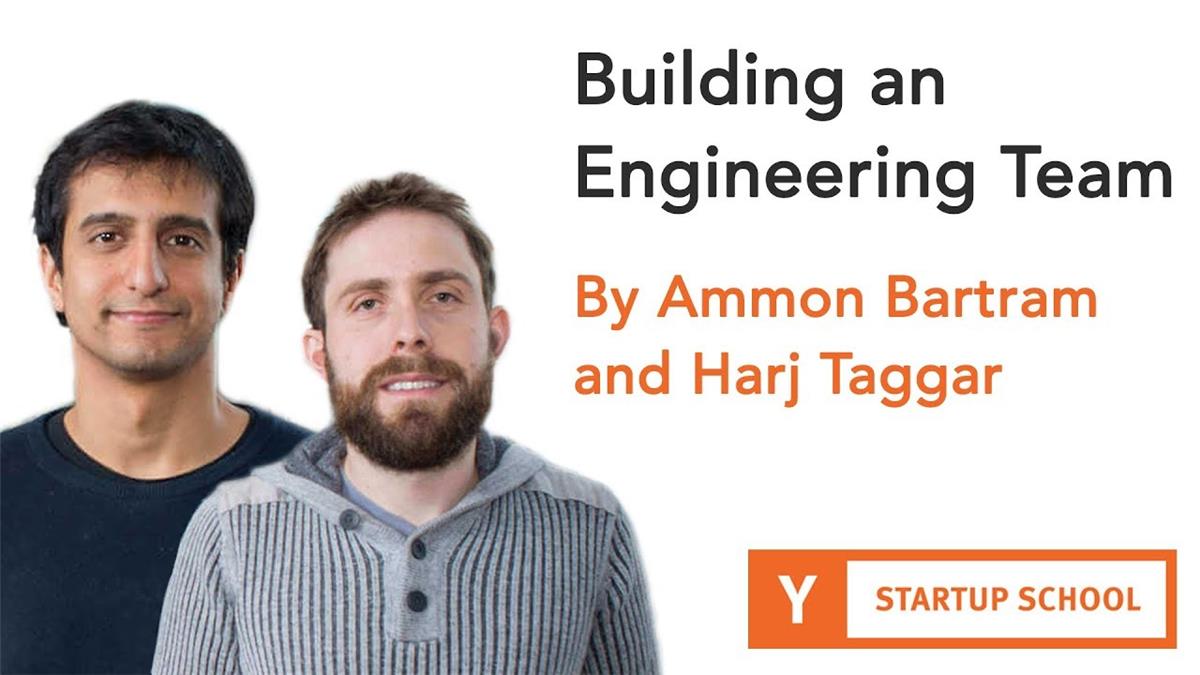
Note: This article is part of the TechFlow专题 "YC Startup Lessons Chinese Notes" (updated daily), dedicated to collecting and organizing Chinese versions of YC course content. The twelfth entry features an online course titled "Building Engineering Teams" by Harj Taggar, former YC partner and co-founder of TripleByte, together with his co-founder Ammon Bartram.
*TechFlow Note: Triplebyte is a U.S.-based engineering recruitment service provider, specializing in developing software and tools to assess engineers' skills and match them with suitable jobs, evaluating potential candidates through online tests and technical interviews.
Introduction to Harj Taggar
I'm Harj, one of the founders of TripleByte, which I co-founded with Amon as a hiring marketplace. The inspiration for starting Triplebyte came after graduating from Y-Combinator and raising our first round of funding—everyone faced the same top challenge: how to hire engineers?
So we gathered extensive data on engineering recruitment and discussed four main topics: where to find engineers, when to use recruiters, and the processes for assessing technical skills and making offers.
But before we begin, I want to issue a warning: make sure you're mentally prepared, because hiring is an extremely painful process. It takes a lot of time, involves massive repetition, most of which leads to dead ends that completely waste your effort. Eventually, you'll inevitably face the situation where the person you really want to hire turns down your offer—even if they were ideally suited to help you achieve growth targets. In reality, they never seriously considered leaving their comfortable big company to join your high-risk, challenging startup.
Therefore, when building your hiring process, you need to be psychologically ready. I recommend viewing the entire hiring process as a funnel consisting of three stages:
-
The top of the funnel is sourcing—the process of finding suitable candidates through various channels.
-
The second key stage is screening, answering the question of whether you want to hire this person. Screening tends to be the most time-consuming and labor-intensive step throughout the funnel.
-
The final stage is closing—the process of structuring and securing acceptance of an offer. This step is crucial because it determines whether you can successfully attract candidates to join your team.
Strategies for Building Hiring Channels
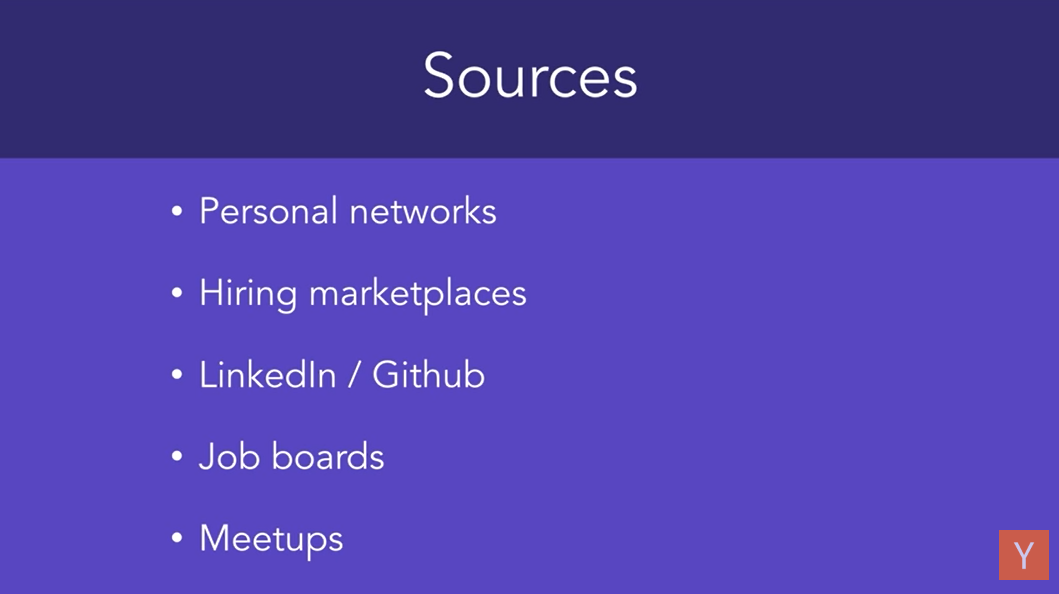
Let’s now discuss strategies for building hiring channels. I’ll introduce five sources: personal networks, job markets, LinkedIn/GitHub, job boards, and events—and examine the pros and cons of each method. This list is ordered according to what I believe should be your priority in focusing time and attention.
1. Personal Networks
In my view, personal networks are among the best sources for hiring, especially during early stages when you’re only bringing on a few people. This is because when considering whether to hire someone, you actually need to answer two questions: Does this person have the skills required to do the job? Can you work effectively with this person?
When you're a large company, you can focus primarily on the first question because your size means you have enough people and teams—somewhere within the organization, there will likely be a team capable of working effectively with anyone. But when you're small, that's not the case.
Your ability to work well with someone becomes a critical factor in your success. Hiring the wrong person early on can be fatal to your company.
Thus, when you hire someone you've worked with before, or someone who has worked with someone you trust, you reduce the risk of poor collaboration.
Therefore, I advise founders to fully leverage their personal networks to find suitable candidates.
However, in practice, I’ve found entrepreneurs often fail to use their personal networks effectively during hiring. There may be two reasons for this:
-
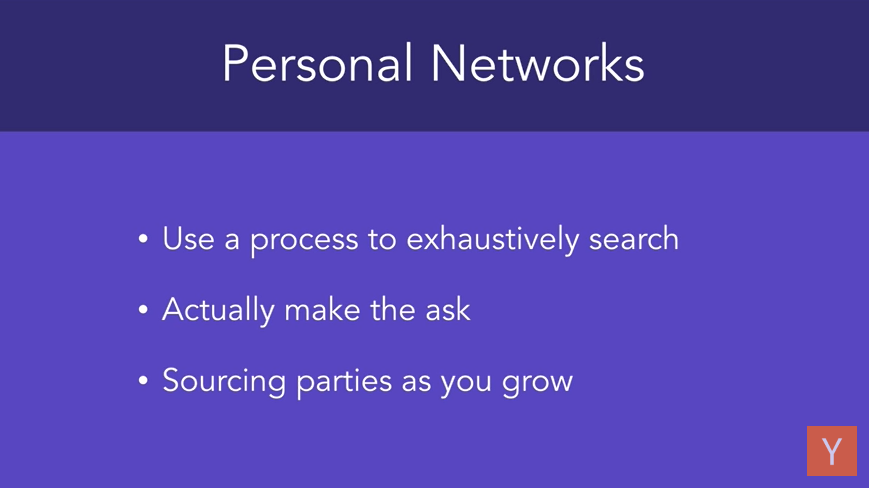
First, they don’t follow a structured process to thoroughly search everyone they might hire;
-
Second, they fear rejection from friends—but in fact, recruiting talent from people you know is an incredibly valuable resource, accessible simply by asking.
I recommend following a strict procedure in hiring. First, create a list of every excellent engineer you know—regardless of availability, even if they've already sold their company at a high price. Then reach out, show them what you're building, and ask if they’d consider joining your team. Even if they decline or hesitate, keep trying to persuade them—invite them to visit your office.
If unsuccessful, ask them if they know others who might fit your team, compile another list, and repeat the process. This cycle never ends—even founders of public companies do this daily.
As your company grows and builds teams, leverage employees’ personal networks to find new hires. I suggest using team activities like categorization sprints—have each person spend time browsing social media sites like LinkedIn and Facebook, adding suitable contacts to a shared spreadsheet. Then personally follow up with potential candidates.
Ensure you use a thorough process, persist in asking people you know, and as you scale, tap into your team’s networks. During hiring, incentivize your team with food, drinks, bonuses, and use proper tools to manage the workflow.
2. Job Markets
Job markets represent a relatively new approach to hiring. In recent years, as traditional methods (like reaching out on LinkedIn or GitHub) have become increasingly difficult for hiring engineers, these platforms have grown more popular.
Job markets resemble dating websites—both engineers and companies create profiles to promote themselves and initiate contact to determine if further interviews are warranted.
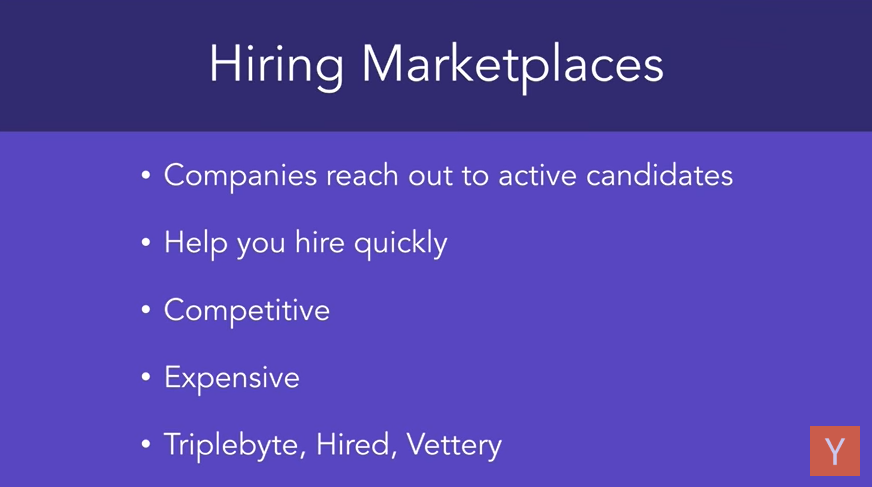
However, demand for top engineering talent far exceeds supply, so companies typically need to proactively reach out to candidates.
The benefit of using job markets is the speed at which you can find suitable candidates, since most are actively seeking opportunities.
But competition is intense—convincing specific engineers to join requires strong persuasion.
Additionally, job markets tend to be expensive, charging per hire—typically 15–20% of the candidate’s first-year salary. TripleByte, Hired, and Vettery are currently the three major platforms, all free to use.
TripleByte differentiates itself by offering higher-quality candidates, measured by the percentage of applicants who pass company interviews via TripleByte. Hiring is a funnel—you must continuously optimize it, tracking conversion rates at each stage to gather data and build effective habits.
3. LinkedIn or GitHub
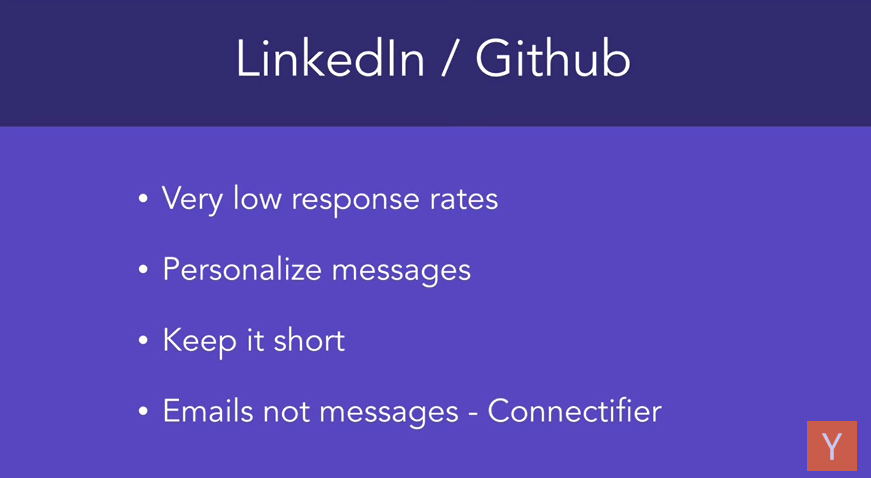
LinkedIn and GitHub are the world’s largest online directories of engineers. Large company recruiting teams typically use these platforms to contact engineers matching certain criteria, sending cold messages to recruit. However, due to increasing numbers of tech recruiters using these platforms, response rates for everyone are declining.
For early-stage startups, this means spending significant time sending numerous messages to attract interested candidates.
To improve effectiveness, avoid mass approaches and instead invest time in deep research and personalized messaging—just like large recruiting teams do.
Review candidates’ LinkedIn, GitHub, etc., study details of their work, send a small number of targeted, personalized messages, and include clear evidence that you’ve read their profile and are genuinely interested. Keep messages concise, emphasizing that you’ve done your homework.
Finally, note that using email instead of platform messages can improve response rates. If you subscribe to LinkedIn Recruiter Lite ($120/month), you can use the Connectifier plugin to extract email addresses from any LinkedIn profile.
4. Job Boards

The two primary platforms for startups are Stack Overflow and AngelList. Hacker News Jobs isn't included here because it's only relevant to YC companies, though it does offer high-quality engineers and usually ranks second.
While job boards vary in quality, their advantage lies in posting across multiple platforms efficiently. The downside is the time required to sift through resumes, as most applicants fall below qualification thresholds.
To maximize ROI and increase the number of strong applicants, focus on making your job listing unique and engaging.
Many online job descriptions are written by HR or marketing staff using corporate templates, failing to appeal to engineering audiences.
Founders can inject personality and passion into listings—write in first person about why you started the company, why you’re excited about its mission, etc.
Also highlight unique cultural aspects and specific technical or product challenges. This attracts more qualified applicants and helps them better understand your company.
5. In-Person Events

The last source I’ll mention involves physical, face-to-face meetings. But I don’t think this method is very effective—it requires long-term effort, and the numbers don’t support it.
Few people attend networking events, and most go mainly for free food and drinks, not actively seeking jobs. Thus, it’s hard to find truly qualified candidates who are actively looking and genuinely excited about your company.
Moreover, you personally need to be highly skilled at conversing with and persuading strangers for this approach to work. While some founders succeed through in-person events, their results are inconsistent.
If you do want to try this, focus on technical conferences. Local coding groups where people gather, bring laptops, and work together are likely better sources than events like Dreamforce.
You can host events at your own office—combine this with network-based hiring by inviting friends or their engineer friends over. For example, at TripleByte, one of our engineers hosted Bay Area Emacs meetups in our office.
Although this hasn’t directly led to hires, it’s a great way to build and expand an engineering network that may yield value in the future. So it’s definitely worth considering.
When Should You Use Recruiters?
Now let’s discuss when you should consider using recruiters.
There’s no strict rule governing when to hire a technical recruiter. Some companies start with fewer than 10 employees, while others wait until surpassing 50.
Here’s my rule of thumb: I believe you should wait until after hiring your first engineer before considering a recruiter. The reasoning follows general startup advice.
Doing the initial hiring yourself is beneficial—it helps you better evaluate candidates. Before delegating hiring, you gain firsthand insight into what makes someone excel in a role at your startup. If you’ve experienced the pain of hiring, you’re more likely to hire the right recruiter.
Another reason: it’s like sales. As a founder, you’re always selling—never knowing when you might meet a truly exceptional employee. If you’ve practiced convincing engineers to join, you’re ready.
My advice: handle the first hire yourself. Over the next six months, aim to hire at least one more engineer to maintain momentum—otherwise, your recruiter may quickly become unemployed.
Finally, empirically speaking, if you spend over 50% of your time on sourcing (including calls and screen interviews), it may be time to seek hiring help—because 50% is roughly the maximum you should dedicate to hiring.
Types of Recruiters
Recruiters generally fall into three categories:
-
First, contract recruiters—paid hourly—who can perform tasks ranging from sending cold messages on LinkedIn to conducting initial phone screens.
-
Second, internal recruiters—full-time technical recruiters hired as part of your team.
-
Third, agencies—they function like sales teams, paid to contact as many engineers as possible on LinkedIn or other platforms, then sell resumes to companies. They typically charge 25–30% of the first-year salary if you hire their referred candidate.
I recommend starting with contract recruiters when seeking help—have them focus on contacting engineers via LinkedIn and GitHub and providing promising leads for phone screens. Then you take over as closer and persuader. When broader hiring support is needed, consider hiring a full-time internal recruiter and train them in outreach calls.
In summary, your startup hiring strategy should ensure you’ve exhausted your personal network and tested job markets. Invest time in personalized, targeted outreach to engineers on LinkedIn and GitHub. Treat job boards, interviews, and events as background efforts—not expecting immediate hires, but building general channels that may prove valuable later.
Ammon Bartram
I’m Ammon Bartram, co-founder of TripleByte. Prior to this, I co-founded SocialCam with Michael Seibel and was an early employee at Twitch. Today, I’ll discuss two steps in the hiring process: resume screening and phone interviews.
First, let me explain why you should trust my advice. One reason is that I’ve conducted many interviews. Since joining TripleByte, I’ve personally interviewed over 1,000 engineers. But I believe a stronger reason is TripleByte’s unique vantage point—we observe candidates’ performance across interviews at multiple different companies. This gives us a dataset others lack, forming the basis of the advice I’ll share today.
Standard Company Interview Process
Most companies follow a basic hiring process that has become fairly standardized—about 95% of tech firms use these core steps to screen candidates.
-
First, resume screening. When someone applies to a company, they submit a resume. A recruiter reviews it to determine if the candidate appears basically qualified.
-
Next, a recruiter conducts a preliminary phone screen—a 30-minute call to learn about the candidate’s background, assess cultural fit, and confirm interest in the company.
-
Then, a technical phone screen—conducted by an engineer, lasting 30 minutes to an hour, usually involving solving a programming problem, sometimes moderately difficult. This is typically done using a shared text editor or code notebook.
-
An optional step: take-home project. A substantial assignment the candidate completes independently and submits for evaluation.
-
On-site interview. The candidate visits the company for 3–6 hours of meetings with engineers discussing technical problems.
-
Final decision meeting. Typically the day after the interview, everyone who interviewed the candidate—including the hiring manager—gathers to discuss feedback and collectively decide whether to extend an offer.
Companies extend offers to only 2–8% of all engineering applicants. Interestingly, where attrition occurs varies significantly between companies.
In the initial screening phase, 75% of applicants are filtered out based on cultural fit.
Then, during interviews, nearly all remaining applicants pass—that’s where all the filtering happens.
About 95% of those hired perform well—meaning roughly 5% of technical hires are let go within months.
From the candidate’s perspective, we see distributions in interview success rates.
Top percentile programmers receive job offers after most interviews.
But most programmers fall in the middle—they interview and receive offers in 15–30% of cases.
Interestingly, no one passes every interview. No magical engineer receives offers after every single interview. I believe this reflects the core challenge and inherent noise in the interview process.
Internal Rater Reliability
Do you believe interviewing is a repeatable and meaningful process? If you could re-interview colleagues, employees, or everyone who passed interviews last year, how many do you think would pass again?
It’s a thought-provoking question, but interestingly, we can find answers through data.
I calculated a statistic called “internal rater reliability,” aggregating data from all TripleByte interviewers. This metric measures consistency—how closely different interviewers agree when evaluating candidates.
The score ranges from 0 to 1, where 0 means no agreement (random consistency) and 1 means perfect agreement. My analysis found agreement values exceeding 0.1.
Though clearly closer to random than perfect, in context, I ran the same calculation on a dataset of online movie reviews and got a similar, slightly higher agreement score.
We can conclude: interviewers and Netflix viewers exhibit similar levels of agreement when judging who’s best. That’s somewhat alarming.
Data shows interviews are far more inconsistent and noisy than most hiring managers realize.
Why Do Interviews At All?
If interviews are so noisy, why use them? Couldn’t we just use trial periods to identify strong engineers? Actually, that’s a great idea.
If you could work with someone for a week, you’d assess their performance far more reliably than through a three-hour interview. But the issue is most engineers aren’t willing to do trial periods.
According to a study by TripleByte, only 20% of engineers are open to trial periods. Trial periods have drawbacks.
Thus, most top programmers still prefer traditional technical interviews—they’re faster and save time.
So trial periods are good in theory, but if you don’t want to deter most top talent, you still need to run traditional interviews.
Methods to Reduce Noise in Traditional Interviews
Today I’ll share concrete suggestions to reduce noise in traditional interviews.
1. Define Key Skills
One way to reduce noise is to determine which skills matter most to your company.
Programmers possess diverse skills—working efficiently, testing slowly and carefully, understanding math and computer science, etc. If you’re unclear about which skills are essential, interviewers will decide for you.
They’ll default to common interview questions and be disappointed by candidates who struggle with them—regardless of relevance to your business.
Every engineer has biases—they assume their expertise represents the most important skills.
But without clear guidance, they’ll express disappointment in areas irrelevant to your company.
2. Structured Interviews
A second method to reduce interview noise is to use structured interviews.
-
In unstructured interviews, the interviewer and candidate engage freely—the interviewer asks questions based on intuition and makes holistic judgments.
-
In contrast, structured interviews are more predictive—they use predefined questions and evaluation criteria to inform final decisions.
Though many believe unstructured interviews are better, data shows structured interviews are more accurate.
During interviews, keep the process consistent—ask every candidate the exact same questions and provide interviewers with defined scoring criteria.
This reduces noise and minimizes bias. When given clear evaluation standards, interviewers are better at ignoring candidate attributes like race or gender.
Then implement centralized decision-making. This mainly applies to larger companies, but regardless of size, ensure one person or group oversees all final hiring decisions.
Treat interviewers not as decision-makers, but as note-takers who score candidates against standards.
Then consolidate all notes and scores for review by a central individual or committee to make the final call. This promotes consistency—centralized decisions are easier to standardize.
3. Use Better Interview Questions
A third suggestion for reducing noise: use better interview questions. Here are some guidelines:
First, avoid questions requiring sudden insights. Instead, favor multi-step, progressive problems.
My rule of thumb: ask yourself—can this question be “leaked”? If solving it hinges on a single piece of knowledge a candidate could learn in advance from friends or Glassdoor, it’s probably a bad question.
For example, a classic question: “Suppose you’re at the bottom of a staircase. Each move, you can go up one or two steps. How many unique ways are there to reach the top?” The answer is the Fibonacci sequence—but a candidate unfamiliar with it may get stuck.
Instead, use multi-step problems. These often lack “aha” moments, but even strong candidates may struggle during interviews. With multiple steps, you can offer hints and still leave time for solid performance.
Avoid niche expertise. If assessing general programming ability, stick to fundamentals—lists, hash tables, strings—rather than specialized topics like red-black trees or tries. Unless you specifically want algorithm/data structure knowledge, ensure candidates understand how to solve the problem.
Overall, stick to classic, foundational computer science concepts.
Spend three times longer preparing for a problem than you expect it to take. Even if you think a solution takes ten minutes, it might become a thirty-minute interview question. As interviewers, we think and solve faster than candidates. We often underestimate difficulty—test questions in practice to refine them.
Also, ensure you ask candidates at least four questions. Each carries noise; more questions yield more consistent signals. A recommended format: have candidates implement a given algorithm rather than design a solution from scratch.
4. Ignore Credentials
Though credentials matter, they’re only weakly predictive and unrelated to actual coding skill. When deciding whom to hire, avoid letting credentials influence your judgment.
Admittedly, people from top companies or schools may have advantages. But don’t equate pedigree with coding ability—evaluate actual performance objectively.
Recommendation: hide a candidate’s credentials from interviewers to prevent bias. We’ve found interviewers favor candidates with strong credentials, leading to unfair evaluations. Only consider credentials alongside interview performance during final decision meetings.
Ultimately, seek skilled programmers lacking traditional credentials—they may be undervalued. Finding such talent can give startups a major edge.
5. Consider False Negative Rates
In interviews, consider false negative rates. A false negative means rejecting someone who could have succeeded; a false positive means hiring someone who performs poorly. Both are costly—hiring the wrong person requires termination, hurting morale and incurring real costs.
Yet in startups, due to engineer shortages, missing a strong candidate can be extremely costly. Therefore, design your hiring bar to account for false negatives and assign them appropriate weight.
Also recognize cognitive bias around false positives. Hiring a bad fit causes prolonged pain—possibly sinking the company. But don’t overlook those who failed your interview yet thrive elsewhere.
Hiring process designers should account for false negatives and weigh them appropriately when setting hiring thresholds. The ultimate goal is measuring this rate to better evaluate your interview process.
6. Consider MAX Skills
Calibrate based on each candidate’s peak skills, not average or minimum performance. Some excel in specific areas but underperform elsewhere.
What matters is their strengths. Judging solely on one weak area makes everyone look foolish. Someone may shine in areas critical to your company despite struggling on one problem.
If an interviewer fixates on that weakness and dismisses the candidate as “stupid,” interview noise has interfered. Note: if a candidate performs poorly in a domain vital to the role, the interview may rightly fail.
But honestly acknowledge: everyone has moments of looking foolish. Don’t write someone off just because they seemed unintelligent at one stage.
7. Focus on Candidate Experience
When designing interviews, consider the candidate’s experience—ensure every candidate enjoys the process. Benefits: candidates who enjoy interviewing are more likely to accept offers, speeding up hiring. Stress greatly impacts performance—many underperform due to pressure. Offer stress-reducing measures: let candidates use their preferred language/tools, work in their own environment.
Beyond technical skills, soft skills matter: be friendly, offer breaks, train interviewers to moderate discussions without overwhelming or insulting candidates. Aim for every candidate to want to join—even those rejected—to leave feeling excited.
Lastly, avoid causing harm—this leads to worst-case interview horror stories. As a hiring manager, act as a welcoming guide, not a source of stress or injury. Stay professional and friendly—ensure everyone has a positive, enjoyable interview experience.
Interview Your Colleagues
We’ve developed an exercise for interviewers to better recognize their limitations and avoid overestimating their ability to distinguish strong from weak engineers.
Here’s how: simulate an interview with a colleague—have them play the interviewer, asking questions and recording your responses. Tell them you’ll deliberately give wrong answers half the time and respond normally the other half. Afterward, they provide feedback on your performance.
This exercise reveals your blind spots and deepens understanding of technical disagreements. If you swap roles multiple times, you’ll better appreciate each other’s perspectives and technical viewpoints.
We’ve practiced this internally at TripleByte with great success. I encourage you to try it and share your feedback. Please test it soon—I look forward to hearing from you.
Advice

Here I’ll summarize best practices and key points for optimizing offer acceptance rates. Five main recommendations:
-
First, as a startup, speed is a huge advantage—you can hire faster than big companies. Through TripleByte, working with both startups and large firms, we’re surprised large companies take weeks to deliver final offer details. Candidates are most eager to decide early—so if you react quickly and move fast at every stage, from first contact to offer extension, you increase your chances of closing candidates.
-
Second, train your interviewers and ensure strong interpersonal skills. When we ask engineers about negative interview experiences, complaints center on interviewers: first, unfamiliarity with the technical questions asked; second, interviewers determined to prove how smart they are—especially that they’re smarter than the candidate. Poor interview experiences drastically reduce offer acceptance likelihood.
-
Third, prepare to discuss company culture in detail: “What’s it like to work here?” “What kind of culture do you have?” Almost every candidate asks. Whether your team is diverse or not, consider how to incorporate diversity into future hiring. When describing culture, recognize many companies use the same words: open, transparent, collaborative. Consider bolder strategies—discuss cultural trade-offs.
-
Fourth, involve your team and investors. Once you extend an offer, ensure your team contacts the candidate, reiterates meeting invitations, answers additional questions, and participates in their decision process. Investors who can help close candidates should do the same.
-
Finally, provide complete, transparent offers—including all details candidates need. Many companies engage in hypothetical negotiations—avoiding salary and equity details, instead asking, “How excited are you about us?” This creates a poor, awkward candidate experience. Provide details upfront to put candidates at ease and increase acceptance odds.
Offer Details
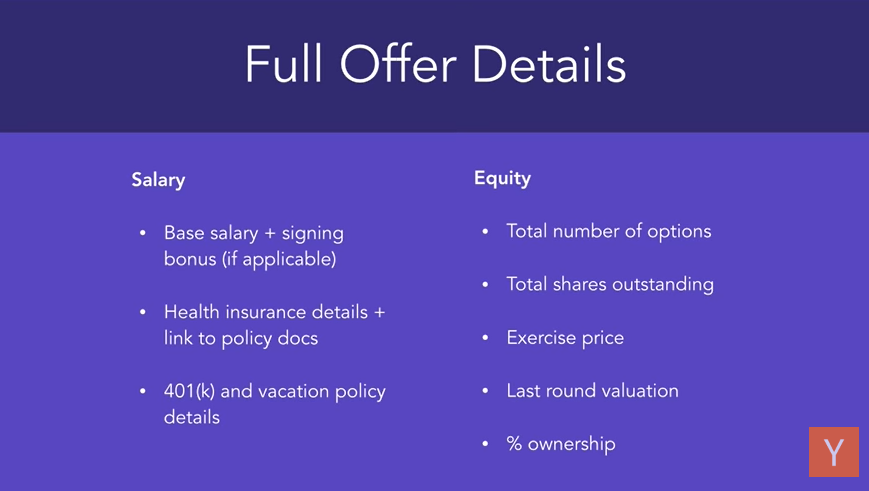
When extending offers, provide full details. For equity offers, include specifics like number of stock options, exercise price, etc.
When gauging candidate satisfaction, understand their background:
-
If a candidate has worked at multiple startups, they likely understand stock options—no need for excessive explanation.
-
But if they’ve spent most of their career at one company, ask if they understand how startup equity works. Provide details without overwhelming—offer follow-up resources for self-study.
Additionally, as a founder, understand how stock options work and the tax implications of different types—people will ask. While you won’t spend much time on equity, ensure you understand key concepts including stock types, fundraising constraints, and tax consequences of different option structures.
How Can Startups Compete with Tech Giants Like Google and Facebook for Engineers?
A common startup challenge: competing with tech giants like Google and Facebook for engineers. These companies offer higher cash compensation, and public tech stocks have performed exceptionally well in recent years—making competition increasingly tough. Yet we frequently see startups succeed, beating well-funded giants.
-
First, emphasize learning. You learn the most—and fastest—when given real decision-making responsibility. At big companies, opportunities are limited due to checks and balances designed to prevent damage, especially from new hires. So tell candidates: “We don’t have that luxury. We move fast—yesterday we had to ship everything. You’ll dive straight into decision-making. If you mess up, it hurts the company—but that’s how you learn and gain real experience.” Emphasize this.
-
Second, highlight career growth. In tech, you can rise rapidly. It’s more meritocratic—you don’t need 20 years of tenure before being considered for senior roles. You can grow quickly as the startup scales. Stress this.
-
Third, discuss opportunity cost. Experience at public tech firms is largely interchangeable. But startup experience varies widely. Your current startup—with your team and opportunity—is a unique, once-in-a-lifetime chance for candidates. If it fails, they can return to a big company. Highlight this perspective.
-
Finally, for hiring junior candidates, emphasize mentorship. Recent grads worry about lacking guidance—joining a startup, they fear missing best practices. But if your team includes experienced engineers, highlight this: they’ll learn from seasoned professionals who’ve mastered best practices locally.
Q&A
Background Checks
While discussion has focused on engineering and technical domains, we should also address background checks and disqualifying candidates. Frankly, most startups don’t conduct formal background checks. Though integration with payroll services now makes it easy, that’s not my focus. More important is understanding whether someone fits a role.
How to Assess the Work Capability of a Junior Computer Science Intern?
If a junior CS student wants to intern with you but your team lacks engineers, you may need to assess their past work to judge suitability. Since they may lack experience for your needs, request a portfolio or samples of completed work. If these align with required skills and task types, hiring them could work.
How to Effectively Evaluate Cultural Fit and Soft Skills?
To avoid mis-hires due to blind spots, focus on skill assessment rather than predictive but less relevant factors like personality type. Everyone has unique traits—job performance matters most in hiring.
I don’t oppose studying frameworks like Big Five or Myers-Briggs, but in hiring, I separate them from technical evaluation. First assess technical abilities, then separately evaluate cultural fit, teamwork, and soft skills.
Finally, synthesize all dimensions to make comprehensive, accurate hiring decisions.
Talent Development
Regarding talent development—such as pre-hire pipelines—are there university partnership models to build a talent pipeline? This may be challenging. Could outsourcing mechanisms serve as effective talent development, rather than pure outsourcing? Partnerships with universities and colleges exist—career fairs, sponsored events—to cultivate talent.
-
But I believe large companies benefit more—they can adapt to academic timelines and graduation cycles.
-
For startups, it’s harder—they typically want to hire immediately, not wait for graduation.
Thus, I wouldn’t recommend startups invest heavily here. Clarification: large companies often extend offers a full year ahead with large signing bonuses—startups struggle to compete in university recruiting.
How to Improve Performance Through Mock Interviews?
During mock interviews, you play the interviewee and intentionally make mistakes, allowing your colleague to critique freely.
Typically, after two colleagues conduct a mock interview, both try their best—but may not honestly critique each other due to social pressures affecting feedback.
By explicitly
Join TechFlow official community to stay tuned
Telegram:https://t.me/TechFlowDaily
X (Twitter):https://x.com/TechFlowPost
X (Twitter) EN:https://x.com/BlockFlow_News
 深潮TechFlow