The Extraordinary Life of Zhao Peng, the Pinnacle of Chinese in Wall Street and CEO of Citadel Securities
TechFlow Selected TechFlow Selected
The Extraordinary Life of Zhao Peng, the Pinnacle of Chinese in Wall Street and CEO of Citadel Securities
Some describe him as a "genius," others as a "natural-born entrepreneur." To simply regard him as an academic overachiever would be somewhat narrow-minded, for while top students emerge constantly, a legendary journey rising through the storms of Wall Street is exceedingly difficult to replicate.
 Navigating Web3 tides with focused insights
By Han Xuyang
Among Wall Street's many legends, Zhao Peng’s story may not be the most mythical, but it is undoubtedly a defining chapter.
As Ken Griffin’s Citadel continues to grow into the "new king of global hedge funds," its hedge fund arm, Citadel LLC, topped the 2022 list of most profitable hedge funds. Meanwhile, its market-making subsidiary, Citadel Securities, has emerged as the industry’s dominant “king.” Behind Citadel Securities stands Zhao Peng, its increasingly recognized leader.
By any measure, Zhao is a quintessential Chinese academic prodigy: admitted to a gifted program at age 10, enrolled in Peking University’s mathematics department at 14, earned a Ph.D. from UC Berkeley, and joined Citadel Securities—rising to CEO in less than a decade.

One of the few Chinese-Americans earning nine-figure annual incomes, Zhao Peng remains enigmatic and low-key, with very little publicly available information. Beyond his staggering earnings, his stature and reputation within financial circles are unmatched among other Chinese professionals.
Some call him a "genius"; others, a "natural-born entrepreneur." To label him merely an academic overachiever would be too narrow—a constant stream of top students emerge, but few replicate Zhao’s legendary ascent through Wall Street’s turbulent tides.
A Life of Advantages Started at Age 10
Zhao Peng was born ahead of the starting line.
Born in Beijing in 1983, Zhao displayed extraordinary intelligence early on: at age 10, he entered the elite "Young Scholars Program" at Beijing No. 8 High School, completing grades five through twelve in just four years. He then gained admission to Peking University’s mathematics department with outstanding results, winning numerous awards including Peking University’s Innovation Award and the Berkeley Fellow Erich Lehmann Citation.
After graduating from Peking University, Zhao pursued a Ph.D. in statistics at the University of California, Berkeley, focusing on online prediction, loss functions for forecasting, natural statistics, financial data analysis, and financial forecasting.
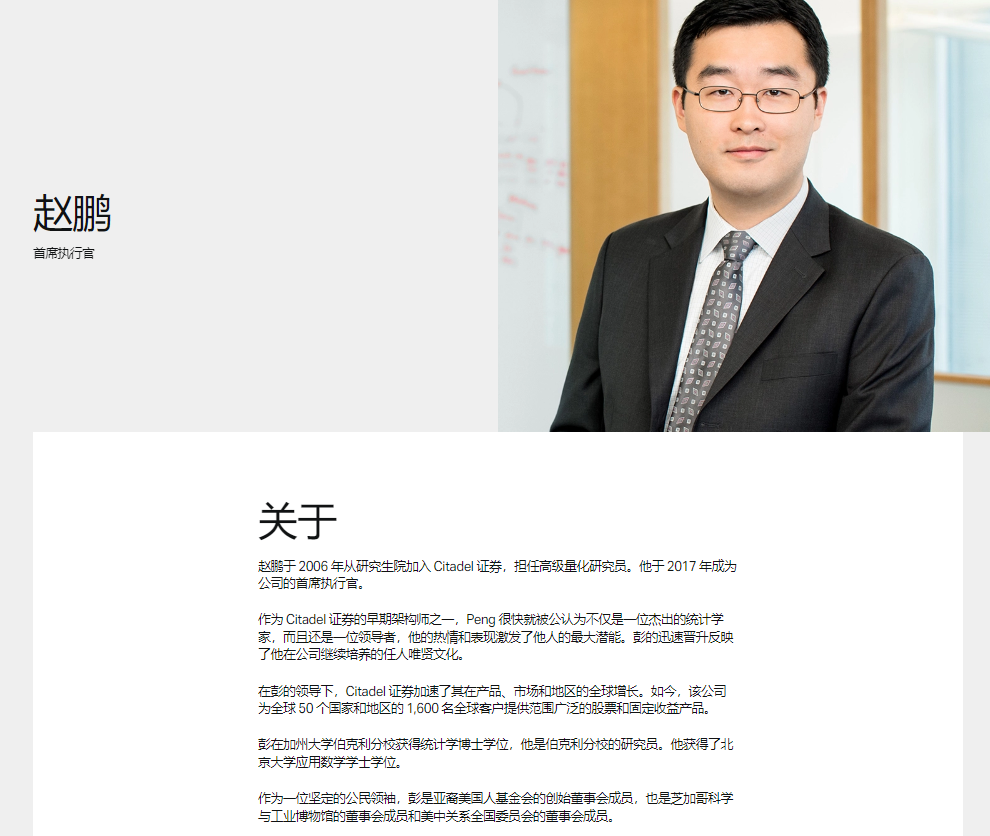
After completing his doctorate in 2006, Zhao joined Citadel Securities as a senior quantitative researcher. With exceptional expertise, he rapidly advanced—from analyst to partner, general manager, and ultimately CEO by 2017, achieving this in under ten years.
Yet the original motivation behind this long journey remains largely unknown.
Zhao had already set his sights early. At age 12, while riding the subway, he read an article describing how physicists, mathematicians, and computer scientists developed systems capable of outperforming Wall Street professionals in predicting market movements. Captivated by the high stakes and potential for massive returns, he thought to himself: since he excelled in these fields, perhaps one day he could become an investment manager or trader.
Zhao later reflected that this newspaper article planted the seed of interest in finance. From that moment onward, every step he took was part of exploring whether he truly belonged in finance—an exploration that forged today’s "No. 1 Chinese figure on Wall Street."
Leading Citadel Securities to Prominence
After earning his Ph.D., Zhao faced a career crossroads—continue down the academic path or leap into the professional world? Uncertain, he opted for a summer internship at Lehman Brothers, working in quantitative research. At the time, he was only 23.
This experience revealed his true talents and showed him where his skills could make a real impact in finance. After careful consideration, Zhao chose Citadel Securities, a firm he had previously encountered.
Although investment banking was the coveted career path back then and hedge funds were far less popular, and although Citadel was only a fraction of its current size, Zhao valued the caliber and professionalism of his future colleagues. He noted that everyone he met at Citadel Securities left a deep impression—each possessed exceptional ability and remarkable work ethic.
In hindsight, this was one of the most astute decisions of Zhao’s life. From this point forward, he led Citadel into a period of rapid business growth and global expansion.
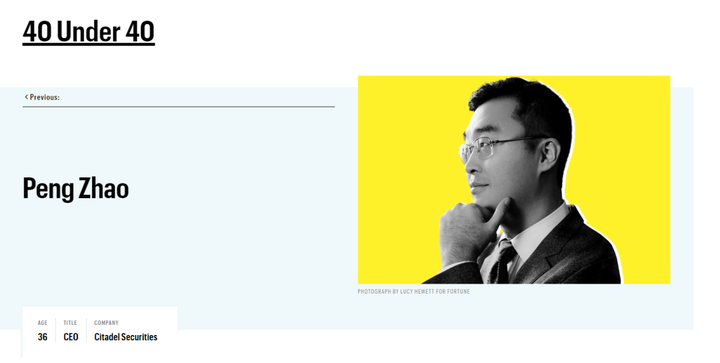
By 2021, during his four years as CEO, Zhao had led the company to multiply its net trading revenue more than fivefold—from $1.2 billion in 2016 to $6.7 billion in 2020. This achievement earned him industry-wide recognition; in 2019, he was named to Fortune magazine’s "40 Under 40" list of the most influential young business leaders.
Citadel operates two main divisions: the hedge fund Citadel LLC offering asset management services, and Citadel Securities providing market-making services. When Citadel suffered heavy losses during the 2008 financial crisis, founder Griffin held firm, pulling the company back from the brink and growing it larger than ever.
Since 1990, Citadel has grown into one of the world’s largest hedge funds—nicknamed the "Amazon of trading"—second only to Bridgewater. Former Federal Reserve Chair Ben Bernanke even joined the firm. Citadel’s prominence gave its founder great confidence; Griffin once boldly declared: "We don’t make cars, but we do print money."
Citadel Securities has evolved into one of the largest options trading firms and broker-dealers in the U.S. In January last year, it secured its first external funding round in 20 years: Sequoia Capital and Paradigm invested $1.15 billion for a minority stake, valuing the company at $22 billion (approximately RMB 140 billion). Alfred Lin, partner at Sequoia, joined the board.
Thus, Citadel Securities became the first super-unicorn of 2022. As the firm’s first acceptance of outside capital, this move brings it closer to a future public listing.
And Zhao Peng—the sole Chinese face among the leadership of this super-unicorn—has gradually come into the spotlight. On the partnership, Zhao said: "We see enormous opportunities to serve more markets and meet broader customer needs. Our collaboration with Sequoia and Paradigm puts us in a stronger position."
As of last year, Citadel Securities provided market-making services for over 4,000 U.S.-listed option issuers, accounting for 99% of total U.S. options trading volume—undisputedly the industry’s 'king'; currently, 36% of U.S. retail stock trades are executed via Citadel Securities’ platform.
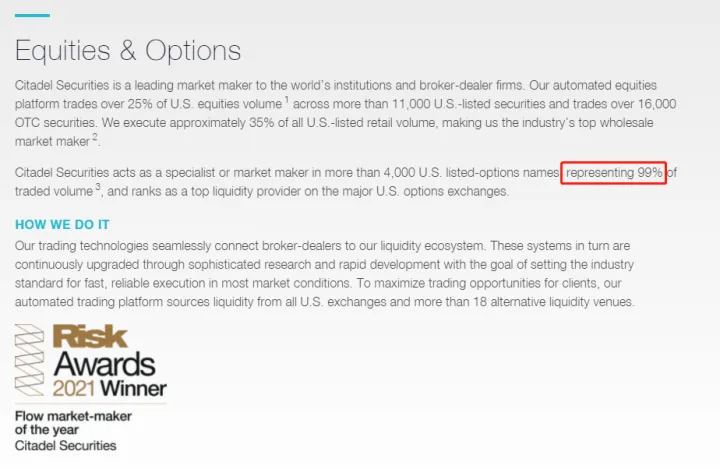
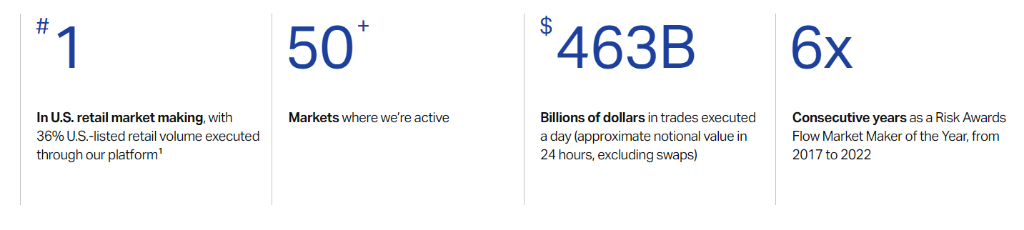
In 2022, Citadel Securities generated $7.5 billion in revenue, surpassing its previous record of $7 billion in 2021; net revenue reached $6.7 billion in 2020, double that of 2018.
Leadership Talent Emerges
The success of Citadel Securities owes much to this so-called "genius CEO." Zhao Peng has fully demonstrated his leadership prowess. Just one year after joining, he began working side-by-side with Griffin.
At the time, signs of a looming crisis in the U.S. mortgage market were emerging, and Griffin was seeking capable allies. A colleague recommended Zhao. After hours of tireless discussion, Griffin promptly set up a temporary desk in Zhao’s office. As the company weathered the 2008 financial crisis and expanded, Zhao’s career trajectory soared.
Insiders revealed that after the 2009 financial crisis, Zhao inherited a struggling high-frequency trading (HFT) team from its previous head and revitalized it within just two years.
The first step in Citadel’s business expansion was in options market-making. The initial approach was straightforward: as more quantitative investors flooded the market using algorithmic trading, the firm stepped in as the counterparty, providing liquidity.
While highly successful, Zhao believed there was still untapped potential. After Citadel co-leaders David Smith and Jim Knight departed in 2014, Zhao was entrusted with redesigning the department’s order-handling system, modeling it after the evolution of stock trading—relying more on predictive analytics and less on manual intervention—fueling another surge in business volume.
Matt Culek, COO who joined Citadel in 2012, commented:
You need the trust of top leadership and Griffin to grow the business. Zhao made it happen.
Zhao prioritized recruitment when building the team. Believing top talent drives profitability, he started with his former classmate Fang Wu. Initially, Wu politely declined, saying he knew little about finance and only understood physics.
But Zhao persisted, calling Wu repeatedly and sending brain teasers that piqued Wu’s curiosity. Eventually, Wu agreed to visit Citadel’s then-headquarters in Chicago, though still hesitant.
He was quickly proven wrong—Wu became a full-time employee at Citadel. Laughing about it later, Wu joked: “(Zhao) isn’t a bad guy. His intentions are good. He just does whatever he wants.”
Becoming CEO Was Never the Goal
During the 2008 financial crisis, Citadel survived and revived thanks to its strategy funds—one of its core strengths—which focused on fundamental value investing while analyzing markets using vast data and mathematical models to identify opportunities. This was precisely where Zhao’s expertise shone.
While pursuing his Ph.D. at Berkeley, Zhao developed a knack for problem-solving: breaking down seemingly subjective or chaotic phenomena into mapped, understandable components. He applied this same mindset to financial markets.
He explained that launching new business lines at Citadel Securities always begins with leveraging mathematics, modeling, and machine learning to determine the correct price of an asset. Once that is solved, the firm designs scalable methods to buy and sell near that price.
Colleagues say that from such detailed problem-solving to gradually managing entire operations, Zhao’s innate leadership abilities were evident—even if he recognized them late.
In mid-2016, Griffin brought in Kevin Turner, former COO of Microsoft, to lead Citadel Securities in a high-profile move. Zhao, demoted to Chief Scientist, said he wasn’t troubled by being sidelined:
Becoming CEO was never part of my original plan. If I’d wanted to be CEO of a financial firm, I wouldn’t have majored in mathematics as an undergrad.
But Turner didn’t mesh well with Griffin, and struggled to adapt to the company culture. He left after only a few months, and Zhao resumed his role as CEO.
Roy Kaiser, head of derivatives at Citadel Securities, praised Zhao: "He is the driving force behind innovation, responsible for research agendas and revenue. In him, you see everything you want in a CEO."
Persistent, Brilliant, Low-Key, Pragmatic
Reflecting on Zhao Peng’s journey reveals several standout traits of this "genius CEO."
First is persistence. Consider how Zhao gained admission to Peking University. In second grade of the gifted program, as the top student, he qualified for the National Olympiad in Mathematics. Unfortunately, he lost his entry ticket.
Later, Zhao and his father spent nearly a full day and night searching through nearby landfills before finally recovering the ticket. He competed successfully, launching the first chapter of his legendary journey.
That math competition served as Zhao’s “fast track” to entering Peking University at age 14—a program allowing 10-year-olds to complete high school in four years. As part of the selection process, Zhao attended a two-week training camp.
During a critical test, organizers brought the children to a running track and gave them a simple task—to keep moving forward. They had to guess how best to impress the observers. Zhao walked for two hours straight, passing the evaluation due to his exceptional perseverance.
To rise so quickly to become a Wall Street CEO, his brilliance might be his least remarkable advantage. Fang Wu, Zhao’s Peking University classmate who is four years older, said: "He was famous on campus—not just because of his age, but also his intellect."
Wu recalled: "Our study group would spend weeks solving problems, but Zhao finished in just a few days—and spent the rest of the time playing video games."
Among Wall Street CEOs, Zhao maintains an unusual level of humility. Unlike the ever-visible Griffin, Zhao rarely draws attention. Jamil Nazarali, former executive at Citadel Securities and current CEO of EDX Markets, said:
The only thing he hasn't done well enough is raising his public profile.
While Griffin frequently speaks publicly, Bloomberg cited insiders saying Griffin rarely visits Citadel Securities, instead monitoring remotely. In all efforts to expand the business, it is Zhao who is constantly on the ground, leading operations. In interviews promoting his firm, Zhao said: "If you want to trade, we should be your first call."
His attitude toward the CEO title—as something almost dismissible—shows Zhao is deeply pragmatic and technically focused. He emphasized that learning matters greatly, noting his academic and professional background is fundamentally technical. Despite lacking an MBA, Zhao continuously reads articles on corporate and talent management to absorb wisdom from predecessors.
Rethinking the Structure of Trading Markets
Currently, Citadel Securities is preparing to join the Federal Reserve’s select list of primary dealers—firms that trade directly with the New York Fed when implementing monetary policy and commit to participating in every U.S. Treasury auction. Its growing influence is attracting notice.
Fadi Abdel Massih, analyst at Moody’s Investors Service, noted a common misconception outside finance: that market makers are relatively safe or even dull, like utility companies keeping the lights on. But in reality, market making is a "highly complex process with potential for massive losses."
Massih added: "When the founders’ own capital is at risk, interests are closely aligned. As business lines diversify, revenues become more resilient, enabling the firm to better withstand occasional losses in any segment."
As CEO, Zhao is known for his obsession with metrics. He helped build an internal management portal at Citadel Securities that tracks employee and departmental performance in real time, measures revenue, and benchmarks the firm against peers. Managers review performance monthly to decide which businesses to expand or scale back.
Regarding Citadel Securities’ future, Zhao stated the firm is bringing cutting-edge technologies—including analytics, engineering, software, and hardware—into finance: "We are fundamentally transforming and shaping how financial markets operate in the future."
A user on social media revealed that in a conversation, Zhao mentioned: his goal is no longer about making money, but about reshaping the traditional structure of bond market trading.
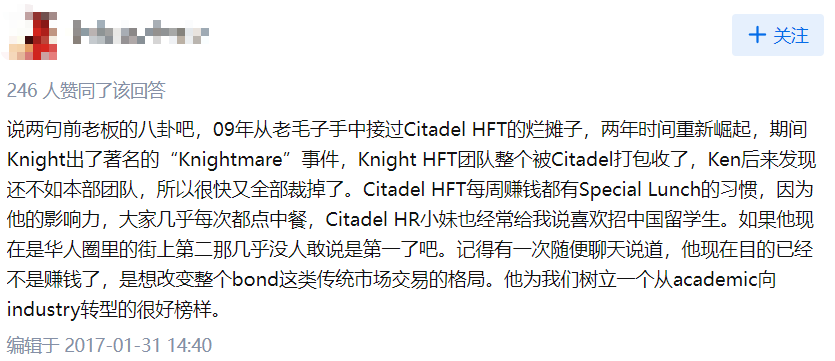
He believes that as a member of the post-80s generation, he bears responsibility for advancing societal progress. In this sense, Zhao sets a strong example of transitioning from academia to commercial application.
Moreover, Citadel was the first foreign hedge fund to raise RMB-denominated funds and remains highly welcoming to Chinese international students. Users report this stems from widespread admiration for Zhao Peng within the team. Thanks to his influence, Citadel’s HR actively recruits Chinese graduates.
[Risk Warning and Disclaimer]
Investing involves risk. This article does not constitute personal investment advice, nor does it take into account individual users' specific investment objectives, financial situations, or particular needs. Users should consider whether any opinions, viewpoints, or conclusions expressed herein are suitable for their circumstances. Investment decisions based on this content are made at the user’s own risk.
Join TechFlow official community to stay tuned
Telegram:https://t.me/TechFlowDaily
X (Twitter):https://x.com/TechFlowPost
X (Twitter) EN:https://x.com/BlockFlow_News