








Exploring Japan's Real Crypto Market: A Mix of Isolation and Contradictions — Where Lie the Opportunities?
TechFlow Selected TechFlow Selected
Exploring Japan's Real Crypto Market: A Mix of Isolation and Contradictions — Where Lie the Opportunities?
What is the real current state of Japan's cryptocurrency market?
 Navigating Web3 tides with focused insights
Produced by: TechFlow
Written by: 0xmin & James
When you think of Japan, what comes to mind?
Cherry blossoms, anime, Mount Fuji, Nintendo…?
Yet when it comes to crypto, most industry practitioners know little about Japan. Despite the fact that cryptocurrency trading and exchanges have been legal in Japan since 2017, the Japanese market has remained relatively invisible. Closed and isolated—that’s the common perception.
What is the real state of Japan’s crypto market? Who are the key players today? And how can one participate in this market?
Out of curiosity, a TechFlow reporter visited Tokyo in April to engage with local crypto professionals and gather firsthand insights. What follows is a concise, no-nonsense summary—pure干货 (ganhuo, "dry goods"—slang for practical, valuable information). Special thanks to Emoote Venture Partner James, co-author of this article.
*This article is an excerpt from the Japan section of TechFlow's report “Web3 Truths in Asia-Pacific Markets.”
Overview of Japan’s Crypto Market
Based on discussions with local experts and third-party data, Japanese participants in virtual currency investments fall into three overlapping circles—the lower layers fully contained within the upper ones. In total, Japan has over 5 million local crypto users.
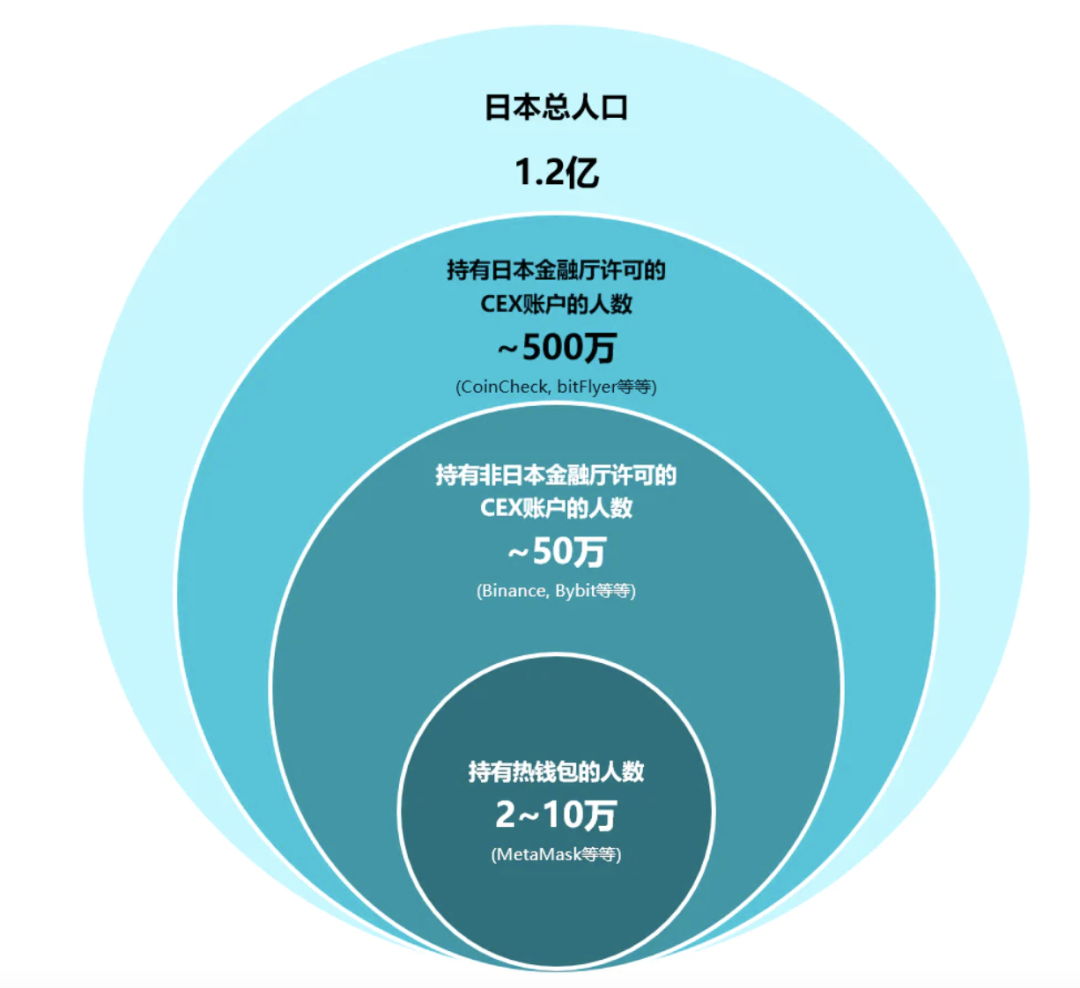
Japan’s crypto market is full of peculiarities and contradictions, mainly reflected in three aspects:
(1) Compliant but Lacking Vitality
In Japan, both crypto trading and exchange operations can be conducted legally under a regulatory framework overseen primarily by the Financial Services Agency (FSA) and the self-regulatory Japan Virtual Currency Exchange Association (JVCEA). The guiding principle is clear: Prioritize anti-money laundering (AML) and counter-terrorism financing regulations, then regulate exchanges to protect user interests. For example, exchanges must separate customer assets from operational funds, and at least 95% of their holdings must be stored in cold wallets—effectively safeguarding retail investors.
However, heavy regulation also brings significant constraints, making the market less dynamic. All tokens listed on compliant Japanese exchanges must first receive approval from JVCEA—a process that takes anywhere from six months to a year.
Additionally, Japan imposes high tax rates. Under current rules, crypto-related income taxes depend on overall personal income. For high earners, the effective tax rate can reach up to around 50%. This creates a paradox: although converting crypto to JPY is legal, there remains strong demand for OTC services, giving rise to numerous OTC operators.
(2) Mismatched Trends, Strong Purchasing Power
Japan’s market is relatively independent and closed, leading to misaligned or delayed responses compared to global trends. For instance, while NFT hype had cooled in China and the U.S., Japan saw a surge in domestic NFT activity.
Moreover, Japanese retail investors still possess strong purchasing power. Two direct examples illustrate this:
1. Cardano conducted its initial coin offering (ICO) between 2015 and 2017, focusing on Asian markets. Over 90% of early funding came from Japan, earning it the nickname “Ethereum of Japan”—though fundamentally, it remains a Western project.
2. The well-known exchange Bybit relied heavily on the Japanese market for growth. A key factor was promotion by a super-KOL: Daichin Ocha (Green Juice Prince), Tsubasa Yozawa, and Hikaru.
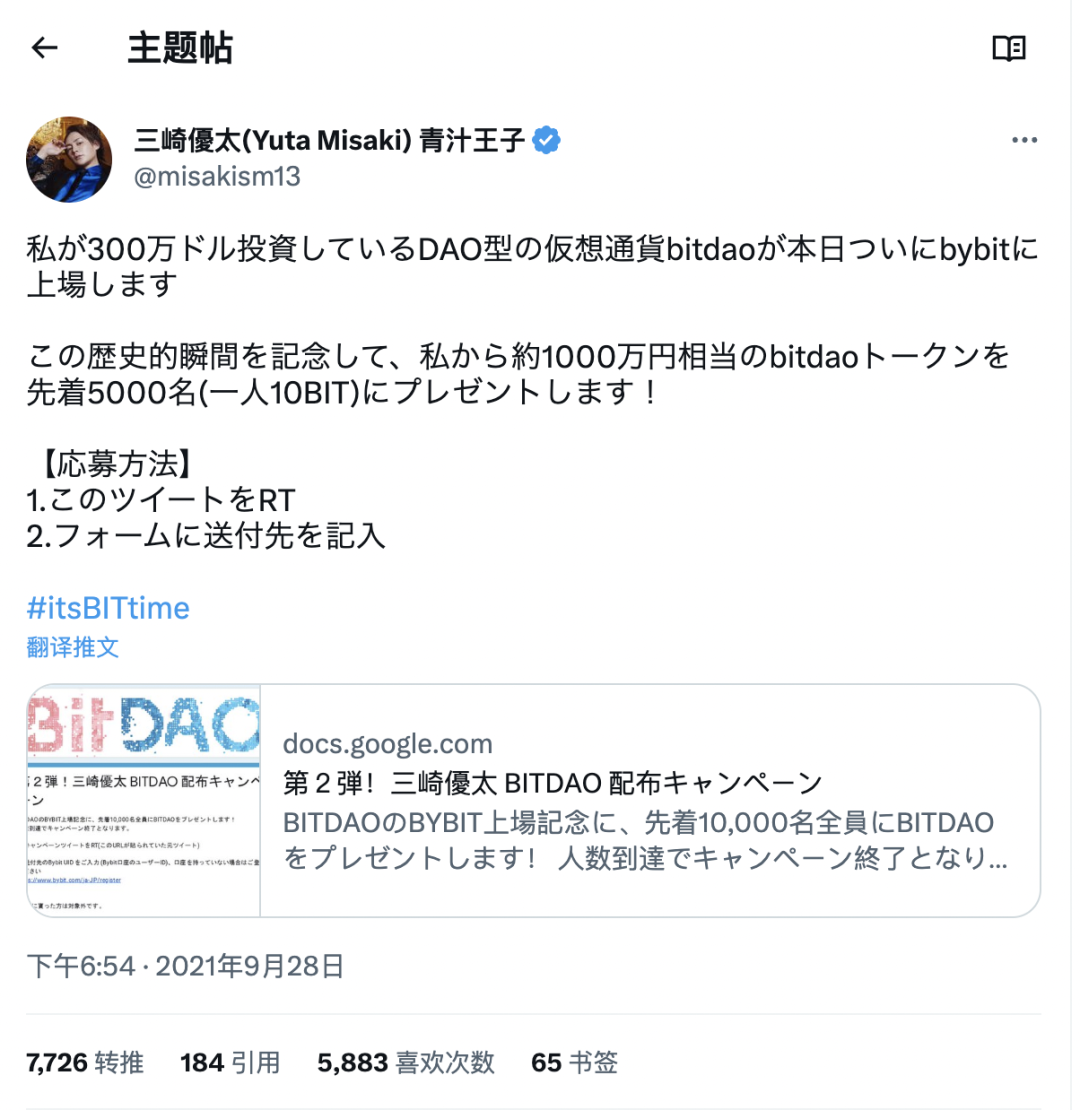
Later, another futures platform, Bitget, entered Japan with even more attractive rebate terms.
Compared to domestic regulated exchanges—limited selection, high taxes, no leverage—offshore platforms offer more coins, zero taxation, and 100x contracts, which are highly attractive to retail traders. Although the FSA has repeatedly issued warnings to Bybit, MEXC, Bitget, and Bitforex, these efforts have had little effect. Complete withdrawal from Japan or strict compliance aren’t viable options. For example, compliant platforms like Coinbase and Kraken exited the Japanese market in early 2023, serving as cautionary tales.
As a result, many industry insiders privately agree on a politically incorrect truth: To make money, you can’t be too compliant.
(3) Turning Point: Japan May Loosen Regulations
Conversations with officials from Japan’s Financial Services Agency reveal mixed feelings.
On one hand, they take pride in how Japan’s strict crypto regulations protected individual investors during the FTX collapse. While billions vanished elsewhere due to SBF’s misuse of funds, Japanese retail holders were largely shielded.
Thus, Mamoru Yanase, Deputy Director of the Strategic Development and Management Bureau (SDMB) under the FSA, stated that Japanese regulators are urging counterparts in the U.S., Europe, and beyond to apply bank- and brokerage-level oversight to crypto exchanges.
On the other hand, they worry about the lack of vitality in Japan’s crypto ecosystem. The exits of Coinbase and Kraken contrast sharply with the thriving presence of offshore exchanges. As such, adjustments may be coming.
In April 2023, Japan’s ruling Liberal Democratic Party released the “Japan Web3 White Paper 2023” under the slogan “JAPAN IS BACK, AGAIN,” proposing several regulatory relaxations:
-
Tax Reform: Previously, investors faced up to 55% income tax on token gains. Under reform, holding tokens issued by one’s own company will be tax-exempt, and holding others’ tokens without “short-term trading intent” will also avoid taxation;
-
Token Review/Issuance/Circulation: The FSA will assist in reviewing overseas tokens for listing to improve efficiency, and establish rules for stablecoin issuance and circulation;
-
NFTs: Prohibit use of NFTs for gambling or money laundering, and clarify rights, benefits, and reward mechanisms associated with NFTs.
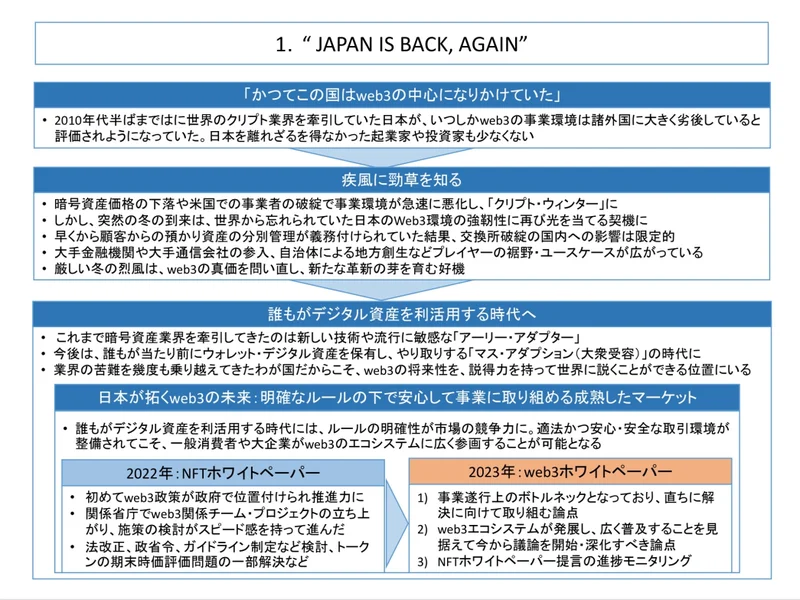
Japan Web3 White Paper 2023
Local Trading Habits
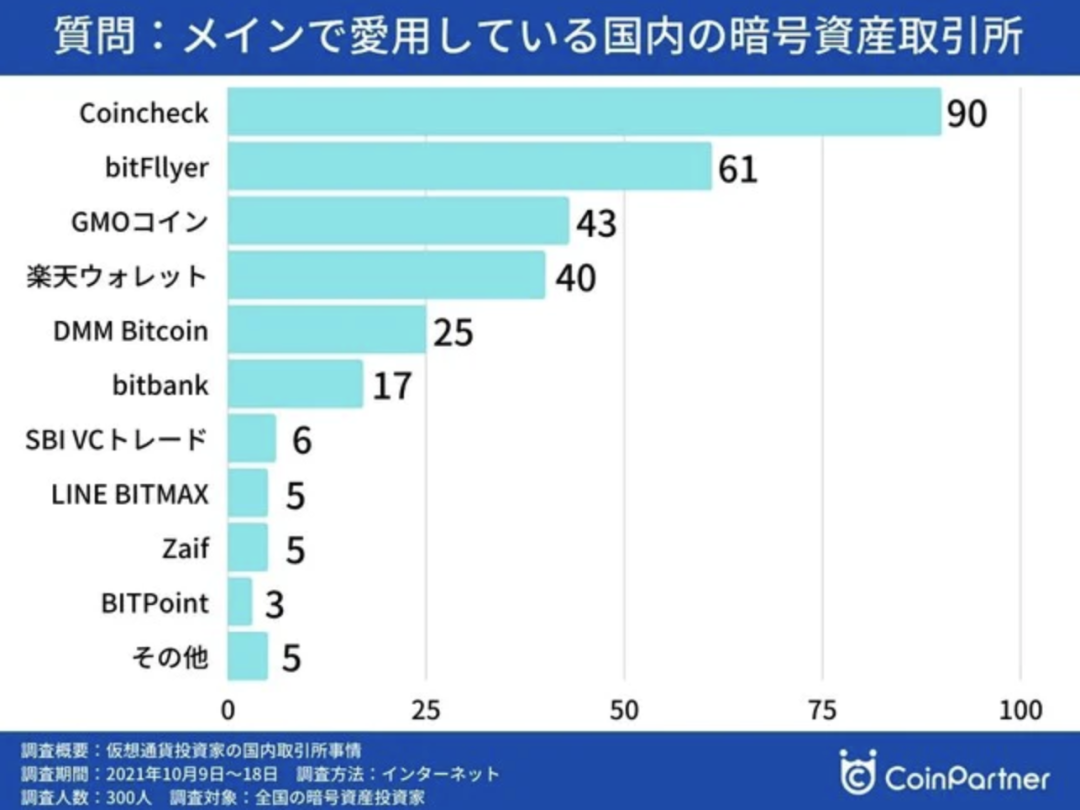
According to a survey of 300 Japanese exchange users, the most popular domestic exchanges include Coincheck, bitFlyer, GMO Coin, Rakuten Wallet, DMM Bitcoin, and bitbank.
Among unlicensed exchanges, Binance and Bybit are the most commonly used by Japanese users—both have received warnings from the FSA.
Japan lacks prominent native crypto projects, especially grassroots success stories. Most notable projects have deep ties to traditional industries. Key projects currently include Astar Network, Oasys, HashPort, and Jasmy.
In terms of social media, Twitter remains the primary channel for information and discussion in Japan, followed by Instagram and Facebook. Some users rely on LINE Open Chat (similar to QQ chat rooms, open to all) for crypto-related discussions, though this isn’t mainstream—largest groups only reach around 5,000 members.
Major vertical media targeting the general public include CoinPost, CoinTelegraph JP, CoinDesk JP, Kaku Tsuka Watch, Atarashii Keizai, and bitpress.
From influence and traffic perspectives, CoinPost is currently Japan’s largest crypto media outlet.
While many outlets provide news alerts, PRTimes stands out as the dominant press release service—not just in blockchain, but across all Japanese companies. It’s widely recognized among office workers.
Some independent creators curate and translate global blockchain content into Japanese. Notable names include dAppsMarket, CRYPTO TIMES, BlockchainGame Info, and NFT JPN. CoinGecko Japan also holds significant influence.
For in-depth research (akin to Messari), HashHub Research leads the pack, with an interface and layout strikingly similar to Messari.
Beyond these, numerous SEO-driven affiliate media (e.g., Kasobu), newsletters, and personal blogs exist. Top newsletters include CoffeeTimes, Nobumei, Manabu, and Ikehaya.
Regarding KOLs, we’ve categorized representative accounts (not exhaustive), primarily focused on Twitter, noting that some individuals span multiple categories.
Researcher/Academic Type KOLs
Mainstream Japanese KOLs, concerned about reputation, conduct thorough due diligence before endorsing any project. They maintain objectivity and rarely publish promotional content.
shingen: Focuses on ETH-related tech and projects.
arata: Founder of Japanese crypto media CryptoTimes.
Yasu@Cryptocurrency: Generalist covering all aspects of crypto.
GameFi-Related KOLs
Note: “GameFi” isn’t widely used in Japan. Locals prefer “BCG” (Blockchain Games). Use this term when searching.
Magic LUCIAN: Undisputed top GameFi influencer in Japan. His influence extends globally. He serves as the Japan ambassador for star GameFi project Defi Kingdoms. His calls carry substantial market impact. Recently launched his community LFG (Lucian Finders Guild).
Makai Witch: Rising star who frequently translates and shares major chain game updates (XANA, Sand, Star Atlas, etc.).
onchan: Smaller following, but serves as Japanese community manager for multiple major projects (LOA, Defina, GameStarter, H&E, Monsta Infinite, Guildfi, RIFI, Demole).
DeFi-Related KOLs
shingen: See above.
lagoon: Analyzes upcoming IDO tokens and potential airdrop candidates.
Kasou Senshi ROI: Emerging figure often collaborating with LUCIAN on Twitter Spaces. Deep focus on AVAX chain, analyzing DeFi and gamified DeFi projects.
Makai (Dark Realm)-Related KOLs
High-risk, high-return tokens (similar to Chinese slang “100x coins”) are jokingly called “Makai” (“Dark Realm”) in Japan due to their addictive nature. Makai tokens generally fall into DeFi, GameFi, and CX categories.
KOLs identifying as Makai specialists include Magic LUCIAN, Makai Witch, MotoGA, Raguragu Purin, and others.
NFT-Related KOLs
miin: Dedicated to discovering quality Japanese NFT projects. Publishes weekly rankings of domestic NFTs.
ikehaya: Early NFT investor holding CryptoPunks and BAYC, with over 340,000 followers.
Ameyu: Head of NFT division at major internet firm SBI, frequently shares insights on corporate NFT initiatives in Japan.
KOL Groups
Kudasai: Japan’s largest and oldest KOL collective. Its Telegram group has over 18,000 members—the biggest crypto community in Japan. Core team of over 20 KOLs with defined roles: project outreach, research, promotion, translation/AMAs, etc. Led by Watacchi.
Sofikura (Sophie Kura): Second-largest group after Kudasai, with over 12,000 Discord members. Led by Sophie Cherie.
Scam Dunk: Shares Makai project info and hosts AMAs (focused on high-risk, high-reward tokens). Led by Sendou.
Otaku Guild: Focuses on blockchain games and metaverse projects.
Giveaway / Airdrop-Focused KOLs
These KOLs are unique—some promote any type of giveaway (crypto, cash, vouchers), so caution is advised. The following are deeply embedded in the crypto space.
Fig: Rose to fame through STEPN airdrops, gaining thousands of retweets.
ADMEN: Regularly promotes major project airdrops. Due to rising popularity, recently launched his own benefit group, ADMEN DAO.
Business Pillars
Yusaku Maezawa: Japanese billionaire, first private passenger on SpaceX’s lunar mission, close friend of Elon Musk, dubbed “Japan’s Musk.” Runs a $70M crypto fund, MZ Web3 Fund, and leads MZ DAO.
Hironao Kumagai: Founder and former chairman of Gumi. After stepping down, founded Third Verse and Financie. Still exerts strong influence—evident in his co-founding role on Harmony, a gaming chain backed by Gumi.
Hirotoshi Kanazawa: Co-founder of one of Japan’s largest exchanges, bitFlyer, and representative director of the Japan Blockchain Association.
Sota Watanabe: Founder of Polkadot parachain Astar Network, carrying hopes of Japanese VCs for Japan to gain prominence in Web3.
Seiichi Yoshida: CEO of HashPort, operator of Japan’s first IEO token $PLT and largest NFT marketplace PLTPlace. Fluent in Chinese.
Noriaki Okabe: CEO of JPYC, Japan’s largest yen-pegged stablecoin. Enjoys inviting people to saunas for deep conversations.
Yosui: Founder of Hokusai, offering turnkey NFT issuance solutions for Japanese enterprises.
Many influencers run their own communities. Choosing the right niche-specific influencer—whether GameFi, DeFi, research, or airdrop-focused—can significantly boost outreach effectiveness.
Japan’s Local Crypto VCs
From our understanding, traditional venture capital in Japan isn’t particularly active, and those dedicated to crypto and Web3 are even scarcer—most limited to equity investments only.
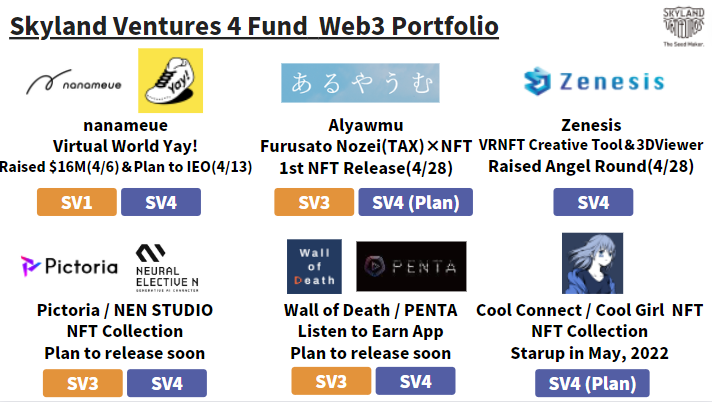
Skyland Ventures is one of the more active Japanese crypto funds, having established a dedicated Web3 seed fund within its fourth fund cycle.
On April 13, Skyland Ventures announced the closing of its Web3 fund “Skyland Ventures No.4 Fund” with ¥5 billion (~$38 million), and revealed investment in Takio, an Ethereum ZK-EVM solution.
Emoote is a Web3 fund launched by Japanese gaming company Akatsuki, with an initial fund size of $20 million. Formerly known as Akatsuki Crypto, it has invested in 24 projects including STEPN, BreederDAO, ETHSign, and Akinetwork. Miss Bitcoin, a famous Japanese KOL, serves as an advisor.
Z Ventures, a joint venture between SoftBank and Line, has made strategic moves into Web3, investing via equity in platforms like NFT marketplace X2Y2, game development platform double jump.tokyo, and crypto livestreaming platform Stacked.
SBI Group, a major financial conglomerate, is active in crypto—serving as Ripple’s core Asian investor and advocate—and has invested in several local exchanges.
Among Japanese-run incubators, Fracton Ventures is best known. Though not directly investing, its founding team recently raised funds from various Japanese VCs to form Next Web Capital, backing projects like EthSign.
Other notable Japan-based or Japan-focused VCs include Gumi Cryptos. Founded by Hironao Kumagai in 2007, Gumi went public in 2014. Interestingly, Kumagai studied at Fudan University in Shanghai from 1996–2000, though his Chinese skills have since declined. He retired from Gumi in 2021 to go all-in on blockchain and VR, yet still maintains strong influence over the company.
Currently, Gumi Cryptos has invested in dozens of crypto projects including Opensea and YGG, but Kumagai expresses concern that many overseas investments cannot launch effectively in Japan or contribute meaningfully to local market development.
Another pivotal figure in Japan’s scene is billionaire Yusaku Maezawa—“Japan’s Musk”—with millions of Twitter followers, arguably Japan’s top KOL. He founded the Web3 fund MZ Fund using his initials, investing $10M–$50M per deal. He also runs Web3 Club, Japan’s largest Web3 guild with 30,000 crypto-native members, and MZ DAO, Japan’s largest “crypto education platform,” claiming 300,000 non-crypto-native users.
To date, MZ Fund has backed numerous projects, including several with Chinese roots such as MetaOasis, Akiprotocol, and SINSO.
Other local VCs include Headline Asia (and its crypto fund Infinity Ventures Crypto), i-nest Capital, and THE SEED.
How to Approach the Japanese Market
STEPN’s success in Japan highlights the market’s potential. As of February 25 last year, 35% of its 21,000 active users were Japanese. Analysis shows that multiple top KOLs hosted giveaways—some even self-funded shoe distributions. This demonstrates that with participation from key KOLs and a sustainable token model, Japan remains a high-purchasing-power market.
However, given the user base size and KOLs’ cautious nature, we recommend not prioritizing Japan initially. But building solid traction there can help projects expand into neighboring markets, especially Southeast Asia.
Moreover, Japan is generally a “hard-to-crack but easy-to-hold” market. While language barriers (Japanese reluctance toward English is well-known) and KOL caution make entry difficult, once engaged, Japanese users tend to be more patient and understanding than those in other regions—if the team stays committed. This fosters healthier community dynamics.
Interestingly, we initially assumed Japanese users would favor domestic projects and distrust Chinese ones. However, interviews revealed a complex sentiment toward local projects, while some actually view a Chinese origin as a positive trait—given the number of successful projects led by Chinese founders (Western projects naturally enjoy similar advantages).
Given the abundance of success stories from China and the West, long-time, rational observers often see such origins as a plus. However, this audience segment remains limited.
Overall, we believe it’s essential to have a community manager fluent in Japanese and culturally literate—someone familiar with Japanese comedy, sports references, political memes, youth slang, and trending phrases (e.g., “All of Japan cried”). Such cultural fluency helps build genuine rapport.
If collaboration goes well, consider bringing the manager onto the core team. From a user psychology standpoint, having Japanese team members builds trust and closeness, while maintaining a global outlook signals long-term potential (“ashitate”) to Japanese audiences.
“Web3 Truths in Asia-Pacific Markets” is a special report series by TechFlow, delving into the realities of crypto markets across the region, profiling users and industry players. We will continue releasing in-depth studies on various markets, consulting experienced local practitioners to deliver comprehensive, genuinely valuable insights for the global Web3 community. If you have deep knowledge of your local crypto market and wish to collaborate with TechFlow on this series, please contact us via our official Twitter: https://twitter.com/TechFlowPost
Join TechFlow official community to stay tuned
Telegram:https://t.me/TechFlowDaily
X (Twitter):https://x.com/TechFlowPost
X (Twitter) EN:https://x.com/BlockFlow_News
 深潮TechFlow






