Bitcoin's ecosystem迎来DeFi wave: Exploring new projects and their performance
TechFlow Selected TechFlow Selected
Bitcoin's ecosystem迎来DeFi wave: Exploring new projects and their performance
The article compiles several Bitcoin DeFi concept projects, such as Stacks, Mintlayer, and Badger DAO.
 Navigating Web3 tides with focused insights
The Bitcoin ecosystem has recently delivered outstanding performance across various sectors. The Ordinals protocol has brought unprecedented exposure and liquidity to the Bitcoin ecosystem, making NFTs on the Bitcoin network possible through Inscriptions. The introduction of the BRC-20 token standard has driven the market into a new upswing, while network congestion and high transaction fees on Bitcoin have become hot topics.
Amid this momentum, some new projects are beginning to explore Bitcoin DeFi. Given Bitcoin's unique architecture, DeFi has rarely been involved—but if even images and tokens can be hyped, perhaps DeFi isn't out of reach after all. BlockBeats has compiled several Bitcoin DeFi concept projects:
DeFiChain
DeFiChain is an innovative DeFi platform dedicated to delivering fast, intelligent, and transparent DeFi services. It aims to fully integrate DeFi functionalities into the Bitcoin ecosystem. DeFiChain itself is a hard fork of Bitcoin, sharing much of its underlying codebase and using Bitcoin’s consensus mechanism to secure its network. The platform offers a range of DeFi services, including decentralized lending, decentralized exchanges, and decentralized asset management.
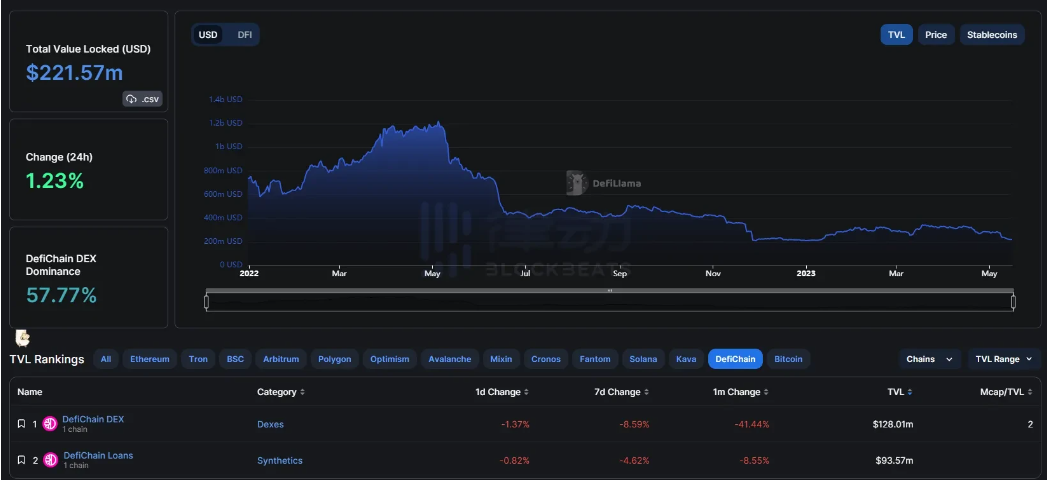
According to DefiLlama data, DeFiChain currently has a TVL of approximately $221 million. DFI is DeFiChain’s native token, used for paying network fees, earning interest on loans, and participating in governance. The platform is permissionless, allowing anyone to join its ecosystem.
Rootstock
Rootstock is a smart contract platform secured by Bitcoin miners and is currently the most secure proof-of-work-based smart contract network. As a Bitcoin sidechain, it enhances the value of the Bitcoin ecosystem by expanding Bitcoin’s monetary utility and maintains strong compatibility with Ethereum in areas such as EVM support. Decentralized applications can be developed using the Solidity compiler and Web3 libraries, achieving full Ethereum compatibility. Additionally, Rootstock enables scalable Bitcoin payments via off-chain transactions through the RIF Lumino payment channel network. The native token of the Rootstock sidechain is RBTC.
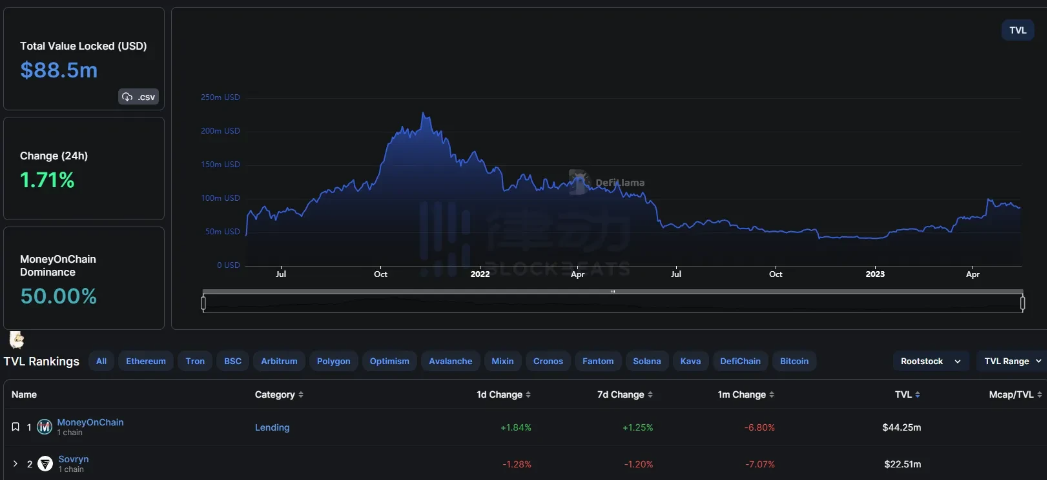
Rootstock’s current TVL stands at around $88.5 million, with the lending protocol MoneyOnChain accounting for approximately $44.25 million and Sovryn holding about $22.5 million.
MoneyOnChain is a Bitcoin-collateralized stablecoin protocol that allows users to mint DOC, a USD-pegged stablecoin, by locking up Bitcoin as collateral. DOC can be used for trading and borrowing within the MoneyOnChain platform.
Sovryn enables users to lend, borrow, trade Bitcoin, and earn interest without relying on centralized intermediaries. Sovryn is open-source and permissionless, welcoming participation from anyone in its ecosystem.
On March 17, 2023, Sovryn launched Sovryn Dollar (DLLR), a stablecoin backed 100% by Bitcoin. DLLR aggregates other Bitcoin-backed stablecoins and is pegged to the US dollar. It maintains a significantly over-collateralized BTC reserve to ensure holders can always redeem it for BTC.
BadgerDAO
BadgerDAO is a project focused on building a bridge between Bitcoin and DeFi within the Ethereum ecosystem. BadgerDAO aims to provide Bitcoin holders with more tools and services by enabling Bitcoin to serve as collateral in DeFi applications, allowing users to easily bring their assets into DeFi and generate yield.
As a community-driven project, BadgerDAO allows users who hold its governance token, Badger, to participate in governance and decision-making. Additionally, BadgerDAO offers incentive programs for developers to contribute code and innovation, aiming to drive continuous growth of Bitcoin in DeFi through novel products and services.
Its core product is Sett, an automated yield-optimization asset management tool. Sett supports multiple Bitcoin-based assets such as Wrapped Bitcoin (WBTC), RenBTC, and tBTC. Users deposit their assets into smart contracts, which then automatically earn yield across various DeFi protocols based on pre-defined strategies. BadgerDAO has also introduced DIGG, an elastic supply currency whose price tracks Bitcoin. DIGG’s supply adjusts according to market demand to maintain price stability relative to Bitcoin.
Stacks
Stacks is a Layer 2 solution for the Bitcoin network, bringing smart contract functionality to Bitcoin without altering the base protocol. Stacks employs a layered approach: Bitcoin serves as the foundational settlement layer at the bottom, Stacks adds smart contracts and programmability above it, and additional layers (such as Hiro’s subnets) are built on top to enhance scalability and speed.
This tiered architecture enables capabilities similar to those of Ethereum. As a Bitcoin Layer 2, Stacks possesses unique characteristics, such as having its own native token, which incentivizes participants to maintain the historical ledger of all transactions and operate with independent security funding.
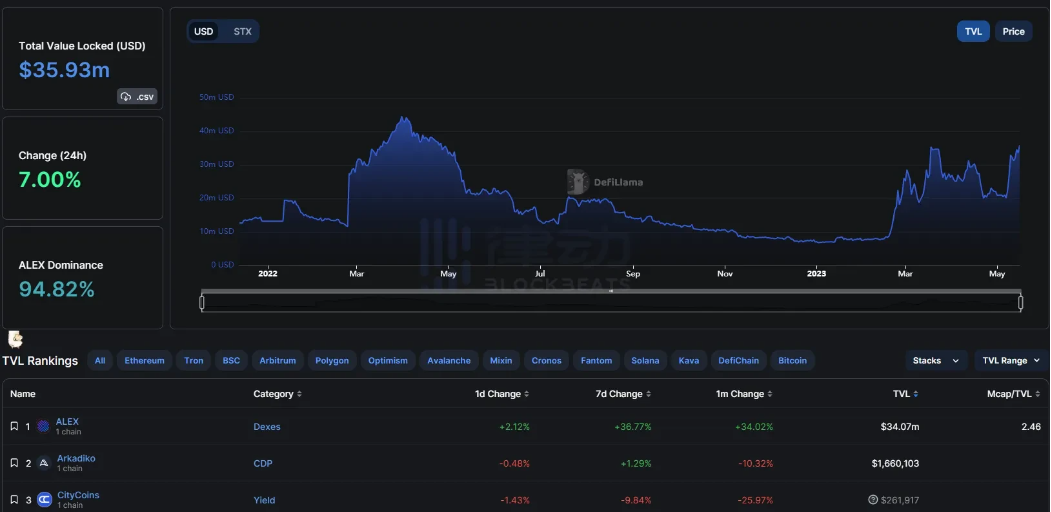
Currently, Stacks’ TVL is approximately $36 million, with the decentralized exchange ALEX (TVL ~$34 million) being the primary contributor. Stacks enables the development of decentralized and censorship-resistant software leveraging Bitcoin as the base settlement layer. Its ultimate goal is to build a network of financial systems and decentralized software products that all use Bitcoin as their native currency. The ecosystem’s top priority right now is tighter integration between Stacks and Bitcoin to streamline user experience with Stacks dApps.
Mintlayer
Mintlayer is a tokenization layer built on top of Bitcoin, supporting interactions with Bitcoin’s Layer 1 and Layer 2 Lightning Network. As a second-layer solution on Bitcoin, Mintlayer eliminates the need for wrapped tokens or token bridges—common attack vectors in DeFi hacks—by instead using atomic swaps to enable 1:1 trades between native BTC and tokens on the Mintlayer blockchain.
Mintlayer empowers Bitcoin holders to access a wide range of DeFi tools and a vast ecosystem of DApps using their native BTC. Through atomic swaps, users can exchange any token within the Mintlayer ecosystem directly for native Bitcoin without relying on trusted third parties. Mintlayer uses Bitcoin’s UTXO model rather than account-based models like Ethereum, Ripple, or Stellar. This design emphasizes privacy and allows payments to be batched (aggregated) within a single transaction, saving significant block space.
Inscribe Finance
Inscribe Finance is a recent DeFi platform built on BRC-20, aiming to consolidate all ecosystem protocols and technologies into one unified platform to democratize Bitcoin DeFi and deliver an optimal user experience. Currently in its earliest stages, INSF is the platform’s native token, designed for governance purposes and enabling interaction with future platform collaborators. According to official data, INSF went on public sale on May 13 and sold out within 15 minutes of launch.
Join TechFlow official community to stay tuned
Telegram:https://t.me/TechFlowDaily
X (Twitter):https://x.com/TechFlowPost
X (Twitter) EN:https://x.com/BlockFlow_News
 BlockBeats