









Huobi Web3 New Year Celebration: 26 Industry Leaders Discuss 2023 Trends and Directions
TechFlow Selected TechFlow Selected
Huobi Web3 New Year Celebration: 26 Industry Leaders Discuss 2023 Trends and Directions
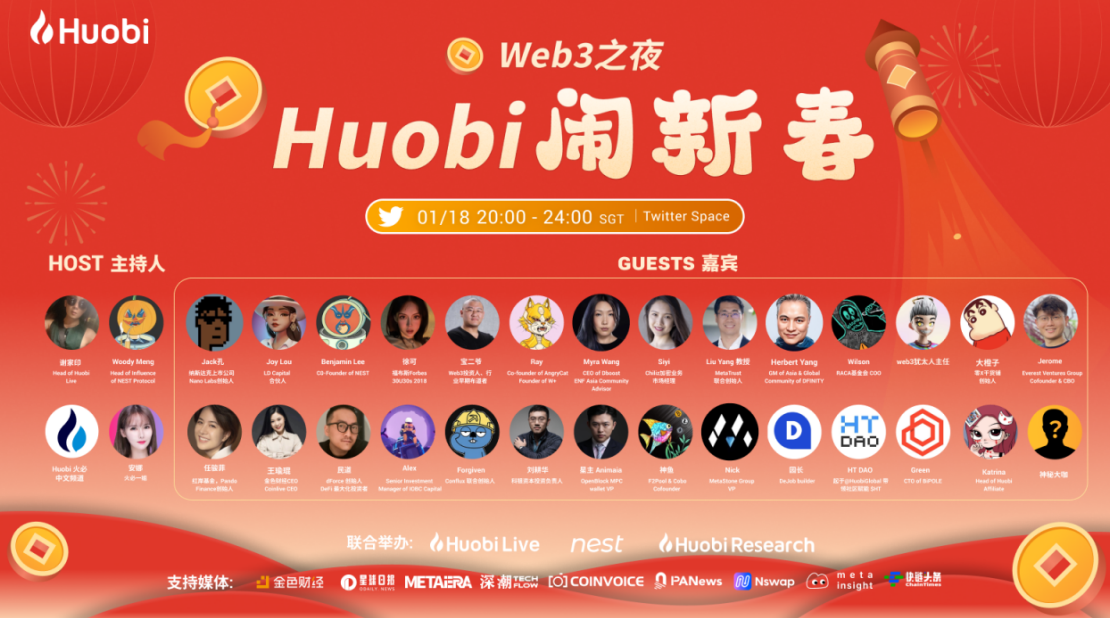
On January 18, Huobi Live, NEST Protocol, and Huobi Research Institute jointly launched the "Huobi Lunar New Year Web3 Night."
 Navigating Web3 tides with focused insights
On January 18, Huobi Live, NEST Protocol, and Huobi Research jointly hosted the "Huobi Celebrates Spring Festival Web3 Night." Industry leaders including Su Zhu, co-founder of F2Pool; Web3 investor BitBull; Jack Kong, founder of Nano Labs; Benjamin, co-founder of NEST; and Liu Yang, co-founder of Meta Trust engaged in in-depth discussions on topics such as industry Lehman moments, milestone events, asset security & cyberattacks, the NFT/Web3/metaverse wave, regulatory sanctions, and policy developments.
Sun Yuchen, member of Huobi Global Advisory Council, founder of TRON, and Grenada’s ambassador and plenipotentiary representative to the World Trade Organization, attended as a special guest, sharing key strategic focuses and directions for Huobi and the TRON ecosystem in the coming year.
Sun Yuchen stated that 2023 will emphasize a dual-driven strategy of “exchange + public chain,” primarily centered around Huobi, Poloniex, BitTorrent Chain, and TRON. The model has taken initial shape, with a focus on enhancing user experience and product traffic. Additionally, efforts will be made to strengthen stablecoin ecosystems and related applications. For BitTorrent Chain, priorities include facilitating the migration of leading DeFi protocol developers and advancing cross-chain protocol development.
Regarding the future of the “Sun Yuchen Art Museum,” he mentioned plans to promote collaboration between traditional institutions like Christie's and Sotheby's and the Web3/NFT space.
During the session reviewing industry collapses and Lehman-like moments, Jack Kong, founder of Nano Labs, said the Terra and FTX collapses represented a new paradigm in blockchain finance—indicating that only with highly advanced underlying infrastructure could such large-scale negative impacts occur. Investor Lou Jiyue added that these collapses revealed the unregulated, chaotic state of the crypto market. However, after experiencing such disorder, the market would recalibrate and move forward with stronger development. The likelihood of similar collapses in 2023 would be significantly reduced. For users, she advised lowering trust levels when using CEXs and moving assets to decentralized wallets during FUD rumors to enhance awareness of self-custody. For CEXs, asset audits proving solvency would become much more rigorous. Overall, the industry faces increasing regulation and is moving toward compliance. Min Dao, founder of dForce, analyzed that financialization in this cycle had deepened dramatically. From Terra to 3AC, FTX, and DCG, it resembled a “love quadrangle,” with the collapse process mirroring deleveraging in traditional financial shadow banking systems.
When discussing the merits of centralized versus decentralized platforms, Professor Liu Yang, founder of Meta Trust, noted that while centralized platforms offer higher efficiency, they require greater trust. Decentralized platforms emphasize transparency, immutability, and traceability, providing natural solutions to user trust issues, though their efficiency lags behind centralized ones. Both types can face security risks today. The root issue lies in whether platforms genuinely prioritize security and conduct sufficient security audits. He also pointed out that due to Web3’s architectural complexity and innovation, security remains highly challenging across Layer1, Layer2, and application ecosystems—over 60% of which rely on open-source communities, potentially introducing code vulnerabilities.
On discussions stemming from the Ethereum Merge, Star Lord, VP at OpenBlock Wallet, believed Ethereum’s security weakened post-merge, mainly reflected in lower resistance to national-level censorship under the PoS consensus mechanism. For individual users, however, entry barriers decreased, and social recovery wallets greatly enhanced asset security. Star Lord also noted that Ethereum’s economic model continued to strengthen, with ETH potentially surpassing half of BTC’s market cap while sustaining its narrative. Xu Ke, partner at DaoVerse Capital, stated that the Merge was inevitable for Ethereum’s sustainability, despite causing some security concerns. Nevertheless, overall performance improved and use cases expanded. As the blockchain ecosystem evolves, embracing a certain degree of centralization is unavoidable.
On Elon Musk’s acquisition of Twitter and the development of SocialFi, Sunil, VP at MetaStone Group, said Twitter already showed signs of SocialFi before the acquisition—being inclusive, widely used, and active in Web3 culture. Undeniably, from DogeCoin to Shiba Inu, Musk has strong influence in promoting crypto and Web3 projects. In his view, acquiring Twitter demonstrated Musk’s high expectations for Web3, hoping to build an inclusive and sustainable platform. Benjamin Lee, co-founder of Nest Protocol, said Musk is a top influencer both in cryptocurrency and tech industries. His acquisition benefits not only SocialFi but also strongly advances the broader crypto space. Currently, Twitter’s architecture already fully supports SocialFi content creation and interaction models, paving the way for evolution into “TwitterFi.”
On the popularity of NFTs and Web3 concepts in 2022, Liu Genghua, investment lead at Krypital Group, said traditional enterprises are eager to explore new business opportunities. In the traditional business world, they recognize where new-era users and trends lie. NFTs will remain a key battleground for major brands for the foreseeable future. From a traditional financial perspective, NFTs possess bill-like attributes and hold significant growth potential. Zhao Chen, Director of the “Jews of Web3,” noted that market behavior shows NFT operations are increasingly community-oriented, implying more innovations such as NFTFi and derivative creations will emerge.
Xu Ke, partner at DaoVerse Capital, analyzed that Web3 still needs time to reach mainstream life. With the global economy declining and the crypto market not yet entering a relatively stable bull phase, widespread adoption of Web3 depends on attracting more participants. At present, traditional giants like Tiffany and Louis Vuitton enter Web3 primarily through NFTs, whose nature still aligns closely with collectible art and luxury goods. While GameFi brought many traditional companies into Web3 in 2021, results were not very successful. The core reason: Web2 companies lack Web3 DNA. Business and value exchange models have changed, requiring traditional giants to truly understand Web3’s essence.
The principal of DeJob Builder said more Web3 products and projects are gradually shifting from simple PFPs (profile pictures) to functional NFTs integrated into practical use cases. Siyi, Marketing Manager for Chiliz’s crypto business, said since the NFT boom began, integration with mainstream users and Web3 has accelerated, spawning numerous applications such as NFT tickets and on-chain gaming that enable participation in Web3.
On regulatory challenges facing the industry, Web3 investor BitBull said regulations are tightening but crypto users aren’t decreasing—in fact, they’re growing—so he isn’t worried about Web3 disappearing. He added that launching tokens via public chains is becoming increasingly difficult. However, PoW chains, due to their inherent resistance to regulation, will endure. Katrina, Business Development Director at Huobi, said 2022 saw regulation focused on security, operability, and traceability. Cryptocurrencies inherently possess decentralization and anti-censorship traits, making the balance between these characteristics and regulatory demands a critical area of negotiation for the market.
Looking back at the 13-year history of the crypto industry, 2022 was one of the most turbulent years ever. Yet only by eliminating the weak can the industry secure a more robust future. Huobi and other steadfast believers remain confident: those committed to continuous building will stay, and the crypto industry, having weathered a volatile year, will emerge stronger—not vanish.
Join TechFlow official community to stay tuned
Telegram:https://t.me/TechFlowDaily
X (Twitter):https://x.com/TechFlowPost
X (Twitter) EN:https://x.com/BlockFlow_News






