








Revisiting the Exchange Landscape: Can OKX "Coast to Victory," and Who Will Secure the Next Web3 Ticket?
TechFlow Selected TechFlow Selected
Revisiting the Exchange Landscape: Can OKX "Coast to Victory," and Who Will Secure the Next Web3 Ticket?
Wait quietly for change to happen.
 Navigating Web3 tides with focused insights
Author: 0xmin
Cantonese Talk: CEX
The crypto tide rises in Hong Kong. The recent crypto summit held there was like a "fireside chat" during this bear market winter.
Major Chinese-speaking crypto players gathered together. After one full market cycle, it's clear that exchanges remain the undisputed protagonists. The once "Big Three" (OKX\Binance\Huobi) have reappeared on stage—but the world has changed. What was once a tripartite balance of power has now become "one dominant player with multiple strong contenders."

Just like in the real world, the most scarce resources in crypto are subject to zero-sum competition. Users equate to population; profits equate to taxes. A "land-grab war" in crypto is inevitable.
Much like the early internet era, tech giants such as Tencent, Alibaba, Baidu, and ByteDance shaped today’s digital landscape through a series of "land grabs" across social media, e-commerce, search, and short videos—turning the internet into societal infrastructure.
The exchange "land-grab wars" are just as intense.
Recall the last bear market, when exchange spokespersons took center stage, fiercely debating topics like "premature liquidations"—infinitely more dramatic than today’s petty squabbles.
Onlookers were thoroughly entertained. While watching the drama unfold, the quality of exchange services and competitive awareness improved amid the chaos.
Yet after every battle, competition grows increasingly exclusive. Dragon-slayers become dragons themselves, turning against the very spirit of blockchain’s origin—in a decentralized world, centralized forces still hold the most power, forcing all other players to court these "centralized giants."
Whether Tencent, Alibaba, Facebook, or Microsoft, once they grow large enough to become infrastructural, they inevitably face a "dual challenge" from public opinion and regulators.
In crypto, with most competitors eliminated, Binance has become the prime target. As CZ noted in an internal memo: “People now see us as the biggest, so they attack us more.” Regulators and industry participants alike keep Binance under constant scrutiny, magnifying every move.
Here’s an interesting anecdote that reveals industry sentiment.
When FTX collapsed and Binance stood alone at the top, staff at OKX received private messages from clients, projects, and media partners encouraging them to “keep going.”
The reason is simple: traders want more choices—competition drives better service and better products; projects desire diverse liquidity rather than monopoly; and countless ecosystem service providers hope for more “clients”...
Self-interest shapes perspective. Just as no one wants a monopolized internet, no one wants an increasingly centralized Web3 either.
Human nature and incentives ensure there will always be challengers.
Looking at current developments, perhaps the most compelling case study is a veteran exchange—OKX.
Why Is OKX 'Winning by Default'?
What comes to mind when you think of OKX?
A year ago, I might have said, “OKX feels too Web2, not sexy enough—too conservative.” But today, I’d say, “OKX is rock solid—truly a veteran exchange.”
Who would’ve thought that OKX, which stumbled mid-bull run, would emerge as one of the biggest winners after the bull market ended?
Data doesn’t lie.
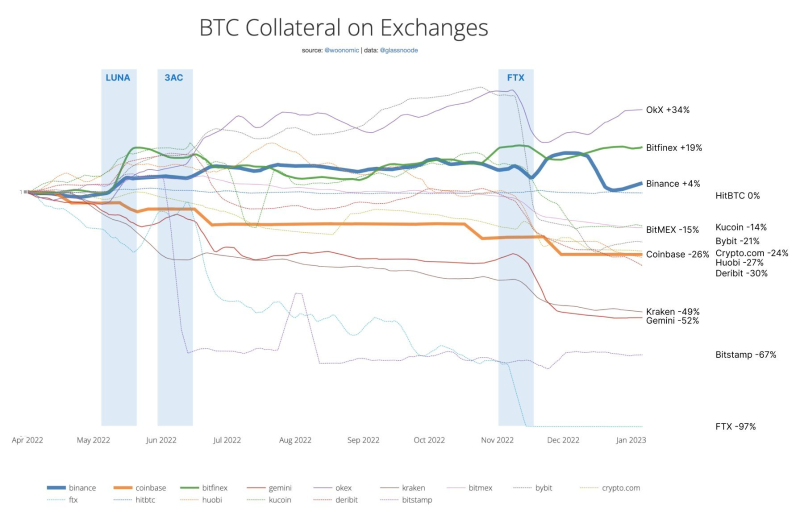
1. According to Glassnode, since April 2022, OKX’s Bitcoin reserves have increased by 34%, Bitfinex by 19%, and Binance by 4%. Among major exchanges, only these three saw increases, while others declined: Coinbase dropped 26%, Gemini 52%, Crypto.com 24%...
2. Per Coinmarketcap, on January 8, OKX ranked second globally in derivatives trading volume.

3. Based on Defillama’s CEX transparency data, OKX holds $6.44 billion in deposited funds, ranking third—just behind Bitfinex’s $6.65 billion. However, all of OKX’s deposits consist of clean assets (excluding its own issued platform tokens). By this metric alone, OKX ranks second globally.
In terms of net inflows, OKX led all exchanges in January with $278 million in net deposits.

4. Its platform token OKB rose 27% in January, briefly entering the top ten by market cap and currently holding eleventh place.
By all key metrics, OKX can now be considered the world’s second-largest trading platform.
How did this happen? How did OKX pull off this turnaround?
A wise saying echoes: “An individual’s fate depends not only on personal struggle but also on historical currents”—and the same applies to exchanges.
Some call OKX’s success “winning by default,” but I see it as the reward for *not* lying down. In crypto, surviving without making fatal mistakes already puts you ahead of 90% of competitors.
OKX was once criticized during the bull market for being too conservative and traditional—but this very caution helped it avoid major blunders and navigate the market cycle with stability.
We interviewed several current and former OKX employees to understand its strengths and strategy. Common responses included “technology-driven,” “security-first—no incidents ever,” “risk-averse, stability-focused”—behind these surface descriptions, we sought to distill two core principles.
One: “System”; Two: “Simplicity”.
“System” refers to internal process standardization and institutionalization—resembling big tech firms, gradually evolving into a proto-Web3 giant.
This “systematization” manifests in many ways:
1. Standardized procedures: Documentation, reporting, approvals, and discussions follow strict protocols, with high proficiency in collaboration tools.
2. Comprehensive compensation system: Salaries and benefits are well-structured and professional.
In December 2021, OKX won LinkedIn’s Most In-Demand 2022 Global Employer Award—the only Web3 tech company on the list, alongside Tencent, Alibaba, ByteDance, Huawei, and Tesla China.
From a personal observation: long-term employees abound at OKX. In some departments, the core team has remained unchanged since 2019—indicating remarkable personnel stability.
3. Clear responsibilities and division of labor: OKX operates more like a professional management model, with clearly defined departments and business units, each with designated leads.
Almost every collapsed company shares one trait: chaotic internal management. Solid governance is the foundation of sustainable growth.
“Simplicity” means focusing tightly on core strengths without blind expansion.
For example, ByteDance started with recommendation algorithms and built an app factory around them. Within OKX, the belief is that it is a technology-driven company using tech to empower trading—avoiding high-risk behaviors. Staying alive matters most.
Searching for Crypto’s Dimensional Weapon
In Liu Cixin’s *The Three-Body Problem*, there’s a concept called “dimensional strike.” A passing alien civilization, the Singer, discovers humanity and casually annihilates the solar system with a “two-dimensional foil,” as easily as crushing an ant.
Instant noodle brands like Kangshifu didn’t decline due to rivals, but because of food delivery apps like Meituan and Elema. Nikon didn’t fall because of competing camera brands, but due to smartphone cameras. Traditional news platforms weren’t beaten by content quality, but by algorithmic feeds. As the saying goes: “It’s never your competitor who beats you—it’s the times.”
Perhaps the true challenger to dominant centralized exchanges isn’t another CEX or DEX, but something like a social app. Someone is always searching for the next “dimensional weapon.”
Competition among exchanges is no longer just about core trading functions. It’s now a full-stack race spanning wallets, blockchains, and DEXs. “Decentralization/DeFi is the future” is now consensus. Every exchange is scrambling for the next Web3 ticket.
Binance has BNB Chain; OKX has fully integrated its own Web3 offerings, prominently featured alongside its exchange business on its homepage.
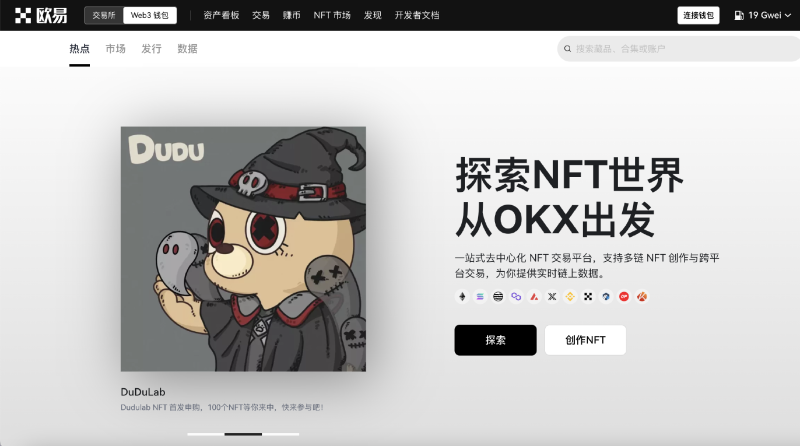
OKX Web3 starts with the OKX Web3 Wallet—a decentralized gateway—offering:
On-chain DEX trading: Algorithms automatically find the deepest liquidity pools, split orders intelligently, and deliver optimal trade paths;
NFT Marketplace: A one-stop decentralized NFT trading platform supporting liquidity from OpenSea, LooksRare, Magic Eden, IMX Official, and others;
Earn: A DeFi yield aggregation platform that bundles cross-chain investment opportunities for one-click multi-asset investing.
Overall, we see two major trends shaping centralized exchanges:
1. Tech Company Evolution: Being an exchange becomes just one identity tag—not the whole picture. Like how Tencent evolved from QQ to WeChat, Honor of Kings, and venture investments, exchange giants are building their own ecosystems and becoming Web3 megacorps.
2. Web3 Integration: Centralized exchange operations are at best Web2.5—they need to go further into Web3.
For OKX, another challenge looms—how to globalize more effectively?
At OKX’s recent annual meeting, the clearest message was: 2023 will be all about globalization—with English becoming the default working language across the board.
Supporting measures followed: employees are encouraged to relocate globally, with visa and IELTS support provided.
According to official figures, OKX now employs over 3,000 people across 50+ countries. It has over 400 staff in the U.S., with offices in San Jose, San Francisco, Texas, and New York. While other exchanges cut staff, OKX remains one of the few still hiring.
Big tech companies wrote internet history—earning both glory and criticism. Crypto exchanges have similarly accelerated mainstream adoption of digital assets. Yet “centralization” seems to be their original sin, making “Web3 self-revolution” an unavoidable path forward.
Imagine: what will crypto exchanges look like four years from now? What shape will the landscape take? The victory of Web3 may ultimately be the “self-elimination” of centralized exchanges. Change is coming—let’s wait and see.
Join TechFlow official community to stay tuned
Telegram:https://t.me/TechFlowDaily
X (Twitter):https://x.com/TechFlowPost
X (Twitter) EN:https://x.com/BlockFlow_News






