








EDE: The Next-Generation Decentralized Exchange That Generates Real Returns for Users
TechFlow Selected TechFlow Selected
EDE: The Next-Generation Decentralized Exchange That Generates Real Returns for Users
Believe that El Dorado's decentralized exchange social trading feature will create a seamless bridge between professional and novice traders.
 Navigating Web3 tides with focused insights
Before discussing the next-generation decentralized exchanges, let's first gain a basic understanding of cryptocurrency trading platforms.
DEX vs CEX
Cryptocurrency exchanges are essentially stock markets for the crypto world. Just as you can buy and sell assets like stocks and derivatives on traditional stock exchanges, crypto exchanges allow you to trade blockchain-based tokens.
Currently, there are two mainstream types of exchanges:
-
Centralized exchanges (CEX), such as Binance and Coinbase,
-
Decentralized exchanges (DEX), which have gained increasing attention following recent high-profile collapses like FTX.
Although both CEX and DEX platforms offer cryptocurrency trading capabilities, they differ significantly in many other aspects. For example, the type of exchange plays a crucial role in determining how specific trades operate. Additionally, user characteristics and flexibility vary greatly between the two types of exchanges.
In the Web3 world, there’s a popular saying: "Not your keys, not your coins."
When using a CEX, users must fully entrust their funds to the exchange to conduct trading. While they can manage their assets at any time under normal conditions, during extreme situations, users may be unable to fully safeguard their funds. The collapse of centralized platforms like FTX led to bank runs and some users being unable to fully withdraw their assets—highlighting the significant risks associated with fully entrusting assets to centralized exchanges.
Data shows that due to the fallout from FTX's collapse, the five largest DEXs saw a significant increase in trading volume between November 5 and November 9.
-
Uniswap reached $387 million in trading volume on November 9, an increase of $214 million over three days—a 124% growth.
-
1inch hit a peak trading volume of $1 billion on November 23.
DEXs use algorithms to directly match buyers and sellers, eliminating the need for intermediaries. As a result, users maintain full custody of their assets within a DEX. However, this custody comes with the responsibility of securely managing private keys. If a private key is leaked or lost, users lose access to their funds. Because there is no central authority behind a DEX, if a user loses their private key, no one can help recover their funds.
The Temporary Advantages of CEX
If DEX users have greater control over their crypto assets, why do so many still prefer centralized CEXs over decentralized DEXs?
In most cases, CEXs offer more user-friendly interfaces (UI) that are easier for newcomers to understand. In contrast, navigating decentralized DEXs can be complex. Some users complain that due to overly simplistic UI design, certain DEXs are nearly unusable.
While decentralized exchanges may not be the first choice for beginners, under the positive influence of DeFi, they are becoming increasingly understood and accepted by more crypto users. At the same time, however, as first-generation DEXs evolve, their limitations are becoming more apparent.
DEX Enters the 2.0 Era
El Dorado Exchange (EDE) is a second-generation decentralized spot and perpetual contract exchange that offers real yield, social trading, AI trading bots, a user identity system, decentralized funds, and more.
EDE aims to build a decentralized exchange suitable for users of all levels, enabling them to earn real returns. Every user can trade and learn alongside others, quickly growing into a skilled and competent trader.
Before further explaining how EDE builds the second-generation decentralized exchange (DEX 2.0), let's first discuss the first-generation decentralized exchanges (DEX 1.0).
What Is DEX 1.0?
A decentralized exchange (DEX) is a peer-to-peer (P2P) platform that relies entirely on smart contracts and dApps to automate trading and transfers. Notable examples include PancakeSwap, Uniswap, and SushiSwap. Unlike centralized exchanges (CEX), DEX platforms are non-custodial—users retain full control over their funds, but must take greater responsibility for securing their private keys.
Advantages of DEX 1.0
DEXs offer all the functionalities of CEXs, along with several additional advantages.
Decentralization
In a DEX, there are no restrictions, no constant system monitoring, no complex codes of conduct, and no governing entities. Users are solely responsible for their actions and outcomes, with all transactions governed by smart contracts. With no single entity controlling operations, no one can shut down trading or freeze your funds.
Enhanced Privacy Protection
Since DEXs are built on DeFi principles, they require no verification process—anyone, regardless of identity, can freely use the services anytime, anywhere, without interference.
Unlike CEXs, DEX users do not transfer their digital assets to third parties, meaning you always retain access to your funds, stored in your personal digital wallet—the only person who holds the private key. DEXs also never require traders to disclose their private keys.
Additionally, most DEXs do not force users to undergo KYC identity verification. This approach provides a degree of anonymity and maximizes user privacy protection.
Lower Usage Costs
Because DEXs use smart contracts to automatically execute trades without intermediaries, transaction fees are significantly lower than those on CEXs. For active traders, long-term use of a DEX can save substantial costs.
More Token Options
On DEXs, you can find thousands of tokens not yet available on CEXs. Investing in these carries higher risk, but the potential returns can also be enormous. For instance, Shiba Inu was initially only tradable on DEXs like Sushiswap and Uniswap, with modest early volumes. Today, it ranks among the top 15 cryptocurrencies by market cap.
Disadvantages of DEX 1.0
Despite many advantages over CEXs, DEX 1.0 has inherent flaws that limit its broader adoption and development.
Not User-Friendly for Newcomers
Unlike CEXs, DEXs are often less intuitive for new users.
For inexperienced users, the interface may be harder to navigate and understand. It’s also difficult for new users to find helpful information to support their trading decisions.
Unsustainable Reward Models
When DEXs continuously mint new tokens to incentivize liquidity providers, their intrinsic value is diluted. The rewards users receive decrease in value over time, eventually leading to liquidity withdrawal.
Lack of Advanced Charting Tools
In DEX 1.0, most retail traders struggle to effectively analyze charts or assess the impact of news on crypto markets, making rational trading decisions difficult.
They can only rely on browsing Twitter and trading groups to find useful information—an inefficient and challenging process.
No User System
DEX 1.0 lacks a user system to reward contributions to the platform. Whether you trade $100 or $1 million, your fee rate remains the same, making it hard to build user loyalty.
What Is EDE DEX 2.0?
EDE DEX 2.0 retains all the benefits of DEX 1.0 while introducing clear improvements to address its core issues.
Beyond simplifying trading, the platform evolves beyond being just a tool—it adds strong social features.
Users transform from mere traders into rewarded participants and contributors to the platform.
Evolution of EDE DEX 2.0
Real Yield
DeFi sparked a yield craze in the summer of 2021, with many projects launching tokens and offering compounded yields. In extreme cases, projects offered artificially inflated APYs, reaching five-, six-, or even seven-digit returns. These projects maintained high yields by issuing more tokens, but behind the impressive numbers, token values declined, driving investors away and sending projects into death spirals.
After cooling down from this APY frenzy, users realized that sustainable liquidity sources and revenue mechanisms should be the foundation of investment.
Projects focused on real yield accumulate actual value—no artificial APYs, no fake yields, no revenue from token inflation. Instead, they rely on real, stable, and relatively loyal user bases. EDE is exactly such a project.
In EDE, 100% of protocol revenue is distributed to users: 60% to ELP token holders, and 40% to EDE stakers.
First DEX User System
Based on the concept of SBT (Soulbound Tokens), El Dorado Exchange will be the first DEX to introduce SBTs into decentralized exchanges (named ESBT).
El Soul Bound Token (ESBT) serves as your gateway into the El Dorado ecosystem, functioning as a decentralized identity (DID) for all users participating in the EDE ecosystem.
ESBT aims to solve user loyalty issues on decentralized trading platforms, providing digital verification tools and automatically rewarding users for active participation and contributions. As users continue using the EDE platform, more points are credited to their ESBT. As points accumulate, their level increases, unlocking higher platform rewards.
At its core, soulbound tokens aim to reshape how we interact with each other and create a decentralized digital identity that rewards those who actively contribute to and grow their communities. Our ESBT program will deliver a brand-new Web3 credential experience for EDE users.
Social Trading
No one is born a great investor. Profitable investing usually requires exceptional insight, luck, execution, and experience—things DEX 1.0 cannot provide.
EDE DEX 2.0 introduces social trading features, including copy trading, AI trading bots, fund managers, and more.
Unlike DEX 1.0, EDE DEX 2.0 connects traders who trade the same tokens—enabling order copying, sharing and discussing real-time information, analyzing and predicting market trends, solving problems together—helping traders learn and improve faster than ever before.
You can learn by observing other traders. If you find a trader performing well, you can study and leverage their skills and knowledge to boost your future profits. Observing failed trades can also help you avoid similar mistakes.
We believe El Dorado’s social trading functionality will seamlessly bridge professional and novice traders.
Decentralized Funds
EDE community members can launch their own funds on the platform in a permissionless manner and set parameters.
Community users can review a fund manager’s track record and strategy shared on social media to decide whether to invest.
Fund managers earn profits from trading performance but cannot withdraw users’ funds.
EDE’s decentralized fund feature will revolutionize the trading landscape by transforming how communities and capital collaborate, using trusted, disintermediated technology.
AI Trading Bots
AI trading bots allow EDE traders to automatically place buy and sell orders based on key technical indicators, freeing them from constant monitoring and allowing more time for market analysis.
Approximately 5–10 AI trading strategies will be available when EDE’s trading functions launch.
Censorship Resistance
Regardless of differences between CeFi and DeFi, as "the face of crypto compliance has deteriorated," global regulators are taking increasingly strict stances toward cryptocurrency regulation.
The collapse of centralized exchange FTX—deeply tied to U.S. and traditional financial institutions—signals deeper systemic issues within the crypto space. Much of the industry's pain stems from CeFi institutions.
Cryptocurrencies were created to be decentralized. In a sense, increased regulation is a side effect of the industry's distorted development.
Only DEX 2.0, adhering to DeFi principles, can truly deliver the privacy and anonymity users desire. Community-built, community-governed DEX 2.0 is the right path forward.
Community-Based Customer Support
Due to its decentralized nature, a DEX does not have a centralized team dedicated to customer support. However, leveraging the ESBT user system introduced by EDE, DEX 2.0 enables any community member to form a support team, offering real-time help to other users. Contributions are recorded via ESBT and converted into incentives for supporters.
Thus, the DEX 2.0 user support team consists of self-organized community members ready to assist others at any time.
More Usable Interface
The DEX 2.0 user interface will be more intuitive, efficiently serving both professional and non-professional users.
More explanatory content, richer tutorials, and comprehensive data visualization will support efficient trading decisions.
What CEXs achieved through years of refinement, the community-built DEX 2.0 will surpass.
$EDE Tokenomics
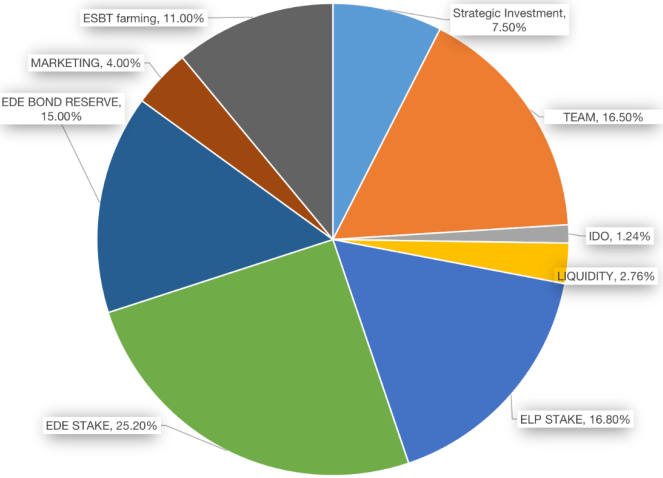
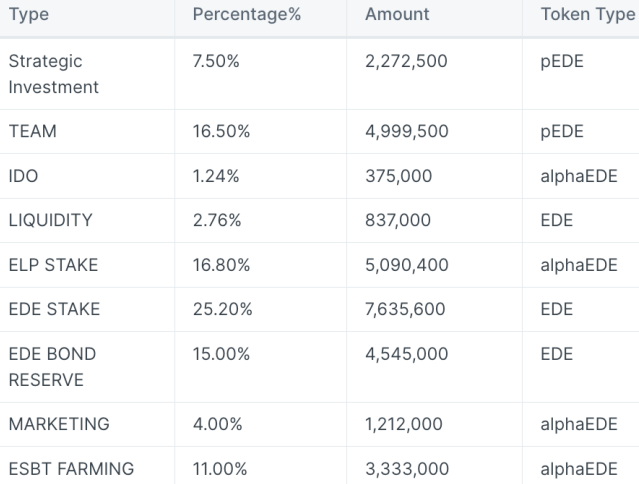
El Dorado Exchange’s governance token is $EDE, with a total supply of 30,300,000.
From EDE’s tokenomics, it’s clear that EDE is a community-driven project, with over 80% of tokens allocated to reward $EDE holders and builders.
$Alpha EDE
$alphaEDE is primarily earned through IDO participation, ELP staking rewards, marketing activities, and ESBT farming.
$alphaEDE has a linear vesting period of 90–365 days—the higher a user’s ESBT level, the faster the release.
$pEDE
$pEDE refers to strategic investment and team tokens, with a fixed four-year linear vesting period that cannot be accelerated in any way.
$gEDE
$gEDE is the governance token within the EDE ecosystem, obtained by staking $EDE. Each $gEDE represents one voting right. Holders of $gEDE receive additional rewards in $EDE and $EUSD tokens.
$ELP Token
Simply put, $ELP is a basket of major cryptocurrencies (including BTC, ETH, USDT, etc.), with structured ELP pools designed to meet long and short demand in perpetual trading. Each asset in the basket has a different weight, and EDE adjusts returns based on these weights to maintain overall ELP stability.
Moreover, long-term data from major CEXs and DEXs show that perpetual contract traders tend to lose money over time—meaning ELP liquidity providers can expect consistent profitability.
To meet diverse trading needs, EDE divides the ELP pool into three categories based on market strength and performance:
-
ELP-1: Pool of top 1–10 market cap coins;
-
ELP-2: Pool of top 10–20 market cap coins;
-
ELP-3: Pool of top 30–50 market cap coins;
LPs can choose pools based on their risk appetite. If you believe we’re near the bottom of a bear market, buying ELP tokens is akin to purchasing an index of major cryptocurrencies—and could be a solid investment strategy.
Driving Further Growth of DeFi with EDE DEX 2.0
Although the market remains deep in a bear phase, we observe that DeFi, especially DEX user numbers, are rising rather than falling—early signs of recovery suggest that DeFi 2.0 and DEX 2.0 are being forged precisely during this downturn.
The last DeFi boom was driven by brilliant technology; the upcoming resurgence must be powered by all DeFi users—through the strength of social trading and real yield!
EDE will be a steadfast force in driving the next wave of DeFi prosperity—building a second-generation decentralized exchange where all DeFi users earn real yield and enjoy rich social trading experiences!
Join El Dorado Exchange and help us grow DEX 2.0.
Join TechFlow official community to stay tuned
Telegram:https://t.me/TechFlowDaily
X (Twitter):https://x.com/TechFlowPost
X (Twitter) EN:https://x.com/BlockFlow_News






