Who Are the Purists and "Tourists" in the Crypto World?
TechFlow Selected TechFlow Selected
Who Are the Purists and "Tourists" in the Crypto World?
The open spirit of cryptocurrency runs counter to traditional business wisdom.
 Navigating Web3 tides with focused insights
Written by: 1confirmation
Compiled by: TechFlow
In 2009, Satoshi Nakamoto released the Bitcoin whitepaper and its open-source code. Since then, the cryptocurrency industry has maintained an open ethos. From the beginning, anyone could copy the code, rebrand it, and launch their own tokens and networks.
Tens of thousands of currencies and networks followed, with some networks even spawning imitators of their own.
The open ethos of crypto runs counter to traditional business wisdom, which holds that when you create a product people find useful, you should protect it from being copied and competed against. The open ethos prioritizes collective progress over any single group’s short-term profits—by enabling anyone to easily replicate and build upon a product, it harnesses the world’s collective intelligence and creativity, theoretically driving greater innovation. This open ethos has worked well, and I believe crypto wouldn’t matter in today’s world without it—though it does come at a cost.
-
The benefit of openness is: anyone can build on existing products, improve them, and bring more empowerment to the world.
-
The cost of openness is: anyone can simply copy a product, combine it with narrative and marketing tactics, extract value from people, and contribute nothing to real progress.
There's an argument that value extractors who mimic others help drive long-term progress—even as unsuspecting retail investors get burned by fleeting clone chains (Terra/Luna) or investment scams (3AC). Regardless, they do increase visibility and staying power for the space. However, these value extractors clearly harm many people (and perceptions of the industry), which leads me to believe we need ways to mitigate the costs of this open ethos.
Some suggest gatekeepers (regulators, trusted brands) are the best way to reduce the cost of openness. But this doesn't just reduce the cost—it kills it. Gatekeepers hinder progress—we’ve seen this across every industry, including finance, until Bitcoin. I believe the best way to mitigate these costs is by understanding the mental models of purists and tourists. The goal of this article is to help anyone begin thinking about this concept.
Purists and Tourists
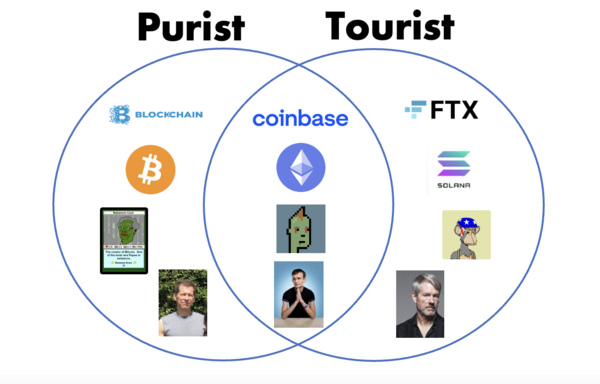
-
Purists are those deeply versed in the craft’s history and nuances. They understand subtleties, build with all prior work in mind, appreciate authenticity, and bring genuinely new things to the field. Products made by purists may be too niche for mass markets, but they are original and thoughtfully crafted.
-
Tourists don’t care about history or nuance; they just want to create something that resonates with people. What they build might gain traction for a while. But tourists come and go easily. If a product is too touristy, it lacks long-term staying power—one day hot, the next gone.
The "purist vs. tourist" mental model was coined by fashion designer Virgil Abloh. His view was that the greatest impact in design comes at the intersection of purists and tourists. He created and led some of the world’s most influential consumer brands. Both Louis Vuitton and Off-White were built on this mindset. When I learned about his approach, I realized it mirrored my own method in crypto over the past decade.
Below is how I see current purists, tourists, and their intersection—from the perspective of crypto companies, cryptocurrencies, NFTs, and founders:
Purists
Blockchain.com is a veteran self-custody wallet company. The founders believed BTC’s true utility lies in enabling people to be their own bank and resist censorship. To this day, their core product remains focused on this principle, showing deep understanding and appreciation of the space. Yet their user base is niche, and they failed to adapt when Ethereum emerged—proving that custodial wallets offering easy buy/sell functions (Coinbase) and ETH self-custody wallets (Metamask) were bigger ideas.
Bitcoin is the bedrock of cryptocurrency. It catalyzed the entire industry and is why we’re here today. It works brilliantly as immutable, scarce value storage, but little beyond that has evolved. BTC maximalists rightly point out many scams that followed BTC, but wrongly label genuine innovations pushing the space forward—like Ethereum—as “scams”.
Rare Pepe was an NFT collection created on Bitcoin in 2016, predating all Ethereum-based NFTs. Rare Pepes were built on Counterparty, a protocol layered on Bitcoin. For various reasons—including lack of interoperability with BTC wallets—the protocol never broke beyond a niche audience. Rare Pepe still holds strong brand recognition and collector loyalty among crypto natives, but in terms of mainstream attention, it has been overshadowed by Ethereum-based series like Cryptopunks and BAYC.
Hal Finney was an early Bitcoin user who received the first-ever Bitcoin transaction from Satoshi Nakamoto on January 12, 2009. He was also a core engineer at PGP, one of the most important cryptography companies before crypto, and arguably the most significant early contributor to both Cypherpunks and the BitcoinTalk forum. He played a crucial role in advancing the space to where it is today, yet only a small fraction of users in the space have heard of him.
Tourists
FTX is an exchange founded in 2019. The company hasn’t contributed anything new or additive to the space. They simply marketed aggressively and captured market share during the 2020–21 bull run. Given that the team behind the exchange also ran a trading firm called Alameda Research—and that they manipulated numerous tokens on their own platform with little scrutiny—it raises serious concerns. For now, the company seems driven primarily by a strong media narrative.
Solana, launched in 2019, branded itself as the “Ethereum killer” and “blockchain built for mass adoption.” The project introduced no original innovations, but made certain design trade-offs that made it cheaper and faster than Ethereum in the short term. I believe these trade-offs helped Solana succeed during bull markets fueled by retail capital, but ultimately will prevent its long-term success. When a blockchain is purely optimized for efficiency, lacks cultural or social depth, and fails to introduce meaningful new products, its ceiling is limited.
BAYC is a PFP project launched in 2021. It came after thousands of other PFP projects but managed to capture early hype and then gained massive celebrity endorsements from Justin Bieber, Jimmy Fallon, and Stephen Curry.
Michael Saylor emerged during the 2021 bull market as a Bitcoin promoter. He has built nothing interesting in crypto nor said anything novel about it—he merely echoes what the Bitcoin community has been saying for over a decade. But his company MicroStrategy gained attention for buying large amounts of BTC, and he has since become a media personality.
Purist X Tourist
Coinbase is an exchange founded in 2012. It was the first product to let users easily link a bank account and buy BTC. For nearly a decade, it has stood at the forefront of bringing mainstream access to crypto innovation. The company made an early decision to hold crypto on behalf of users—a centralization that many purists dislike—but there’s no denying its product played a major role in onboarding new users into crypto.
Ethereum launched in 2015, six years after BTC. Without Ethereum, we wouldn’t have DeFi or NFTs. Compared to Bitcoin, Ethereum made some compromises on decentralization, but it’s undeniable that most of the innovation in the space over the past seven years has stemmed from the rise of the Ethereum blockchain and its developer ecosystem.
Cryptopunks is a pioneering PFP collection that helped catalyze today’s NFT-driven creative empowerment revolution.
Vitalik Buterin is the founder of Ethereum. He is an inclusive leader who has guided a major blockchain ecosystem, advanced the space, and embodies all the qualities one would hope to see in a crypto leader.
I know many will disagree with my views and claim their beliefs—and portfolios—are tied to specific assets. Most public discussion around crypto revolves around what people own. But I believe that thinking through the “purist vs. tourist” framework and drawing your own conclusions can greatly help you navigate and invest in this noisy space. The intent of this article is simply to get more people thinking about this concept.
Join TechFlow official community to stay tuned
Telegram:https://t.me/TechFlowDaily
X (Twitter):https://x.com/TechFlowPost
X (Twitter) EN:https://x.com/BlockFlow_News
 @1confirmation