
Misconceptions and Clarifications about Stablecoins: Algorithms, Collateral, Pegging/Floating, and Origins
TechFlow Selected TechFlow Selected
Misconceptions and Clarifications about Stablecoins: Algorithms, Collateral, Pegging/Floating, and Origins
Stablecoins are a misunderstood DeFi infrastructure.
 Navigating Web3 tides with focused insights
Author: Patrick Collins
Translation: TechFlow
Stablecoins are a widely misunderstood DeFi infrastructure. Let’s clarify some key points:
1. "Algorithmic stablecoins are bad" is a mistaken view;
2. "Stablecoins are pegged to another asset" is misleading;
3. Where do stablecoins come from? (Important)
Let’s cut through these misconceptions and understand the truth about stablecoins in DeFi.
1. Algorithmic stablecoins are bad
I believe that categorizing stablecoins as "algorithmic or non-algorithmic" is the most serious misrepresentation of stablecoins.
MakerDAO's $DAI is "algorithmic." It is managed by on-chain smart contracts—an "algorithm" that determines when DAI can be minted or burned based on collateral.
But this raises a question: "How should we classify tokens like Terra-Luna?"
Here, we need to understand one of the three attributes of stablecoins: type of collateral.
Type of Collateral
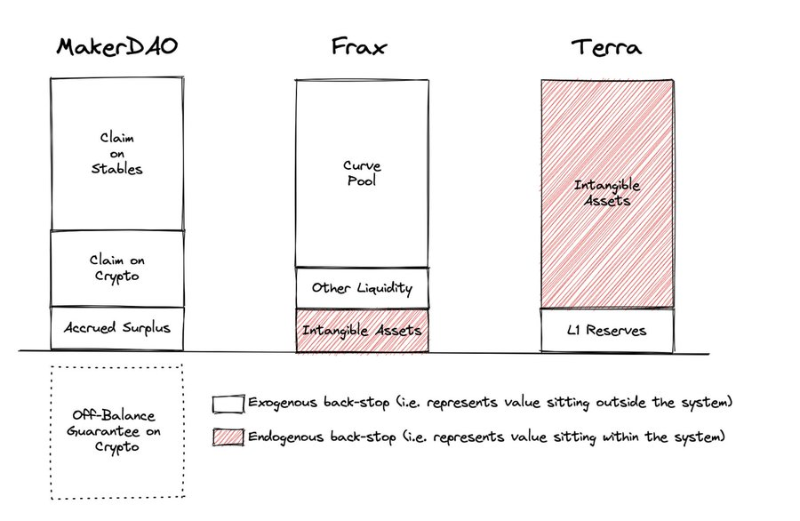
Stablecoins can have exogenous or endogenous collateral. Exogenous collateral comes from outside the system; endogenous collateral originates within the system.
A good rule of thumb to distinguish them is: "If the stablecoin fails, will the collateral also fail?"
For $DAI, we can ask: if DAI fails, will the collateral ETH also fail? The answer is "no," so we can say DAI has exogenous collateral—meaning it’s fundamentally different from something like Terra-Luna.
If UST fails, will LUNA (now LUNC) collapse? The answer is yes, so we know that LUNA (in an indirect way) served as endogenous collateral for the UST stablecoin system.
2. Stablecoins are pegged to another asset
A stablecoin's stability mechanism is either more algorithmically governed or more centrally controlled.
Tokens like $USDC, $UST, and $USDT are more "centrally controlled," because a centralized entity has 100% control over them.
Coins like $DAI, $RAI, and the original UST/LUNA are more algorithmic, because their stability is primarily driven by autonomous on-chain algorithms. This is attribute #2 of stablecoins: their "relative stability."
Stablecoins are either "pegged" or "floating."
Tokens like $DAI, $USDC, and $USDT are all "pegged," because they can be exchanged 1:1 with the US dollar. They derive their stability by being anchored to another asset already considered stable.
But here's the thing: the dollar isn't even that stable. When we seek a "stable" currency, what we're really looking for is one whose purchasing power doesn’t change much over time. Due to inflation, we know that a dollar loses value every year. But what if there were a coin where today you could buy 10 apples with 1 coin, and 20 years later, you could still buy 10 apples with 1 coin?
We would consider that a far more stable asset.
This is where "floating" stablecoins come in. A stablecoin like $RAI is "floating" because it isn’t tied to any other asset—it aims instead to maintain stable purchasing power over time.
3. Where do stablecoins come from?
We talk a lot about the benefits of stablecoins—we need low-volatility units to price goods and conduct transactions.
But who actually mints these tokens?
Suppose you only care about $ETH—you’ve bought all the ETH you can, but you want more.
What can you do?
In Web2, you might take out a loan to buy more, hoping your "ETH holdings grow" faster than your loan payments... This is exactly how large quantities of stablecoins are created.
That is, stablecoins are primarily generated through investors’ leveraged strategies.
We desperately want a trustworthy way to price things, so stablecoins emerge—but don’t forget, at their core, stablecoins represent a financial game played by investors, and their risks stem precisely from this fact.
Join TechFlow official community to stay tuned
Telegram:https://t.me/TechFlowDaily
X (Twitter):https://x.com/TechFlowPost
X (Twitter) EN:https://x.com/BlockFlow_News