








Taking the FTX Crypto Cup as an example, exploring how to integrate NFTs with community operations
TechFlow Selected TechFlow Selected
Taking the FTX Crypto Cup as an example, exploring how to integrate NFTs with community operations
In recent years, NFTs have seen explosive growth as consumer-facing Web3 products.
 Navigating Web3 tides with focused insights
Author: Aditya Shetty
Translation: Web3 MKT - Linda
Editor's Note: If asked what distinguishes Web3 marketing from Web2 marketing, "community operations" is one of the most frequently cited terms. However, this area remains dominated by theory, with few practical execution examples. The FTX Crypto Cup is one of the rare recent case studies on community operations we’ve seen. The author thoroughly explains the methods of community engagement and how integrating NFTs unlocks new possibilities for such communities.
Below is the translated content:
In recent years, NFTs have experienced explosive growth as consumer-facing Web3 products. In 2021, total NFT sales reached approximately $25 billion. OpenSea rapidly became the leading NFT marketplace thanks to its excellent Web2-style user experience and strong market share in Web3.
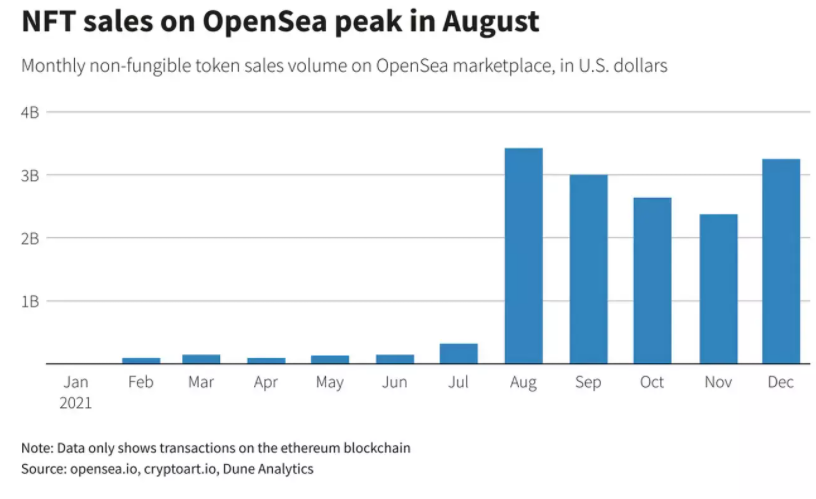
Source: Reuters
The exponential growth of NFTs has not gone unnoticed. Major exchanges like Coinbase and FTX quickly launched NFT platforms to more easily connect with their existing large customer base using their exchange and wallet services. It’s rumored that Coinbase’s NFT waitlist is larger than OpenSea’s monthly active users (MAUs).
On the other hand, we also have platforms like Rarible, which prioritized decentralization and community governance early on.
The team at Multicoin Capital wrote an excellent blog post explaining why the future of NFT markets will be increasingly community-centric.

Source: Coindesk
Tech giants such as Instagram, Twitter, and Shopify have begun integrating NFTs into their products. Brands in media, sports, film, luxury fashion, and other industries are seizing this opportunity to better engage with and monetize their fan bases. TechCrunch reported that Instagram is expanding NFT support to 100 countries. Shopify now allows sellers to build and monetize communities through NFT-based experiences.
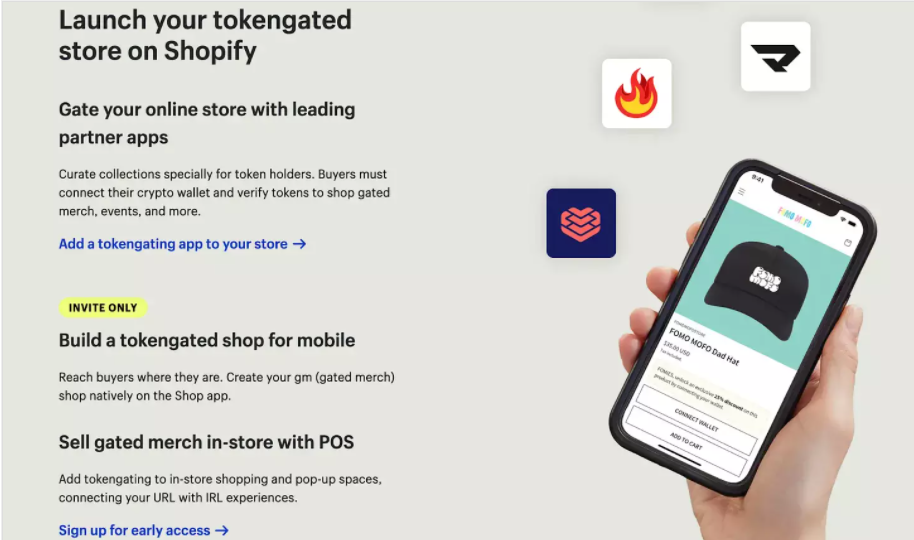
Source: Shopify
However, they’ve faced significant criticism. Many argue these efforts are merely another sales pitch—an approach to monetize existing IP without adding substantial value. The meme of “million-dollar monkey pictures” has dominated the narrative around NFTs, accompanied by stories across the internet of people spending large sums on tiny images now worth nothing. But this narrative overlooks a much bigger possibility brewing beneath the surface.
I prefer to think of NFT utility along a spectrum.
- On one end, you have the value of digital collectibles—digital versions of art with no inherent utility. The difference is that authenticity is verified via blockchain rather than a single issuing entity.
- On the other end, NFTs represent an opportunity to create cross-brand shared experiences, digitize real-world assets, and enable internet communities to organize in unprecedented ways. It’s important to recognize that the journey toward the latter end of the spectrum isn’t automatic or overnight—it requires a series of intermediate steps.
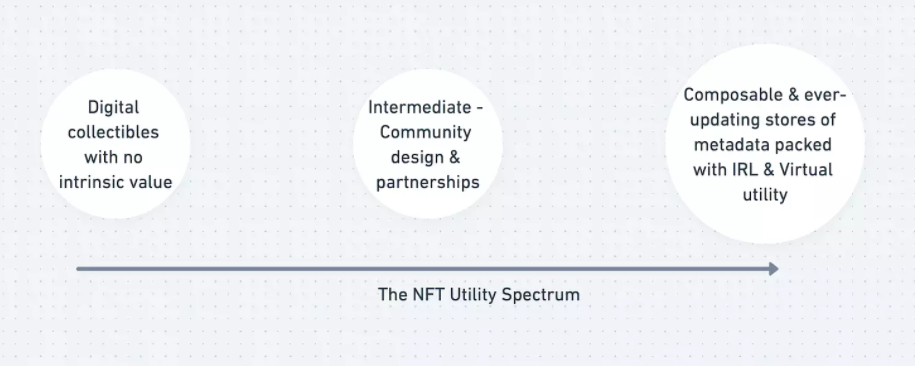
To unlock greater value from NFTs, it requires more than just utility provided by the issuer. After all, if a brand or entity wants to interact with its customers, current platforms may do so more effectively. NFTs truly shine when they contain user-specific information worth carrying across the internet—information that other applications can read and build experiences upon. Communities need to invent new organizational and decision-making models around shared brands. There are few precedents for this, and expecting it to happen spontaneously and decentralized from day one would be foolish.
The best NFT communities require real-world utility and careful design. They may appear centralized at first—and that’s okay. Someone must establish rules, conduct business development, and drive early growth. Much of the initial utility doesn’t necessarily “need NFTs”—it could be achieved via coupon codes and partnerships. So abandoning these traditional methods isn’t the right move. Instead, view them as necessary intermediate steps.
In this article, we’ll walk through a community I stumbled upon—the FTX Crypto Cup - Key Holders. Disclaimer: This analysis is purely from a fan’s perspective and does not represent official statements or views of the organizers. This is not sponsored content.
With that context, let’s begin.
About the Tournament
Before diving into analysis, let’s cover some background: What is the FTX Crypto Cup? It’s one of the MeltWater Champions Chess Tour events operated by Chess24. Launched in 2021, the final event of that year accumulated 1.7 million viewing hours, peaking at around 80,000 concurrent viewers. The tournament offered a prize pool of approximately $1.5 million.
At the end of 2021, they partnered with Chess Champs to launch their first set of NFTs. A cool aspect was that they didn’t just sell “boring pictures”—they cut and produced high-quality highlight clips/video packs from the matches. Click here to view.
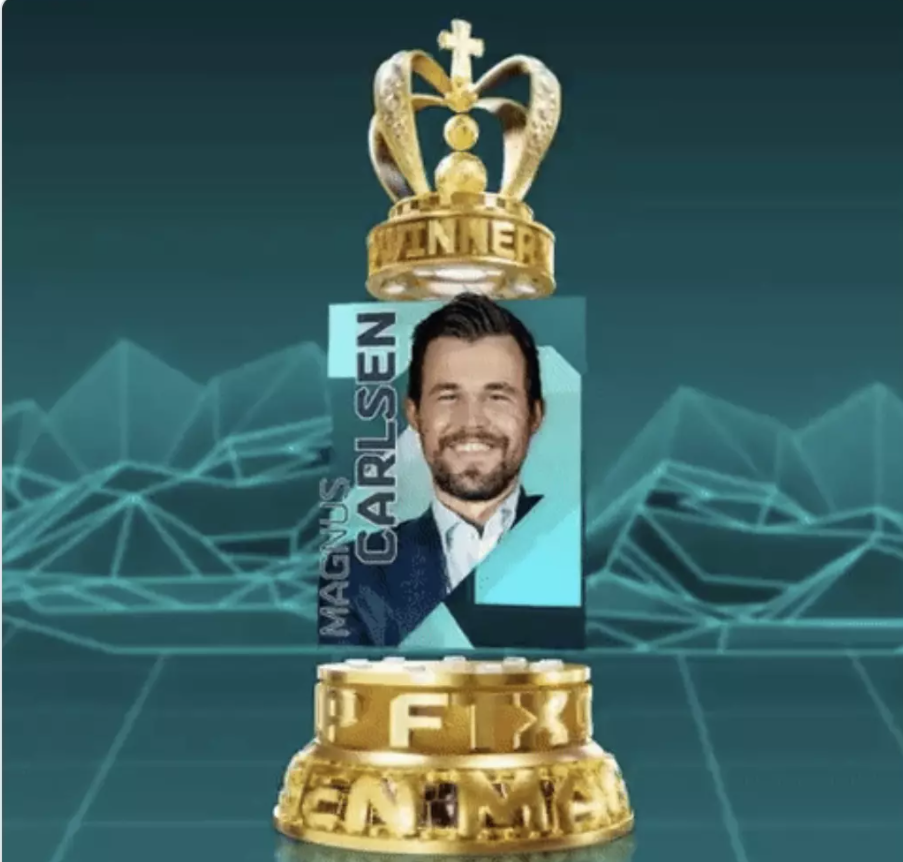
They also awarded winners with trophies in the form of 2/2 NFTs. A second copy of the trophy sold for 7 ETH. Winners got to meet Magnus Carlsen virtually and play a game with him, receiving an on-chain copy of the final match. They even created a “get rekt” version, where you could win an NFT by playing against a GM during the event (note: “get rekt” means something entirely different in chess).
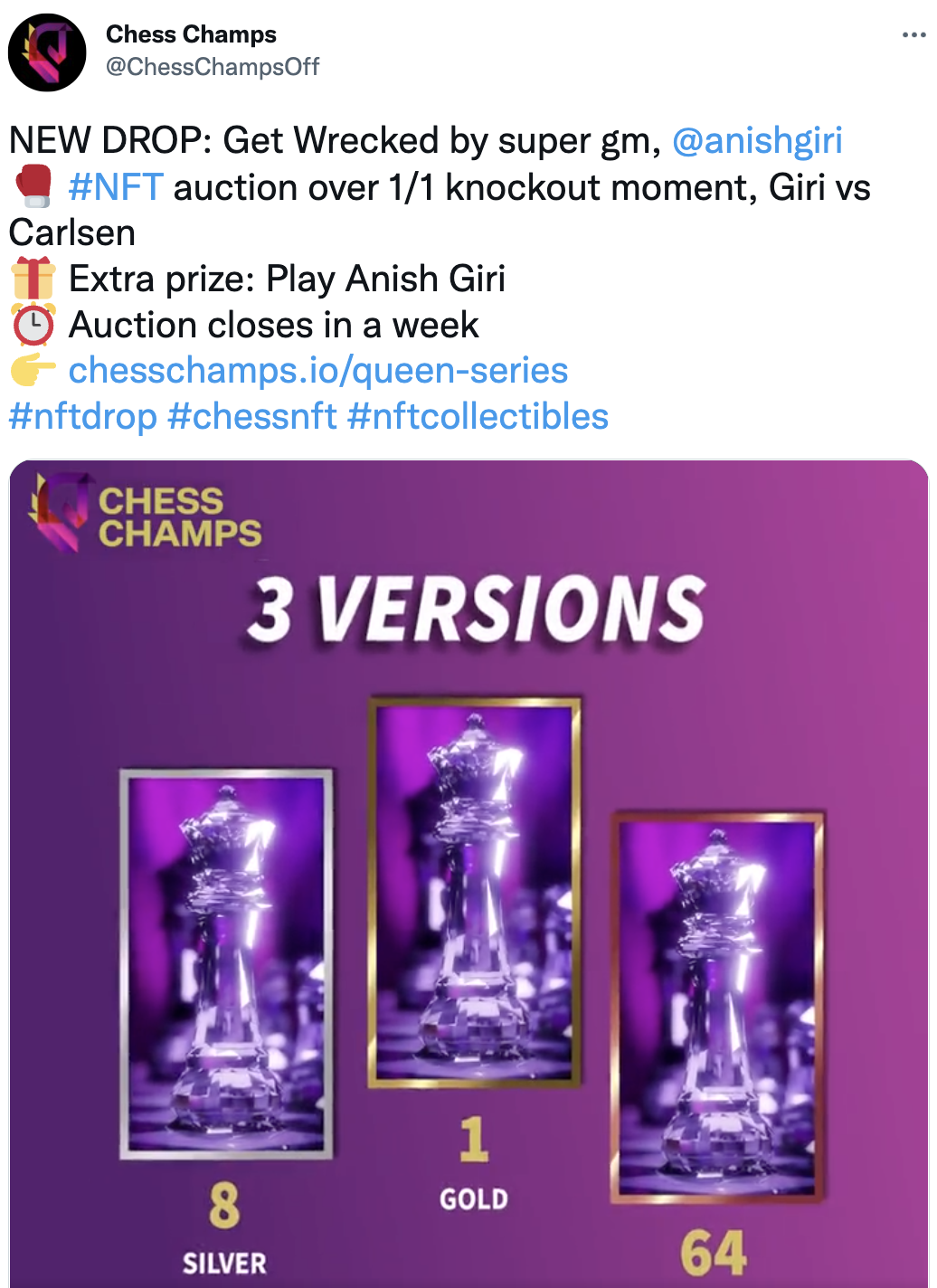
2022 FTX Crypto Cup
The 2021 NFTs featured very cool designs and genuine utility—already exceeding what most NFT projects deliver. Yet, they lacked one critical element: community. This time, the team appears determined to change that in the 2022 edition.
Free NFT airdrop. Replacing the previous paid model, anyone can now claim the NFT directly into their FTX wallet. I personally love this approach—it lowers barriers to entry and attracts more users since the cost of joining is nearly zero. It reduces user expectations and gives room for experimentation, allowing learning from failed community-building attempts. By removing price from the equation, you’re more likely to attract genuinely passionate chess fans.
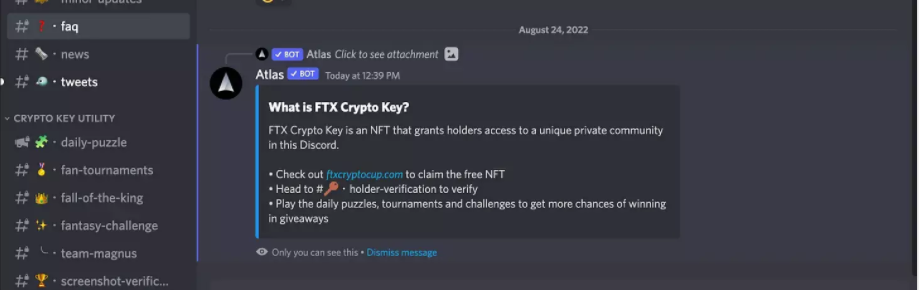
Community design. This free NFT airdrop helped form a Discord community of 1,500 members. The next step was building engagement and reputation. Typically, NFT communities award “badges” to whales (holders of over “x” NFTs) or early adopters (first 100 minters), granting them special roles in servers. But in this case, those factors are irrelevant. All community activities revolve around chess. The team designed daily puzzles, fantasy leagues, and other contests to identify and reward their most loyal supporters.
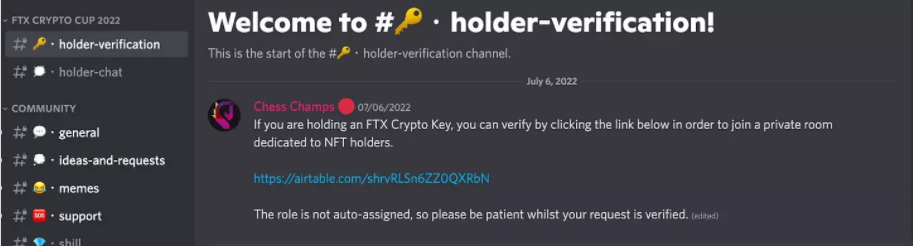
Token-gated access. This step first identifies “token holders” and restricts participation in all activities to them only.
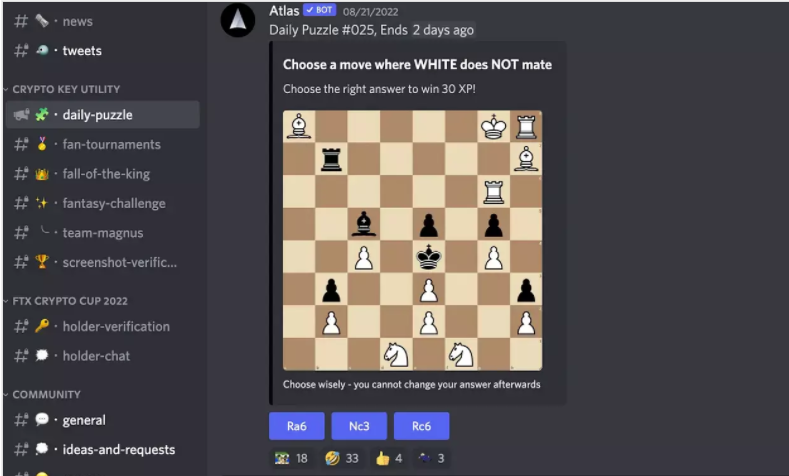
Daily puzzles. Now that we have a dedicated “token-gated” space, let’s look at engagement and reputation systems. First up: daily puzzles. These are simple chess puzzles with three answer options. Each correct answer earns you “30 XP.” Some might say this is too easy, so moderators occasionally release harder puzzles (see image below).
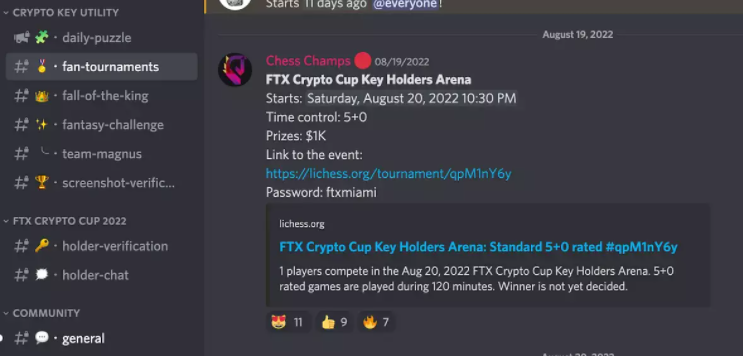
Fan tournaments. They hosted multiple fan tournaments on lichess. Winners received cash prizes and XP. Compared to daily puzzles, this requires significantly more effort and time.
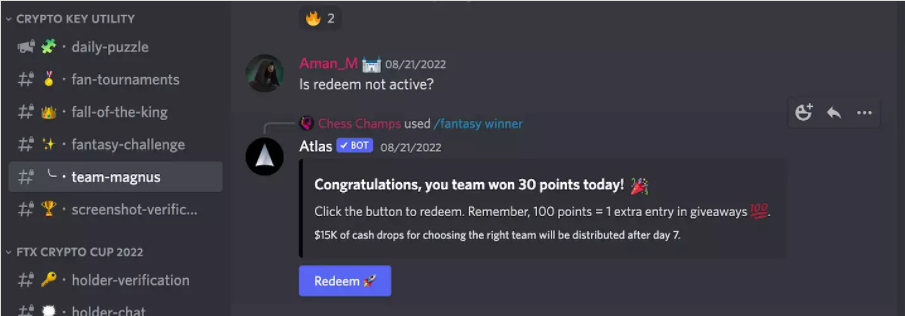
Fantasy league. Given this is a community centered around an active chess championship, a fantasy league is a natural fit. The team wisely kept it extremely simple—you pick one player out of eight each day and claim XP based on their ranking. Note the “Claim” mechanism: even if your chosen player leads, you must visit Discord and click the button. This small tweak is highly effective in driving daily visits.
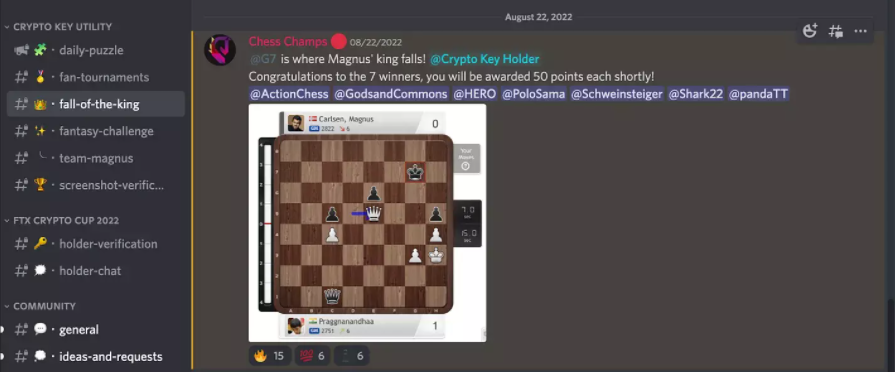
Fallen King. Another daily game where you predict the square where the losing king will ultimately fall. You earn XP if you guess correctly or if the game ends in a draw.
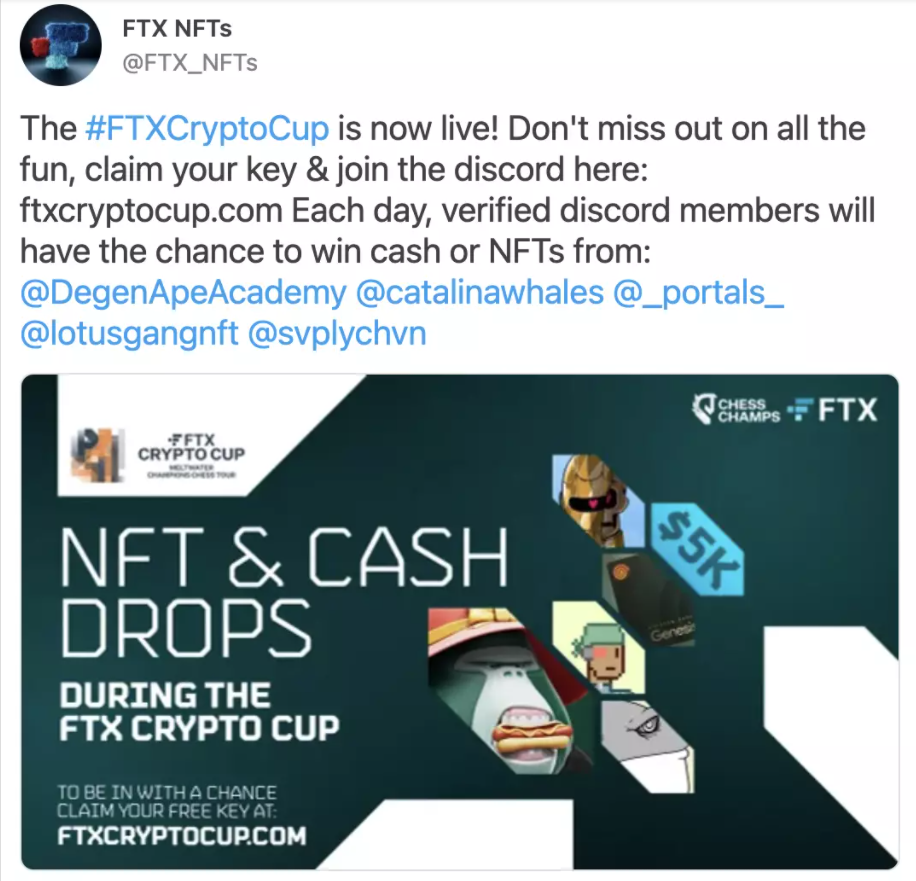
NFT giveaways. Finally, there are occasional blue-chip NFT giveaways.
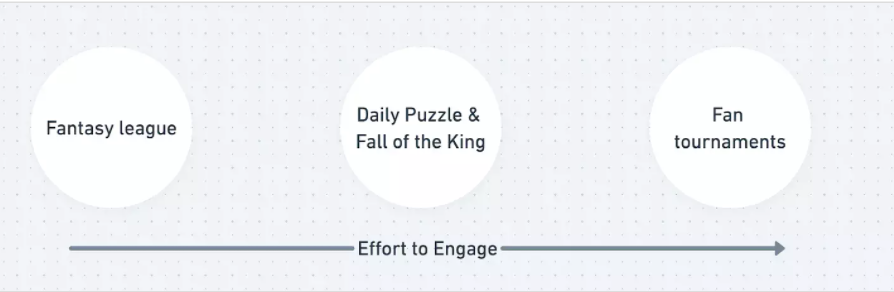
You’ll notice they’ve run a range of activities all aimed at maximizing engagement. Fantasy League requires selecting one player and claiming XP once per day if your player wins; daily puzzles and Fallen King require some mental effort; while fan tournaments demand several hours.
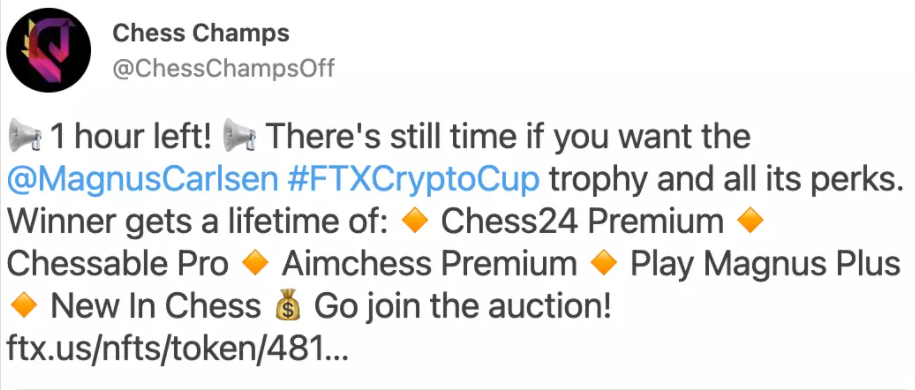
Monetization. As last year, you can still purchase a replica of the tournament trophy. It sold for 1.5 ETH and was backed by numerous lifetime chess memberships, whose value far exceeds the price.
Quantifying engagement. Putting it all together, all this XP creates a “fan engagement score” within Discord. Here’s my score:
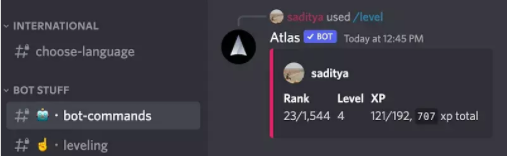
This score isn’t tied to my NFT—it’s confined within Discord. In fact, this system doesn’t technically require NFTs. But imagine if this score were continuously updated on my NFT and became part of my public profile visible via my Twitter and Instagram DPs. Other chess apps could then use this data to offer me personalized services. That opens up far greater possibilities.
Some Suggestions
We hope to help push this community forward. A simple yet powerful way is enabling members to export their reputation on-chain. We invite the team to implement the following:
- Allow members to connect their Discord account.
- Verify they are legitimate token holders. If verification via Discord isn’t possible, ask them to connect their FTX NFT account as well.
- Upon confirmation, read their reputation score and mint a beautifully designed NFT on the Solana network. This NFT should display their XP, level, and rank—visible both on the NFT and in metadata.
- Let them mint it for free.
- Build support for all major Solana wallets.
- Enable seamless onboarding for new crypto users—letting the minting process work smoothly with their custodial FTX NFT accounts and remain gas-free.
- Ensure regular synchronization between their Discord reputation scores and NFT metadata. Ideally continuous, but annual syncs are acceptable.
We applied for a Solana Foundation instagrant to fund $10,000 for this project and received a response within 48 hours.
Final Thoughts
The most brilliant aspect of this community is how effectively they used Discord automation to build a genuinely engaged NFT community. This keeps costs low—for example, building a full standalone app wouldn’t make sense, as it would never scale. This approach enables rapid experimentation without constraints on mindset or development. Think of it as a “no-code” toolkit for Web3 community design.
A key part of this process is transitioning to a web3-native community. This involves moving user data and assets on-chain so others can build upon them. Apps like FRIDAY are already building tools to enable exactly this. Personally, I’m thrilled to see a group of chess enthusiasts having fun together, and I’m bullish on communities that prioritize membership experience.
About Web3 MKT
Web3 MKT is a Web3 growth strategy study group initiated by TechFlow, aiming to dissect real cases, research Web3 marketing strategies, and transform insights into actionable outcomes to help projects achieve better global growth.
We welcome more friends interested in exploring Web3 marketing and growth to join us. Add WeChat zolohands to connect and share. Web3 MKT Link
Join TechFlow official community to stay tuned
Telegram:https://t.me/TechFlowDaily
X (Twitter):https://x.com/TechFlowPost
X (Twitter) EN:https://x.com/BlockFlow_News
 @SuperteamDAO






